Both the Soviets and the British tested the Medium Tank M4A4 (Sherman V). One of them rejected the tank, the other became a prolific user despite initial hesitation. See what experiences they had in common in my latest video.

This blog is dedicated to bringing World War II era documents to the general public, with an overall focus on armoured warfare. Questions? Requests? Comments? Email me at tankarchives@gmail.com or find me on Twitter @Tank_Archives.
Showing posts with label Sherman. Show all posts
Showing posts with label Sherman. Show all posts
Monday, 17 August 2026

Monday, 22 June 2026
Video: T-34 vs Sherman Rate of Fire Trials
Is the T-34 better than the Sherman? Yes. No. Maybe? It depends on how you're measuring it. In my latest video I compare how fast and how effectively these two tanks can strike a target and how a direct comparison might be harder than you might think.
Monday, 6 April 2026
Video: Lend Lease Complaints - M4A2 Sherman
The Sherman was a great tank, but it was far from perfect. In my latest video, I discuss the complaints that the British and Soviets had about the M4A2, where they agreed, and where their assessments of the tank's features differed.
Monday, 30 March 2026
Video: Tigers and Panthers in Mud
The Tiger and Panther had wide tracks and powerful engines that should, at least in theory, have given them good performance in heavy mud and other difficult terrain. I look at whether or not this was actually the case in my latest video.
Monday, 17 November 2025
Russo-American Tank Destroyer
One of the key problems with using foreign tanks is keeping a steady supply of spare parts and ammunition. This problem is not exclusive to captured tanks. A similar situation often took place with vehicles that were sent willingly. For example, a lack of ammunition delayed the arrival of American tanks on the battlefields of the Eastern Front by several months. These shortages happened more than once. It is not surprising that arming foreign tanks with domestic guns was a frequently suggested solution.
 |
| S-1 (SU-76I), the first design of the TsAKB. The bureau had some experience in re-arming foreign chassis. |
It just so happened that the best results in rearming foreign tanks were achieved by the design bureaus of factory #92 and factory #592. The first only offered experimental solutions, but the latter built a small batch of SG-122 SPGs. Specialists from both bureaus were later united in one organization: the Central Artillery Design Bureau (TsAKB). Their first project, the S-1, was a part of rearming a foreign tank (SU-76I). It’s not surprising that new rearmament projects followed, including grassroots proposals.
Monday, 7 August 2023
Shermans in "August Storm"
In Soviet historiography, the Soviet-Japanese War of 1945 is overshadowed by grandiose operations against Berlin and Vienna earlier that year. However, Western historians pay close attention to this campaign and debates on whether it was the A-bombs or the Soviet invasion that forced the Japanese to surrender rage on to this day. Famous historian David Glantz even invented a grandiose name for this operation: August Storm. The Red Army's advance was indeed lightning fast, in part thanks to foreign vehicles. This included the M4A2(76)W HVSS, the most advanced Sherman variant sent to the USSR.
Clouds gather
Stalin promised to enter the war against Japan within three months of Germany's defeat at the Yalta conference in February of 1945. Colonel-General Alfred Yodl signed an order for unconditional capitulation of all German forces on May 7th, 1945, coming into effect at 23:01 on May 8th. This kicked off the countdown for a Soviet offensive against Japan. The Red Army had three months to move an enormous force to the other side of an equally enormous country.
 |
Concentration of the 6th Guards Tank Army in the vicinity of Tamsagbulag. The army included the 9th Guards Mechanized Corps that used Sherman tanks. |
The 6th Guards Tank Army was one of the units that was destined to transfer to the far east. On June 26th, 1945, the unit was reallocated to the Transbaikal Front. It would have to cover a distance of 9000 km to cross from Czechoslovakia to Choibalsan. 88 trains of 60 cars each were allocated for this journey. The full transfer took 30 days, but the first elements began to form up by July 17th. New tanks awaited them there: 100 M4A2(76)W including the latest tanks with HVSS suspensions. These tanks were described in documents as "M4A2 with wide tracks". The 46th Guards Tank Brigade was fully equipped with these vehicles. One company from each of the tank regiments of the 18th, 30th, and 31st Guards Mechanized Brigades that made up the 9th Guards Mechanized Corps also received new tanks.
From Choibalsan, the tanks would make a 300 km march to Tamsagbulag, where the army would prepare for the upcoming offensive. This march took place in extreme conditions. The temperature reached 45 C during the day, as a result of which marches took place only at night to avoid overheating the engines and running gear. This also helped hide the tanks from air reconnaissance, as there was nowhere to conceal them in the desert. The army's documents describe the M4A2 as less sensitive to hot weather than the T-34-85. The American tanks could cover more ground every day, but at the cost of increased fuel consumption. The Shermans normally burned 40 kg of fuel per hour, but this went up to 60 kg in Mongolia. Each tank could only run 90-100 km before refuelling instead of 150 km. The T-34-85 burned only 26 kg of fuel per hour.
 |
| M4A2(76)W HVSS, the newest tanks of the 9th Guards Mechanized Corps. |
Monday, 12 June 2023
Firefighters of the Fiery Salient
Supplies of M4A2 tanks to the USSR began in late 1942. Unfortunately due to technical defects (chiefly to do with injectors) they did not see service right away. Only a few units received these tanks in the spring of 1943, but one of them ended up fighting in the most famous tank battle of the Great Patriotic War.
Firefighters of the fiery salient
The 229th Independent Tank Regiment was one of the first Soviet tank units to receive the new American medium tanks. 31 tanks of this type were issued to the unit on April 10th, 1943, and by the start of July the regiment had 38 functional Medium Tanks M4A2. The regiment was assigned to the 48th Army at the time. As of July 1st it was located in reserve in the village of Perehozheye. The regiment was commanded by Lieutenant Colonel Merkulov with Major Bogatyrev serving as the Chief of Staff.
 |
| A very early M4A2 tank in Soviet service. This vehicle still has the return roller in the middle of the bogey, M34 gun mount with a narrow external mantlet, and direct vision ports |
The regiment was moved to the vicinity of Kazakovka by July 5th, 1943. At the start of the Battle of Kursk the regiment had 1.2 loads of fuel per tank, three refills of ammunition, and 4 days worth of rations on hand. The Shermans got lucky, as the German spearhead struck west of them.
Monday, 8 May 2023
Sherman's African Debut
The Medium Tank M4A1 that arrived in the UK in the summer of 1942 was much more promising than the Medium Tank M3 that had arrived shortly prior. The layout of the armament was much more conventional, the armour was tougher, and the crew's workspaces were more comfortable. Before too long, these tanks were on their way to North Africa, where they would have to fight against the harsh environment in addition to an experienced enemy. The Sherman's career was not going to be an easy one.
First blood on the sand
The tanks that arrived in North Africa were not prepared for desert warfare. They were modernized in field workshops, where British technicians added dust shields, brackets for the Sunshield camouflage tarps, racks for canisters with water and fuel, stowage bins, and other equipment necessary for life in the desert. Desert camouflage was applied over top of the olive drab paint. 252 Shermans were ready by the Second Battle of El Alamein: 92 in the 1st Armoured Division, 124 in the 10th Armoured Division, and 36 in the 9th Armoured Brigade.
The situation with the delivery was far from ideal. The tanks arrived only weeks before the planned offensive. The lack of time to train had an impact not only on the skills of the crews, but also on the cohesion with the forces fighting alongside the tanks. Since the Shermans were going to attack at night through minefields, cooperation with infantry and engineers was quite important.
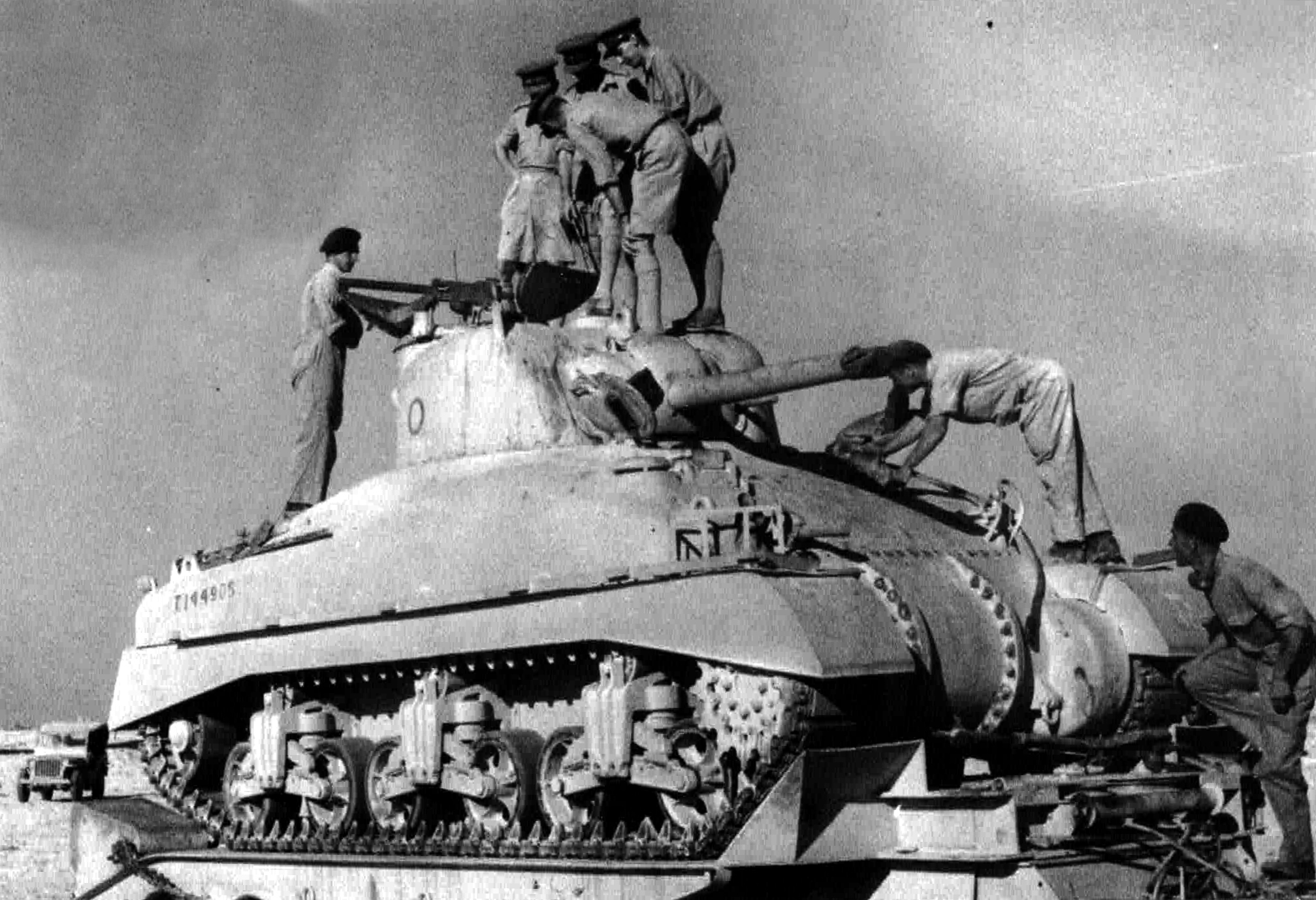 |
| Shermans of the 9th Hussars, 9th Armoured Brigade, September 15th, 1942. The tank is likely already painted in desert yellow, but disruptive camouflage has not yet been applied. |
Monday, 13 March 2023
Anti-Aircraft Lizard
The British began to build SPAAGs after the start of the Second World War. As soon as it became clear that the Light Tank Mk.VI was obsolete as a tank, it was converted to take a new turret with four AA machine guns. The same thing was done to the Crusader tank, but with two 20 mm Oerlikon autocannons. This armament upgrade did not resolve other issues with these tanks, namely thin armour and poor reliability. Finding spare parts for these out of production vehicles was not the easiest task either. It was clear that a SPAAG based on a chassis still in production was needed. Since Canada was just setting up production of the Grizzly tank, a variant of the American Sherman, this vehicle was chosen as the chassis. This was the start of the Skink AA tank, which was built and even saw battle, unlike the tank that it was based on.
Born to crawl
Work on mechanizing the 20 mm AA gun began in December of 1942. The AFV Users Committee suggested building an AA tank on the chassis of either Ram or Sherman tank for escorting armoured units on December 19th. The committee required the vehicle to be equipped with either two or four 20 mm guns, carry 600 rounds of ammunition, and be able to fire at targets moving at a speed of up to 350 mph (563 kph) at a height of 100 yards (91 meters). This required the turret to rotate a full 360 degrees in 4.8 seconds. The vehicle’s armour was required to withstand a hit from a 40 mm aircraft cannon at a range of 100 yards.
Development of this new vehicle began on March 19th, 1943. The initial variant called for a new turret welded together from 25-50 mm thick armour plates. The turret contained a quad Hispano-Suiza gun mount. Each gun was fed with a 50 round belt. The mount could be aimed vertically at a speed of 45 degrees per second and horizontally at a speed of 55 degrees per second. Production of such a vehicle was pitched to the Angus Shops and Montreal Locomotive works as well as the American General Motors company, but all three declined this project.
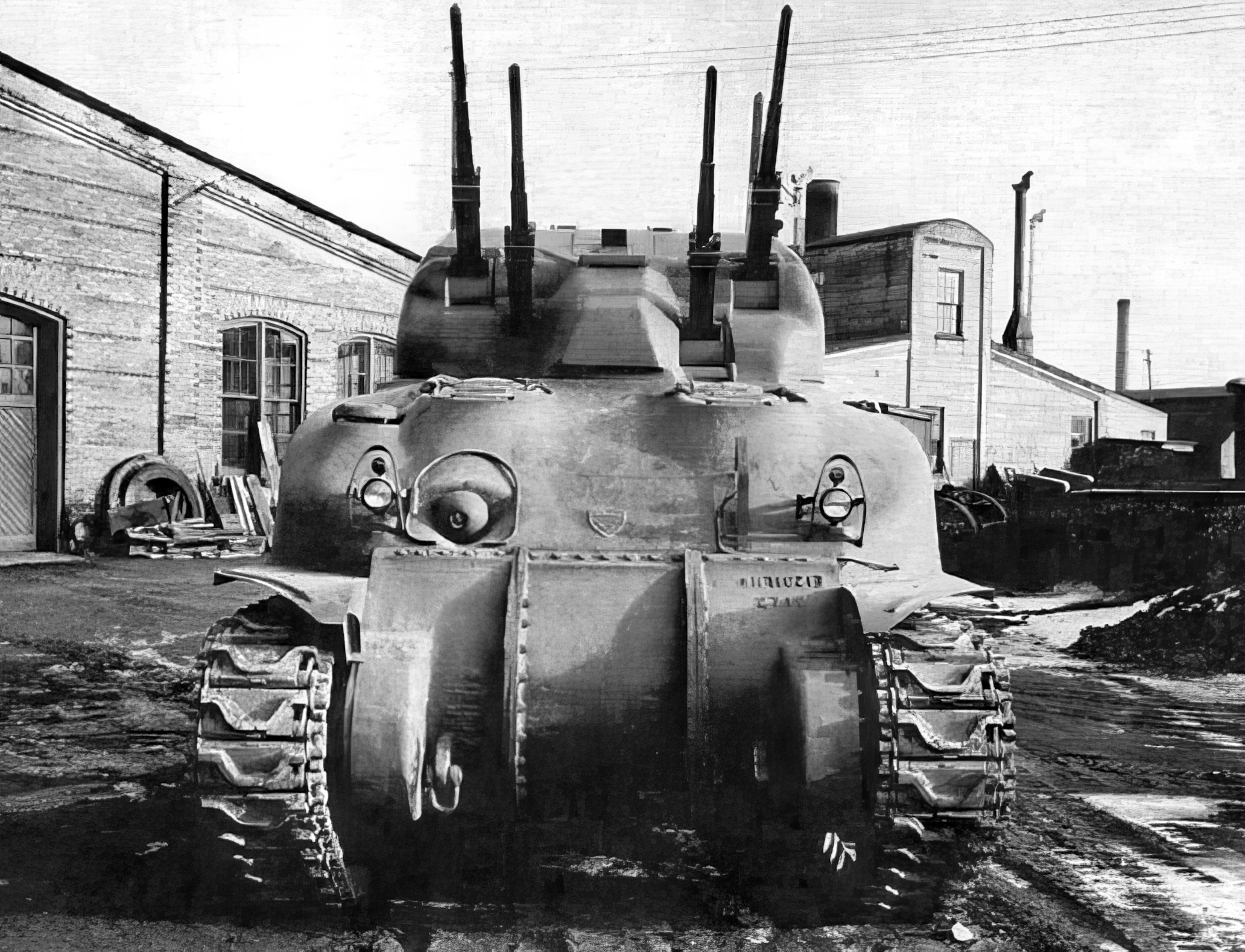 |
| Skink AA tank with an early cast turret. This tank still has Hispano-Suiza guns. |
Friday, 3 March 2023
A Firefly with a Stinger
Several variants of mechanizing the powerful 76 mm 17-pounder gun were developed by the end of 1943. One of them involved installing the gun on various types of Sherman tanks. The new Sherman Ic and Sherman Vc tanks passed trials at proving grounds in early 1944, but had yet to prove their worth on the battlefield.
Live and learn
To start, let us make a small note about the name of these tanks. The Sherman Ic and Sherman Vc (also stylized IC and VC) are commonly known under the name Firefly. This nickname did not come from official documents. Just the opposite, British commanders tried to fight it and mandated that these tanks be called only by their proper names. No one knows where the nickname came from, but it appears to have been British in origin. New Zealanders who used these tanks in Italy did not seem to ever use this name. These tanks were also called Sherman C and Sherman 17-pounder in official documents. Although unofficial, the name Firefly will be used in this article to refer to Sherman tanks equipped with 17-pounder guns.
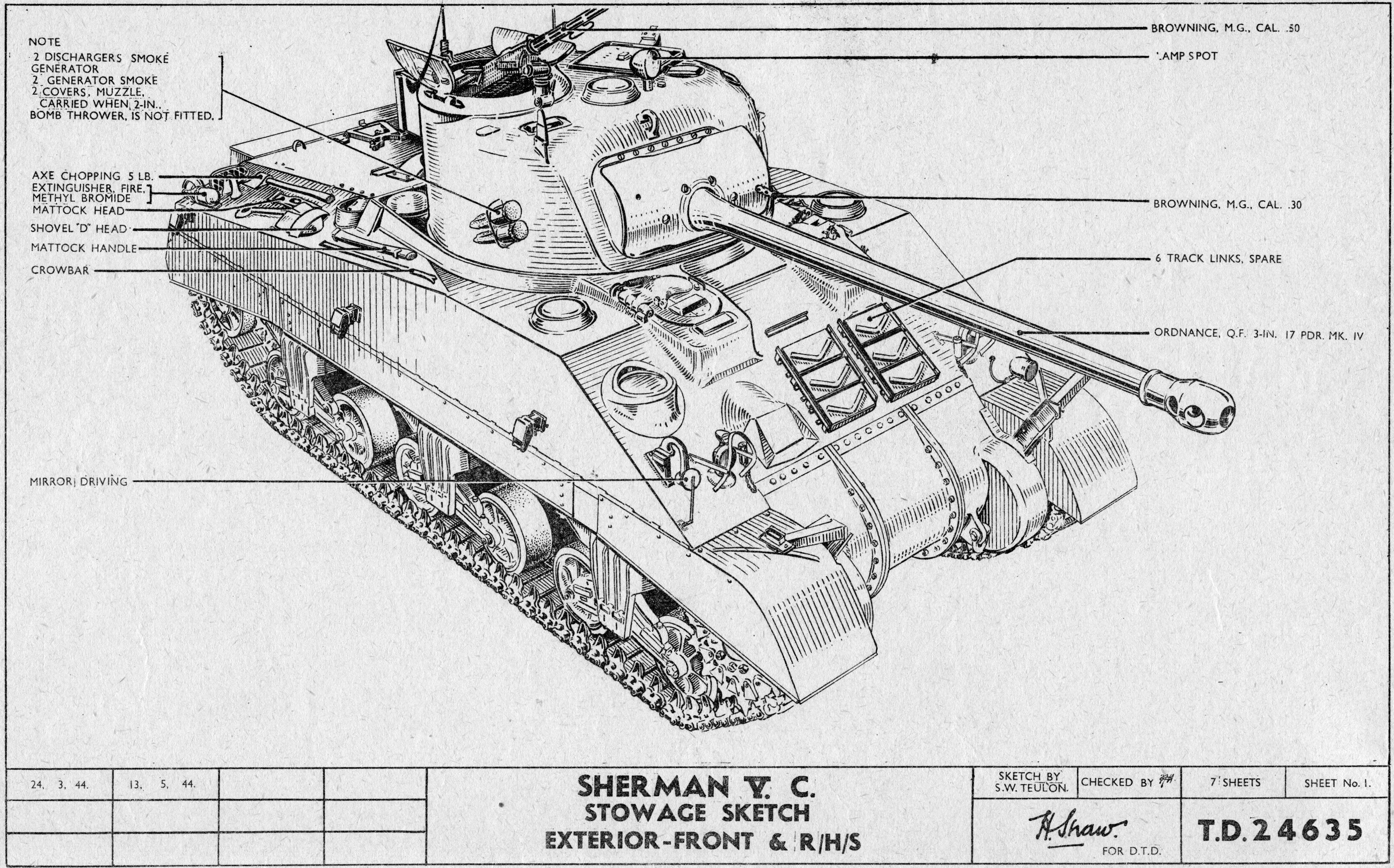 |
| A stowage sketch showing the tank’s official designation: Sherman V.C |
Monday, 27 February 2023
Modernization in the British Style
Great Britain, the nation that was first to invent the tank, lost its first place in tank building by the end of WWII. Nevertheless, the British designed the 17-pounder, a first class tank gun, and put it to good use on a number of vehicles, both domestic and imported ones. The most famous such vehicle was the Sherman Firefly.
Chassis for a big gun
The main British tank gun at the start of WWII was the 40 mm 2-pounder. This gun was enough against German light and medium tanks at first, but enemy tanks encountered in North Africa already had thicker armour. At first, extra protection came from applique armour that would fall off after 1-2 hits, but soon tanks with 50 mm of monolithic armour appeared that could only be penetrated at point-blank range.
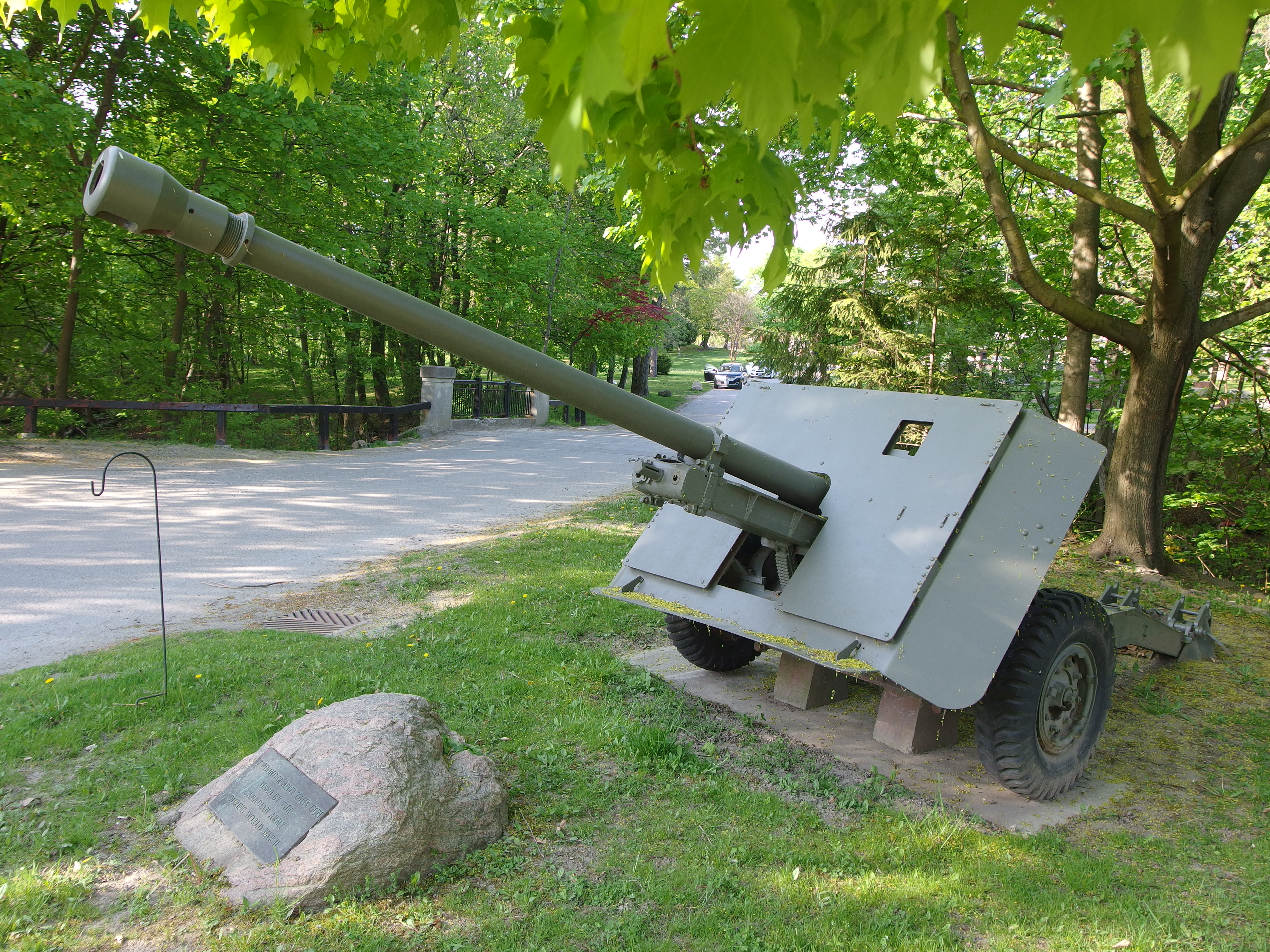 |
| 17-pounder gun, The 17-pounder anti-tank gun was a powerful weapon, but vulnerable on the battlefield due to its size and weight. The muzzle brake on this gun is not original. |
The need for more powerful tank guns was discussed as early as the summer of 1941. Arrivals of Lee and Grant tanks with the 75 mm M2 gun helped, but not for long. The American gun was deemed to be an acceptable interim measure until the arrival of sufficient quantities of towed 57 mm 6-pounder and 76 mm 17-pounder guns. The 6-pounder was small enough to fit into a tank turret, but the 17-pounder was far too large.
Friday, 24 February 2023
Anglo-Canadian Cruiser
When the Canadians decided to produce their own armoured vehicles in 1940, they had a whole world of tanks to choose from. British, American, and even French vehicles were considered. A suitable infantry tank was quickly found, but not a single foreign cruiser tank was entirely satisfactory. As a result, the Canadians created a hybrid tank that combined American, British, French, and original solutions. This tank became known as the Ram.
War against bureaucracy
Selection of an infantry tank was simple for Canada. The Infantry Tank Mk.II was already unsatisfactory by 1940, and the Infantry Tank Mk.IV was too unrefined, plus the design was too complex and heavy for Canada’s fledgling tank industry. The choice was made in favour of the Infantry Tank Mk.III, which was successfully put into production in Montreal at the Canadian Pacific Rail company’s Angus Shops. The cruiser tank would have to be produced in greater amounts. Unlike the Infantry Tank Mk.III, which was produced for export, this tank was meant for Canada’s own army. It was decided on August 13th, 1940, that Canada would raise its own armoured force and it required 1100 cruiser tanks for this purpose.
On one hand, Great Britain was already working on the promising Cruiser Tank Mk.VI. On the other hand, the Americans had just designed the Medium Tank M3 to replace their unsatisfactory M2. The British initially insisted that all of their dominions must build British tanks, but after inspecting Canadian facilities Brigadier Pratt came to the conclusion that the chances of successfully producing the Cruiser Tank Mk.VI here were low.
The final decision was made in favour of cooperation with the neighbour to the south, even though their tank was not entirely satisfactory either. The Hyde Park Declaration signed by President Franklin D. Roosevelt and Prime Minister William Lyon Mackenzie King on April 20th, 1941, declared that “...each country should provide the other with the defense articles which it is best able to produce, and, above all, produce quickly, and that production programmes should be co-ordinated to this end.” This declaration bypassed the main obstacle for American-Canadian cooperation: a shortage of American currency in Canada. According to the declaration, Canadian industry helped the Americans, and the Lend Lease program was expanded to cover Canadian goods made for Great Britain.
 |
| Canadian women assembling a Ram tank. |
Monday, 23 January 2023
Video: Was the M4A2 Sherman an elite tank for Guards units?
I often hear that the Sherman was considered an elite tank in the Red Army and only given to the best Guards units. In my latest video, I take a look at how many units that received the Sherman were actually elites.
Friday, 9 December 2022
Well Fed Sherman
In 1942 the British asked the Americans to develop a tank based on the Sherman with improved armour. The Americans gave them the Assault Tank T14, but didn’t take much interest in the idea themselves. However, the idea of such a tank returned in 1944 and eventually culminated in the M4A3E2 or Sherman Jumbo.
Assault tank in a hurry
Until 1944 the American army was certain that the ordinary Sherman was more than capable of facing German medium tanks. Sure, the Germans had Tigers and Panthers, but based on experience in Africa and Italy these dangerous tanks were very rare. Nevertheless, the Americans decided to play it safe and develop a heavily armoured tank. It was clear that the Heavy Tank M6 was not suitable for battle and the Medium (future Heavy) Tank T26 would not be ready until the end of 1944 at the latest. US Army Ground Forces command proposed three temporary solutions in February of 1944.
The first idea consisted of a basic Medium Tank M4 with thicker armour. An extra 2 inches (50 mm) was welded to the front and 1 inch (25 mm) to the sides. This kind of modernization took 200 man-hours to complete and increased the weight of the tank by 6870 lbs (3.1 tons). This conversion could be performed in a field workshop.
 |
| An M4A1 Sherman with additional armour drives past a knocked out Pz.Kpfw.IV. This kind of additional armour was installed in field workshops and its design varied from vehicle to vehicle. |
Wednesday, 16 November 2022
The Most American Sherman
A number of different fates could befall a Sherman tank. They fought in the deserts of Africa, the jungles of South-East Asia, the steppes of the Soviet Union. Tanks build at American factories could end up anywhere and fight with any crew, with one exception. The Medium Tank M4A3 with a Ford GAA engine was almost guaranteed to be crewed by Americans. Let us tell the story of the Sherman tank that the American preferred to keep to themselves.
Ford vs. Wright
The American automotive industry made a large contribution to victory in WWII. As one of the largest automotive manufacturers, Ford couldn’t avoid taking part. The company began working on an analogue to the British Rolls-Royce Merlin in 1940. The Air Force rejected this V-12 engine, but soon it found a home on land. Like the Merlin, a version of which was used on Cromwell tanks, the new Ford engine could be used on American medium tanks.
 |
| Ford GAA engine, Saumur tank museum. |
Monday, 7 November 2022
Shermans in Mud
The Medium Tank M4 showed itself as an effective weapon over the course of decades of service. Tanks from the Sherman family successfully fought in every corner of the world in WW2 and after. However, these tanks still had a number of design drawbacks that American engineers had to fight to solve while the tank was already in production. One of these drawbacks was poor mobility in soft soil.
Attachments of every kind
One of the reasons why the Sherman’s off-road mobility left much to be desired was the high ground pressure. Even the prototype Medium Tank T6 didn’t have particularly wide tracks, and every subsequent variant of the Sherman became heavier and heavier. Ground pressure increased along with weight.
 |
| A Medium Tank M4A1 that sank in mud, Miturno, Italy, 1944. The high weight and narrow tracks of this vehicle meant that off-road mobility was low. |
Monday, 19 September 2022
The Tank's Hidden Foe
On paper, German anti-tank rocket launchers were a weapon of unimaginable terror for enemy tank crews. An infantryman with a light anti-tank weapon capable of penetrating up to 200 mm of armour could be lurking behind every corner and in every window. This weapon was powerful enough to destroy any Allied tank. What was the real effectiveness of the Panzerfaust and Panzerschreck, and what did the Allies do to protect themselves from it?
Friday, 9 September 2022
Swords to Plowshares
"Report to Marshal of the Soviet Union N.A. Bulganin
#00810675
November 17th, 1947
Armoured and Mechanized Forces are in possession of 1185 foreign tanks, broken down as follows:
Monday, 29 August 2022
The Longest Millimeter
The first tanks of the Medium Tank M4 family saw combat for the first time in the summer of 1942, during the Second Battle for El Alamein. Combining excellent mobility, thick armour, and firepower that could defeat any enemy tank, the “General Sherman” was a solid contender for the title of the best tank on the continent upon its debut. However, progress did not stand still. The German army began fielding improved Pz.Kpfw.III and Pz.Kpfw.IV tanks, equipped with thicker armour and longer guns. Thankfully for the Sherman, American tank designers began to think about its modernization even before it reached the battlefield.
Monday, 1 August 2022
Soviet Upgrade for an American Tank
Modernization of a fighting vehicle over the course of production is a normal phenomenon. This was not the case from the very beginning, but modernization rather than creation of whole new designs was the norm by the 1920s. In Soviet practice, a good example of this is the MS-1. The first and fourth series differ significantly, and even so the full plans for improving the characteristics of the tank were not realized as it had become obsolete and did not satisfy the military's requirements even with changes. The MS-1's successor, the T-26 light tank, shows a much fuller spectrum of modernization. It started out with two turrets, one with a cannon and one with a machine gun. The first major modernization took place in 1933, and the tank that was produced at the end of its production run differed considerably from the first vehicle. Similar processes were not unusual for tank building of the era.
 |
| The first M4A2 tanks arrived in the USSR in the fall of 1942, but true mass deliveries began closer to the end of 1943. By that point the tank's armament was a bit weak. |
Subscribe to:
Posts (Atom)