The Panzerfaust was a very powerful weapon when used correctly. However, there are many misconceptions about the effectiveness of this weapon and the methods devised to protect against it. In this video I talk about how the American, British Commonwealth, and Soviet tank forces protected themselves against the Panzerfaust and similar weapons.

This blog is dedicated to bringing World War II era documents to the general public, with an overall focus on armoured warfare. Questions? Requests? Comments? Email me at tankarchives@gmail.com or find me on Twitter @Tank_Archives.
Showing posts with label infantry. Show all posts
Showing posts with label infantry. Show all posts
Tuesday, 28 October 2025

Friday, 26 May 2023
German Tank Tactics, 1945
"April 9th, 1945
#0417
To the commander of the Armoured and Mechanized Forces of the 2nd Shock Army
RE: #08562 dated March 20th, 1945
Report of the 46th Independent Guards Order of the Red Banner Order of Suvorov Tank Breakthrough Regiment on the study of tactics and combat use of heavy tank regiments in the Red Army as well as enemy tank tactics and use of tanks in combat from January 1st to April 1st, 1945. Map scale 1:50,000
...
2. Tactics and use of enemy tanks in combat
Recently, enemy anti-tank defenses rely more and more on close combat weapons, especially Panzerfausts, which are continuously improved. This is explained by the growth of the Red Army tank fleet and heavy enemy losses in tanks and anti-tank artillery. Because of this, the enemy compensates for a shortage of anti-tank weapons (especially tanks and anti-tank guns) with mass use of Panzerfausts. As before, the enemy creates ambushes using tanks and SPGs, chiefly heavy ones, which combat our tanks and SPGs in most likely directions of advance. The proportion of heavy and superheavy King Tiger tanks compared to the overall number of tanks continues to increase.
In areas where the enemy could prepare anti-tank defenses, they include anti-tank ditches (Ciechanow, Mława, Graudenz, Danzig) minefields (bridgehead west of Narew), and anti-tank guns. Passive anti-tank obstacles were covered with direct fire artillery, tanks and SPGs, as well as small arms fire.
More recently, the enemy foregoes using tanks and SPGs in the front of their defenses and only uses them in the depth in order to avoid heavy losses.
During the mud season, the enemy expected our tanks to be bound to roads and constructed defenses around forks, crossroads, and major settlements, leaving anti-tank combat between these strongholds to Panzerfausts.
In the January operation, up to 12 enemy tanks and SPGs were spotted in front of the regiment, most of them Tiger and Ferdinand types.
In the operation near Danzig up to 10 tanks and SPGs were spotted, of them 6 were Ferdinand type SPGs.
The enemy clearly works on improvements and modernizations to the Panzerfaust to improve its effect and make it more convenient to use. Expect to see new Panzerfausts in action.
Commander of the 46th Independent Guards Order of the Red Banner Order of Suvorov Tank Breakthrough Regiment, Guards Lieutenant Colonel Parshev
Chief of Staff, Major Bannov"
Wednesday, 29 March 2023
Pz.Kpfw.II Weaknesses
"To Chemistry Chiefs of the 29th and 65th Rifle Corps, 21st Mechanized Corps, 46 [cut off]
July 28th, 1941
The most vulnerable locations on the German light tank are:
1. The open vision port on the right side of the fighting compartment (driver's port). It is fairly wide, but there is no triplex glass in it. The port on the right (the commander's port) has triplex glass.
2. The hatch under the turret next to the commander (on the front left part of the tank's fighting compartment) does not seal well.
3. Slits between the engine deck and engine deck hatches on the engine deck (in the rear).
Give your instructors that organize the use of Molotov cocktails these instructions to ensure more effective combat against tanks.
Chemistry Chief of the 27th Army, Colonel Novoselov"
Friday, 3 February 2023
T-34 as an Ersatz APC
The Red Army began to explore the issue of transporting infantry around the battlefield in special vehicles in the 1930s. A number of vehicles were developed for this purpose, primarily on the chassis of the T-26 tank. Most of the time, the result was not what the army needed. The vehicles ended up too bulky and uncomfortable, and so work did not progress past prototypes. A program to develop an APC on a tracked chassis (T-40 tank) and wheeled chassis (GAZ-62 truck/LB-62 armoured car). This work reached the technical requirements stage before priorities shifted in the summer of 1941.
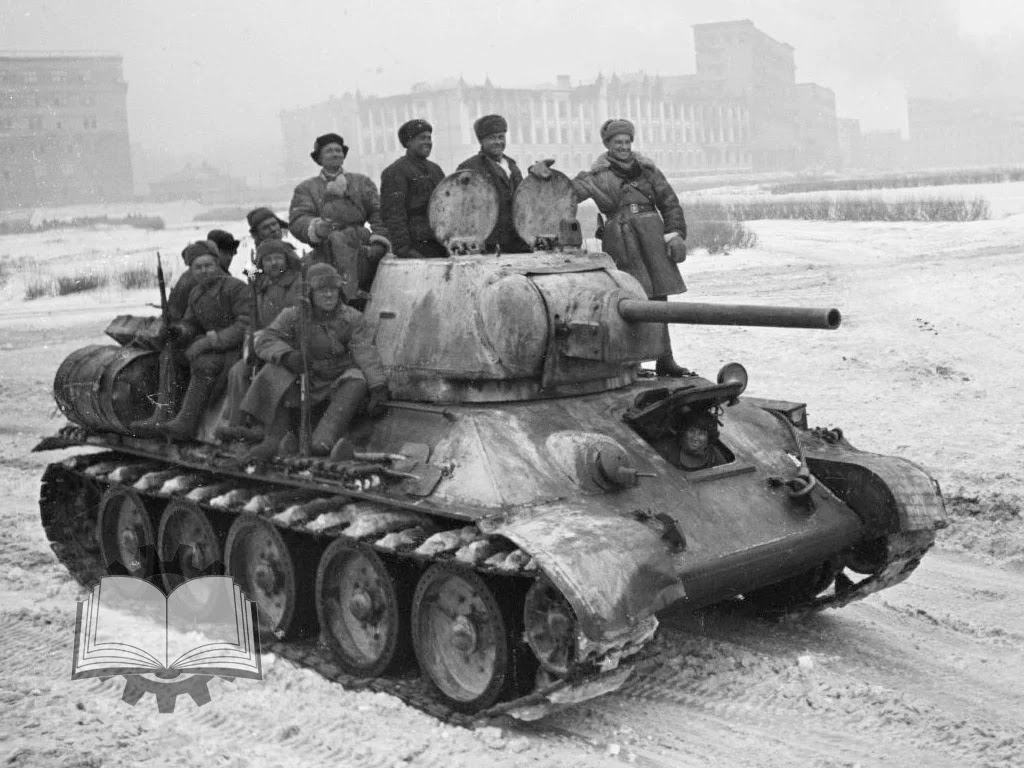 |
| Handrails were added to the T-34 and KV-1 tanks to help carry infantry riders. |
Wednesday, 7 December 2022
Panzerfaust Usage
"To commanders of formations and units of the 1st Mechanized Krasnograd Corps
Copy to: 37th MBr
Recent battles showed that the enemy is using "Faust" grenade launchers against our tanks and SPGs. In street fighting they are used against infantry, firing positions, etc.
When the enemy retreats, the "Fausts" are left behind in large amounts in working condition and can be used to combat enemy tanks, SPGs, personnel, and objects fortified for long term defense.
However, most commanders do not allocate the necessary attention to collecting, storing, studying, and using this simple and highly penetrating weapon.
Sunday, 27 November 2022
Anti-Tank Dog Instructions
Check the equipment of both the soldiers and the dogs.
"Instructions on using anti-tank dogs in various types of combat
1942
A. Main points
- Anti-tank dogs are an auxiliary weapon for infantry in anti-tank defenses, but they can be used in all types of combat.
- Anti-tank dog units are subordinate to the Army command. Individual companies or platoons are subordinated to infantry divisions as reinforcements of anti-tank defenses.
- The reserve and rear line elements of the anti-tank dog unit are located in the rear of the Army. There the personnel and the dogs systematically train and prepare themselves for service.
- An anti-tank dog company has 81 anti-tank dogs. The company is split into three platoons of 27 dogs. The platoon is split into three squads of 9 dogs each.
- The main method of destroying tanks is by releasing the dog from cover at a range of up to 200 meters from the enemy tank.
- If correctly used at a close range of 100-150 meters, the anti-tank dog is an effective weapon for the destruction of enemy tanks.
- Anti-tank dogs carry a bundle of explosives with a trigger on top.A dog will dive under the front part of the enemy tank. The lever touches the floor of the tank and the tank is destroyed by an explosion.
- Anti-tank dogs work precisely and flawlessly only if the dogs are systematically trained and correctly fed. To achieve this, anti-tank dog platoons and companies must be removed from forward positions every ten days and recalled to the rear for training.
- The infantry division commander allocates one functional tank, preferably a captured one, for training the anti-tank dog company.
- For additional maneuverability, the anti-tank dog company commander must be allocated two GAZ-AA (1.5 ton) trucks to move one anti-tank dog platoon rapidly.
- Soldiers of anti-tank dog platoons chiefly fight individually, and thus must display initiative, courage, discipline, decisiveness, and calmness.
- The anti-tank dog soldier is armed with an anti-tank dog, an automatic rifle, an anti-tank grenade, and two bottles of incendiary fluid.
- Having released his dog, the anti-tank dog soldier continues to fight with his rifle, anti-tank grenade, and bottles with incendiary fluid as a part of his squad.
- Anti-tank dog soldiers that released their dogs return to the rear after the completion of the battle to continue service according to their speciality.
Friday, 14 October 2022
DShK vs Pz.Kpfw.IV
"Results of firing the 12.7 mm DShK machine gun with the B-32 bullet against the German Pz.Kpfw.IV tank
|
Range |
Hit location |
Armour slope from vertical |
Total angle (slope + shooting angle) |
Armour thickness |
Hits |
Results |
|
100 m |
Right side of the turret |
25 deg |
70 deg |
20 mm |
5 |
15 mm deep impacts (1 on photo #63) |
|
50 |
25 |
90 |
20 |
2 |
18 mm deep impacts (2 on photo #63) |
|
|
100 |
Right side of the hull, engine compartment |
0 |
70 |
20 |
3 |
Complete penetration |
|
100 |
Turret rear |
12 |
90 |
20 |
5 |
One complete penetration, 4 18 mm deep dents |
|
100 |
Hull rear |
0 |
70 |
20 |
2 |
Complete penetration |
|
150 |
0 |
70 |
20 |
2 |
17 mm deep dents |
|
|
150 |
0 |
90 |
20 |
2 |
18 mm deep dents |
Monday, 19 September 2022
The Tank's Hidden Foe
On paper, German anti-tank rocket launchers were a weapon of unimaginable terror for enemy tank crews. An infantryman with a light anti-tank weapon capable of penetrating up to 200 mm of armour could be lurking behind every corner and in every window. This weapon was powerful enough to destroy any Allied tank. What was the real effectiveness of the Panzerfaust and Panzerschreck, and what did the Allies do to protect themselves from it?
Wednesday, 17 August 2022
First Anti-Tank Rifles
"To the Chairman of the State Committee of Defense, I.V. Stalin
August 9th, 1941
Trials of the German 7.92 mm Pz.B.39 rifle conducted by the Scientific Research Small Arms Proving Grounds of the Red Army showed the following results:
- Muzzle velocity: 1189 m/s
- Weight: 12.12 kg
- Bullet weight: 14.8 grams
- Chamber size: 17.06 cm³
The rifle penetrates a 20 mm surface hardened plate at 20 degrees at a range up to 500 m inclusive, a 30 mm surface hardened plate at 20 degrees from up to 300 meters inclusive.
Thursday, 4 August 2022
Room Clearing Guide

Assault group - forward!
Your submachine gun is around your neck, 10 grenades are at hand, and courage is in your heart. Act!
Be bold and take initiative! Believe in your strength!

Move unseen and without noise!
Close with the enemy using hidden paths: trenches, travelways, holes in buildings or fences. Crawl, use bomb craters and ruins. You can hide well here. And then - a brave rush forward.
Wednesday, 3 August 2022
Back to Battle
"On the actions of liberated POWs and repatriated citizens in the 47th Guards Tank Regiment between January 18th and February 8th, 1945.
On January 14th, 1945, after the 9th Guards Tank Corps was introduced into a breach, the 47th Guards Tank Brigade fought at the vanguard of the corps.
In battles for Grójec, Mszczonow, and Sochaczew the brigade took heavy losses in the motorized riflemen submachine gunner battalion.
When Sochaczew (January 18th), Bromberg (January 22nd), and Kutzer (January 28th) were liberated, Russian POWs and repatriated citizens were freed from camps.
Friday, 14 January 2022
Panzerfaust Instructions

"Order of the Chief of Staff of the Armoured and Mechanized Forces to Chiefs of Staff of Armoured and Mechanized Forces for Fronts on the issues of usage of captured Panzerfausts
#0792134
March 17th, 1945
Friday, 31 December 2021
RPG-40 Manual
"Study combat techniques! Anti-tank grenade model 1940

The impact anti-tank hand grenade model 1940 is designed to combat armoured cars and tanks. It can also be used to combat strongholds and field fortifications. The grenade weights approximately 1.2 kg.
The RPG-40 consists of a hull, a handle, and an impact fuse. The hull contains explosives. A handle is screwed on. A fuse is inserted into the top before throwing or on special orders from the commander. The fuse is held inside with a latch.
The grenade's trigger is held in the handle. The safety level disconnects when thrown and pulls out the safety pin. When the grenade strikes its target, a mobile weight inside the grenade will drive a rod forward. This frees two balls that then allow the spring to drive the firing pin into the primer.
Monday, 18 October 2021
Finland's "Elephant Gun"
Many nations searched for effective anti-tank weapons in the interbellum years. One of the most popular countermeasures was the anti-tank rifle. These rifles ranging in caliber from 7.92 to 20 mm were issued to infantry units. Finland also followed this path as it nervously observed the development of armoured vehicles by its eastern neighbour, the Soviet Union.
Monday, 11 October 2021
The First Soviet RPG
Widespread use of anti-tank rocket launchers by both the USSR's allies and enemies starting in 1943 forced it to expedite experimental work on these weapons. The first positive results were achieved in early 1944.
Friday, 6 August 2021
Book Review: The Assault Platoon of the Grenadier-Company

The Assault Platoon of the Grenadier-Company November 1944 German Army Pamphlet - Merkblatt 25a/16 is the second book by Bernard Kast (Military History Visualized) and Christoph Bergs (Military Aviation History). Much like their first book, The Assault Platoon of the Grenadier-Company is a translation of a German tactical pamphlet, but on a closer look it's a lot more than that.
Wednesday, 26 May 2021
German Tank Riders
For some reason, infantry hitching a ride on tanks is a tactic stereotypically associated only with the USSR. In reality, infantry from all nations did this, even those that produced APCs such as Germany. This was not an ad hoc maneuver either, but a tactic officially described in field manual. For instance, manual 130/2b "Motorized company of an infantry motorized division" signed by General Walther von Brauchitsch on October 11th, 1941, states:
"190. To defeat an enemy positioned in cover, it is sometimes reasonable to mount troops on tanks that would be able to defeat the concealed enemy firing from their vehicle or in close combat. In this case, equip them with hand grenades, pistols, submachine guns, and flare guns.
Communication with tanks is achieved through the normal signals (attachment #2). However, regardless of this, one must carefully negotiate cooperation between the tank crew and the troops that ride the tank ahead of time."
Friday, 16 April 2021
Winter War Tank Experience

"Copy #1
4th Army Chief Command
Army Staff
#578/41 secret
- General rules of using Russian tanks:
- Russians support their offensives with tanks (50-100 per division, up to 200 or about 20 per battalion when attacking fortified regions).
- Tanks advance in 2-3 echelons:
- To penetrate and to reach objectives in the rear.
- To suppress fire and break into the main line of defense.
- Tanks always drove with closed hatches. Observation was done through periscopes. Hatches were opened only for self-defense if the crew was in danger.
Wednesday, 14 April 2021
Elephant Hunters
"Characteristics of penetrative ability of guns and mines against enemy tanks
Based on combat experience and trials
1. Experimental firing against the 88 mm "Ferdinand" self propelled gun gave the following results:
A) Armour:
- Roof: 45 mm
- Rear: 80 mm
- Sides: 80 mm
- Front vertical plate: 200 mm
- Ball mount armour: 110 mm
- Driver and radio operator visor plate: 200 mm
Monday, 8 March 2021
Spaced Armour
I previously posted some photos from trials of the armour skirts of a captured Pz.Kpfw.III Ausf.N tank. It turned out that the skirts themselves were not very difficult to penetrate, but they destabilized small projectiles enough to prevent penetration of the main armour, as well as offer a few other benefits. Here are some more results from that same test.

"RPG at close range. Photo #3. Penetration in the spaced armour plate (the main armour does not have damage."
Subscribe to:
Posts (Atom)