The Tiger and Panther had wide tracks and powerful engines that should, at least in theory, have given them good performance in heavy mud and other difficult terrain. I look at whether or not this was actually the case in my latest video.

This blog is dedicated to bringing World War II era documents to the general public, with an overall focus on armoured warfare. Questions? Requests? Comments? Email me at tankarchives@gmail.com or find me on Twitter @Tank_Archives.
Showing posts with label Churchill. Show all posts
Showing posts with label Churchill. Show all posts
Monday, 30 March 2026

Friday, 12 December 2025
Video: Churchill Infantry Tank: Outlier on the Eastern Front
The Churchill tank was the heaviest and most thickly armoured foreign tank to see combat with the Red Army. Why were so few ordered and why do we seldom hear about its accomplishments? I dive into this question in my latest video.
Wednesday, 22 May 2024
Quick-Fix Tank Destroyer
British tank building was in crisis in the spring-summer of 1941. The latest Pz.Kpfw.III and Pz.Kpfw.IV tanks encountered in North Africa could only be defeated with the 2-pounder gun at short range. Intelligence reported on heavy and superheavy Pz.Kpfw.V, Pz.Kpfw.VI, and Pz.Kpfw.VII tanks that the 40 mm gun would be completely powerless against. The British were in urgent need of a vehicle with a more powerful gun.
Any color the customer wants
The British needed to find a suitable gun and a suitable chassis. There were promising weapons: the 57 mm 6-pounder and 76 mm 17-pounder. These guns could deal with the even the most modern tanks. There was, however, a small problem. Mass production was not scheduled to start until at least the end of the year. It was also necessary to develop new gun mounts and turrets to fit these guns. The issue of cost was also an important one, as the British had to replenish their tank fleet after abandoning a good part of it in Europe, and a 2-pounder gun was considerably cheaper than a 6-pounder, let alone a 17-pounder.
 |
| Penetration of the 3" gun using a new round with increased muzzle velocity. This gun could theoretically fight any German tank. |
There was a more budget friendly variant. The QF 3-inch 20 cwt AA gun accepted into service back in 1914 was being pushed out of service by a more modern 3.7" gun. Old AA guns could still be found in storage, and they could make a powerful anti-tank weapon.
Trials showed that the HE shell was useless against even light tank armour. However, 12.5 lb (5.67 kg) AP shot with a muzzle velocity of 2600 fps (792 m/s) could penetrate 75 mm of armour at 30 degrees from 400 yards (365 meters), 58 mm from 1000 yards (914 meters) and 37 mm from 2000 yards (1828 meters). An improved AP shot was also developed that was supposed to penetrate 100 mm from 100 yards (91 m) and 80 mm from 750 yards (686 meters). In trials, the shot penetrated 91 mm at 400 yards, 77 mm at 1000 yards, and 55 mm at 2000 yards. This weapon couldn't defeat phantoms like the Pz.Kpfw.VII, but it was good enough to fight any real German tank. There was also some discussion of developing an AP-HE shell that would be more effective than simple shot.
 |
| Carrier, Churchill, 3-inch Gun, Mk.I with a 3" 20 cwt gun. The WD number is still in a tank format. |
Monday, 5 June 2023
First Among Equals
The defeat of the British Expeditionary Force in France in 1940 was a wake-up call for British tankers. It was clear that their tanks were not suited for modern war. Light tanks had no chance to survive on a battlefield saturated with anti-tank guns, and even heavier infantry tanks were more vulnerable than expected. The Infantry Tank Mk.I armed only with a machine gun was discarded immediately. The Infantry Tank Mk.II proved itself better, but was still far from perfection. German forces were expected to cross the Channel any minute, and Britain had no modern tanks to repel them with. The only choice was to develop a new tank, and quickly. This tank was called the Infantry Tank Mk.IV or Churchill I.
A tank of compromises
Work on the new tank began in July of 1940. The A20 tank, a potential replacement for the Infantry Tank Mk.II, looked quite archaic compared to its German adversaries. However, the British were not prepared to give up on the concept just yet. Harland & Wolff built one prototype, but there were many issues with it, not the least of which was the insufficiently powerful Meadows DAV engine.
 |
| Experimental A20 tank, the Churchill’s predecessor. |
The British were in a tough situation when it came to tank engines. The army didn’t want to spend money on engine development, expecting to be able to adapt an engine already in production. This is what happened in this case: the DAV was initially meant to go into the much lighter Cruiser Tank Mk.V. The Vauxhall company proposed their own engine, the Bedford Twin Six, to replace the troublesome Meadows DAV. As the name implies, it was composed of two six-cylinder engines produced by Bedford, a subsidiary of Vauxhall. These engines showed themselves well on trucks. Vauxhall’s proposal was so enticing that they ended up with a contract not just for the engine, but for the entire tank.
Monday, 20 March 2023
Prime Minister on the Front Lines
In 1941 it became clear to British tankers that the Churchill I armed with a 40 mm 2-pounder and 3” howitzer won’t remain competitive for long. Due to difficulties with developing a new weapon, the Churchill III armed with the more powerful 57 mm 6-pounder only entered production in March of 1942. These tanks gradually forced out the Churchill II, but some units kept the Churchill I as close support tanks. The low reliability of these tanks did not allow the British to test them in the desert, but an opportunity for a trial by fire soon arose.
If at first you don’t succeed…
The Churchill tanks first went into battle on August 19th, 1942, during the infamous Dieppe raid. A raid against German coastal defenses was risky, but after a series of raids including the famous raid on Saint-Nazaire, Lord Mountbatten’s Combined Operations Headquarters had all but carte blanche when it came to planning.
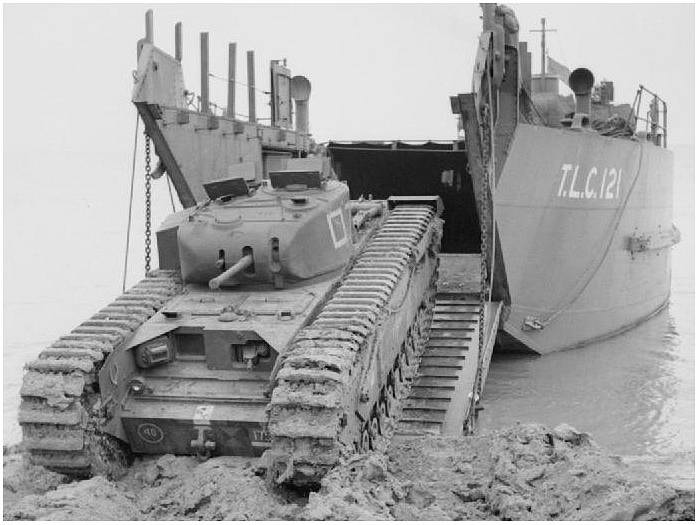 |
| A Churchill II tank used in a practice amphibious landing. |
Monday, 7 November 2022
Shermans in Mud
The Medium Tank M4 showed itself as an effective weapon over the course of decades of service. Tanks from the Sherman family successfully fought in every corner of the world in WW2 and after. However, these tanks still had a number of design drawbacks that American engineers had to fight to solve while the tank was already in production. One of these drawbacks was poor mobility in soft soil.
Attachments of every kind
One of the reasons why the Sherman’s off-road mobility left much to be desired was the high ground pressure. Even the prototype Medium Tank T6 didn’t have particularly wide tracks, and every subsequent variant of the Sherman became heavier and heavier. Ground pressure increased along with weight.
 |
| A Medium Tank M4A1 that sank in mud, Miturno, Italy, 1944. The high weight and narrow tracks of this vehicle meant that off-road mobility was low. |
Friday, 7 October 2022
Deliveries
"Table of arrivals of tanks at the front lines in 1941, by type
|
Type |
Domestic |
British |
American |
Total |
||||||
|
Month |
KV |
T-34 |
T-60 |
T-70 |
Mk.II |
Mk.III |
Mk.IV |
M3 S |
M3 L |
|
|
Total 1941 |
|
|
|
|
|
|
|
|
|
20,740 |
|
Jan |
126 |
206 |
348 |
- |
- |
16 |
- |
- |
- |
696 |
|
Feb |
165 |
420 |
260 |
- |
- |
- |
- |
- |
- |
845 |
|
Mar |
105 |
338 |
84 |
- |
- |
- |
- |
- |
- |
527 |
|
Apr |
320 |
702 |
576 |
- |
134 |
144 |
- |
14 |
32 |
1922 |
|
May |
350 |
1003 |
898 |
- |
255 |
171 |
- |
30 |
16 |
2723 |
|
Jun |
199 |
698 |
657 |
103 |
- |
74 |
- |
144 |
222 |
2091 |
|
Jul |
299 |
1177 |
746 |
371 |
86 |
44 |
- |
66 |
91 |
2880 |
|
Aug |
178 |
1378 |
250 |
583 |
10 |
63 |
- |
35 |
98 |
2595 |
|
Sep |
45 |
598 |
- |
439 |
- |
72 |
- |
54 |
43 |
1251 |
|
Oct |
160 |
1100 |
75 |
640 |
- |
10 |
- |
24 |
5 |
2024 |
|
Nov |
215 |
1312 |
- |
838 |
85 |
163 |
- |
187 |
61 |
2861 |
|
Dec |
239 |
1678 |
48 |
1026 |
- |
- |
42 |
23 |
16 |
3072 |
|
Total 1942 |
Total domestic: 20,957 |
Total foreign: 2530 |
23,487 |
|||||||
This data is interesting on its own, but it's also interesting to compare to deliveries of foreign tanks. The first Matilda and Valentine tanks began arriving during the Battle for Moscow and were thrown into battle with little preparation. As you can see in the above table, once the situation stabilized a little bit it took some time before new units with British tanks could be properly outfitted. Large deployments of Matildas and Valentines only take place in April, four months after deliveries began.
A similar picture can be seen with American tanks. The first shipments arrived in January of 1942 and we start seeing a small number of these tanks on the battlefield in April-May, 4-5 months later. Once the pipeline was set up, it was not as hard to deploy new tanks. A bump shipments that came in May hits the front lines in June. A lot of tanks were tied up in delivery by the end of the year: 3875 foreign tanks were delivered to the USSR in 1941-1942, but only 2530 were actually fielded before the end of 1942.
You can see the same pattern with Soviet tanks. Evacuation of factory #183, the USSR's largest producer of the T-34 tank, began in September of 1941. The factory began to set up in the Urals in December-January, and by May of 1941 you see a spike in deliveries of T-34 tanks. Similarly, production of the T-70 was authorized in March of 1942 and we see these tanks begin to arrive on the front lines in July.
Subscribe to:
Posts (Atom)