The Red Army wanted a superheavy tank since its inception and in 1945 the conditions were finally right to procure one. The IS-7 was the heaviest Soviet tank yet, but could it see service if the war lasted long enough?

This blog is dedicated to bringing World War II era documents to the general public, with an overall focus on armoured warfare. Questions? Requests? Comments? Email me at tankarchives@gmail.com or find me on Twitter @Tank_Archives.
Showing posts with label IS-7. Show all posts
Showing posts with label IS-7. Show all posts
Monday, 23 June 2025

Saturday, 16 March 2024
There are Always Two
The tank was initially conceived as a mobile fortress; huge and slow. However, the army had to rein in their appetites from a 300 ton monster to just 28 tons. This didn’t mean that the idea of a mobile fortress died off. The mass of tanks continued to grow and the development of the K-Wagen clearly suggested that not only Lebedenko was thinking about Tsar-tanks. Only the prompt end of the First World War stopped these giants from reaching the battlefield. Although, the monstrous projects that were built by 1919 were about as useful as the rest of the Tsar family: a tank that doesn’t fight in addition to a bell that doesn’t ring and cannon that doesn’t shoot.
 |
| T-39, the first Soviet "large" heavy tank. Thankfully, clearer minds prevailed. |
For obvious reasons, Soviet tank designers didn’t even think about a heavy breakthrough tank. Ironically, the most numerous tank in the Red Army at the time was the British Mark V that fit this role perfectly. The USSR began working on its own heavy tank in the early 1930s. It just so happened that they ended up with two designs over and over again for two decades. They choice was always made in favour of the lighter one, but it didn’t prevent work on the heavier one from moving forward.
Monday, 25 September 2023
Two Tanks In One
A story of what a Main Battle Tank is and how it came to be.
Tanks evolved considerably over the course of over 100 years of service. The first tanks were built to break through enemy fortifications, but still ended up being much smaller than the landships that H.G. Wells dreamed of. Nevertheless, the effect they had was considerable. All armies of the world wanted to have their own tanks, but not all managed to create one. A tank only seems simple, but in reality is quite a complicated fighting machine that requires a powerful industry to produce. Far fewer nations managed to build their own tanks than their own aircraft. In addition, like any weapon individual tanks quickly became obsolete. It is only in the last few decades that tank development slowed down from its breakneck pace. Tanks remain one of the key types of vehicles on the battlefield. There have been many attempts to write them off as a relic of the past, but practice shows that this time has not yet come.
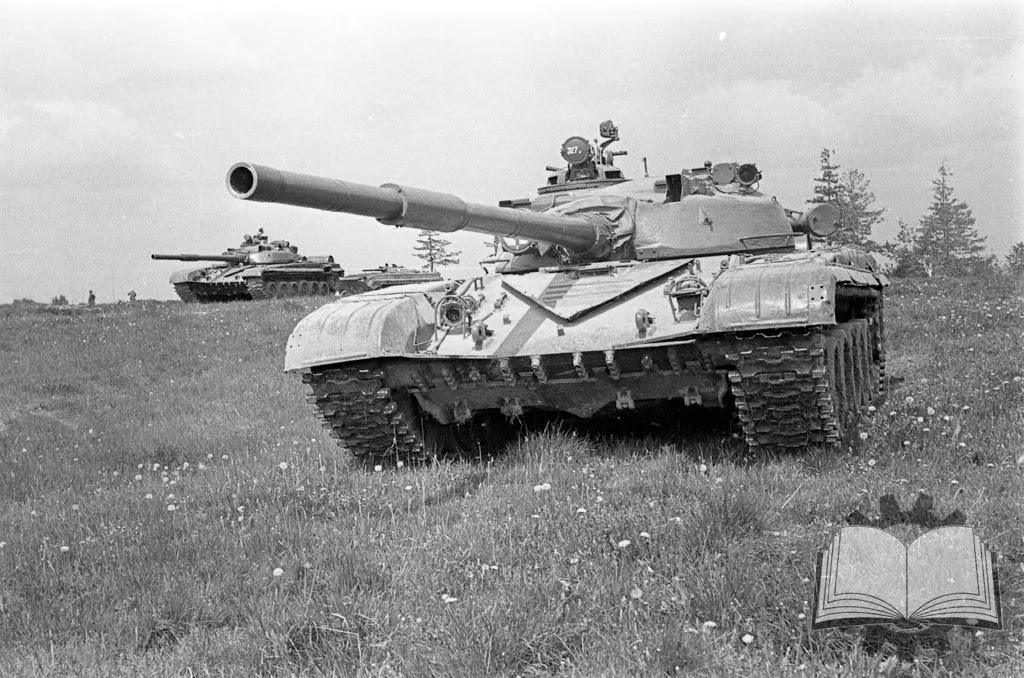 |
| T-72, the most numerous Main Battle Tank. These tanks were developed in the late 1960s but continue to serve and will do so for decades to come. |
Friday, 30 October 2020
IS-7 Trials
"Commission for Government Trials according to decree of the Council of Ministers of the USSR issued on July 28th, 1948
#0306cc
September 4th, 1948
Kirov factory, Leningrad
To Acting Minister of Transport Machinebuilding of the USSR, comrade Yu.Ye. Maksarev
CC Acting Commander of the Amoured and Mechanized Forces, Colonel-General Solomatin
I report on the results of trials of tank #4 and its condition as of September 3rd, 1948.
On August 31st, 1948, after driving trials on a cobblestone highway, intensive leakage of oil from the engine block pressure plug due to gas penetration was discovered. When the engine was disassembled at the factory, the following was found: destruction of the piston and rings, deformation of the sixth left hand cylinder, high wear on the rings of the other pistons.
The destruction of the piston and rings took place due to working the engine at high head during trials that was permitted to occur by the cooling system in normal conditions and the general unrefined nature of the M-50T piston group.
In total tank #4 travelled for 1400 km between July 25th and August 31st, 1948. The engine worked for 84 hours 30 minutes, 16 hours 40 minutes of those without load.
Thursday, 16 July 2020
Soviet Panzer '46
"Plans for experimental design and scientific research work of the Ministry of Transport Machinebuilding of the USSR for 1946
Item
|
Description of work
|
Factory
|
Cost
|
Heavy tank (Object 701)
|
Finishing technical documentation for mass production
|
Chelyabinsk Kirov factory
|
100
|
IS-6 heavy tank with an electric transmission
|
Trials and finishing of the
experimental prototype
|
Factory #100 branch
|
1500
|
New heavy tank with improved armour (IS-7)
|
Technical project development, prototype production, conducting
trials
|
Ditto
|
7000
|
Artillery SPG on the chassis of the new heavy tank (IS-7) with a
fully rotating turret
|
Development of a technical project
|
Ditto
|
150
|
New heavy tank with a mechanical transmission
|
Development of a technical project
|
Chelyabinsk Kirov factory
|
Approved by the board January 22nd, 1946."
Monday, 27 April 2020
End of the Superheavies
"I order:
- My deputy, Chief of the Main Tank Directorate, comrade Maksarev, and Director of the Kirov factory in Chelyabinsk, comrade Zaltsmann:
- Cease further production of the IS-4.
- Correct defects discovered in the design of the IS-4 listed in attachment 1, then transfer all technical documentation and blueprints for the IS-4 to the mobilization reserve.
- Present 12 IS-4 tanks for trials to the Ministry of the Armed Forces of the USSR by May 1st, 1949, with defects corrected in accordance with the decree issued by the Council of Ministers. 2 tanks will be put through 1000 km driving trials, 10 tanks will be put through army trials according to a program approved by the Minister of the Armed Forces of the USSR.
- Correct defects on other tanks, present at both the factory and in the armed forces, with changes introduced as a result of the trials before January 1st, 1950.
Wednesday, 6 July 2016
Soviet Heavy Tank Characteristics
The following table compares the prospective post-war heavy tanks of the USSR (the T-34 is included for completeness' sake, but they seem to have merged the T-34 and T-34-85 into one tank). The table was approved fairly quickly after the war, since the IS-3 and IS-7 already have its index, but the IS-7 still has characteristics of the Object 257 rather than a later model, and the IS-4 is still referred to as Object 701.
Sunday, 12 June 2016
Object 257: The First IS-7
The IS-7 heavy tank is well known to armour enthusiasts. A combination of impressive armour, a powerful gun, and an engine that could propel the 70 ton tank at 60 kph made it the pinnacle of its class. At the same time, no less than 7 vehicles existed under the IS-7 index, and three of them were called "Object 260". The creation of this vehicle is shrouded in mystery, partially due to the conditions of secrecy created at the factory #100 design bureau. Thanks to recently discovered archive materials, we can now see how the IS-7 (back then, still Object 257) developed in its early stages.
Friday, 10 June 2016
IS-7, Take One
Most literature refers to the IS-7 as one tank, but this is far from the truth. Like many tanks, the IS-7 underwent a long and complicated development path, which started out with something completely alien to anyone familiar with the end result: Object 257.


The first thing you might notice is the suspension. Since there was not enough room for torsion bars in the hull, the designers used volute springs in a layout somewhat similar to the Sherman. The gun is not the 130 mm S-70 yet, it's only a 122 mm gun with a 1000 m/s muzzle velocity. The front armour of this beast was 150 mm at 60 degrees. The turret was almost impenetrable; the limit of damaging the rear surface (far from complete penetration) with its own gun was point blank.
Sunday, 8 May 2016
IS-7: a Titan Late for the War
The IS-7 was born in a strange time for the Soviet tank industry. The raising of the Red Banner over the Reichstag marked not only the glory of victory, but the problems of rebuilding for peace. Cities had to be rebuilt, factories returned from evacuation, defense industry repurposed.
Saturday, 24 October 2015
IS-7

This is what the IS-7 (Object 260) looked like in 1946.


Three blueprints of various versions of the tank.
Saturday, 28 June 2014
IS-7 Loader Instructions
I have come across some photos from the inside of Kubinka's IS-7, some of which show the plaques on the automatic loader well enough to read. They are instructions on how to operate it, unsurprisingly.

"[painted over]

"Instructions
- Before turning on, inspect the mechanism.
- Do not grab the conveyor chain when the mechanism is on.
- Do not bend into the loading area when the mechanism is on.
- Make sure the gun returns to the loading angle (0 degrees +/- 1 degree) and that that loading tray is up against the breech.
- If the automatic loader fails to load fully, switch to manual loading."
- Remove [illegible] from travel position and [illegible] grips [illegible]
- Turn on the electric power supply to the mechanism.
- Turn on manual controls and move the rammer chain to the initial position. Turn on automatic controls.
- Open the breech.
- Roll a shell on the conveyor.
- Stop the upper stopper of the conveyor tray and lower it to the loading line.
- Roll the propellant on the conveyor.
- Push the rammer button."
Thursday, 9 January 2014
World of Tanks: Today in History: Vasiliy Gavrilovich Grabin
One of the best known Soviet artillery engineers was born on January 9th, 1900 (December 18th, 1899 in the old calendar) in the Kuban region. In 1923, he graduated from the Petrograd heavy field artillery command school, and served in Karelia until 1926. In 1926 he became a student at the mechanical engineering faculty of the Technical Military Academy of the Red Army.
In November of 1932, Grabin was appointed the deputy chief of the Main Design Bureau #38, which developed barrelled artillery systems. In 1933, the bureau was disbanded due to Tukhachevskiy's fondness for recoilless guns. Grabin did not want to participate in projects that he thought had no future, so he was reassigned to Gorkiy (Nizhniy Novgorod today) in 1933, to the "Novoye Sormovo" artillery factory #92.
First, factory #92 only built cannons. It was in need of a design bureau. Grabin created such bureau, and became its chief. The design bureau of factory #92 produced many high quality artillery designs.
In 1942, Grabin, already a Lieutenant-General, became the chief of the Main Artillery Design Bureau, in Kaliningrad (Korolev today). He worked here for many years.
The sheer amount of material prevents us from talking about all of Grabin's guns, but we will examine several of them.
The gun of the famous T-34 was born in the design bureau of the Gorkiy factory: the 76 mm F-34. It was accepted in 1941 under the name "76 mm tank gun model 1940". Over 38 000 F-34 guns were produced before 1944.
The ZiS-4 was another one of Grabin's creations that was installed on the T-34. It was based on the 57 mm ZiS-2 gun, and started production in July of 1941, but was only produced in very limited numbers. Tanks armed with this gun fought in defense of Moscow in the 21st Tank Brigade.
In 1941, based on the F-32 and F-34 tank guns, Grabin's bureau designed a gun for heavy tanks, initially indexed F-27. This gun was renamed to ZiS-5, and adopted by the army under the name "76 mm tank gun model 1941". It was installed on KV-1 and KV-1S tanks.
In May of 1941, Grabin, under his own initiative, began development of the 76 mm ZiS-3 divisional gun. It consisted of a 76 mm gun barrel on the ZiS-2 gun mount. In June of 1941, the prototype was ready, entered trials in July, and was demonstrated to Marshal Kulik on July 22nd. Despite the gun's excellent performance, Kulik opposed its adoption. Grabin, due to his stubborn personality, decided to produce the gun anyway. The engineer's work did not go to waste, and the gun was adopted by the Red Army in February of 1942. This gun became not only the most numerous gun in the Red Army, but in the world. Over 100 000 barrels (including the ones installed on the SU-76 SPG) were produced. This gun was the first in the world that was assembled on a conveyor belt. From 1943, this gun became the main gun of divisional artillery, as well as anti-tank regiments.
We will cover one more of Grabin's guns, the 130 mm S-70. This was the first domestic gun with an automatic loading mechanism. The mechanized ammo rack held both shells and propellant. The gun was loaded with mobile carriages and a mechanical rammer. The S-70 reached a rate of fire of 5.5 RPM with the automatic loader and 1.1 RPM without. A small batch of guns was produced in 1948.
Original article available here.
In November of 1932, Grabin was appointed the deputy chief of the Main Design Bureau #38, which developed barrelled artillery systems. In 1933, the bureau was disbanded due to Tukhachevskiy's fondness for recoilless guns. Grabin did not want to participate in projects that he thought had no future, so he was reassigned to Gorkiy (Nizhniy Novgorod today) in 1933, to the "Novoye Sormovo" artillery factory #92.
First, factory #92 only built cannons. It was in need of a design bureau. Grabin created such bureau, and became its chief. The design bureau of factory #92 produced many high quality artillery designs.
In 1942, Grabin, already a Lieutenant-General, became the chief of the Main Artillery Design Bureau, in Kaliningrad (Korolev today). He worked here for many years.
The sheer amount of material prevents us from talking about all of Grabin's guns, but we will examine several of them.
The gun of the famous T-34 was born in the design bureau of the Gorkiy factory: the 76 mm F-34. It was accepted in 1941 under the name "76 mm tank gun model 1940". Over 38 000 F-34 guns were produced before 1944.
The ZiS-4 was another one of Grabin's creations that was installed on the T-34. It was based on the 57 mm ZiS-2 gun, and started production in July of 1941, but was only produced in very limited numbers. Tanks armed with this gun fought in defense of Moscow in the 21st Tank Brigade.
In 1941, based on the F-32 and F-34 tank guns, Grabin's bureau designed a gun for heavy tanks, initially indexed F-27. This gun was renamed to ZiS-5, and adopted by the army under the name "76 mm tank gun model 1941". It was installed on KV-1 and KV-1S tanks.
In May of 1941, Grabin, under his own initiative, began development of the 76 mm ZiS-3 divisional gun. It consisted of a 76 mm gun barrel on the ZiS-2 gun mount. In June of 1941, the prototype was ready, entered trials in July, and was demonstrated to Marshal Kulik on July 22nd. Despite the gun's excellent performance, Kulik opposed its adoption. Grabin, due to his stubborn personality, decided to produce the gun anyway. The engineer's work did not go to waste, and the gun was adopted by the Red Army in February of 1942. This gun became not only the most numerous gun in the Red Army, but in the world. Over 100 000 barrels (including the ones installed on the SU-76 SPG) were produced. This gun was the first in the world that was assembled on a conveyor belt. From 1943, this gun became the main gun of divisional artillery, as well as anti-tank regiments.
We will cover one more of Grabin's guns, the 130 mm S-70. This was the first domestic gun with an automatic loading mechanism. The mechanized ammo rack held both shells and propellant. The gun was loaded with mobile carriages and a mechanical rammer. The S-70 reached a rate of fire of 5.5 RPM with the automatic loader and 1.1 RPM without. A small batch of guns was produced in 1948.
Original article available here.
Saturday, 9 November 2013
Comrade Vovk and the Chamber of Secrets
Decades after the fact, documents on tank development are scattered throughout archives. You can't go into CAMD and open the IS-4 box to get everything and everything on the project. You'd think that it would be a lot easier to get information on the projects at the time of their creation, provided you had proper clearance. You'd be wrong.
"To the chief of the Red Army GBTU TU, Major-General of the Tank Forces, comrade Afonin
I send to you the report of the senior military representative at factory #100, Guards Engineer-Lieutenant-Colonel colonel Vovk. I think that the facts of the matter violate the proper behaviour towards military representatives, especially senior military representatives, and require immediate action.
Without a concrete plan of experimental works, factory #100 performs discretionary research, which brings little benefit to producing new tanks or improving already existing ones.
Through a private means, I discovered that factory #100, led by comrade Kotin, is developing a new vehicle that is a counter to Object 701. When requested details on this project, comrades Kotin and Soloduhin officially stated that no such work is being performed at the factory.
When comrade Vovk was appointed as the senior military representative at factory #100, he happened upon a "mysterious room", to which he was not admitted, which is described in the attached report. At the same time, most work on subjects such as approval of IS blueprints and technical documentation have not been completed: steel plate radiator, planetary transmission, improvements of the gearbox, AA mount, driver's seat, final drive gears, V-2IS engine defects, etc.
I ask you to act on the leadership of factory #100 and restore firm control of the factory by military inspectors, especially regarding hiding experimental work. The leadership must be reminded of the role of the military inspectors in accordance to a Government Decree well known to you.
GBTU KA representative, Engineer-Lieutenant-Colonel Markin
April 22nd, 1944
Attachment: report on 1 page
To the GBTU KA representative, Engineer-Lieutenant-Colonel comrade Markin
After my appointment to the role of senior military representative at factory #100, I encountered the following situation:
When familiarizing myself with the work of the design bureau, I discovered a room, which was guarded by factory staff. They denied me entry, stating that only a note from General Kotin can grant access. When I met comrade Kotin, I told him of the event, to which he answered "This is my personal office". In reality, this room is occupied by Schneidman, Shashmurin, Turchaninov and Mitskevich, who replied to my inquiry of what goes on in that room with "it is a smoking room".
It is evident that the factory is conducting work which are being hidden from me. On April 12th, 1944, an AA mount for Goryunov's machine gun arrived. It should take 3-4 days to figure out how to mount it on the tank. No work has been done by this point, and my demands are being ignored. Factory director comrade Kotin gave it to the chief engineer, comrade Belyakov, and told him "if it doesn't take too long and will not compromise the quota set by the People's Commissar, then do it".
I checked, and the factory does not have a quota for either the second quarter or the month of April set by the People's Commissariat of Tank Manufacturing; the factory is working to quotas it set itself.
As a result, the Goryunov AA mount is not ready. I consider the above abnormal, and ask for directions on what to do.
Senior Military Representative of the Red Army GBTU at factory #100, Guards Engineer-Lieutenant-Colonel Vovk.
April 18th, 1944."
CAMD RF 38-11355-2214
The situation didn't improve one year later.
"To the Director of factory #100, Lieutenant-General of the Engineering-Tank Forces, comrade Kotin
The GBTU KA representative at the Kirov factory, Engineer-Lieutenant-Colonel comrade Markin and senior military representative at factory #100 comrade Vovk reported that the working conditions at factory #100 are such that he cannot fulfil his duties.
The impeding work conditions consist of employees hiding a portion of experimental work performed at the factory. This treatment of military inspections violate the Decree of the Committee of Defence of the USSR SNK from July 15th, 1939 #204, "On military representatives of the People's Commissariat of Defence in industry".
I ask you to take necessary measures to create proper working conditions for military inspections in accordance with the above Government Decree.
Deputy chief of the Red Army GBTU Lieutenant-General of the Engineering-Tank Forces Lebedev
Chief of the Red Army GBTU TU, Engineer-Lieutenant-Colonel Blagonravov
April 10th, 1945"
CAMD RF 38-11355-2805
Judging by the dates, the former secret project would have been the IS-6, and the latter one Object 260 (IS-7).
"To the chief of the Red Army GBTU TU, Major-General of the Tank Forces, comrade Afonin
I send to you the report of the senior military representative at factory #100, Guards Engineer-Lieutenant-Colonel colonel Vovk. I think that the facts of the matter violate the proper behaviour towards military representatives, especially senior military representatives, and require immediate action.
Without a concrete plan of experimental works, factory #100 performs discretionary research, which brings little benefit to producing new tanks or improving already existing ones.
Through a private means, I discovered that factory #100, led by comrade Kotin, is developing a new vehicle that is a counter to Object 701. When requested details on this project, comrades Kotin and Soloduhin officially stated that no such work is being performed at the factory.
When comrade Vovk was appointed as the senior military representative at factory #100, he happened upon a "mysterious room", to which he was not admitted, which is described in the attached report. At the same time, most work on subjects such as approval of IS blueprints and technical documentation have not been completed: steel plate radiator, planetary transmission, improvements of the gearbox, AA mount, driver's seat, final drive gears, V-2IS engine defects, etc.
I ask you to act on the leadership of factory #100 and restore firm control of the factory by military inspectors, especially regarding hiding experimental work. The leadership must be reminded of the role of the military inspectors in accordance to a Government Decree well known to you.
GBTU KA representative, Engineer-Lieutenant-Colonel Markin
April 22nd, 1944
Attachment: report on 1 page
To the GBTU KA representative, Engineer-Lieutenant-Colonel comrade Markin
After my appointment to the role of senior military representative at factory #100, I encountered the following situation:
When familiarizing myself with the work of the design bureau, I discovered a room, which was guarded by factory staff. They denied me entry, stating that only a note from General Kotin can grant access. When I met comrade Kotin, I told him of the event, to which he answered "This is my personal office". In reality, this room is occupied by Schneidman, Shashmurin, Turchaninov and Mitskevich, who replied to my inquiry of what goes on in that room with "it is a smoking room".
It is evident that the factory is conducting work which are being hidden from me. On April 12th, 1944, an AA mount for Goryunov's machine gun arrived. It should take 3-4 days to figure out how to mount it on the tank. No work has been done by this point, and my demands are being ignored. Factory director comrade Kotin gave it to the chief engineer, comrade Belyakov, and told him "if it doesn't take too long and will not compromise the quota set by the People's Commissar, then do it".
I checked, and the factory does not have a quota for either the second quarter or the month of April set by the People's Commissariat of Tank Manufacturing; the factory is working to quotas it set itself.
As a result, the Goryunov AA mount is not ready. I consider the above abnormal, and ask for directions on what to do.
Senior Military Representative of the Red Army GBTU at factory #100, Guards Engineer-Lieutenant-Colonel Vovk.
April 18th, 1944."
CAMD RF 38-11355-2214
The situation didn't improve one year later.
"To the Director of factory #100, Lieutenant-General of the Engineering-Tank Forces, comrade Kotin
The GBTU KA representative at the Kirov factory, Engineer-Lieutenant-Colonel comrade Markin and senior military representative at factory #100 comrade Vovk reported that the working conditions at factory #100 are such that he cannot fulfil his duties.
The impeding work conditions consist of employees hiding a portion of experimental work performed at the factory. This treatment of military inspections violate the Decree of the Committee of Defence of the USSR SNK from July 15th, 1939 #204, "On military representatives of the People's Commissariat of Defence in industry".
I ask you to take necessary measures to create proper working conditions for military inspections in accordance with the above Government Decree.
Deputy chief of the Red Army GBTU Lieutenant-General of the Engineering-Tank Forces Lebedev
Chief of the Red Army GBTU TU, Engineer-Lieutenant-Colonel Blagonravov
April 10th, 1945"
CAMD RF 38-11355-2805
Judging by the dates, the former secret project would have been the IS-6, and the latter one Object 260 (IS-7).
Subscribe to:
Posts (Atom)