Showing posts with label tankette. Show all posts

Monday, 26 December 2022

British Carrier as a Soviet Tractor

There is a common misconception that tankettes disappeared by the mid-1930s. On the contrary, some nations (for example Japan) continued to produce these vehicles even during WW2. There is also a question of classification. Tankettes were multipurpose vehicles. Their initial purpose was a machine gun carrier. The first Carden-Loyd tankettes didn't even have a roof for the gunner and driver. This classic British tankette evolved into a vehicle that some call an APC. In reality, this was a machine gun carrier that had a few seats in the back (like the T-27 tankette, for example). This means the most produced armoured vehicle in history is, in fact, a tankette. This would of course be the Universal Carrier. 113,000 units were built during its time in production, which is about as many as all Medium Tanks M4 and T-34s put together.

The Universal Carrier carried 2 crewmen plus 4 riders in the back. In practice, as many as 6 could fit in the back.

Friday, 21 October 2022

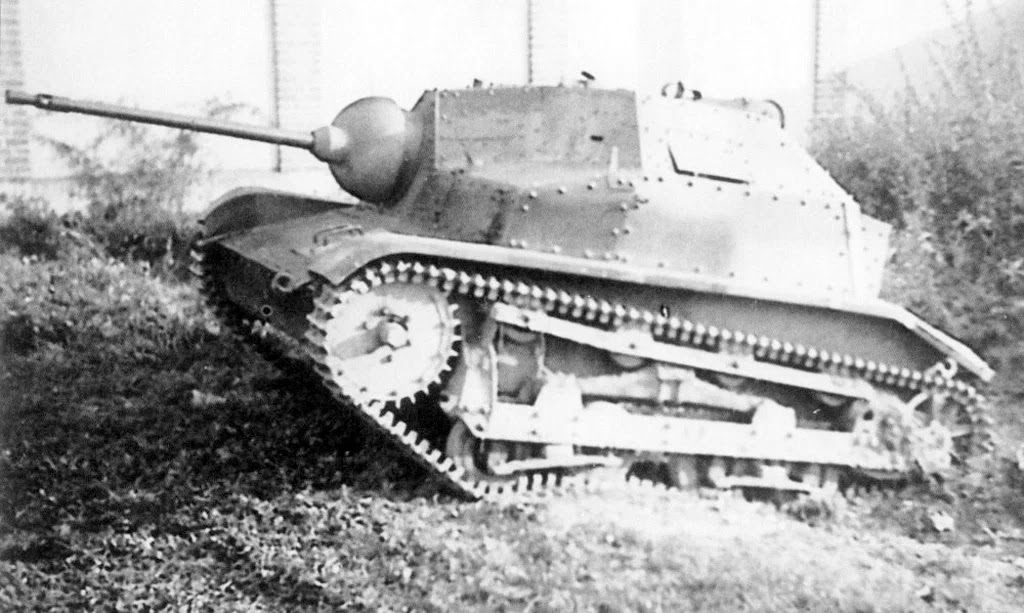
Polish Tank Destroyer

The growth of tactical-technical requirements is a normal phenomenon for any army in the world. The brass also often doesn't know when to stop, which results in a strange metamorphosis. This happened to the tankette class of vehicles. Initially, the concept was something akin a mobile machine gun nest: a machine gun with a shield, engine, and tracks. Early tankettes were one-man vehicles, but experiments in the early 1920s showed that you need at least two crewmen. The Carden-Loyd Mk.VI is a classic example of this concept. Nevertheless, many nations quickly started treating it as a tank, albeit a small one. Requirements for these tankettes grew until they were more suited to tanks, and so the tankette withered away. 

TK-S tank destroyer, a great example of a successful modernization of an obsolete vehicle.

Friday, 1 December 2017

Little Tank, Great Success

Czech-made weapons were popular since the start of the 20th century. Skoda's artillery was in demand even outside of Austria-Hungary, which Czechia belonged to until 1918. Weapons exports continued after the formation of the First Czechoslovak Republic. As a rule, their excellent quality was accompanied by a very agreeable price.

Tanks joined cannons in the mid-1930s. Czechoslovakia managed to take second place in tank exports worldwide, coming up just behind Great Britain. The first and most popular export item was the Praga AH-IV tankette.

Friday, 1 September 2017

Trophies from Galicia

Starting with the late 1930s, testers in Kubinka began receive foreign vehicles from all corners of the world to try on for size. The first to come were trophies captured in Spain during the civil war, but the floodgates opened in 1939. The first to come was the Japanese Ha-Go tank, and Polish vehicles came after that. One of them was the TK-S tankette.

Friday, 6 January 2017

TK-3 and TKS: Poland's Armoured Cockroaches

By pure numbers, Poland had an impressive amount of armoured vehicles in WWII: about 870 units (against approximately 2700 German tanks in Army Group North and South). However, three quarters of them were rather unusual vehicles: TK-3 and TKS tankettes. What were the machines that formed the backbone of the Polish armoured forces like?

Thursday, 28 May 2015

German Intel: Polish Tanks

Unlike the Red Army, which got sketches and dry statistics, the Polish get photographs of their vehicles and even a bit of a text blurb, even if they are mostly laconic.

Carden-Loyd type tankette (TK)

"Polish: czolg rozpoznawczy = reconnaissance tank.
Most tank battalions are composed of this tank. They are to be replaced with the improved TKS or TKF models.
Produced in Poland at: state Engineering Works."

TK (F or S) (improved Carden-Loyd TK3)

"Made in Poland. 
The most common small tank in Poland."

Light Renault tank mod. 1918 FT

"This tank is only present in a few battalions and only used for training purposes."

Renault NC27

"Improved light tanks used in Poland, could be replaced with Vickers-Armstrongs."

Vickers Armstrong's 6 ton tank type A

"License-built Polish tank built with modifications based on the English tank described in Heigl's book. This model was allegedly not kept, and the type B (single turret) is preferred."

Vickers Armstrong's 6 ton tank type B
"Polish license-built."

TP 7

"This tank is similar to the Vickers Armstrong type B, but has an improved turret."

Citroen armoured car, Kegresse mod. 1927

"This model is obsolete and will be used up by the troops."

Peugeot armoured car

"French armoured car, obsolete but still down in parades."

"Ursus" armoured car

"Produced in Poland"

Monday, 23 February 2015

Achievements and Predictions, 1929

"Report of the Artillery Directorate of the Supplies Directorate on achievements from 1925 to 1928

Part 2: Scientific research work on improving armament (Artkom)
Moscow, 1929
  1. The army's technical strength is a consequence of the technical and cultural condition of the country.
  2. Between exiting the World War in 1917 and until the end of the Civil War, the USSR was completely cut off from the West for four years. This, as well as the destruction of industry and a lack of materials and production capacity impeded any development of an armament improvement program.
  3. Artkom places three principles into the development of artillery technology, same as in the West: surprise, mass, and depth.
  4. The principle of surprise is achieved in the following ways:
    1. Increasing mobility, primarily operational mobility (wide use of mechanical transport, development of railroad artillery).
    2. Development of methods that permit opening lethal fire immediately (such as use of land or air observers).
  5. The principle of mass involves admitting that artillery can only be effective when used in massed amounts. It is necessary to strengthen artillery as a type of forces and establish a powerful Supreme Command reserve, as well as centralized control of artillery in battle.
  6. The principle of depth is achieved by increasing the range of all guns and increasing the horizontal and vertical field of fire.
  7. Requirements for new artillery systems that solve the issues of modern war are composed considering the following factors:
    1. Widespread use of aircraft.
    2. Group infantry tactics and use of defense in depth, using both natural terrain and artificial fortifications.
    3. Widespread use of tanks.
    4. Use of chemical weapons.
  8. Considering the above, it is suggested that a new system of armament should be developed and taken as the baseline.
    1. Existing weapons should be evaluated from the point of view of the new system.
    2. A realistic plan of improvements should be adopted, and weapons that cannot be adapted to the new system must be found out.
    3. A realistic plan for development of new designs that satisfy the new system must be created.
      However, this path is long, so the first stage is defined by Artkom to be:
      1. Modernization of existing designs.
      2. Creation of new designs, made necessary by tactics of modern battle.
  9. Modernization is defined by Artkom as changes made to a design that improve its characteristics according to the new tactical-technical requirements without interfering with production and acceptable according to economic and supply considerations.
  10. In order to better describe work performed in the past years on modernization and development of new designs, let us briefly describe the state of armament in 1925, analyze it, and attempt to evaluate the modernization work based on this analysis.
...

In 1925, support tanks with a special domestic tank motor were sent to the Bolshevik factory with the aim of producing the first batch in 1928. Work proceeded mostly as follows:
  • 1926: working blueprints were finished, production began.
  • 1927: trials were performed, the first production batch was organized.
  • 1928: mass production of the MS-1 began, working blueprints of the T-12 maneuver tank were completed, work on a one-man tank began.
Modernization of existing B and M tanks was scheduled.

Existing tank Modernization Replacement
B tank (breakthrough) Planned T-12
S tank (maneuver)


M tank (support) Planned One-man tank

Foreign achievements


Maneuver
Support
England
USSR
Czechoslovakia
USSR
Vickers
T-12
KN convertible drive
MS-1
Mass (tons)
12.2
16
8.5
5.9
Crew
5
4-5
2
2
Fuel capacity (liters)
410
-
100
100
Range (hours)
10
8
8
11
Cannons
1
1
1
1
Machineguns
4
3 coax
1
1
Maximum speed
25
25.5
14.2
16
Front and side armour (mm)
14
22
13
16
Roof armour (mm)
8
12
10
8
Maximum traversible trench width (meters)
1.83
2.6
1.8
1.8
Maximum fording depth (meters)
1.2
1.2
0.8
0.8
Maximum grade (degrees)
40
40
35
40
Armament of tanks and armoured cars

In 1926, the following weapons were available:
  1. 37 mm Hotchkiss tank gun
  2. 57 mm Hotchkiss tank gun
  3. 0.303 inch Hotchkiss machinegun
The last two weapon types were captured.

As a result of proving grounds trials, it was discovered that existing cannons and machineguns were hard to use, and a series of improvements for the 37 mm Hotchkiss gun was defined. 
Orders were made for a 45 mm tank gun that could replace captured armament. Work began on using Fedorov machineguns instead of captured ones.

1927:

A special shoulder stock was designed for the 37 mm Hotchkiss gun, with sights and a trigger mechanism, and production started for existing tanks. At the same time, changes were made to the gun mantlet to increase horizontal traverse range.
A new mount for 37 mm Hotchkiss guns was designed and tested for new tanks and armoured cars.
A mount for two coaxial Fedorov Avtomats was tested, and a mount for the Degtyaryev machinegun was designed. Orders were made for a high power 37 mm tank gun.

1928:

The Degtyaryev tank machinegun mount was designed and entered production for both new vehicles and replacement of machineguns captured vehicles. Production of a special 37 mm tank gun started.
A 45 mm gun is being tested for maneuver tanks and replacement of captured B tanks.
A universal stock for 37 mm Hotchkiss guns with an optical sight was designed.

Supplies of tank columns:

Aside from battle vehicles, it is necessary to equip tank units with tracked tractors and trailers, capable of following a tank unit on marches and transporting personnel (commanders, scouts, communications personnel, support personnel) with their belongings and supplies (ammunition, fuel, lubricant, etc). The speed of these tractors should be no less than that of tanks, and their off-road performance should allow them to follow tanks on any terrain.

It is necessary to limit the number of different types of these tanks due to our limited manufacturing capacity and to reap the benefits of having one chassis. This suggests that such a tractor should use as many existing tank components as possible.

Initially, a light tractor based on the standard MS-1 tank was developed, with a maximum speed that is equal to the maximum speed of the tank, even when it is towing a trailer. The trailer is in development, with the aim to make it compatible with existing trailers in order to provide mechanized transport for artillery.

Conclusions
  1. By 1929, after four years of research, design, construction, and trials, tank building work is underway at three factories. The RKKA will receive its first domestically designed support tank, smallest in its weight class, with an air cooled engine, with high off-road performance, high speed that allows it to support infantry and cavalry on marches and in battle, armour that is invincible against regular riflemen, with armament that allows it to complete objectives for the tanks of this type (fighting infantry and enemy positions at ranges of effective fire during tank attacks). Tanks are capable of fighting against tanks with analogous armour at straight shot ranges. Experimental 37 mm guns that are more appropriate for a modern battlefield are in development, and orders for production will be made after they finish trials.
    Simultaneously with production of the tank, the issue of tractors and auxiliary vehicles is being solved.
  2. An experimental maneuver tank has been designed and is being assembled.
  3. The first tankette is finishing trials. Its components and design, first used in our industry, will be studied in the summer of 1929 to obtain data required for a design to be assembled in 1930 that will be acceptable for use by the army.
  4. When the three required types of tanks are completed, the issue of arming the RKKA with tanks that match our closest enemies will be resolved.
  5. The path of motorization of the RKKA is inevitable, as we cannot afford to provide an advantage to our enemies. This challenges the AU to design new tanks that fully match the requirements provided by the RKKA, which need significant technical and tactical research to define.
  6. Artkom's current priority is increasing the movement speed of support tanks without decreasing other combat characteristics.
The issues of radio communications, AA defenses, poison gas protection, smokescreens, and transport on wheeled trailers on roads will be solved in the near future."

V. Lehn collection

The B tank in question is a British MkV tank. Presumably the S tank is a Whippet, and M tank is an FT-17.

Tuesday, 6 January 2015

Tank Program for 1929/30

"Approve the tank program for 1929/30 in the following volumes:
  1. T-18: 300 units (excluding units owed from 1928/29)
  2. T-12: 30 units
  3. Tankettes: 10 units
Propose that the USSR VSNKh takes all measures to expand tank production for 1930/31 in order to fulfil most of the five year plan in the first half. If factories are expanded during the five year plan, it is necessary to give them work. In the event of a decrease of orders from NKVM, give them peacetime tasks.

Propose that the USSR VSNKh and NKVM expand design and research work, designing tanks in 1929/30 that are no worse than the best foreign tanks with the goal of beginning mass production in 1931/32.

Take all measures to increase the amount of foreign assistance.

RZ STO secretary Appoga"

Sunday, 24 August 2014

State of Affairs, 1932

"Conclusions of the RKKA staff based on materials provided by the Directorate of Mechanization and Motorization on the development of armoured forces

May 10th, 1932

1. T-27 tankette

Given that the Red Army possesses the T-26, the T-27 is unsatisfactory as a reconnaissance vehicle for motorized infantry for the following reasons: low maximum and average speed, limited off-road capability, insufficient horizontal traverse, poor visibility, low range, lack of backup driving controls. It is necessary to produce a new amphibious tankette that is capable of performing reconnaissance for motorized infantry. For infantry, the T-27 is not very useful due to its limited off-road capability and difficulty in shooting on the move.

I think it is necessary to rapidly perform trials of an amphibious tankette with the aim of producing the improved variant instead of the T-27. Preliminary trials of the tankette show a top speed of 30-31 kph on a highway, good maneuverability and satisfactory buoyancy. Drawbacks include an overly rigid suspension, engine overheating, low fuel capacity (6 hours of driving), low speed on land and on water, poor off-road performance (drives over trenches with difficulty, hits the propeller on highways. The amphibious tankette requires the following characteristics:
  1. A speed of 50-60 kph on a highway, no less than 35-45 off-road, 15 kph on water with perpendicular current.
  2. Capable of crossing trenches 1.6-1.8 meters wide.
  3. Fuel capacity to run the engine at maximum RPM for 8 hours.
  4. Capable of traversing a 35-40 degree grade that is three times as long as the tankette.
  5. 360 degree traverse with one regular or high caliber machinegun.
  6. Gyroscopic compass and speedometer.
  7. Armour should protect the crew and mechanisms from SMK and AU armour piercing bullets from 50 meters.
  8. Crew of two.
  9. Ammunition capacity: 3000 rounds for the machinegun.
  10. Water cooled engine.
2. T-26 light tank

Trials of a 45 mm gun with a coaxial machinegun in the T-26 turret show that the semi-automatic mechanism is unreliable, the turret is cramped (420 and 430 mm for the gunner and loader, which reflects poorly on the rate and precision of fire, the turret does not turn fast enough, leading to poor agility of fire. The foot trigger is poorly positioned, the optical sight is unreliable, the ventilation is inadequate, which reflects on the combat ability of the crew. After trials of this mount are done, two others must be tested immediately.
  1. In order to increase the rate of fire and precision, push the gun forward, tilt the front of the turret, and remove the rear turret bustle, designed to balance the turret. 
  2. Make a wider turret with a tilted forward section and lack of turret bustle.
If the tank commander is to the right of the gun (acting as the loader), give him a second periscope, otherwise he cannot control the tank as he cannot see.

Rapidly finish the trials of the 45 mm gun, and produce only tanks with a single turret, carrying a 45 mm gun capable of rotating 360 degrees with 110 rounds of ammunition and 3000 bullets. Install a gyroscopic compass and speedometer. Work on the following issues:
  1. Extend fuel capacity to 10 hours at maximum engine RPM.
  2. Investigate the issue of buoyancy (or underwater driving) with a tank on the T-26 chassis.
  3. Investigate the possibility of a convertible drive.
  4. Investigate the possibility of making the tank air-tight.
  5. Increase the speed to 50 kph on tracks and 100 kph on wheels.
  6. Increase the reliability of mechanisms, reaching 1000 km before medium repairs are needed.
3. TMM-1 and TMM-2

Due to the variety of theaters of war and special climate conditions where winter lasts 3-5 months, it is more reasonable to develop air cooled engines and have automotive factories produce them instead of making the vehicle rely on availability of water in the summer and antifreeze in the winter. TMM-1 and TMM-2 vehicles based on imported water-cooled engines are of no value. It is reasonable to develop domestic engines for armoured vehicles.

4. Fast BT tank

Factory trials of the original and domestically produced BT tank show that the tank can drive on asphalt and dirt roads on wheels. The original was not trialled on tracks, as the left idler was broken. Our tank was not trialled on tracks over a large distance, and it is impossible to make conclusions of its tactical value. 

Given current tactical-technical qualities, the BT cannot be considered a fully functional battle machine, capable of driving on wheels on wet dirt and dirty roads. RKKA UMM should, without stopping production, design a BT tank with four drive wheels, later increasing that number to six. The track removal and installation process should be mechanized, as taking 30-45 minutes to install tracks and 15-30 minutes to remove them is excessively high. 

RKKA HQ insists on rapid modernization of the BT and construction of a prototype amphibious tank.

5. T-28 medium tank

We currently produce no medium tanks. The construction and trials of a prototype should be accelerated in order to begin production in August-September.

6. Heavy tank

I consider it necessary to have a heavy tank designed for penetration of enemy defenses, fortresses, and fighting enemy heavy tanks. The tank should have the following technical-tactical characteristics:
  1. Speed: 40-50 kph
  2. Range: 300-400 km
  3. Air cooled engine
  4. Maximum grade: 45 degrees
  5. Ability to cross trenches 7 m wide
  6. Capable of moving on railroads (foreign and domestic) on its own power
  7. Can cross water hazards either by driving underwater or swimming
  8. Capable of knocking over two trees at once, with a diameter of 0.5 meters each
  9. Armour should guarantee protection from a 3-inch shell fired at 800 m/s at 50 meters.
  10. Armament:
    1. 1 152 mm gun with 360 degree traverse
    2. 2 semi-automatic 76 mm guns with 280 degree traverse
    3. 12-14 machineguns
    4. 2 37 mm AA autocannons and 2 AA machienguns (out of the 14)
  11. Ammunition:
    1. 152 mm shells: 60
    2. 76 mm shells: 200
    3. 37 mm shells: 1000
    4. 2000 rounds of ammunition per machinegun
  12. A radio
  13. The tank should have a gyroscopic compass, speedometer, and observation devices.
  14. The tank should be impenetrable to gases.
  15. The combat weight should be less than 150 tons.
  16. Blueprints of the tank should be delivered to the RKKA HQ no later than August of this year. Work with the aim to have a prototype by the start of 1933.
Conclusions on tanks
  1. Tanks are a powerful offensive force, and their development should follow corresponding types: first light and medium, then heavies and tankettes. Meanwhile, the plan for 1932 has equal amounts of tankettes as tanks: 3000 T-26, 2000 BT, 5000 T-27. I deem it necessary to make a push for light tanks for next year.
  2. Currently, there is no complete data on the tactical-operative value of vehicles in the RKKA. I consider it necessary to investigate the issue of testing the BT, T-26, T-27, D-13, and D-8 in combat conditions (three vehicles of each type) in order to determine the following:
    1. Daily range of vehicles on highways, dirt roads, and mixed terrain in various conditions.
    2. Average speed over 100, 200, 300, 400, and 500 km on highways, dirt roads, and mixed terrain, with various obstacles (water, swamps, sand, elevation, etc)
    3. Average range of night marches on various roads.
    4. Exhaustion of crews of tanks and armoured cars after day and night marches.
    5. The capability of each vehicles to cross various obstacles: trenches, elevation, fording, driving over sand, swamps, stumps, etc.
    6. Accuracy of shooting from 100 to 2000 meters.
    7. Reliability of vehicles, increase reliability to 5000-8000 kilometers
  3. Perform trials no later than May of this year. Perform additional trials in fall-winter conditions. The RKKA considers performing these trials for all combat and auxiliary vehicles, both domestic and foreign bought.
7. Tractor

The tractor will work in motorized infantry units, and must have the same tactical-technical characteristics as a T-26. The tractor should be based on the T-26 chassis, and not only be useful for transporting infantry, but also evacuating the wounded, delivering ammunition and fuel, and as a command vehicle for motorized and tank units. It can also be used as a mobile workshop for battlefield repairs and a radio tank.

8. Engineering vehicles

An experimental prototype has been built with a 76 mm mountain gun on a T-26 chassis. As the tank does not have a rotating turret, I would suggest withholding production. It is necessary to develop a T-26 tank with a semi-automatic 76 mm gun in a rotating turret. It is also unreasonable to produce SPGs using Moreland trucks, as they are imported and have poorer off-road performance than Ford AA trucks.

9. Sapper tank

No complaints about the sapper tank. Aside from a sapper tank, we need a mine carrier tank. The mine carrier tank should have the same characteristics as a light tank, and should carry 1200-1500 AT mines, and two machineguns. The mine carrier is meant to lay mines in three rows in an interleaving pattern 1.5 meters away from one another during tank battles, when being chased by enemy tanks, when retreating and creating minefields for defense, on flanks, etc.

RKKA HQ Chief, Egorov"

Friday, 2 May 2014

Kirov Factory Experiments, 1935

A note: this document seems to have been written in a transitional period, where workers still used the old name (Krasniy Putilovets) out of habit, rather than the new name (Kirov factory). 


"Plan for experimental and design at the Krasniy Putilovets factory for 1935

January 27th, 1935

6. 76 mm K regimental cannon on the T-27 tank, 6 items
7. 152 mm K self propelled gun, 3 items

New items for GAU in 1935

10. Installation of a 76 mm model 1915 AA gun in the T-28, 1 item
11. Finishing of an experimental 76 mm L-3 universal SPG gun, 1 item

To the factory chief engineer, comrade Ter-Asaturov M.L. :

According to your orders regarding experimental and design work at GVMU for 1935, I report the following:
  1. A short description and manual for the Kirov factory 203 mm howitzer will be completed and handed to the AU military representative by July 1st, overall price is 6000 roubles. I agree.
  2. Experimental blueprints for the KT-27 are submitted to the plant.
  3. Blueprints of the experimental ST-27 ammunition container will be completed by May 15th, overall price is 20,000 roubles. I agree.
  4. The blueprints for the L-7 gun, a model 1915 76 mm AA gun in a T-28 turret are already completed. 
  5. The new 76 mm regimental gun project will be completed for June 1st. I do not agree with the price. My price is 100,000 roubles for the project and blueprints."

Wednesday, 9 April 2014

Soviet Tanks in the Far East

Here are the tanks the Red Army had available in the Far East for war with Japan as of August 5th, 1945. As you can see, some of these tanks have been there for quite a while, as they are downright antiques. As per Soviet tradition, tanks that require light repairs (repairs that can be completed by the strength of the tank unit) are included in the "functional" column.

Vehicle In possession Functional Med. Repairs Maj. Repairs Irreparable
T-34 1899 1794 32 70 3
M4-A2 250 250 - - -
BT-7 1030 797 41 179 13
T-26 1461 1272 33 122 34
KV 77 47 5 23 2
Valentine 81 78 3 - -
T-60/70 46 14 - 28 4
BT-5 190 101 - 23 66
T-38 325 304 20 1 -
Tankettes 52 52 - - -
IS 19 6 1 12-
T-27 56 56 - - -
T-37 52 52 - - -
M3 light 1 - 1 - -
M3 medium 1 - 1 - -
Various 5 5 - - -
Total tanks 5548 4841 137 455 125
ISU-152 197 188 1 8 -
ISU-122 1 1 - - -
SU-100 262 261 1 - -
SU-76 952 944 9 - -
SU-152 11 - - 11 -
SU-85 6 1 - 5 -
SU-122 6 2 - 3 1
Total SPGs 1422 1393 11 28 1
Total  6980 6234 148 483 126

The small number of IS tanks available casts doubt on the assertion that IS-3 tanks were present in the theater.

Saturday, 25 January 2014

Arming Vickers Tanks


"Confirmed
June 6th, 1930
Chief of the RKKA AU Bondar

Confirmed
June 6th, 1930
Chief of the RKKA UMM
Halepskiy

Minutes #9003188ss

Meeting between representatives of the NTK AU and NTK UMM on the issue of installing armament in Vickers tanks.

We heard Rozhkov's report on installing Maxim machineguns in Carden-Lloyd Mk IV tankettes, and a high power 37 mm gun in the turret of the 12-ton tank, and reached the following conclusions:
  1. A machine gun can be installed in a Carden-Lloyd Mk IV tankette by the company as a part of the order, according to a note on the Vickers blueprint #012390.
  2. Installing a 37 mm tank gun in the turret of a six-ton tank: the installation of a 37 mm tank gun in the front part of the turret would require the following changes:
    1. The sides are straight, gradually transitioning into the turret cylinder.
    2. In order to achieve sufficient horizontal traverse angles, and ensure comfort of use, the turning mechanism should be turned into a position parallel to the turret axis.
    3. The front of the turret is tilted back 13 degrees in order to achieve 20 degrees of gun elevation, like on the MS-1 turret.
    4. In order to provide 360 degree view and balance the turret, the turret roof should be lowered by 60 mm, and a cupola should be installed.
    5. Increase the diameter of the turret ring ball bearings, as they were made with a machine gun in mind.
  3. Installing a 45 mm gun in the turret of a 12-ton tank: the following should be done to install a 45 mm gun into the 12-ton tank:
    1. Cut a circular hole in the front of the turret of the proper size.
    2. Attach a flat metal sheet from the inside of the turret using straightening valves.
    3. Bolt the cradle carrier for the 45 mm gun to this sheet.
    4. In order to increase the robustness of the roof, attach the sides at an angle to the turret axis.
    5. Install the turning mechanism next to the gunner's left hand.
    6. Place the machinegun at the end of the perpendicular turret axis.
    7. The second turning mechanism is placed in a convenient location for the right gunner. Both mechanisms can be disabled.
    8. The rear of the turret will hold a radio. In order to develop the mount, we need to provide the company with the size of the gun and its recoil length.
Signatures: Sverchkov, Miller, Braverman, Rozhkov, Ozerov."