![]() |
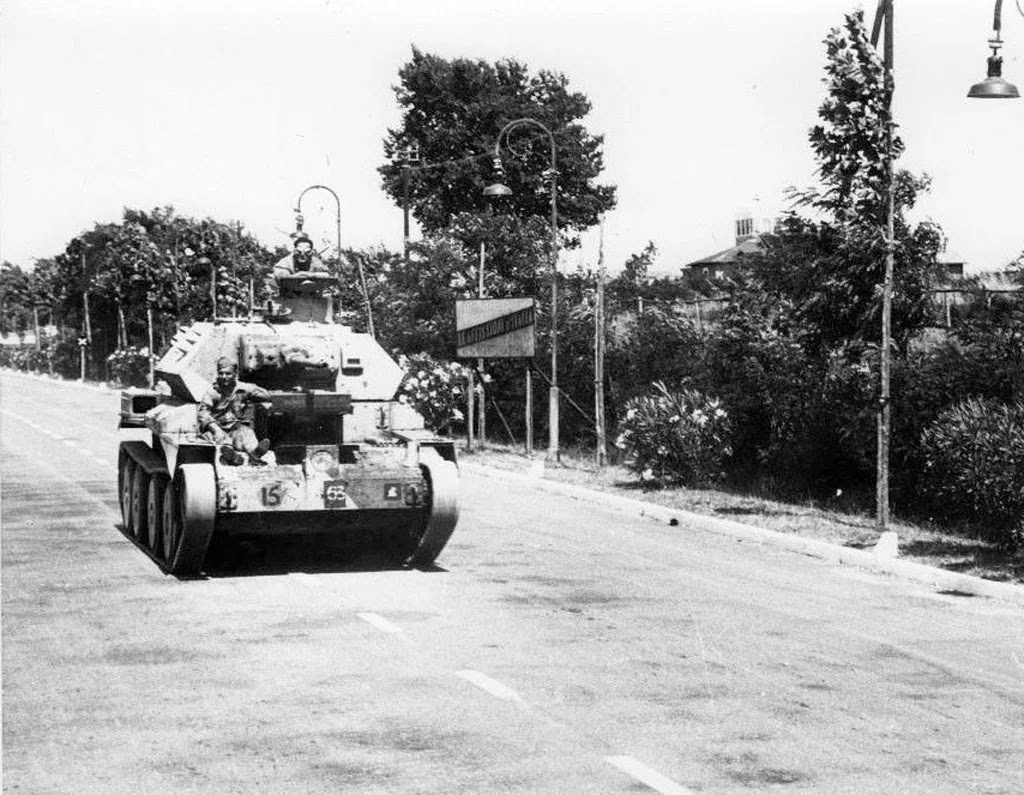
| Captured Cruiser Tank Mk.IVA at trials in Nettuno. This tank was the inspiration for a "colonial" tank. |
Showing posts with label cruiser. Show all posts
Monday, 11 September 2023
Italian Cruiser Tank
Italian tank building developed along a fairly usual trajectory. Once a direction was identified, the Italian military tried to stay on course. Under their close guidance, Ansaldo developed a series of combat vehicles: first a tankette, then a light tank, a medium one, and a breakthrough tank. In almost all cases, success was based on a foreign idea, primarily the British one. At first the Italians further developed the idea of the Carden-Loyd Mk.VI tankette and then the Vickers Mk.E support tank.
Combat in North Africa revealed a series of deficiencies, including insufficient characteristics of Italian medium tanks. One of the biggest issues was their low mobility. The increase in engine power was not an accident. British vehicles were studied in parallel. A Cruiser Tank Mk.IVA was among those examined. This was not the most successful tank, but it was fast. A captured tank was tested at Nettuno in May of 1941. The idea of creating an Italian cruiser tank came about around the same tank. This tank was later called Carro M Celere Sahariano.
Monday, 28 February 2022
Playing Catch-up
When talking about the status of tank building in various nations at the start of WW2, many tend to point to the Americans as the worst ones off. This is entirely incorrect. First of all, the American infantry and cavalry had a decent number of tanks, although not many medium ones. Second, these tanks were adapted for the American theatre of war and had exceptional mobility. Third, the Americans started the war with a well formed concept of what a tank should look like, which allowed them to quickly begin production of next generation tanks. In comparison, the British were doing very poorly, to the point where only their status as an island nation saved them from a catastrophe. This was the result of a crisis that began in the 1920s.
Saturday, 12 January 2019
Cruiser Tank Mk.II: With Best Intentions
The British army met the start of WWII in a difficult position. The policy of appeasement allowed it to win a year to set up tank production, but it was hard to call the British army prepared for war. This can be seen in the result of the fighting in May of 1940 in France. The British Expeditionary Force used four different types of Cruiser tanks at the same time. Among them was the Cruiser Tank Mk.II, perhaps the most controversial of the quartet.
Saturday, 5 January 2019
The First Cruiser
British tank building developed rapidly in the 1920s, but started slipping in the first half of the 1930s. At the time, the British army was only buying light tanks, and even then miserly amounts of them. The situation with medium tanks was a fiasco. The replacement for the Medium Tank Mk.II never made it into production. By the time a worthy heir turned up, British policy regarding the use of tanks changed entirely. The result of this change was the Tank, Cruiser, A9, also known as the Cruiser Tank Mk.I.
Wednesday, 27 July 2016
Soviet Intel on British Tanks
"British Tanks (modern)
British classification:
"
British classification:
- Light tanks: for reconnaissance and communications
- Infantry tanks: used in army tank battalions. Used for supporting infantry.
- Cruiser tanks: used in tank division. Used for independent action.
Light Tank Mk
VIB
|
Light Tank
MkVII
|
Infantry Tank
MkI
|
Infantry Tank
MkII Matilda
|
Infantry Tank
MkIII Valentine
|
Infantry Tank
MkIV Churchill
|
Cruiser MkIV
main type
|
Cruiser MkI
three turret
|
Cruiser MkII
one turret
|
|
Mass (tons)
|
5-6
|
7
|
12
|
25 or 32
|
16
|
38-40
|
14-16
|
12-14
|
12-14
|
Crew
|
3
|
3
|
3
|
4
|
3
|
5
|
4
|
4-5
|
3
|
Armour (mm)
|
12-16
|
Up to 16
|
Up to 60-65
|
Up to 75-80
|
60
|
75
|
Up to 30
|
16
|
Up to 20
|
Armament
|
12.7 mm MG
7.62 mm MG
Smoke launcher
|
40 mm gun
7.62 mm MG
2 smoke
launchers
|
12.7 mm MG
7.62 mm MG
Smoke launcher
|
40 mm gun
7.62 mm MG
2 smoke
launchers
|
40 mm gun
7.62 mm MG
2 smoke
launchers
|
40 mm gun
2 MGs, one high caliber
|
40 mm gun
7.62 mm MG
2 smoke launchers
|
37 or 40 mm gun
2 MGs
|
37 or 40 mm gun
1 MG, possibly 2
|
Engine
|
-
|
160 hp
Meadows gasoline
|
85 hp
|
2 diesels 95
hp each
|
131 hp diesel
|
360 hp
gasoline
|
180 or 340 hp
gasoline
|
180 or 250 hp
gasoline
|
180 or 250 hp
gasoline
|
Speed (kph)
|
~50
|
Up to 64
|
-
|
30-35
|
25-26
|
~35-38
|
Up to 84
|
30-35
|
30-35
|
Range (km)
|
-
|
200
|
-
|
-
|
114
|
-
|
-
|
-
|
-
|
Communications
|
Radio
|
Radio
|
Radio
|
Radio and intercom
|
Radio and intercom
|
Radio and intercom
|
Radio and intercom
|
Radio
|
Radio
|
Sunday, 15 May 2016
Cruiser IV: A Bit More Armour
The adoption of the Cruiser Tank Mk.III in 1938 didn't mean that the British were fully satisfied with it. Armour that was only 14 mm thick made the tank vulnerable to anything bigger than a rifle. High caliber machineguns that were one of the most popular anti-tank weapons during the Spanish Civil War made the military seriously think about improving protection. It was impossible to do anything radical with the Cruiser Tank Mk.III, since a whole new tank would be needed. It was decided to go down the road of minor modernization. The resulting tank became one of the best and longest lasting pre-war British tanks.
Local Reinforcements
Work on modernizing the Cruiser Tank Mk.III began in 1938, the same year as it was accepted into service. The Cruiser Tank A13E3 became a test lab for ideas for the new vehicle. No serious changes would be made to the hull, suspension, or engine, all of these were satisfactory to the British. Changes were confined to the armour, and applique armour at that. The only part that became thicker was the driver's hatch, increased to 28 mm.
The turret had some changes done to it. The commander's cupola became round instead of hexagonal (similar to the cupola of the Light Tank Mk.VIB). The observation device to the left of the gun mantlet was moved to the applique armour, and the four sections of front applique armour were installed parallel to the hull. The configuration of the side applique armour was similar to that used on the Cruiser Tank Mk.III*. The gap that was characteristic for field modifications disappeared.
Local Reinforcements
Work on modernizing the Cruiser Tank Mk.III began in 1938, the same year as it was accepted into service. The Cruiser Tank A13E3 became a test lab for ideas for the new vehicle. No serious changes would be made to the hull, suspension, or engine, all of these were satisfactory to the British. Changes were confined to the armour, and applique armour at that. The only part that became thicker was the driver's hatch, increased to 28 mm.
The turret had some changes done to it. The commander's cupola became round instead of hexagonal (similar to the cupola of the Light Tank Mk.VIB). The observation device to the left of the gun mantlet was moved to the applique armour, and the four sections of front applique armour were installed parallel to the hull. The configuration of the side applique armour was similar to that used on the Cruiser Tank Mk.III*. The gap that was characteristic for field modifications disappeared.
Production of the Cruiser Tank Mk.IVA at Nuffield Mechanizations & Aero, 1940. These tanks will later be sent to Africa.
Applique armour tested on the Cruiser Tank A13E3 showed that an extra half ton of weight did not have a serious impact on the tank's performance. Of course, the extra armour was just a half-measure. As it became more and more evident that a large war was brewing up in Europe, delaying production could become more costly. In December of 1938, an order for 65 tanks was made, indexed Cruiser Tank Mk.IV. These vehicles were also called A13 Mk.II.
Since the order for new tanks surpassed the capabilities of Nuffield Mechanizations & Aero, the London Midland & Scottish Railway Company (LMS) was given a part of the order. It is worth mentioning that the railway company played an important role in British tank building. For example, the Matilda infantry tank was assembled there. With the combined efforts of Nuffield and LMS, the Cruiser Tank Mk.IV became the most produced pre-war cruiser tank.
Cruiser Tank Mk.IVA turret.
The volume of production deserves its own mention. Often, numbers of 655 and 430 tanks are quoted, but archive data shows that these numbers are overestimated. The registration numbers for tanks of this type were given out in the following ranges:
- T.7030-T.7094 (65 tanks)
- T.9096-T.9190 (95 tanks)
- T.15215-T.15294 (80 tanks)
- T.18096-T.18160 (65 tanks)
In total, the ranges add up to 305 tanks. A report received by Soviet intelligence in 1942 gives an even smaller number. According to it, 630 Cruiser Mk.I through Mk.IV tanks were made, 121 Mk.I, 170 Mk.II, 65 Mk.III, 270 Mk.IV. A comparison with registration numbers and official data regarding the production of Cruiser Tanks Mk.I, II, and III makes this data seem reliable.
Early Cruiser Tank Mk.IV. These tanks did not have extra armour of the gun mantlet.
According to the same intelligence data, most cruiser tanks were built in 1940 (454 tanks), and in 1941, only 16 Cruiser Tanks Mk.IV were assembled. This explains why early types of cruiser tanks did not receive a name (for example, the Cruiser Tank Mk.V was called "Covenanter"). By the time that the new system of titles was in place, the tanks were no longer in production.
Changes to the Cruiser Tank Mk.IV design were made soon after production began. The applique armour, as with the Cruiser Tank Mk.III*, did not apply to the gun mantlet, which remained 14 mm thick. This problem was solved with additional spaced armour that covered the gun mantlet. These tanks were the most numerous among those equipped with a Vickers Mk.VI machinegun.
Cruiser Tank Mk.IV with spaced armour on the gun mantlet.
The next change was connected with the machinegun. In 1939, the British army introduced the BESA machinegun. The new machinegun was a Czechoslovak ZB.53 heavy machinegun modifies by the Birmingham Small Arms Company (BSA). The compact machinegun that did not need water cooling was immediately adopted by the tank branch. The Cruiser Tank Mk.IV was no exception. The modification with an altered gun mantlet and a BESA machinegun was called Cruiser Tank Mk.IVA. The mantlet and observation device were attached to the main applique armour plate on the front of the turret, which now consisted of three pieces instead of four. The mass of the tank grew to 15 tons.
Early Cruiser Tank Mk.IVA in Africa, 1941. This is vehicle T.15219, the same one as was seen in the Nuffield factory photo.
A little later, a second version of the Cruiser Tank Mk.IVA appeared. The biggest change was the cast gun mantlet, much easier to manufacture, but not devoid of drawbacks like gaps that "caught" shells and bullets. Later, this gun mantlet migrated to the Covenanter and Crusader. It's important to point out that changes made to the tanks did not result in a different numbering system. For example, tanks from three of the four modifications of the tank can be found within the range T.9096-T.9190.
Late Cruiser Tank Mk.IVA, the most numerous modification.
Some sources mention a Cruiser Tank Mk.IV CS armed with a 94 mm OQF 3.7" Mk.I howitzer, the same weapon as was used on the Cruiser Tank Mk.I CS and Cruiser Tank Mk.II CS. There are, however, some doubts about its existence, as there is no information about this modification aside from a text description. There was also a commander's version of the Cruiser Tank Mk.IVA, equipped with an additional antenna on the front right part of the turret roof.
Battles on Two Continents
As of May 1940, the Cruiser Tank Mk.IV was the second in number after the Light Tank Mk.VI among British tanks. These tanks were used by nine tank regiments in the 1st and 2nd Armoured Divisions. In the middle of May of 1940, when the British Expeditionary Force was deployed in France, 65 tanks of this type were sent there. Vehicles of all modifications were used, mostly late Cruiser Tanks Mk.IV with additional gun mantlet armour. The tanks were spread out among regiments in the 2nd and 3rd Armoured Brigades.
- 2nd Armoured Brigade: 2nd Dragoon Guards Regiment, 9th Her Majesty's Own Royal Lancers Regiment, and 10th Royal Hussars Regiment.
- 3rd Armoured Brigade: 2nd, 3rd, and 5th Royal Armoured Regiments.
The vehicles used by the Royal Armoured Regiments were very heterogeneous. For example, the 3rd regiment had Cruiser Tanks Mk.III, Cruiser tanks Mk.I, and Cruiser Tanks Mk.I CS aside from Cruiser Tanks Mk.IVA.
Cruiser Tank Mk.IV from the 2nd Dragoon Guards Regiment, 1st Armoured Division, abandoned due to mechanical failure. France, May 1940.
The French Campaign turned out to be longer for the Cruiser Tank Mk.IV than for the Cruiser Tank Mk.III. Aside from battles for Abbeville and Pas-de-Calais, tanks of this type also fought in defense of Dunkirk during the evacuation, where most of the vehicles were lost. During battles in France, the Cruiser Tank Mk.IV was a worthy opponent for German medium tanks. Its armour was comparable, as both the Pz.Kpfw. III and Pz.Kpfw. IV were protected with armour designed to resist high caliber machineguns and autocannons. Anti-tank guns used by France, Germany, and Britain made this armour ineffective. The speed of German and British tanks was also comparable. However, the British cruiser tanks had very picky engines, which often caused losses.
Unlike the Cruiser Tank Mk.III, its younger brother was destined to return to Europe. In March of 1941, the 1st Armoured Brigade from the 2nd Armoured Division was sent to Greece from Egypt. It contained two regiments, 4th Her Majesty's Own Royal Hussars and the reformed after losses in France 3rd Royal Armoured. The 3rd Royal Armoured Regiment contained Cruiser Tanks Mk.IV in addition to Cruiser Tanks Mk.IIA and Cruiser Tanks Mk.IIA CS, a part of which was taken from the 5th Royal Tank Regiment.
The fate of the 1st Armoured Brigade was even sadder than that of the BEF. The attempt to stop a German invasion of Greece failed, and most tanks were lost due to mechanical failure. After defeat in the Balkans, the 3rd Royal Armoured Regiment was reformed in July of 1942, but armed with other tanks.
This tank was lost due to a broken engine. It was a part of the 1st Armoured Brigade and fought in Greece in the spring of 1941.
Unlike in Europe, the African career of the Cruiser Tank Mk.IV was long. The first tanks arrived in early 1940, when Percy Hobart's mobile division (one of the creators of the cruiser tank doctrine) was reformed into the 7th Armoured Division, also known as the "Desert Rats". By June of 1940, the division included two armoured brigades which used Light Tanks Mk.VIB and cruiser tanks, the majority of which were Cruiser Tanks Mk.IVA.
Tanks fighting in Africa had tropical modifications. Several vehicles had long boxes attached on the left side of the turret, and mounts for 2-gallon cans were added to the rear of the hull. Side skirts were also added.
Despite Italy's official entry into the war on June 10th, 1940, active combat in Africa began in September. A month later, reinforcements were sent from Britain to Egypt: the 2nd Royal Armoured Regiment from the 1st Armoured Division and the 3rd His Majesty's Own Hussars from the 2nd Armoured Division. Two more brigades from the 2nd Armoured Division arrived in January of 1941. All glory of battle with the Italians fell to another unit that came to help in October of 1940: the 7th Royal Armoured Regiment, which consisted of Matilda IIA and Matilda III infantry tanks. While Italian artillery could fight British cruiser tanks, it was powerless against Matildas.
During Operation Compass, infantry tanks from the 7th Armoured played an important part. Nevertheless, the Cruiser Tank MkIVA was still the backbone of most British tank units. This situation persisted until the landing of the German Africa Corps in Libya in February of 1941. The first victim of the Germans was the 2nd Armoured Division, a part of which was sent to Greece in March of 1941. As of early April, the division included the 3rd Armoured Brigade, consisting of the 3rd His Majesty's Own Royal Hussars Regiment as well as the 5th and 6th Royal Armoured Regiments. The Cruiser Tank MkIV was the most popular among those units, including both early and late types. The 2nd Armoured Division was defeated in battles against the German 5th Tank Regiment and the Italian 132nd Ariete Tank Division, and by April 8th, 1941, it was disbanded.
Knocked out Cruiser Mk.IVA from the 2nd Armoured Division, Africa, March 1941.
By June 1941, the career of the Cruiser Tank MkIV was coming to an end. Operation Battleaxe was the last major battle where tanks of this type were used. By that time, the 7th Armoured Division began receiving large amounts of Crusader I tanks. Arrival of the American M3 Light Tank, known as the Stuart I in the British army, spelled the end of the Cruiser Tank Mk.IV. Its firepower was equal to the British cruisers, and its armour was superior. Most importantly, it was much more reliable. Single Cruiser Mk.IVA tanks continued serving in Africa until early 1941. Vehicles on Malta served longer than the rest. At least one Cruiser Tank Mk.IVA (serial number T.18117) remained in that garrison until at least late March of 1942.
Under a Foreign Flag
The Cruiser Tank Mk.IV was the only cruiser tank included in the BEF that was massively used by the Germans. Its new masters tried it out during the French campaign of 1940. The Kreuzer Panzerkampfwagen Mk IV 744 (e) was used as it was captured, without even a new paint job. Cosmetic changes were limited to painting over the British identifying marks and addition of the Balkenkreuz. After the French Campaign, the Germans no longer used Cruiser Tanks Mk.IVA and B, at least in Western Europe.
Cruiser Tank Mk.IVA that was captured and put into battle immediately in France, June1940. The engine betrayed its new masters.
After the 1940 campaign, several tanks (up to six) made it to the proving grounds at Kummersdorf. The other tanks were spread out between training and active units. In February of 1941, 9 tanks were transferred to Beutepanzer-Kompanie (e) within Pz.Abt. (Flamm) 100. There is also information about the use of the Kreuzer Panzerkampfwagen Mk IV 744 (e) by police units.
Tanks that were used by training units were not changed significantly. Some tanks even retained British camouflage. Tanks from Pz.Abt. (Flamm) 100 were also mostly unchanged from the fall of 1940 to spring of 1941. Notek night lights were installed, the tanks were painted in a German grey, and unit markings were added. As for tanks that were sent to the front lines, that story is more interesting. The modernization was systematic: all tanks were altered in the same way.
Kreuzer Panzerkampfwagen Mk IV 744 (e) from Pz.Abt. (Flamm) 100.
First, tanks from Pz.Abt. (Flamm) 100 received new tracks, borrowed from the Pz.Kpfw.II Ausf. D1. The change might seem strange if one does not consider that the donor tank was essentially the German vision of a cruiser tank. The cause of this replacement was unknown, it was possible that the new tracks were simply longer lasting.
A bigger change compared to the original design was the addition of wooden shelves along the sides for fuel canisters, located behind the skirt armour. Holders for canisters were also added on the fenders. Front and rear mudguards were replaced with simplified ones. At the same time, the side elements of the fenders were removed.
In addition to standard lights, Notek night driving lights were added to the front and rear. The muffler was partially covered by a screen, and a mount for an unditching log was added. At least one tank from Pz.Abt. (Flamm) 100 (turret number 265) received a movable tow hook for a Renault UE trailer. Almost all Kreuzer Panzerkampfwagen Mk IV 744 (e) in Pz.Abt. (Flamm) 100 were of the later type, and only tank #142 was from the early series.
Typical Kreuzer Panzerkampfwagen Mk IV 744 (e) at the end of its career. The removed engine compartment roof indicates a broken engine.
Converted tanks were used in the first days of the Great Patriotic War. Tanks from Pz.Abt. (Flamm) 100 of the 18th Tank Division were included in the 2nd Tank Group of Army Group Center. The battalion participated in the assault on Brest Fortress and later fought in Belarus. However, the combat career of the Kreuzer Panzerkampfwagen Mk IV 744 (e) was not long. By July 11th, 1941, three weeks after combat began, the battalion no longer had a single tank of this type. Most were lost due to breakdowns.
Aside from Europe, the Cruiser Tank Mk.IVA fought under a foreign flag in North Africa. As of July 23rd, 1941, the German 5th Light Division had two Cruiser Tanks Mk.IVA. These vehicles were lost by September 12th. Aside from the Germans, the Italians used captured tanks, both as tanks and as immobile pillboxes. Unlike tanks that fought on the Eastern Front, the African trophies were not altered at all. They did not even have new markings.
Friday, 25 March 2016
Covenanter: Reservist Tank
Winston Churchill's saying "The tank that carries my name has more drawbacks than I do!" in regards to the Infantry Tank Mk.IV is well known. Despite this evaluation, the Churchill was the longest-living British tank, even finding itself useful in Korea. It is not know what the Prime Minister thought about the Cruiser Tank Mk.V, more known as the Covenanter, but there is one fact that says more than enough: it is the most numerous tank of the Second World War that never saw combat.
In a Hurry
The increase in armour of the Cruiser Tank Mk.III that resulted in the Cruiser Tank Mk.IV was a half-measure, unable to radically improve the combat effectiveness of the tank. The British Ministry of War knew that the modernization reserve of this chassis ran out. A deep modernization was necessary to make the tank meet the expectations of the military, and fast.
The Ministry of War, and especially one of the minds behind the cruiser tank concept, Lieutenant Colonel Giffard Le Quesne Martel, did not sit still. In 1936, specifications were developed for a "heavy" cruiser tank. Martel was inspired by the T-28 tanks he saw alongside BT tanks during Soviet exercises. Interestingly enough, the T-28 was initially inspired by the three turreted British Medium Tank Mk.III.
Two companies got to work: Nuffield Mechanization & Aero and the London Midland & Scottish Railway Company (LMS). LMS began work on the A14 heavy cruiser tank, which was indeed similar to a T-28. Nuffield chose a different direction. Their result was more similar to the experimental T-29. Even though the difference in weight between the two tanks was about 9 tons, the characteristics were similar. By 1939, one prototype of both the A14 and A16 was built. Neither the military nor the developers were particularly impressed with them. The result was the same cruiser tanks, but bigger, slower, and more expensive.
Pilot prototype of the Cruiser Mk.V, fall of 1940. The hull machinegun is a distinctive feature of this design.
On February 2nd, 1939, specifications for a new cruiser tank were developed. The maximum thickness of its armour was 40 mm. The Christie suspension was preserved, and the same 2-pounder (40 mm) gun and BESA machinegun were used. The combat weight of the tank was supposed to be about the same as that of the A13 vehicles (Cruiser Tank Mk.III and Mk.IV). Seeing these requirements, Nuffield and LMS themselves asked the Ministry of War to cancel the heavy cruiser tanks, since thickening their armour served no purpose. Another vehicle was needed, a much lighter one.
Work on the new tank, indexed A13 Mk.III, was assigned to three companies. LMS was working on the hull and chassis, Nuffield was designing the turret. A third company, Henry Meadows, was tasked with the engine. This decision was made due to the negative feedback that came from users of the Nuffield-Liberty engines. However, the participation in the A13 Mk.III project didn't mean that Nuffield gave up on their own tank. Instead of the rejected A16, work began on the lighter A15 vehicle.
The A13 Mk.III project was ready in mid-April of 1939. Instead of a deep modernization, LMS ended up with a brand new tank which inherited only the suspension type from its predecessor. Even this component was not exactly the same. LMS engineers installed the springs on an angle in order to make the hull lower. Overall, the hull was not only lower, but shorter than its predecessor.
Thanks to the angled suspension elements, the Covenanter's hull was very low.
The low hull was made possible by the 16 Liter DAV engine developed by Henry Meadows. This 12 cylinder 300 hp engine was designed using the opposite layout, which allowed reduction of the height of the engine compartment. The Wilson planetary transmission was paired with this engine.
The aim to make a compact and low hull conflicted with common sense. There was no room for cooling radiators in the engine compartment, so LMS engineers didn't think of anything better than moving them to the front of the hull. The radiators were placed on the left side of the tank, and the driver was displaced to the right. The air vents for the radiators were in the most important place from the point of view of armour protection, and even though there was a deflector that protected the vents from the front, its effectiveness was negligible. It's worth mentioning that the radiators were cooled by fans which were powered by the turret traverse motor. There was also no room in the engine compartment for air filters, which were instead moved to the engine compartment roof and protected with light covers.
Meadows DAV opposite engine which made height reduction possible.
The original plan was to make the hull fully welded, but even by early summer of 1939, it was obvious that there would not be enough skilled welders. LMS was forced to redesign their hull, which increased in mass by 100 kg. Instead of welding, rivets were used as much as possible, which was only natural for a locomotive company. Another feature was layered armour. The armour was composed of two plates without any space between them. For example, the front plate was composed of a 21 mm plate and a 19 mm one, with the inner plate being made from mild steel.
The turret, designed by Nuffield, also had its oddities. On one hand, the armour was sloped. On the other hand, for some reason only the rear and sides were. The front of the turret remained at an almost right angle. The oddities did not end there. Someone clever in Nuffield decided that there is no reason to have a commander's cupola, so it was replaced with a Mk.IV periscope. This periscope was installed right in the middle of the turret, right above the gun breech. Of course, it could be used somehow, but when the gun fires right under the commander's chin, it must have been rather uncomfortable. There was another periscope on the right side of the turret for the loader.
The turret hatch was also interesting. There was only one, but it was large. During travel, the hatch could be flipped back and used as a seat. Aside from a 2-pounder gun and a BESA machinegun, the turret also had a 2" (50.8 mm) breech-loaded mortar for firing smoke grenades.
Cruiser Tank Mk.V production at the LMS factory. April, 1941.
Despite the unusual decisions made during the design process, the tank was deemed satisfactory by the Ministry of War. On April 17th, 1939, LMS received a contract to make 100 tanks with serial numbers ranging from T.7095 to T.7194. No prototype was to be built, and the tank would enter production immediately. However, later, a T.7195 pilot tank was built after all.
English Electric and Leyland Motors were going to be involved in the production starting in September of 1939. The first received a contract for 100 tanks (T.15295-T.15394) and the second for 151 tanks (T.15395-T.15545). The A13 Mk.III was accepted into service as the Cruiser Tank Mk.V before the first tank was even built.
This rush can be easily explained. Say what you will about Chamberlain and his actions in Munich, but he did buy Britain a year of peace. It is fair to say that this year proved decisive for Britain, including Britain's tank production. In fall of 1938 there was simply nothing to fight with. The production of new tanks was just getting off the ground, and the majority of the armoured forces was composed of 4 ton tanks equal to the Pz.Kpfw. I. The British military had to take a risk.
Reliability? Never heard of it
During the construction of the first Cruiser Tank Mk.V, it became clear that the Wilson transmission was a no go. Instead, it was replaced with a stock Meadows gearbox from the Cruiser Tank Mk.IV and combined with the Wilson planetary turning mechanism. This introduced additional problems connected with cooling. Another loss was the decision to not use an aluminium alloy for the road wheels. Even though each wheel weighed 10 kg less than a pure steel one, sacrifices had to be made in the name of simplicity.
Covenanter I from the 1st Armoured Division during Exercise Bumper, September 1941.
The pilot tank T.7195 had both aluminium road wheels and a Wilson transmission. Turning was done with a steering wheel as opposed to levers. The engine compartment size was increased compared to mass production models, which had a positive effect on the engine cooling. The first two tanks also had a hull machinegun, presumably so the driver wouldn't be bored during battle.
The experimental tank arrived sans turret to the Farnborough proving grounds on May 23rd, 1940. It travelled 802 miles (1283 km) during trials, reaching a speed of up to 60 kph. Since it had experimental cooling equipment, no problems with overheating were observed. Later, an experimental Merritt-Brown transmission was installed on the tank, and it drove another 839 miles (1342 km).
The real problems began when the second tank, T.7095, arrived on September 29th, 1940. Aside from the driver's machinegun, this vehicle was exactly identical to mass production models. After 50 minutes of driving, the water temperature in the cooling system was 75 degrees Celsius. After 2.5 hours, the temperature reached 177 degrees! The oil cooling system was also overheating, and there were problems with the gearbox.
A common pastime for Covenanter crews. This "lucky" Covenanter I crew belongs to the 9th Armoured Division.
Attempts to correct the situation resulted in delays. The first tanks only left the factory in late December, and only 7 units were finished that year. They were sent directly to Bovington, where they took part in military trials. A torrent of unkind words followed. The compact layout of the engine compartment resulted in problems during service. There were also complaints about the fighting compartment, which was found equal to that of the competitor Cruiser Tank Mk.VI, which was already in use by the military at the time.
Both tanks had problems with the suspension. Since 242.5 mm wide 102 mm long track links migrated from the lighter Cruiser Tank Mk.IV, the ground pressure increased and the lifetime of the tracks decreased. Work began on 272 mm wide 103 mm long track links, which reduced the ground pressure by 10% and reduced the amount of links per track from 120 to 114. Later, a third type of track link was developed, made with different materials and with different track pins.
Covenanter II from the 9th Armoured Division, 1942. The radiator cooling vents have been redesigned.
Despite the fact that problems with the cooling system were not corrected, the production of the tank was not cancelled. LMS, Leyland, and English Electric made 81 tanks in the first quarter of 1941, 186 tanks in the second quarter, and 212 in the third. These still weren't the volumes that the Ministry of War was looking for. The army's requirement for cruiser tanks alone was 9930 units in January of 1941. Contracts for production of the tank named Covenanter in spring of 1941 were handed out in abundance. Strangely, LMS produced the fewest tanks. Aside from the aforementioned 100 units, it only built 60 more (T.81347-T.81406).
English Electric built the following series of tanks:
- T.18361-T.18660 (300 tanks)
- T.18661-T.18760 (100 tanks)
- T.78244-T.78346 (103 tanks)
- T.81407-T.81446 (40 tanks)
- T.81447-T.81612 (166 tanks)
- T.81613-T.81862 (250 tanks)
- T.130695-T.130719 (25 tanks)
In total, English Electric built a little over half of all Covenanter tanks. In parallel with tanks, this famous company also built Hampden and Halifax bombers.
Nominally a car company, Leyland also built A27L Centaur and then Centurion tanks. As for the Covenanter, the company carried out the following contracts:
- T.23104-T.23203 (100 tanks)
- T.81863–81902 (40 tanks)
- T.81903-T.81962 (60 tanks)
- T.81963-T.82087 (125 tanks)
- T.130720-T.130769 (50 tanks)
The last contract was signed in August of 1941, but production went on for a lot longer. The Cruiser Tank Mk.V, Covenanter I, remained in production until the fall of 1941. 500 units were built. Tanks from the early series had the same gun mantlet as the Cruiser Tank Mk.IVA. Later tanks received an improved mantlet that was protected from being jammed by shells.
Covenanter tanks took part in may experiments. For instance, amphibious equipment was tested on this model.
Production of the Covenanter III began in October of 1941. Most of the differences in this model were in the rear of the hull. The tank received improved air filters and a radically redesigned engine compartment, which improved the situation with cooling. This was the most numerous modification: 680 tanks were built. Later models received an external fuel tank, mounted in the rear.
LMS was not particularly saddened by the small amount of tanks it built, as in April of 1942, it began modernization of Covenanter I tanks. The tanks received an improved cooling system, improved air filters, and other equipment, making the life of their crews merely difficult instead of nightmarish. These modernized tanks were indexed Covenanter II, and some of which were converted into Covenanter IICS tanks.
Covenanter III tank from the 9th Armoured Division on exercises, 1942. It is easy to see how the rear of the hull is significantly different from tanks of other modifications.
The last modification, Covenanter IV, went into production in June of 1942. The hull was similar to Covenanters I and II. This modification used a third type of air filters, the same types as used on late Crusader models. The tanks continued to use 2-pounder guns, while Crusader and Cavalier tanks already had 6-pounder (57 mm) guns. There are suspicions that the Ministry of War was already aware of the Covenanter's limited future and didn't want to install expensive new guns on it. Some tanks were converted into Covenanter IVCS tanks with 3" howitzers.
The last Covenanter tanks were produced in early 1943. In total, 1771 Covenanter tanks of all types were built. 20 Covenanter I and 60 Covenanter IV tanks were converted into Covenanter Bridgelayers.
Training Tank
The first unit to receive the Cruiser Tank Mk.V was the 1st Armoured Division. Its tankers already had a go at the Light Tank Mk.VII, which they rejected. The new cruiser tank also caused little joy. In September of 1941, the 1st Armoured Division participated in Exercise Bumper. At their conclusion, the division handed off their tanks to receive Crusaders and left for North Africa.
Covenanter Bridgelayer on trials, 1943. According to Peter Brown's research, this is a conversion of the first prototype of the A13 Mk.III.
The 9th Armoured Division "inherited" the Covenanters. It was formed in December of 1940 as a training unit. The Covenanter was received with enthusiasm at first. This is not surprising, as the unit previously had worn out Cruiser Tank Mk.IV tanks, which weren't famous for their reliability to begin with. This enthusiasm didn't last long, and many complaints about breakdowns were sent to the manufacturers. Tankers of the 9th Armoured Division were forced to endure the Covenanter until September of 1942 when they were replaced with Centaurs.
The Irish Guards also received Covenanter tanks, this time the reliable Covenanter III, which they kept until September of 1943. In May of 1943, this unit participated in Exercise Columbus.
Winston Churchill using a Covenanter III from the 9th Armoured Division as a podium, May 1942.
The last to receive these unlucky vehicles were the Poles. In 1942, the 1st Polish Armoured Division was formed, armed with Valentine and Covenanter tanks. The only "combat" loss of a Covenanter was in this unit. As a result of a night raid by German aircraft on Canterbury in Kent County, a bomb hit a tank that was a part of an armoured train. Covenanter tanks served with the Poles until early 1944.
The 1st Polish Tank Division was the last to use Covenanter tanks. This photo was taken in early 1944.
Due to many problems with the cooling system, the Covenanter never reached the battlefield. To be fair, Crusader tanks weren't exceptional in this regard either, and the Covenanter eventually surpassed its competitor. In July of 1942, during comparative trials, the Covenanter managed to drive for 1600 km, while the Crusader engine only lived for 1120 km. Likely as a result, the military risked sending four Covenanter IV tanks with sand shields to Africa. These tanks were never used in combat and remained at the training camp in Abbasiyah (north-west of Cairo). It's likely that their technical problems never went away.
The only known photo of Covenanter tanks in Africa, March 1943. The tank is in its usual state: undergoing maintenance.
The Covenanter was written off in February of 1944. Nobody particularly cared about these tanks, and only one survives to this day. This is a Covenanter III T.23140, produced by Leyland in later 1941. The vehicle with a personal name "Achilles" was a part of the 9th Armoured Division. It spent several decades at a junkyard, after which it ended up in the Bovington tank museum. In addition, two Covenanter Bridgelayer vehicles survived to our time.
Subscribe to:
Posts (Atom)