The T-54 is best known as a Cold War era tank, but if the war unfolded a little differently it could have seen battle in WW2. Check out my latest video to see when the T-54 was ready for battle and why it took so long to fight.

This blog is dedicated to bringing World War II era documents to the general public, with an overall focus on armoured warfare. Questions? Requests? Comments? Email me at tankarchives@gmail.com or find me on Twitter @Tank_Archives.
Showing posts with label T-54. Show all posts
Showing posts with label T-54. Show all posts
Friday, 4 October 2024

Monday, 25 September 2023
Two Tanks In One
A story of what a Main Battle Tank is and how it came to be.
Tanks evolved considerably over the course of over 100 years of service. The first tanks were built to break through enemy fortifications, but still ended up being much smaller than the landships that H.G. Wells dreamed of. Nevertheless, the effect they had was considerable. All armies of the world wanted to have their own tanks, but not all managed to create one. A tank only seems simple, but in reality is quite a complicated fighting machine that requires a powerful industry to produce. Far fewer nations managed to build their own tanks than their own aircraft. In addition, like any weapon individual tanks quickly became obsolete. It is only in the last few decades that tank development slowed down from its breakneck pace. Tanks remain one of the key types of vehicles on the battlefield. There have been many attempts to write them off as a relic of the past, but practice shows that this time has not yet come.
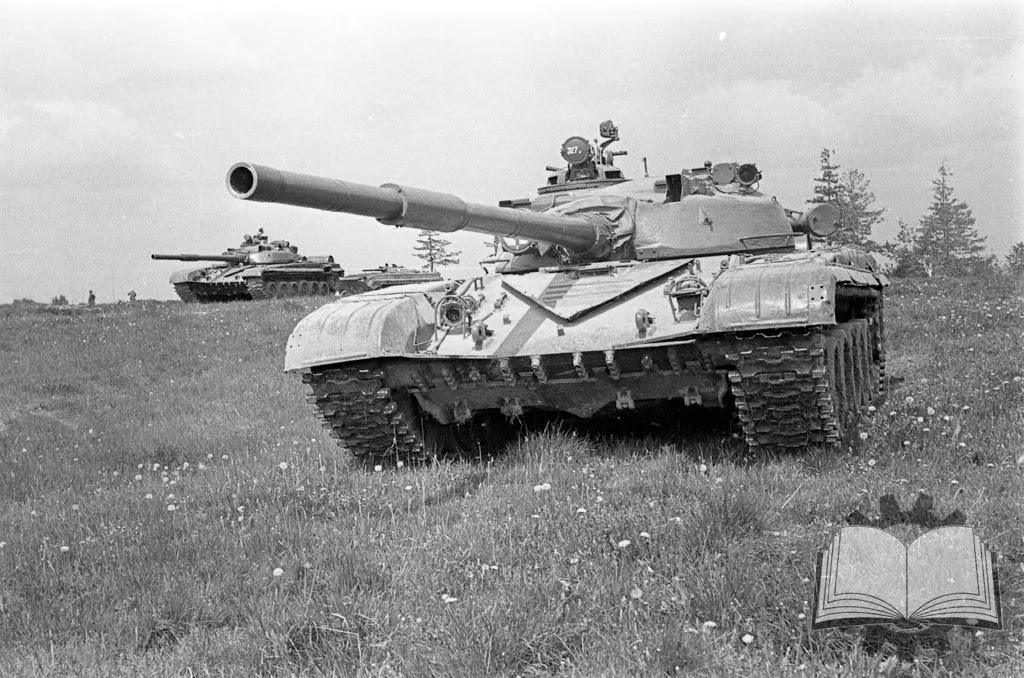 |
| T-72, the most numerous Main Battle Tank. These tanks were developed in the late 1960s but continue to serve and will do so for decades to come. |
Wednesday, 20 July 2022
T-54 at Aquino Tank Weekend
The T-54 tank and its close successor the T-55 were key players in nearly every Cold War conflict. Many nations keep these tanks in service to this day and even though they are no match for modern MBTs, modernization kits ensure that even these veterans can still pack quite a punch. The museum's vehicle was captured by British forces in Iraq and made its way to Canada from there.
Monday, 6 June 2022
T-54 with a Pipe
The army always needs tanks that can cross water obstacles. There are two ways of solving this issue: the tank can either swim or drive underwater. The Soviet T-54 tank went with the second option.
The topic of researching and studying underwater driving equipment was a very important one at the NIIBT Proving Grounds after the war. Experience gathered during WW2 showed that it was important to find methods of crossing water obstacles as quickly as possible. The proving grounds at Kubinka became one of the main developers of various underwater driving systems.
 |
| T-54 tank with underwater driving equipment installed, three quarters view. |
Monday, 18 April 2022
Eternal Proving Grounds in the Middle East
Throughout the various Arab-Israeli wars of 1948-1982 Israel, Egypt, and Syria received foreign military vehicles in large amounts. The Middle East was an excellent proving grounds to compare the performance of Soviet and Western military vehicles in real combat. Let's see which vehicles Israeli and Arab tankers got their hands on and how they performed over the decades of conflict.
Friday, 8 April 2022
Start of the T-54
"May 7th, 1945
I report that in mid-February of this year I ordered NKTP factory #75 to develop a mount for the 100 mm gun in the T-44 tank with a new 1700 mm wide turret ring. The design and working blueprints are complete.
On May 5th of this year I gave orders to produce experimental prototypes of the T-44 tank with a 100 mm gun. Trials of these tanks are scheduled for June 10th.
As for stowing 50 rounds of ammunition as requested in your letter, it is very difficult to achieve. 34-35 rounds is much more realistic. Additional orders were given to factory #75 to investigate the possibility of stowing 50 rounds.
I will inform you of the results of this work.
People's Commissar of Tank Production of the USSR, V. Malyshev"
CAMD RF F.38 Op.11355 D.3048 L.9
Printed in Glavnoye Bronetankovoye Upravleniye Lyudi, Sobytiya, Fakty v dokumentakh, 1944-1945 p.487
Wednesday, 6 April 2022
100 mm Guns
"May 17th, 1945
I report to you on the work performed by the People's Commissariat and factories #92 and #9 on improving the firepower of T-34, T-44, and T-54 medium tanks.
Two types of 100 mm guns were produced for these tanks with turret rings widened to 1700 mm.
- 100 mm LB-1 gun produced at factory #92 (Gorkiy).
- 100 mm D-10T gun incorporating design elements of the D-10S SPG gun produced at factory #9 (Sverdlovsk)
Both guns were installed in turn into a T-34 tank with an expanded turret ring and tested at the Gorohovets proving grounds from April 6th to April 27th. Trials included firing 100 shots and 500 km of driving.
Monday, 28 December 2020
Herald of a Revolution
The decision to mass produce the T-44 medium tank was made in the summer of 1944. This happened not only before the final prototype indexed T-44A was built, but before the GBTU even composed tactical-technical requirements for a new tank based on the combat experience of the first half of 1944. As a result, the tank seemed obsolete before it was even put into production, especially its armament. Work to correct this went in two directions. The first was evolutionary and led to the T-44-100 tank. The second was revolutionary and brought about a deeply modernized T-44 indexed T-54.
Tuesday, 7 January 2020
T-54 Delays
"To the Chief of the GBTU TU, Engineer-Colonel comrade Blagonravov
RE: preparing production of the T-54
Order of the NKTP #217ss given in May 1945 instructed factory #183 to send blueprints of the T-54 turret to factories ##75, 264, 112, 174, and the Ilyich Mariupol Factory within 15 days of issue.
The same order factory #183 was instructed to explore the issue of producing the T-54 and present the NKTP with necessary measures to achieve this no later than August 1st.
Wednesday, 18 December 2019
Start of T-54 Development
"Order of the People's Commissar of Tank Production of the USSR #637s
Moscow
November 1st, 1944
Factory #183 (comrade Morozov) developed a new T-54 medium tank with improved armour.
The review of the project showed that the new T-54 medium tank retains high maneuverability and mobility characteristics but has significantly better armour and more powerful armament than existing medium tanks.
The presented T-54 medium tank project should be approved and a prototype developed.
Thursday, 24 October 2019
What's In A Name?
When the T-44 was created, the 85 mm gun was already insufficiently powerful. One solution was to install a 100 mm gun, but a widened turret ring was required. The result was the T-44B tank, which eventually evolved into the T-54.
"To the People's Commissar of Tank Production of the USSR, comrade Malyshev
"To the People's Commissar of Tank Production of the USSR, comrade Malyshev
Factory #183 developed a modernization of the T-44 tank with reinforced armour and a 100 mm gun installed on a 1800 mm wide turret ring.
According to my information the lead designer of factory #183 comrade Morozov has already arrived in Moscow with the project materials.
I ask you to instruct comrade Morozov to deliver the materials to the Tank Directorate for review and evaluation of the T-44B project.
Deputy Commander of the Motorized and Armoured Forces of the Red Army, Colonel-General of the Tank Forces, Korobkov.
November 2nd 1944"
Saturday, 29 April 2017
E-50 and E-75: A Story of Failed Unification
Tanks that could have been built are often discussed within certain circles. Aside from the superheavy Maus and E-100, there are the light and medium E-10 and E-25 tank destroyers. Despite very incomplete data about these vehicles, the overall characteristics are known, including the armament.
Meanwhile, the core of "Panzerwaffe-46" was going to be composed of the medium E-50 tank and heavy E-75 tank, at least in the minds of fans of alternative history. The story with these tanks is a lot more complicated, since work stopped at an early stage, and a good half of the information available on these tanks is divination at best. Let's try to figure out what about the E-50 and E-75 is true and what is blatant misrepresentation.
Wednesday, 8 March 2017
D-10 CIA Intel
The following are penetration and ballistics tables for the D-10 gun mounted in a T-54 tank recovered by the CIA from a Soviet manual.

Saturday, 5 November 2016
T-55: The Third World's Main Argument
UralVagonZavod: a change in generations
The T-54, a logical improvement on the T-44, was designed at factory #183 in Nizhniy Tagil (the future UralVagonZavod), and was the main tank of the first post-war decade. The first T-54 prototypes were created during WWII, in late 1944 and early 1945. The tank was accepted into service in 1946, and production began that same year. The T-54 was ahead of other tanks in its class in all parameters. The design was so progressive that the Soviet Army had no need to develop a replacement for over a decade. This success can be largely explained by the fact that Nizhniy Tagil was home to a unique group of engineers who created the legendary T-34 during the war and the first few post-war years. They were evacuated along with factory #183 from Kharkov and continued working in the Urals.
Wednesday, 16 March 2016
The Log
From the first clumsily mass produced tanks to post-war state of the art fighting machines, only one element remained present in Soviet tank design: the log.


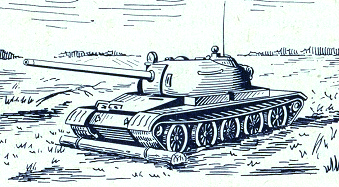


The purpose of the log was simple: to help the tank climb out of mud where tracks don't have enough traction. Simply hook up the log to the front of your tracks, drive forward slowly with the log serving as an anchor in the mud, then unhook it from the rear and move it to the front of the tank, repeating the process until you're back on solid ground. However, simply any old twig you found lying around wasn't good enough. The log must conform to precise specifications.

The log must be 190-220 mm thick and 3280 mm long. A log that stretches out past the sides of the tank is explicitly prohibited. Clips to hold the log in place are also stored on the rear of the vehicle, whereas on older vehicles you would have to tie the log to the tracks with the tow cables.
Wednesday, 11 February 2015
Swedish Intel
Today's article is brought to you by Something Awful forums poster TheFluff who works with Swedish archive documents. He dug up a rather interesting instruction to the Swedish army attache in Moscow, which reveals that the Swedes had a rather high opinion of Soviet armour:

"Armored fighting vehicle development in the Soviet Union
Briefing for the army attache in Moscow, 1962-09-03, 13:00-13:50.
(Handwritten: head of the vehicle department, head of the intelligence section [both of the army ordnance administration] and Sundin [engineer at the intelligence section at the time])
"Armored fighting vehicle development in the Soviet Union
Briefing for the army attache in Moscow, 1962-09-03, 13:00-13:50.
(Handwritten: head of the vehicle department, head of the intelligence section [both of the army ordnance administration] and Sundin [engineer at the intelligence section at the time])
- The Russians started committing a great deal of resources to the AFV sector as early as in the 1920's. It is a very telling fact that during the 1931-1939 period, when other great powers held trials with maybe 5-10 different tank types and took 3-4 types to series production, the Russians trialed 32 different tank designs, both foreign and domestic, and took 10 different types to significant series production runs. The Russian tanks have heavily influenced the tank and anti-tank technology of other countries ever since the late summer of 1941, when the Russians surprised the Germans with the T-34 tank. For a long time - since 1944 - our best reference manuals on armored fighting vehicle technology have been Russian works.
- Our current knowledge regarding Russian AFV's is documented on a number of datasheets, which are kept at the army attache office. The general characteristics of these vehicles will be shown on the following slides:
- T-34-85, IS-3 (both 1945)
- T-54, T-10, PT-76, ASU-57 (four different chassis types)
- APC (8 wheels)
- SU-100 - T-54 chassis
- ZSU-57-2 - T-54 chassis
- ISU-152 - T-10 (IS-3) chassis
- "SU400"- T-10 (IS-3) chassis
- BTR-50 - PT-76 chassis
- "SU-85/62" - PT-76 chassis
- Rocket launcher vehicle - PT-76 chassis
- Artillery tractor - ASU-57 chassis
- Regarding new AFV's, the following intelligence is of primary interest:
- Photos or drawings
- Designation
- Type of armament and armament characteristics (gun bore, guided missiles, any electronics, turret or fixed casemate) (Handwritten note next to point 3) Card with this text provided to the army attache. The attache said he would request that a tank expert be sent over to be present at parades and other such events in the future.")
- Weight (chassis class, number of road wheels)
- Amphibious capability or lack of such capability
- Presence of external armor screens or such things (on heavier tanks and other well armored vehicles)
- Night fighting equipment"
Friday, 9 January 2015
Soviet Medium Tank Family
Towards the end of WWII, Soviet medium tanks were due for a firepower upgrade. The new T-44, despite having a superior layout and armour to the T-34-85, still carried the same 85 mm gun. While it was possible (with some difficulty) to fit a 100 mm gun in a T-44 or even a T-34-85, the Red Army opted for a brand new tank to carry the gun. Enter the T-54, in its first iteration.

"Comparative tactical-technical characteristics of the T-54, T-44, and T-34-85"
| Characteristic | T-54 | T-44 | T-34-85 | |||
| Type | Tracked | Tracked | Tracked | |||
| Engine | V2-44 | V2-44 | V2-34 | |||
| Combat Mass | 35500 | 31800 | 33200 | |||
| Hp/ton | 14.6 | 16.8 | 15.52 | |||
| Ground pressure without submerging | 0.9 | 0.8 | 0.84 | |||
Dimensions
|
||||||
| Length with gun forward | 8970 | 7650 | 8100 | |||
| Length with gun backward | 8490 | 7440 | 7050 | |||
| Hull length with MDSh | 6555 | - | - | |||
| Width | 3185 | 3150 | 3000 | |||
| Height | 2275 | 2400 | 2700 | |||
| Height of the hull (from road surface) | 1375 | 1400 | 1560-1680 | |||
| Clearance | 400 | 425 | 400 | |||
| Width between middle of tracks | 2610 | 2610 | 2460 | |||
| Length of the contact surface | 3940 | 3885 | 3850 | |||
| Turret ring diameter | 1800 | 1600 | 1600 | |||
| Fighting compartment width | 1850 | 1850 | 1420 | |||
| Fighting compatment length (from ammuniton rack to engine compartment) | 1570 | 1550 (from driver's seat) | 1450 | |||
| Height of the fighting compartment, from the floor to turret roof | 1570 | 1590 | 1585 | |||
Armour
|
||||||
| Thickness | Angle | Thickness | Angle | Thickness | Angle | |
| UFP | 120 | 60 | 90 | 60 | 45 | 60 |
| LFP | 120 | 45 | 90 | 45 | 45 | 60 |
| Side | 90 | 0 | 75 | 0 | 45 | 40 |
| Upper rear | 30 | 60 | 30 | 60 | 45 | 40 |
| Middle rear | 45 | 17 | 45 | 17 | 45 | 47 |
| Lower rear | 30 | 70 | 30 | 70 | 45 | 45 |
| Engine compartment roof and floor | 15 | 90 | 15 | 90 | 20 | 90 |
| Fighting compartment roof | 30 | 90 | 20 | 90 | 20 | 90 |
| Turret front | 180 | - | 120 | - | 90 | - |
| Turret side | 150 to 90 at rear | 20 | 90 | 20 | 75 | 20 |
| Turret rear | 75 | 12 | 75 | 12 | 52 | 12 |
| Turret roof | 15 | 90 | 15 | 90 | 20 | 90 |
Armament
|
||||||
| Gun | D-10T-K (experimental) | ZiS-S-53 | ZiS-S-53 | |||
| Caliber | 100 mm | 85 mm | 85 mm | |||
| Horizontal traverse | 360 degrees | 360 degrees | 360 degrees | |||
| Maximum elevation | 17 degrees | 20 degrees | 22 degrees | |||
| Maximum depression | 3 degrees | 5 degrees | 5 degrees | |||
| Ammunition capacity | 34 | 58 | 56 | |||
| Aimed ROF | 5-6 RPM | 7-8 RPM | 7-8 RPM | |||
| Machinegun type | GVG | DT | DT | |||
| Amount | 2 | 2 | 2 | |||
| Caliber | 7.62 mm | 7.62 mm | 7.62 mm | |||
| Hull machineguns | 1 (fixed) | 1 (fixed) | 1 (ball mount) | |||
| Coaxial machineguns | 1 | 1 | 1 | |||
| Machinegun ammunition | 3000 rounds | 1890 rounds | 1953 rounds | |||
| Hand grenades | 12 | 20 | 20 | |||
| Commander turret control | Electric motor points turret at target selected by commander | - | - | |||
| Smokescreen | MDSh | - | MDSh | |||
| Number of smoke charges | 2 | - | 2 | |||
| Location of charges | Middle rear | - | Upper rear | |||
Speed
|
||||||
| Maximum speed | 43.5 kph | 51.1 kph | 56 kph | |||
| Average speed: | ||||||
| Highway | 30-35 kph | 30-35 kph | 30-35 kph | |||
| Off-road | 15-18 kph | 15-20 kph | 15-20 kph | |||
Saturday, 18 October 2014
World of Tanks History Section: Morozov's Top Ten
On October 16th, 1904, one of the most talented Soviet tank engineers, Alexander Alexandrovich Morozov, was born. He lived for 75 years, and gave nearly two thirds of his life to tanks. He started out a blueprint copier at a Kharkov factory, then served as a rank and file engineer, then section chief, then chief engineer. Morozov was never on the front lines, but his tanks took part in battle from the first days of the war.
He continued designing tanks after 1945, and his vehicles set the trends of Soviet tank design. Here are ten vehicles from this exceptional engineer's career that can be called exemplary.
1. BT-7.
The convertible drive BT tanks were one of the main components of the RKKA tank forces before the war. The BT-7 was the last of this family.
The BT-7 was armed with a 45 mm gun, could reach speeds of 70 kph, and had anti-bullet armour. In the late 1920s and early 1930s, this armour was standard in nearly every army, but in the late 1930s, it was no longer enough.
The BT series served as a chassis for new technical solutions, like the installation of a 76 mm gun or experiments with sloped armour (BT-SV).
The BTs fought in the Spanish Civil War, at Khalkin-Gol, during the Winter War. In June of 1941, Soviet mechanized corps that were still armed mainly with BT-7s took the brunt of the Wehrmacht's offensive.
2. A-20
In 1937, a new tank for the Red Army was being developed. The A-20 still used the convertible drive, such was the requirement from the military. Externally, it had little in common with the BT-7, aside from large road wheels, characteristic of the Christie suspension.
The tank had a welded hull and a new turret. The armour plates were sloped to increase the chances of a ricochet. The front armour was up to 20 mm thick. The tank could accelerate up to 80 kph on a highway.
The vehicle was never mass produced. The only A-20 ever built fought with the 22nd Tank Brigade. Engineers, including A. Morozov, managed to convince the military that a purely tracked vehicle was better than a combination of wheels and tracks, and so the A-20 was not needed.
Morozov and his bureau did not waste their time. The A-20 was the predecessor of a vehicle that earned its legendary title.
3. T-34
The T-34 needs no introduction. Countless books and articles have been written about it. The T-34 fought in the Great Patriotic War from the first day to the last as the workhorse of the Red Army.
At the start of the war, this tank's 45 mm thick armour and 76 mm gun made it one of the most powerful tanks in the world. The Germans only managed to surpass it in armour and firepower with the Tiger, Panther, and Ferdinand.
The first T-34s were far from ideal, and were improved greatly throughout the war. A T-34 built in 1943 was significantly different from a T-34 built in 1940-41. Morozov played a key role in all of the tank's modernizations and improvements.
4. T-43
The tank was supposed to be a descendant of the T-34, but the design differed greatly from it. Due to a superior placement of components and alteration of the hull, the level of protection rose drastically. The front armour was increased to 75 mm. The tank used a torsion bar suspension, which was more compact than the T-34's Christie suspension.
The T-43 was better armoured, but this also made it heavier. Its ground pressure came close to that of heavy tanks.
The tank was accepted into service, but was not placed into production, as the military demanded an 85 mm gun. The T-43 was so tightly coupled that there was no potential for modernization. Introducing it into production demanded the development of new technological processes, which the USSR could not allow in time of war.
5. T-34-85
The main problem with the T-34 was that in 1943, its gun was no longer sufficiently powerful. In the middle of 1943, it was decided that n 85 mm gun will be installed. In order to do this, engineers developed a larger turret with better armour, big enough for three crewmen.
The 85 mm ZiS-S-53 gun was based on an AA gun design, and provided superior penetration. This increased the effectiveness of the T-34 when fighting new German tanks. The vehicle retained excellent mobility.
It cannot be said that the T-34-85 was a radical leap forward that gave Soviet forces unparalleled supremacy, but this was a necessary and timely replacement of the T-34.
6. T-44
This tank was the leap forward. It seemed similar to the T-34-85, but its internals differed greatly.
The T-44 had a new diesel engine, placed perpendicularly across the hull. This allowed the turret to be moved further back to balance the suspension. The driver's hatch was removed from the front plate, which raised the vehicle's protection. All components and mechanisms were improved.
The Christie suspension was replaced with torsion bars. This allowed the tank to be smaller and have more room inside, making life easier for crews and repairmen.
The T-44 was accepted for service in 1944, but it had no time to serve in battle, partially due to the fact that Soviet leadership did not wish to reduce the number of T-34-85s being produced. 2000 T-44s were built after the war.
7. T-54
Another leap forward. Designed in 1946, the T-54 remained in the Soviet design school for a long time. The first vehicles had expected growing pains, but after being improved, it became a reliable and technologically efficient vehicle with a large resource for modernization.
The T-54 had a new rounded turret with up to 200 mm of front armour, an improved hull, improved transmission, and a series of other improvements. The vehicle had a 100 mm D-10T gun, which, for a while, was the most powerful tank gun in the world. Its shell could penetrate 125 mm of armour at 2000 meters.
The T-54 was used by about 30 countries worldwide, and participated in many 20th century conflicts.
8. T-55
The T-55 was developed in 1958, and had many improvements over the T-55. One of the most important ones was the installation of a full anti-radiation system. The tank had a semi-automatic rammer. The caliber and type of gun were the same as on the T-54.
The T-55 remained in production until 1979. It fought in many conflicts, and 30 countries still use it to this day. More than 10 foreign variants of the vehicle exist.
The T-55 could reach 50 kph on a highway, and its range was up to 500 km on one tank of fuel.
9. T-64
The vehicle made for a new 115 mm gun, also known as "Object 432". The tank was in production from 1960, and was a laboratory of sorts for engineers and technologists. The vehicle turned out very complicated and not exceptionally reliable. Many were built before it was accepted into service, for testing by the army. The information that came back from the military was used to continue perfecting the design.
In 1966, Object 432 was approved for service. It had a 115 mm smoothbore gun. The tank's armour was composite, and used materials other than steel to defeat HEAT shells and protect from radiation. The same armour was used on the T-64A.
10. T-64A
In the end of the 1950s and start of the 1960s, the age of Main Battle Tanks began. The MBT concept called for a tank that could perform many tasks, combining mobility, firepower, and protection.
The T-64A was accepted into service in 1969. The tank had an automatic loading mechanism, which allowed manual shell type selection. Because of this, the loader was excluded from the crew.
This was the first Soviet tank to use an optical rangefinder. It had the same composite armour as the T-64. It is hard to say whether or not the T-64A was the best tank in the world, but in the 1990s, Western military specialists admitted that it would have been a very dangerous opponent.
About the designer:
Alecander Alexandrovich Morozov was born on October 16th, 1904 in the village of Bezhitsa, located inside the modern boundaries of Bryansk. After finishing a "real academy" (an educational institution with a focus on natural sciences and mathematics), he worked at the Kharkov Locomotive Factory. He was a file clerk, then a copier. From 1926 to 1928, he served as an aircraft engine technician.
In 1928, he returned to HPZ. Despite its peaceful title, this factory was one of the key Soviet producers of armoured vehicles, including tanks.
In 1931, he finished a machine-building college, and became a group chief in the factory's design bureau. In 1936, he was promoted to section chief. In 1938, he was promoted to Deputy Chief Engineer.
Before the war, he worked on the T-24 tank and BT tanks. Along with Mikhail Koshkin and Nikolai Kucherenko, he worked on the future workhorse of the Red Army, the T-34 medium tank.
When Koshkin died in 1940, Morozov became Chief Engineer. In 1941, the factory was evacuated to Nizhniy Tagil. Here, Morozov directed the development of the T-43, T-34-85, T-44, and T-54. After the war, Morozov designed the T-55, T-64, and T-54A.
The T-54 earned Morozov his third USSR Government Award. He earned two Hero of Socialist Labour titles and two first class Stalin Awards. In 1972, Morozov was awarded the title of Doctor of Technical Sciences.
Original article available here.
He continued designing tanks after 1945, and his vehicles set the trends of Soviet tank design. Here are ten vehicles from this exceptional engineer's career that can be called exemplary.
1. BT-7.
The convertible drive BT tanks were one of the main components of the RKKA tank forces before the war. The BT-7 was the last of this family.
The BT-7 was armed with a 45 mm gun, could reach speeds of 70 kph, and had anti-bullet armour. In the late 1920s and early 1930s, this armour was standard in nearly every army, but in the late 1930s, it was no longer enough.
The BT series served as a chassis for new technical solutions, like the installation of a 76 mm gun or experiments with sloped armour (BT-SV).
The BTs fought in the Spanish Civil War, at Khalkin-Gol, during the Winter War. In June of 1941, Soviet mechanized corps that were still armed mainly with BT-7s took the brunt of the Wehrmacht's offensive.
2. A-20
In 1937, a new tank for the Red Army was being developed. The A-20 still used the convertible drive, such was the requirement from the military. Externally, it had little in common with the BT-7, aside from large road wheels, characteristic of the Christie suspension.
The tank had a welded hull and a new turret. The armour plates were sloped to increase the chances of a ricochet. The front armour was up to 20 mm thick. The tank could accelerate up to 80 kph on a highway.
The vehicle was never mass produced. The only A-20 ever built fought with the 22nd Tank Brigade. Engineers, including A. Morozov, managed to convince the military that a purely tracked vehicle was better than a combination of wheels and tracks, and so the A-20 was not needed.
Morozov and his bureau did not waste their time. The A-20 was the predecessor of a vehicle that earned its legendary title.
3. T-34
The T-34 needs no introduction. Countless books and articles have been written about it. The T-34 fought in the Great Patriotic War from the first day to the last as the workhorse of the Red Army.
At the start of the war, this tank's 45 mm thick armour and 76 mm gun made it one of the most powerful tanks in the world. The Germans only managed to surpass it in armour and firepower with the Tiger, Panther, and Ferdinand.
The first T-34s were far from ideal, and were improved greatly throughout the war. A T-34 built in 1943 was significantly different from a T-34 built in 1940-41. Morozov played a key role in all of the tank's modernizations and improvements.
4. T-43
The tank was supposed to be a descendant of the T-34, but the design differed greatly from it. Due to a superior placement of components and alteration of the hull, the level of protection rose drastically. The front armour was increased to 75 mm. The tank used a torsion bar suspension, which was more compact than the T-34's Christie suspension.
The T-43 was better armoured, but this also made it heavier. Its ground pressure came close to that of heavy tanks.
The tank was accepted into service, but was not placed into production, as the military demanded an 85 mm gun. The T-43 was so tightly coupled that there was no potential for modernization. Introducing it into production demanded the development of new technological processes, which the USSR could not allow in time of war.
5. T-34-85
The main problem with the T-34 was that in 1943, its gun was no longer sufficiently powerful. In the middle of 1943, it was decided that n 85 mm gun will be installed. In order to do this, engineers developed a larger turret with better armour, big enough for three crewmen.
The 85 mm ZiS-S-53 gun was based on an AA gun design, and provided superior penetration. This increased the effectiveness of the T-34 when fighting new German tanks. The vehicle retained excellent mobility.
It cannot be said that the T-34-85 was a radical leap forward that gave Soviet forces unparalleled supremacy, but this was a necessary and timely replacement of the T-34.
6. T-44
This tank was the leap forward. It seemed similar to the T-34-85, but its internals differed greatly.
The T-44 had a new diesel engine, placed perpendicularly across the hull. This allowed the turret to be moved further back to balance the suspension. The driver's hatch was removed from the front plate, which raised the vehicle's protection. All components and mechanisms were improved.
The Christie suspension was replaced with torsion bars. This allowed the tank to be smaller and have more room inside, making life easier for crews and repairmen.
The T-44 was accepted for service in 1944, but it had no time to serve in battle, partially due to the fact that Soviet leadership did not wish to reduce the number of T-34-85s being produced. 2000 T-44s were built after the war.
7. T-54
Another leap forward. Designed in 1946, the T-54 remained in the Soviet design school for a long time. The first vehicles had expected growing pains, but after being improved, it became a reliable and technologically efficient vehicle with a large resource for modernization.
The T-54 had a new rounded turret with up to 200 mm of front armour, an improved hull, improved transmission, and a series of other improvements. The vehicle had a 100 mm D-10T gun, which, for a while, was the most powerful tank gun in the world. Its shell could penetrate 125 mm of armour at 2000 meters.
The T-54 was used by about 30 countries worldwide, and participated in many 20th century conflicts.
8. T-55
The T-55 was developed in 1958, and had many improvements over the T-55. One of the most important ones was the installation of a full anti-radiation system. The tank had a semi-automatic rammer. The caliber and type of gun were the same as on the T-54.
The T-55 remained in production until 1979. It fought in many conflicts, and 30 countries still use it to this day. More than 10 foreign variants of the vehicle exist.
The T-55 could reach 50 kph on a highway, and its range was up to 500 km on one tank of fuel.
9. T-64
The vehicle made for a new 115 mm gun, also known as "Object 432". The tank was in production from 1960, and was a laboratory of sorts for engineers and technologists. The vehicle turned out very complicated and not exceptionally reliable. Many were built before it was accepted into service, for testing by the army. The information that came back from the military was used to continue perfecting the design.
In 1966, Object 432 was approved for service. It had a 115 mm smoothbore gun. The tank's armour was composite, and used materials other than steel to defeat HEAT shells and protect from radiation. The same armour was used on the T-64A.
10. T-64A
In the end of the 1950s and start of the 1960s, the age of Main Battle Tanks began. The MBT concept called for a tank that could perform many tasks, combining mobility, firepower, and protection.
The T-64A was accepted into service in 1969. The tank had an automatic loading mechanism, which allowed manual shell type selection. Because of this, the loader was excluded from the crew.
This was the first Soviet tank to use an optical rangefinder. It had the same composite armour as the T-64. It is hard to say whether or not the T-64A was the best tank in the world, but in the 1990s, Western military specialists admitted that it would have been a very dangerous opponent.
About the designer:
Alecander Alexandrovich Morozov was born on October 16th, 1904 in the village of Bezhitsa, located inside the modern boundaries of Bryansk. After finishing a "real academy" (an educational institution with a focus on natural sciences and mathematics), he worked at the Kharkov Locomotive Factory. He was a file clerk, then a copier. From 1926 to 1928, he served as an aircraft engine technician.
In 1928, he returned to HPZ. Despite its peaceful title, this factory was one of the key Soviet producers of armoured vehicles, including tanks.
In 1931, he finished a machine-building college, and became a group chief in the factory's design bureau. In 1936, he was promoted to section chief. In 1938, he was promoted to Deputy Chief Engineer.
Before the war, he worked on the T-24 tank and BT tanks. Along with Mikhail Koshkin and Nikolai Kucherenko, he worked on the future workhorse of the Red Army, the T-34 medium tank.
When Koshkin died in 1940, Morozov became Chief Engineer. In 1941, the factory was evacuated to Nizhniy Tagil. Here, Morozov directed the development of the T-43, T-34-85, T-44, and T-54. After the war, Morozov designed the T-55, T-64, and T-54A.
The T-54 earned Morozov his third USSR Government Award. He earned two Hero of Socialist Labour titles and two first class Stalin Awards. In 1972, Morozov was awarded the title of Doctor of Technical Sciences.
Original article available here.
Thursday, 25 September 2014
World of Tanks History Section: Post-War Light Tanks
LTTB
The acronym has a rather oxymoronic meaning: Light Tank with Heavy Armour (Legkiy Tank Tyazhelogo Bronirovaniya). However, if one looks at the requirements sent by the military to the Omsk tank factory in 1944, everything falls in its place.
The LTTB was meant for recce in force. Because of this, it was supposed to have good armour protection from the front. The sides were about on the level of a T-34, up to 45 mm. The tank was first planned with a 76 mm gun, but it was later replaced with an 85 mm S-53.
In theory, this tank could be useful for the army. Fast, well protected, effectively armed. However, the production of the LTTB would have been too complicated. It would have to start from scratch, which means new assembly lines, extra spending, extensive trials. Neither the extra time nor money existed for this project, as the factory was busy producing T-34-85s. In the end, the design never left paper.
T-54 Lightened
The project was developed at factory #183 in Nizhniy Tagil, a producer of the regular T-54, in 1949. The vehicle was meant for special duties, for which the use of a regular T-54 was not possible.
The tank had thinner armour in the turret and hull, which allowed the reduction in mass from 36 tons to 31 tons. Additionally, the new vehicle would have had wider tracks, reducing ground pressure even further, and allowing for the vehicle to be used in difficult terrain.
Due to its lighter mass, the speed of the tank was expected to reach nearly 58 kph. The armament would have been the 100 mm D-10T. Work on the vehicle never made it past blueprints.
T37
This tank was designed as a replacement for the M24 Chaffee. The requirements for this vehicle were ready in early 1945. Work on the project started after the end of the war, when the American military budget was slashed.
The T37 received its designation in September of 1946. Initially, the military ordered three prototypes at the Detroit Arsenal, but this order was reduced to 2. The wooden mockup and technical documentation were ready by 1949. The vehicle was tested at Aberdeen in 1949-1950.
The T37 did not reach mass production. The Korean War, which began in 1950, forced some changes to the American design program. The T37 did not meet the new requirements, and a new vehicle was designed using it as a starting point, the T41.
M41 Walker Bulldog
The vehicle was initially indexed T41, and used many components of the T37. It was ready in 1948, and Cadillac Motors received an order for 100 vehicles, increased tenfold with the start of the Korean War, along with increased requirements for the engine, aiming mechanisms, and ammunition rack. In 1953, it was adopted into the Army under the index M41.
At first, the tank was to be called "little bulldog". However, after American General Walton Walker died in an airplane crash, the vehicle was renamed in his honour.
The Walker Bulldog was produced until the end of the 1950s, with over 3700 vehicles built. The tank was taken out of the American armed forces for its weak armour and armament, but continued service in some nations for many years.
T49
The Korean War and clashes of American vehicles with the T-34-85 forced the US military to consider greatly increasing the firepower of its vehicles, including light tanks.
In 1954, the T49 began trials at the Aberdeen Proving Grounds. The M41 chassis was equipped with a new turret and the 90 mm T231E3 gun. Trials of the T49 lasted until May of 1955, but the military demanded even greater firepower.
In the end, the T49 was equipped with a new 152 mm gun. T49 trials ended when a new chassis was developed, and the turret with the 152 mm gun was transferred over to it.
Spahpanzer Ru 251
This lesser known German experimental tank was based on the Kanonenjagdpanzer 4-5 vehicle with a 90 mm gun. Unusual, since usually SPGs are based on a tank chassis, and not the other way around.
The light, fast, and well armed Ru 251 was meant to replace the ageing Walker Bulldog in the German army. The Henschel company was tasked with production and testing. The tank was meant for reconnaissance battalions of tank divisions and other units. A notable feature of the vehicle was its speed, up to 80 kph. The Ru 251 had a 90 mm Rheinmetall gun.
According to known sources, there were two Ru 251 vehicles built.
Original article available here.
The acronym has a rather oxymoronic meaning: Light Tank with Heavy Armour (Legkiy Tank Tyazhelogo Bronirovaniya). However, if one looks at the requirements sent by the military to the Omsk tank factory in 1944, everything falls in its place.
The LTTB was meant for recce in force. Because of this, it was supposed to have good armour protection from the front. The sides were about on the level of a T-34, up to 45 mm. The tank was first planned with a 76 mm gun, but it was later replaced with an 85 mm S-53.
In theory, this tank could be useful for the army. Fast, well protected, effectively armed. However, the production of the LTTB would have been too complicated. It would have to start from scratch, which means new assembly lines, extra spending, extensive trials. Neither the extra time nor money existed for this project, as the factory was busy producing T-34-85s. In the end, the design never left paper.
T-54 Lightened
The project was developed at factory #183 in Nizhniy Tagil, a producer of the regular T-54, in 1949. The vehicle was meant for special duties, for which the use of a regular T-54 was not possible.
The tank had thinner armour in the turret and hull, which allowed the reduction in mass from 36 tons to 31 tons. Additionally, the new vehicle would have had wider tracks, reducing ground pressure even further, and allowing for the vehicle to be used in difficult terrain.
Due to its lighter mass, the speed of the tank was expected to reach nearly 58 kph. The armament would have been the 100 mm D-10T. Work on the vehicle never made it past blueprints.
T37
This tank was designed as a replacement for the M24 Chaffee. The requirements for this vehicle were ready in early 1945. Work on the project started after the end of the war, when the American military budget was slashed.
The T37 received its designation in September of 1946. Initially, the military ordered three prototypes at the Detroit Arsenal, but this order was reduced to 2. The wooden mockup and technical documentation were ready by 1949. The vehicle was tested at Aberdeen in 1949-1950.
The T37 did not reach mass production. The Korean War, which began in 1950, forced some changes to the American design program. The T37 did not meet the new requirements, and a new vehicle was designed using it as a starting point, the T41.
M41 Walker Bulldog
The vehicle was initially indexed T41, and used many components of the T37. It was ready in 1948, and Cadillac Motors received an order for 100 vehicles, increased tenfold with the start of the Korean War, along with increased requirements for the engine, aiming mechanisms, and ammunition rack. In 1953, it was adopted into the Army under the index M41.
At first, the tank was to be called "little bulldog". However, after American General Walton Walker died in an airplane crash, the vehicle was renamed in his honour.
The Walker Bulldog was produced until the end of the 1950s, with over 3700 vehicles built. The tank was taken out of the American armed forces for its weak armour and armament, but continued service in some nations for many years.
T49
The Korean War and clashes of American vehicles with the T-34-85 forced the US military to consider greatly increasing the firepower of its vehicles, including light tanks.
In 1954, the T49 began trials at the Aberdeen Proving Grounds. The M41 chassis was equipped with a new turret and the 90 mm T231E3 gun. Trials of the T49 lasted until May of 1955, but the military demanded even greater firepower.
In the end, the T49 was equipped with a new 152 mm gun. T49 trials ended when a new chassis was developed, and the turret with the 152 mm gun was transferred over to it.
Spahpanzer Ru 251
This lesser known German experimental tank was based on the Kanonenjagdpanzer 4-5 vehicle with a 90 mm gun. Unusual, since usually SPGs are based on a tank chassis, and not the other way around.
The light, fast, and well armed Ru 251 was meant to replace the ageing Walker Bulldog in the German army. The Henschel company was tasked with production and testing. The tank was meant for reconnaissance battalions of tank divisions and other units. A notable feature of the vehicle was its speed, up to 80 kph. The Ru 251 had a 90 mm Rheinmetall gun.
According to known sources, there were two Ru 251 vehicles built.
Original article available here.
Subscribe to:
Posts (Atom)