Showing posts with label 107 mm. Show all posts

Monday, 26 September 2022

Big Gun for a Big KV

ZIS-6 and other 100-107 mm tank guns developed in 1941

Vasiliy Gavrilovich Grabin is one of the best known Soviet gun designers. It just so happened that design bureaus under his direction created the most common tank and divisional guns used by the Red Army in the war. Grabin rose to fame as an artillery designer in the second half of the 1930s. He first created the F-22 and F-22 USV guns, then the F-32 and F-34. Far from all products developed at factory #92 went into mass production, but that was a typical scenario. The most important thing was that Grabin's designs were often better than its competitors. Factory #92's design bureau has no equal in 1940-1942. Their F-34 gun became the T-34's main weapon, and a variant of it called ZIS-5 became the main gun of the KV-1 in the fall of 1941. The Red Army's main towed gun was the ZIS-3, a grassroots initiative that could be used both as field artillery or an anti-tank gun. As an anti-tank gun, it was only beaten by another of Grabin's creations, the ZIS-2. The Central Artillery Design Bureau created on Grabin's initiative began to lose ground to factory #9's design bureau, but nevertheless the S-53/ZIS-S-53 was the T-34-85's main gun. The TsAKB was also responsible for the BS-3, another combination anti-tank and field gun. The BS-3, ZIS-S-53, and ZIS-3 still fight in distant corners of the world.

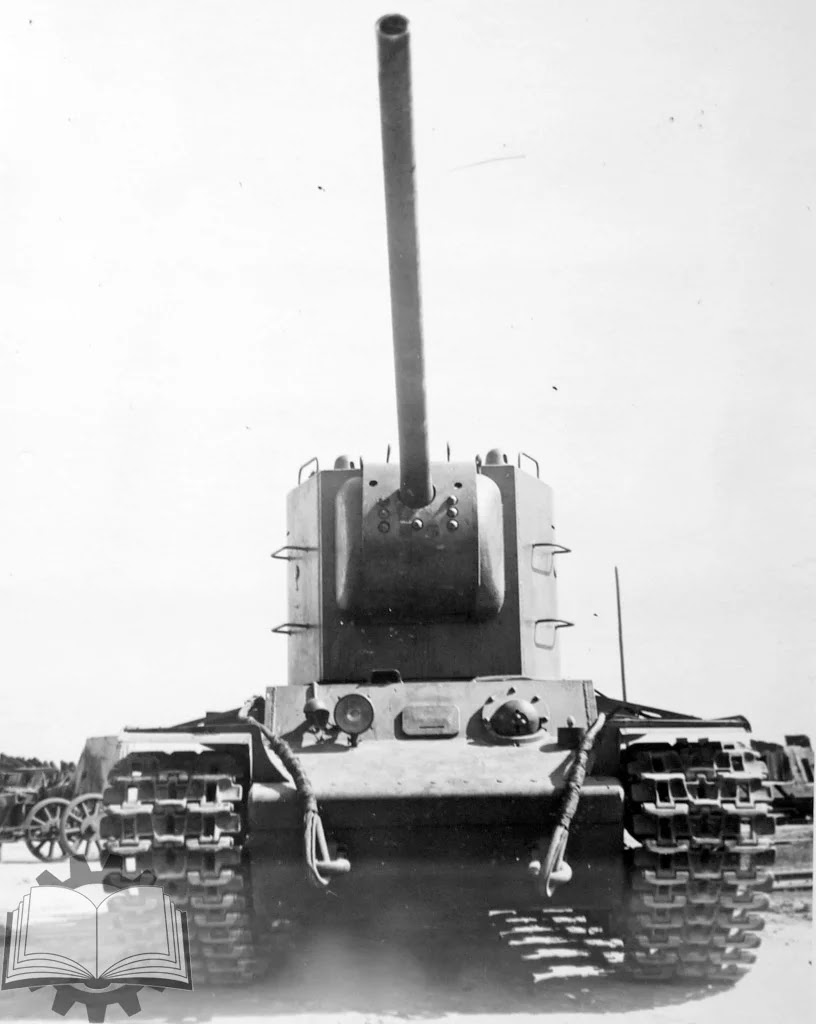
KV-2 with a ZIS-6 at the Gorohovets ANIOP, June 1941.

Factory #92 was working on a whole family of guns in early 1941, both towed and tank. They included the main character of this article: the 107 mm F-42 gun, later renamed to ZIS-6. Unlike most of factory #92's designs, this one was a grassroots initiative. However, a proposal to develop a 107 mm gun with the ballistics of the M-60 came about in June of 1940, and not from Grabin. In March of 1941 the ZIS-6 became relevant to a tank other than the KV-2. The gun became necessary for a whole number of new tanks that entered development that spring. Rumours and omissions are common when discussing the history of this gun, so let's fill in the gaps.

Friday, 3 September 2021

New Gun for the KV-2

 "To the Director of the Kirov Factory, comrade Zaltsman
CC: Chief of the GABTU, Lieutenant General of the Tank Forces, comrade Fedorenko
CC: Chief of the GAU, Colonel General of Artillery, comrade Yakovlev

Following government decree, we produced two experimental prototypes of 107 mm ZIS-6 tank guns and began mass production. According to the decree, we installed one of the two prototypes into a KV-2 tank and conducted trials, the second prototype is to be installed in a KV-3 tank.

Due to a delay in the mass production of the KV-3, we propose installing ZIS-6 guns into the KV-2 tank.

In order to reduce the time spent on developing the mount, we send out blueprints for the frame and mantlet developed by our factory for the ZIS-6 prototype.

Attachments: blueprints and specifications on 4 pages (only on the copy sent to the Kirov factory).

Factory Director Elyan
Chief Designer Grabin

July 22nd, 1941"

Via Padikovo Museum.

Friday, 24 July 2020

Field Artillery Penetration

"USSR NKO
Artillery HQ of the 22nd Army
Pestovo
September 7th, 1941

To chiefs of artillery of infantry divisions
To the commander of the 56th Corps Artillery Regiment
Personal copy for:_________

On orders of the Chief of Artillery of the 22nd Army I send you information regarding penetration of 76 mm and 107 mm HE and 122 mm and 203 mm concrete piercing shells.

The data was obtained at the ANIOP firing at plates angled at 30 degrees from normal.

When firing at plates at normal the penetration is 15-20% higher.

Have all commanders of artillery regiments familiarize themselves with this data.

Attachment: table of penetration on one page.

Chief of Staff of Artillery of the 22nd Army, Colonel Chudin
Chief of the 2nd Department, Captain Matyunenko"

Saturday, 18 January 2020

Optimal Modernization

GKO decree #3892ss "On organization of 85 mm SPGs on the T-34 chassis at the Uralmash factory" was signed on August 8th, 1943. The first 100 vehicles of this type were ready by early September. The SU-85 ended up being the most numerous Soviet SPG of the war. However, the question of its successor was already raised at the start of its production. The cause of this was information from the Kursk salient about new German Panther tanks and Ferdinand SPGs. A program to develop a gun more powerful than the D-5 was launched in September of 1943. The result was the SU-100, the best Soviet medium SPG of the war.

Saturday, 30 November 2019

From Medium Assault Gun to Medium Tank Destroyer

Development of armoured vehicles in many nations proceeds in parallel. A clear example of this is the creation of German and Soviet medium SPGs. Initially, Soviet SPGs were built as tank destroyers. Later, under the influence of the German StuG III Ausf. B, the medium assault gun program was launched, which gave birth to the SU-122. By this time, the Germans had modernized the StuG III and transformed it into primarily a tank destroyer. This SPG was known as the StuG 40. In the USSR this process took longer, as there was no gun to combat German heavy tanks until the spring of 1943. That is when the SU-85 appeared, the most numerous Soviet medium SPG used in the war.

Tuesday, 29 August 2017

Tractor Trials

"Trials were performed from June 15th to July 10th at the GANIOP. Corps and high power artillery was used in the trials. 

During the trials, the tractors traveled:
  • TD-18 tractor, with a B-4 203 mm mod. 1931 howitzer (in armed condition): 100 km
  • TD-14 tractor: 200 km, of those:
    • With a Br-10 trailer (the barrel of a B-4 howitzer): 100 km
    • With a 152 mm mod. 1937 gun-howitzer: 100 km
  • HD-10 tractor, with a B-4 203 mm mod. 1931 howitzer (in armed condition): 100 km
  • HD-7 tractor: 225 km, of those:
    • With a 152 mm mod. 1937 gun-howitzer: 100 km
    • With a 152 mm mod. 1938 howitzer: 100 km
    • With a Br-10 trailer (the barrel of a B-4 howitzer): 25 km
  • D-6 tractor: 225 km, of those:
    • With a 152 mm mod. 1937 gun-howitzer: 100 km
    • With a 152 mm mod. 1938 howitzer: 100 km
    • With a Br-10 trailer (the barrel of a B-4 howitzer): 25 km

Monday, 17 July 2017

Experimental Guns, 1941

"Experimental works
at the Order of Lenin Molotov factory #172, 1941

According to contract #3-84 signed on March 18th, 1941, the factory is working on the following systems and parts:

1. 152 mm gun, 203 mm howitzer, and 280 mm mortar on a unified mount (M-70)

The technical project was completed in March of 1941. In August of this year, it was reviewed by the NKV Technical Council, along with a GAU representative. As a result, the factory received several directions regarding the technical project and the permission to begin development of working blueprints, which were completed to 40%, after which the factory ceased work under orders from the NKV. Until the end of the year, we did not work in this area.

According to the agreement, the factory was supposed to deliver working blueprints and the prototype by March of 1942, but it appears that the factory cannot do that.

Monday, 19 June 2017

KV Gun Upgrades

"The following work is necessary to perform trials of KV tank armament and improvement of blueprints:
  1. Install the F-34 gun instead of the F-32 gun into the KV-1 tank at factory #92 by March 1st, 1941.
    A commission composed of representatives from ChTZ, the Kirov factory, GABTU, and GAU must perform trials and approve blueprints by March 5th, 1941. Factory #92 received a KV tank with a 76 mm F-32 gun on February 2nd, 1941.
  2. Install the 107 mm F-42 gun instead of the M-10 gun into the KV-2 tank by May 1st, 1941. Perform trials and work on blueprints, presenting them to the NKO no later than May 15th, 1941. Factory #92 received a KV tank with a large turret on January 29th.

Tuesday, 9 May 2017

ZIS-6 Characteristics

"To the Director of the Kirov Factory, comrade Zaltsmann,
GABTU Chief, Lieutenant-General of the Tank Forces, comrade Fedorenko

On the issue of installing the ZIS-6 into the KV-3 tank

We accompany the design for installing the ZIS-6 gun into the KV-3 tank with the following characteristics:
  1. Muzzle velocity: 800 m/s
  2. Recoil resistance: 20,000 kg
  3. Mass of the recoiling parts: 1600 kg
  4. Mass of the oscillating part with the gun mantlet: 2600 kg
  5. Recoil length: 640 +/- 40 mm
  6. Ammunition: one piece
  7. Breech: semiautomatic
  8. Coaxial DT machinegun
  9. The horizontal range of the gun is from +20 degrees to - 5 degrees.
  10. The recoil mechanisms allow firing from +40 degrees to -15 degrees.
  11. The gun will have a fume extractor.
  12. The length of a shell casing is 625 mm.
  13. The length of the full round (HE) is about 1200 mm.
  14. The initial pressure in the recoil brake is 50 atm.
  15. The TD telescopic sight is installed.
  16. The armour layout will be of the same type as in existing KV turrets.
  17. The experimental prototype of the gun will be tested in the KV-2 tank turret.

Tuesday, 2 May 2017

100 mm Tank Gun, First Attempt

"To the director of the Kirov factory, Leningrad, in response to letter #838s sent on January 31st, 1941
CC: GAU UVNA Military Representative at the Kirov factory
NKTM Military Department Chief
March 13th, 1941

Having examined these projects developed at the Kirov factory under its own initiative:
  • 412-1V, 100 mm tank gun, and
  • 412-2V, 107 mm tank gun
the GAU UVNA has come to the conclusion that:
  1. Both guns are equivalent and modern, both in their ballistics and armour penetration.
  2. Out of the two presented variants, the 412-1V is not recommended for production, because:

Saturday, 30 April 2016

Stalin's Maus Killers

Gun design is driven by the desire to be at least half a step ahead of its opposition. The creators of tank armour aim to provide tank crews with maximum possible protection from all existing weapons, and gun designers aim to create a gun that would penetrate the armour of any modern tank. In the spring of 1941, work on a new 107 mm anti-tank gun began in the Soviet Union, a gun that would not see a worthy adversary for several years. Both these guns and their likely enemies were built in metal, but neither one ended upon the battlefield.

Shooting at Shadows

At the start of 1941, Soviet anti-tank artillery evolved simultaneously in several directions. The most promising weapon was the 57 mm F-31, later indexed ZiS-2. This gun was developed at factory #92 under the direction of V.G. Grabin. In parallel, a "powerful 76 mm AT gun on the USV base" was developed, with the factory designation F-26. It was plagued with difficulties. Due to problems with the recoil brake, the gun was redesigned several times. Finally, in early January of 1941, under Grabin's initiative, an 85 mm anti-tank gun was also developed. It was based on the mount of the experimental 95 mm F-25 divisional gun with lengthened trails. In January, it fired 225 shots.

On March 11th, 1941, the chief of the Red Army General Staff Intelligence Directorate, Lieutenant-General F.I. Golikov, prepared a special report "On the direction of development of the armed forces of Germany and changes in its status". According to this document, German industry began constructing three new types of tanks. The most powerful one, called "Type VII" allegedly weighed 90 tons and was armed with a 105 mm gun. The military treated this information very seriously. The T-150, which was supposed to enter production as the KV-3, was cancelled. Instead, a new vehicle was developed on the basis of the KV-220. The new KV-3 would have a 107 mm gun, have armour about 120 mm thick, and weigh 67-68 tons. In addition, KV-4 and KV-5 tanks were developed in parallel.

Tanks weren't the end of it. By April 18th, 1941, a Council of Commissars decree titled "On tank armament, new anti-tank gun, artillery SPGs, and armour piercing ammunition" was prepared. The sixth point of the decree is most relevant:

"6. On the powerful 107 mm corps gun.
Order the NKV to develop and produce at factories #172 and #92 experimental guns with a 107 mm barrel with the muzzle velocity of 1100 m/s on the mount of the 152 mm mod. 1937 gun-howitzer mount.
Due date for delivery of experimental prototypes to the NKO: July 1st, 1941
By the same due date, produce a tank destroyer with a 107 mm gun of the aforementioned ballistics. The NKTM must build this tank destroyer on a lengthened KV-4 chassis with 60 mm of armour.
The NKB must develop and produce by that date 3000 armour piercing shells with tracer, phlegmatizer, and decopperer in the propellant."

The tank destroyer mentioned in the decree was to be developed in parallel with the SU-B-13 and "212" SPG. According to project documentation, development of the SU-B-13 began, a project was drafted, tactical-technical requirements were made, and the project stalled. The production of the 212 SPG ended during construction of the hull. Unlike these two, the project of the tank destroyer did not even reach the tactical-technical requirements stage. However, the "powerful 107 mm corps gun" made it further.

Preliminary calculations showed that the new powerful gun with a muzzle velocity of 1100 m/s would penetrate 188 mm of armour at a 30 degree angle at 1000 m. By early May, the characteristics changed. According to calculations for the 107 mm anti-tank gun, the muzzle velocity was reduced to 1020 m/s and the length of the barrel would be about 60 calibers. Even this data was not final.

Meanwhile, Grabin displayed his initiative and began developing a lighter alternative for the ZiS-24. This gun, indexed ZiS-23, used the mount from the 107 mm M-60 divisional gun, and its muzzle velocity would be 1150 m/s with a 70 caliber barrel.

The development of tactical-technical requirements for the new guns dragged on. The GAU Artillery Committee reviewed them only on May 22nd, 1941. According to the characteristics, the velocity of the 18.8 kg 107 mm armour piercing shell was kept at 1020 m/s and the penetration was decreased to 160 mm at 30 degrees. The barrel length was limited to 70 calibers. The rate of fire was set at 10 RPM with one piece rounds. The mount from the 152 mm ML-20 would be used as much as possible during development, including the sight. In addition to its AT duties, the gun would act as a corps gun, which is why it would also have an 18.8 kg HE shell fired at 730 m/s.

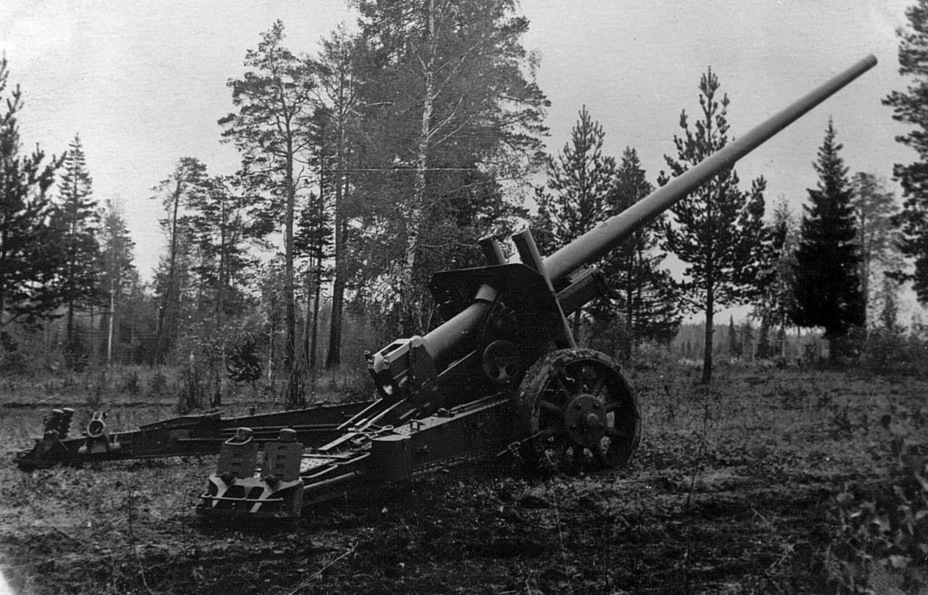
Draft project of the 107 mm M-75 antitank gun.

On the same day, requirements for a "special purpose 85 mm anti-tank gun" were approved. The gun would also serve as a divisional gun, and have a 9.2 kg 800 m/s HE shell. As for the AP shell, it was fired at 1150 m/s and weighed 10.5 kg, letting it penetrate 160 mm of armour at 1000 m at a 30 degree angle. The requirements included the use of the M-60 107 mm gun mount. Changes would be minimal and would include the gun shield.

Heavyweight Competitor

Until early June of 1941, design of high power AT guns proceeded only at factory #92, even though the decree mentioned two factories. This can be explained by Grabin's initiative, which was noticed at the top. Either way, factory #172 was too busy: it still had a large order for howitzer artillery and Supreme Command Reserve artillery to complete.

The requirements kept changing throughout the end of May and the beginning of June. The final variant was only sent to the factories on June 7th. By that time, factory #172 finally began the development of its own 107 mm gun. The latest changes put the factory in a difficult position, as they included the use of a mechanical rammer and variable rifling. In a letter to the chair of the Artillery Committee, Major-General Hohlov, acting director Kudryavtsev wrote that the design bureau would design a gun without these features. According to the bureau, the rate of fire of 10 RPM was attainable without a mechanical rammer. The gun designed at factory #172 was indexed M-75. According to preliminary calculations, its muzzle velocity was 1020 m/s and its penetration matched the requirements.

The gun shield that would be installed on all high power anti-tank guns.

Interestingly enough, development of an 85 mm gun began in Molotov (modern day Perm), and only fragmented information survives to this day. Information on it first comes in up mid June of 1941. Correspondence between factory #172 and the People's Commissariat of Ammunition reveals that not enough test rounds were produced for the ZiS-23 to also test the factory #172 gun. As a result, another 300 shells would have to be made: 50 by July 5th and the remaining 250 by July 15th. Further letters reveal the index of this gun: M-76. The letters also state that factory #172 received permission from the state to build a prototype. 

No tactical-technical characteristics for the M-76 were found. As for its competitor, the ZiS-23, its characteristics were finally confirmed in early July of 1941. To develop a muzzle velocity of 1150 m/s, the gun barrel was 96.8 calibers (8228 mm) long. The ZiS-24 also did not meet its barrel length restrictions. According to the final characteristics, the overall length of its barrel was 73.5 calibers, or 7843 mm.

The characteristics document dated July 4th, 1941, also mentions that factory #92's guns were finished and were currently at the stage of prototype assembly. Whether or not assembly was ever completed is not known. By June 31st, 1941, both guns were still being designed. Factory #92 had to send off two ZiS-23 prototypes (priority of the ZiS-24 was reduced) by August 15th. This did not happen, and furthermore, both guns are absent from a report on factory #92's experimental work. No additional information appears in subsequent documents. It is very likely that the ZiS-23 and ZiS-24 were never built.

Unexpectedly, a third competitor entered the race. On July 7th, 1941, a letter from Sverdlovsk arrived, addressed to the chief of the Orders and Production of Land-based Artillery Directorate (UVNA). The authors of the letter were the chief engineer of the Ural Heavy Machinebuilding Factory (UZTM) and F.F. Petrov (one of the creators of the ML-20 gun). In the letter, they described a draft of an anti-tank gun indexed UML-20.

Draft project of a 107 mm UML-20 anti-tank gun, July 1941.

The main feature of the project was that the gun was as unified as possible with existing guns, the ML-20 and A-19. The screw breech lock and barrel case were taken from the A-19. The breech and mount came from the ML-20. The A-19 also donated its shell casing. The possibility of using M-60 shells was mentioned, but it was not known if the shell would survive the higher pressure. The muzzle velocity was estimated at 1050 m/s with a barrel length of 59.5 calibers. In order to compensate for the altered center of mass, the barrel was extended by 235 mm.

Calculations for the UML-20 barrel. Unlike this gun, documentation for the ZiS-23 and ZiS-24 did not survive to this day.

UZTM's proposal was very reasonable. Thanks to the use of existing parts, development and, most importantly, production could have been completed quickly. However, the UML-20 project did not move past the design proposal stage.

In the end, the only high power anti-tank gun that reached the trials stage was S.N. Dernov's M-75.

Without a Worthy Target

Technical documentation for the 107 mm M-75 anti-tank gun was prepared by factory #172 by the end of June of 1941. The start of the Great Patriotic War did not influence its development. Unlike work on the KV-3, KV-4, and KV-5 tanks, no one cancelled work on the high power gun. Factory #172 began production of two prototypes in early July, and factory trials began by the end of the month. Muzzle velocities between 1017 m/s and 1047 m/s were recorded, which met requirements. The driving bands were not torn. Penetrations in the plate were in the form of a circle, meaning that the shells were stable in flight. The biggest problem during trials was the work of the semi-automatic mechanism. This was caused by the materials that were used to make the breech and breechblock.

M-75 on trials, October 1941.

On July 15th, a technical project was sent to UVNA chief, Military Engineer 1st Grade Komarov, developed in parallel with the production of prototypes. Overall, the gun met requirements. Its muzzle velocity was 1020 m/s, the barrel was 70.5 calibers long (7550 mm), and the design used the ML-20 mount. Nevertheless, the project was met with the following response:

"Instead of installing the new 107 mm barrel on the ML-20 mount, the factory performed an unfortunate "modernization" of the mount."

A more complete version of this appraisal was sent to factory #172 on July 28th, 1941, signed by GAU chief General-Colonel Yakovlev.

The same gun in firing position.

This reaction was caused by changes made at factory #172 to the design of the mount. Instead of the stock system to move the barrel from travel to firing position, a pulley was used, like the M-60. Aside from the change, GAU made a reasonable complaint about whether or not the addition would increase the speed at which the barrel could be transferred to and from the firing position. The designers of the M-75 also changed the recoil system and designed an almost completely new limber. In the conditions of war when German heavy tanks were expected any day, this was deemed unacceptable. Mass production M-75 had to be built on an ML-20 mount with a stock limber.

Despite a requirement to use the ML-20 mount as much as possible, the M-75 prototypes had may changes in their design.

Further trials of the M-75 were performed at the Ural Artillery Proving Grounds (today the Nizhniy Tagil Metals Research Institute, NTIIM). The trials program was approved on August 16th, 1941. The robustness of the system, its ballistics, and penetration were tested. Gun #1 had a barrel #4 with 25 caliber rifling and gun #2 had a barrel #7 with 32 caliber rifling. Barrel #5 was shipped with the guns, also with 32 caliber rifling.

Gun in travel position. Instead of the stock system for moving the barrel from travel to firing position, a pulley like on the M-60 was used.

Documentation for the gun was delivered on August 28th, but trials only began one month later, on September 29th. The first stage of the trials was disassembly and reassembly, during which the guns switched barrels. Trials were complicated by a lack of equipment at the Ural proving grounds for various necessary work.

The first shots were fired only on October 5th from gun #1. On October 16th, after 105 shots, trials were stopped due to a suggestion from factory #172. This was caused by the need to make a new breechblock and several other components. Trials resumed on November 3rd. After 402 shots, barrel #5 was replaced with barrel #4 due to significant wear of the rifling. Firing trials ended on December 11th, but due to the busyness of the proving grounds staff with other guns, the report was only composed on January 2nd, 1942.

Gun in firing mode, from the front.

The results of the trials were not encouraging. Fist, the lifespan of one barrel was estimated at 250-300 shots, which was not enough. Second, there were serious problems with penetration. The gun penetrated 152 mm of armour, but only at 100 meters. No attempt was made to fire at one kilometer due to the weakness of the shell hulls. This was a problem with many Soviet shells already in production, and it was not solved immediately. The real rate of fire of the gun was 5-6 RPM. There were significant problems with extraction. The M-75 failed trials.

Shells for the 107 mm M-75 gun.

Factory #172 had the potential to improve the M-75. Many guns, including anti-tank guns, showed these drawbacks. Trials showed what had to be corrected. Also, as mentioned above, the Ural proving grounds were not properly equipped for trials, and many problems could easily be solved at the factory. Nevertheless, on April 22nd, 1942, a decree was issued cancelling work on high powered anti-tank guns.

"Since the experience of modern war did not confirm the need for such guns to fight tanks, further work on the M-75 gun and its ammunition is considered unreasonable. Reporting on the above, I ask for your permission to cease all work on the 107 mm M-75 gun and similar work on 85 mm and 107 mm ZiS-23 and ZiS-24 guns at Order of Lenin factory #92.

107 mm shells could penetrate armour, but cracked on impact.

The People's Commissar of Armament, Colonel-General Volkov, did not know that right when he signed that letter, Ferdinand Porsche's design bureau began work on the super-heavy tank that super-powered anti-tank guns were made for. Of course, neither the VK 100.01 nor the Maus ever reached the front lines. Nevertheless, the gun cropped up once more in 1943.

M-75 gun #1 on display at the future site of the Armed Forces Museum of the Republic of Kazakhstan, in Astana.

In July of 1943, at Ponyri, another brainchild of Porsche K.G. entered battle: the Ferdinand SPG. Its appearance was treated seriously by the Red Army. The M-75 appeared once more in the list of work on tank, anti-tank and self-propelled artillery dated September 15th, 1943. One of the reasons that the project was buried in 1942 was the use of the ML-20 mount. The idea of a tank destroyer with the M-75 had another chance at life two years after it was first discarded in 1941, especially now since it had a worthy target. 

The return to 107 mm artillery was brief. In the same letter that mentioned the M-75, Major-General Hohlov proposed discarding a number of projects, replacing them with a much more promising 122 mm gun with the muzzle velocity of 1000 m/s.

Sunday, 7 February 2016

KV-3: Gaining Weight

After the adoption of the KV-1, it seemed that the upward trend in the weight of Soviet tanks stopped. Instead of the 60 ton SMK and T-100, the Red Army decided on a vehicle that was almost one third lighter and had identical armament and thicker armour. However, work on bigger and heavier tanks in the KV family began in the summer of 1940. The T-220 began trials in January of 1941, a tank that was heavier than either the SMK or T-100. This tank was the harbinger of a series of even heavier vehicles that were meant to replace the KV-1. First and foremost, this was the KV-3.

By Personal Initiative

The 95 mm divisional F-28 gun began trials in 1939. This gun, along with the F-25 122 mm howitzer, would become the "duplex" of divisional artillery. Despite the impressive caliber, the gun turned out very compact while retaining worthy characteristics, including those of an anti-tank gun. The F-28 could penetrate 65 mm of armour at 30 degrees at a distance of one kilometer.

It was logical to develop a tank gun with the F-28's ballistics. The project, initiated by the factory #92 design bureau, was indexed F-39. V.G. Grabin's bureau based their work on the F-34 gun. Periodically, rumours surface that the gun underwent trials in a T-28 tank, and even a photograph is shown, but unfortunately, this is a result of an improper analysis of facts and disinformation by factory #92. The photograph is actually re-touched, a practice common in factory #92 albums. The F-39 was indeed designed and planned to be tested in a T-28, but the gun was never built in metal. By the summer of 1940, interest in 95 mm guns waned, and designers switched to more powerful 107 mm guns.

On June 11th, 1940, a curious item appears in a  list of proposed tank armaments. A new 107 mm gun  based on the corps M-60 gun designed by factory #172 (Molotov, modern day Perm) was proposed as a replacement for the 152 mm howitzer in the KV-2. Trials showed that the M-60 could penetrate 107-110 mm of armour at 30 degrees at 800 meters. This system appears once more in a summary of tank, anti-tank and self propelled guns as "107 mm gun installed in the KV tank turret (oscillating part from the new 107 mm M-60 corps gun)". The due date for this project was November 1st, 1940, carried out by the Kirov factory.

Until now, it was not known the Kirov factory worked with such artillery systems. The design bureau did not take up this work right away, declining it initially. In January of 1941, Kirov factory proposed a high power gun to GAU with the index 412. 400-series indexes were used at the Kirov factory for artillery systems since 1940. For instance, the 152 mm howitzer in the lowered KV-2 turret was indexed 402.

412 was proposed in two variants. 412-1v was a tank version of the naval 100 mm B-24 gun. GAU rejected this design outright. The only parts of the B-24 that were reused were the barrel, shell, and casing. There was no AP shell for this caliber, and GAU fairly insisted that the nomenclature of tank guns should be compatible with field artillery. The first proposal of a 100 mm gun failed.

The second system, 412-2v, had a caliber of 107 mm. GAU proposed that Kirov factory develop this gun at their own expense, as they already refused a government proposal for a 107 mm gun in 1940. Another factory displayed initiative and made this gun by January of 1941. This ends the history of 107 mm guns at the Kirov factory.

It became known in December of 1940 that factory #92 is developing a 107 mm gun on their own initiative. Until then, no information about his new F-42 gun was sent to GAU. The new design used experience with the F-39 and F-34 guns as much as possible. As requested by GAU, the gun used the barrel of the 107 mm mod. 1940 divisional gun (the army designation for the M-60).

It was expected that the F-42 would be ready by December 25th, 1940, but work lagged behind schedule. The new gun was to be tested in the new T-220 heavy tank, but this idea was rejected, as the tank's turret was too small. On February 19th, 1941, Marshal Kulik sent a letter to factory #92 instructing them to install the experimental gun in a KV-2 turret by May 1st, 1941. The tank was already delivered to the factory by January 29th. At the same time, it was decided that an attempt would be made to equip the second T-220 prototype with the F-42, and its turret would be sent to factory #92 for installation.

New Perspective

On March 15th, 1941, USSR SNK and CC of the VKP(b) decree #548-232 was issued, ordering the Kirov factory to prepare the T-150 for production. The improved tank, with factory index 222, would be called KV-3. This was essentially a KV-1 with an F-34 gun, improved turret and commander's cupola, a more powerful V-5 diesel engine, and armour thickened up to 90 mm.

This order did not stand for long. In late March, intelligence revealed that heavy tanks were being built in Germany. It is not known what the spies meant, but the information was taken very seriously. Work on more powerful AT guns began and the KV and T-34 tanks received additional armour. Of course, plans for future tanks were also revised. In mid-April of 1941, work on a new vehicle began, even heavier than the T-150 or even T-220.

On April 7th, 1941, USSR SNK and CC of the VKP(b) decree #827-345ss was issued, establishing the characteristics of the new tank indexed KV-3. The senior engineer of this project was L.E. Sychev, later replaced with B.P. Pavlov. The new tank was indexed 223, occasionally called Object 223. Its mass was estimated at 67-68 tons, its turret armour was 115 mm thick, front of the hull was 115-120 mm thick, sides were 90 mm thick. The armament of the tank consisted of a 107 mm gun and three DT machineguns. The engine would be an 850 hp V-2SN. Until production of the V-2SN got off the ground, it was permissible to use the 700 hp V-5.

Kirov factory was freed from making spare parts for the KV-1, this task was moved entirely to ChTZ. The task of producing the "former" KV-3, now indexed KV-6, would also gradually be transferred there. It's worth mentioning that GABTU was against this decision, proposing that instead of the 223, the T-150 with a 76 mm gun with 3-K ballistics and turret and hull armour increased to 120 mm be built instead.

The new tank did not come from nothing. The KV-3 was a T-150 that was lengthened like the T-220, with a T-220-like turret mounting the F-30 85 mm gun. From the start, the turret would be produced by stamping. Even the experimental hull was not built from scratch. On February 10th, 1941, a set of parts for the T-221 (Object 221) hull arrived at the Kirov factory. This was a T-150 with a lengthened hull that was going to receive a KV-1 like turret with a 76 mm gun. The tank was supposed to be assembled by December 1st, 1940, but Izhor factory was late with parts for a series of reasons and Kirov factory had no time for it either.

Marshal Kulik's aforementioned letter proposed the installation of the F-27 76 mm gun with 3-K AA gun ballistics. This was the second prototype, assembled in the fall of 1940, as it was already called ZiS-5 by spring of 1941. These plans were not to be, as nobody touched the T-221 in February or March of 1941. The same thing happened to the hull of the 212A SPG. In April, it was finally decided that the T-221 hull will be used as a basis for the KV-3. This task was made easier by the fact that the tanks had identical side armour, and only the front had to be thickened.

Design work on the new tank began immediately after the order was received from NKTM. In parallel with the design, trials of the T-220 with a V-5 engine were held. This was the engine meant for the KV-3 before V-2SN production began. The tank, loaded to 70 tons, with the suspension sagging an extra 2-3 cm, drove 150 km between April 12th and April 15th. The missing 150 hp were felt, but the tank could drive, and the V-5 could be used as a temporary measure.

N.F. Shashmurin designed a new gearbox for the tank, a further development of the T-220's gearbox. In parallel, VAMM was tasked with developing an electric transmission. This type of transmission was developed under the direction of Professor N.I. Gruzdev at the academy previously, under its own initiative. Tactical-technical requirements were confirmed on April 29th, 1941. At the same time, requirements for a hydraulic transmission were confirmed. Employees of the All-Union Institute of Hydraulic Machinebuilding were tasked with its design.

By April 26th, a full sized model of the KV-3 was ready, which underwent preliminary inspection. As a result, the rear DT machinegun was removed, and replaced with a PPSh port. It was also recommended that the ZiS-6 (the new name for the F-42) should have a mechanical gun rammer, a travel lock in the rear of the turret, and slight improvements to the turret design. The railroaders made their changes, limiting the width of the tank to 3410 mm. It was also proposed that the round for the ZiS-6 should be one piece and that the ammunition capacity should be increased to 60 rounds.

The second time the commission reviewed the improved KV-3 model was on May 7th, 1941. Along with the model, they inspected a large amount of technical documentation. Aside from minor improvements, one major change was introduced: now, instead of the hull machinegun, the tank could mount a flamethrower designed by factory #174. The tank design was approved, but  a list of a few dozen minor changes was composed.

It's worth mentioning that by now, the KV-3 was treated as a temporary measure. The thickness of its armour was based on the penetration of the 88 mm Flak 18. Looking into the future, even 120 mm of armour was seen as not enough.

Based on results of firing trials of a 105 mm Flak 39 gun purchased in Germany, it was discovered that 130 mm of armour was required for complete protection from this gun. In April 1941, a new even heavier KV-4 tank began development, then the KV-5. Everyone knew that work on the KV-4 and KV-5 would continue on for a long time, and the KV-3 remained a priority for 1941.

According to an addendum to contract #B1-081, signed on June 5th, 1941, the Kirov factory promised to make 500 KV-3 tanks in 1941. The first 55 tanks were to be built in August, then 105 in September, 110 in October and November, and 120 in December. A single tank cost 740,000 roubles. To compare, a KV-1 cost 523,000, and KV-2 cost 558,000. A German Tiger cost 400,000 Reichsmarks, or 840,000 roubles by the 1940 exchange rate. A Tiger II cost 321,500 Reichsmarks or 675, 150 rubles.

Production of the KV-3 was far away. The turret was a big problem, since, as mentioned above, it was to be stamped. As of May 13th, 1941, the tooling for its production was only partially ready, and stamping only began in mid-June. Work on the hull also lagged behind, and it began in June as well. The ZiS-6 arrived at the Kirov factory in May, but trials began in late June. This is how the KV-3 met the start of the Great Patriotic War.

Evacuation

The start of the war quickly made some changes to project work. On June 26th, 1941, NKTP order #253ss was issued, passing the production of the new heavy tank to ChTZ. The same order was sent on June 30th to Kirov factory. The order also cancelled work on the KV-4 and KV-5, but in practice, work on the KV-5 continued until the evacuation. 18 engineering designers were transferred to Chelyabinsk, including Dukhov, Pavlov, and Shashmurin. As for the experimental prototype, it was decided to assemble the hull, give it a production suspension and a T-220 engine. Stamped turrets were sent to Chelyabinsk as well as all tools to make them.

In early July of 1941, the half-assembled KV-3 and its turret were loaded on train platforms and sent to Chelyabinsk. It is said that the history of the tank ends here, since production never started, nor was the prototype ever fully assembled.

In reality, this was not so, as archive documents colourfully describe. It is known that trials of the ZiS-6 started on June 25th, after the start of the war. Trials continued until July 5th, and 618 shots were made. On one hand, trials showed good penetration, 120 mm at 1600 meters. On the other hand, the system underwent criticism regarding the reliability of certain assemblies. Conditional on improvement of reliability, the ZiS-6 gun received a green light.

The work of the factory #92 design bureau did not end here. On their own initiative, a variant of the gun called ZiS-6A was designed. Some authors mistakenly consider it a design for the KV-7 assault tank, but was not the case. What the ZiS-6A really was can be seen in this letter to ChTZ's chief engineer, S.N. Makhonin:

"We developed and are producing a system with a 107 mm ZiS-6 gun and a coaxial 45 mm gun, with the DT machinegun in the previous place. The tactical purpose of this system of obvious, conserving 107 mm shells on targets that could be destroyed with a 45 mm shell.
Due to the absence of a KV-3 at the factory, we are testing this system in a KV-2. Your engineer comrade Schneidman told us that you are making a new turret for the KV-3. Since it is advantageous to have a 45 mm gun in the KV-3 and it only requires minor changes to the turret, we ask you to widen the gun port, and change the frame and mantlet according to the attached blueprints. We do not have blueprints of the new KV-3 turret and are forced to use old ones, but the difference does not matter. At the same time, we ask you to develop an ammunition rack for 107 mm and 45 mm shells, for which we send a dimensional blueprint of a 45 mm shell."

Grabin was proposing to turn the KV-3 into a KV-4 analogue, where two guns (a 45 mm gun and a 107 mm gun) were used in Dukhov's approved design. The letter also suggests that Chelyabinsk was designing a new turret for the KV-3, since there was nowhere to stamp the old one. Sadly, by September of 1941, ChTZ had better things to do than work on the KV-3, as after the evacuation of the Kirov factory, it became the sole producer of KV-1s.

Nevertheless, it was too early to speak of the death of the KV-3. First of all, the tank was still the chassis of the 212A bunker buster, which was not cancelled. Second, the KV-3 remained in experimental work documents of ChTZ (ChKZ from the end of the year). In the plan for 1942, approved on December 22nd, 1941, the KV-3 is first, listed as work that's being transferred from the previous year which, at the very least, should be completed by assembling a prototype. The due date is May 1st, 1942. By December of 1942, a new 1200 hp two-stroke diesel engine based on the V-2 should be ready.

Unnecessary Heavy

The tank's older brother, the KV-1, dug the KV-3's grave, or, more specifically, the unreliable transmission did. Due to the thickening armour and increasing weight, the KV-1 was pursued by breakdowns. The gearbox had the most problems. In the spring of 1942, orders from above dictated that the mass of the KV-1 needs to be decreased. In these conditions, nobody needed a 70 ton KV-3.

Unfortunately, the KV-3 was never built or tested. Not because the 70 ton tank could change the course of the war, despite surpassing every foreign tank. The powerful armour would make the KV-3 a tough nut for the Germans to crack, but that was not the benefit. The main benefit was that the assembly and trials of even one of these tanks could be a wake-up call for the military, knocking off the desire for something similar once and for all.

The result of the trials could be predicted by the issues that the testers and designers of the lighter T-220 ran into. It would have been clear that such a monster could not have been pulled off the battlefield by any recovery vehicle and that transporting it on railroads would be problematic. If our tank designers earned this experience in 1941 with the KV-3, there would be no IS-7 or IS-4. The lesson that a heavy tank should not surpass 50 tons could have been learned in the early 1940s and not in 1949, after 4 years of mucking around with the IS-4 and IS-7. Sadly, history doesn't know the word "if".

Original article by Yuri Pasholok.

Saturday, 9 January 2016

T-220: Prototype in Combat

There is an opinion that the Red Army dropped other tank projects for some time after the appearance of the KV tank. Indeed the SMK and T-100 heavy tanks were cancelled in the summer of 1940. However, it became necessary to improve the armour and armament of the tank immediately afterwards, resulting in even heavier tanks like the KV-4 and KV-5. The first step in this journey of increasing firepower, armour, and eventually size and mass was the KV-220 tank, later renamed T-220. Even though only two were made, both participated in battle during the Great Patriotic War.

Big Gun

The first signs that neither the "small turret" KV nor the "large turret" variant were satisfactory for the army were seen in June of 1940. According to a proposal for improvement of tank guns, the KV-1 should be armed with a 76 mm gun with the ballistics of the model 1931 AA gun (3-K). It was also proposed that the front armour be increased to 90-100 mm.

Some doubts arose regarding the 3-K. According to calculations, the 76 mm AA gun could penetrate 70 mm of armour at 1000 meters at an angle of 30 degrees. This is a good amount, but it turned out that the thickness of the KV-1's armour would be greater than this value. In addition, the 3-K was already removed from production, replaced with a new more powerful 85 mm AA gun that could penetrate 88 mm of armour under the same conditions.

It is not surprising that two new guns appeared of tank, SPG, and anti-tank guns: a 76 mm gun with AA ballistics and an 85 mm gun with AA ballistics. The due date for arming a KV with a small turret with both of the guns was set as September 1st, 1940. Factory #92 was chosen to develop both systems.

The gun with 3-K ballistics was indexed F-27, and the gun with 52-K ballistics was indexed F-30. The factory's chief designer, V.G. Grabin, was in charge of both projects. Much hope rested on the F-30: according to defense plans for 1940, 50% of KV tanks would be armed with this gun.

Both guns were ready by the due date and already began trials. Factory #92 didn't reinvent the wheel and followed the development path of the F-34. Using that gun as the basis, the design bureau installed new barrels and strengthened the recoil mechanisms. Thanks to this approach, the design of the guns took a short time. By September 2nd, 1940, the F-27 performed 5 trials of 122 shots in total, with satisfactory results.

By that time, the F-30 performed 2 trials of 68 shots in total. Some design flaws were discovered in the process, and the factory began working on improvements. By September 24th, the gun made 90 shots, after which a crack in the breech was discovered. Trials of the F-30 continued until October 29th, after which the gun was removed from the T-28 and sent to the Kirov factory. At the same time, factory #92 began building another F-30 prototype, which they finished in late October, but further trials stalled.

Growing Appetites

On July 17th, 1940, SNK and VKP(b) decree #1288-495ss was issued, according to which Kirov factory was tasked with producing two prototypes of improved KV tanks by December 1st, 1940. Both prototypes were to have 100 mm of front armour, but differed in armament; the first prototype got the 76 mm F-27 gun, and the second the 85 mm F-30. However, changes were soon made. Instead of the F-27, the 76 mm F-32 gun was used, and the front armour was decreased to 90 mm. In addition, it turned out that the F-30 did not fit into the existing KV-1 turret, and a new turret was necessary.

It was not possible to just change the turret, as the required changes snowballed. In the end, the tank that was referred to as KV-220, Object 220, and T-220 significantly differed from the initial KV-1, having almost caught up to the SMK in size and surpassed it in mass. The T-220 was also called KV-4 in writing at least once.

The design of this tank is connected with the 212A SPG, whose design was ordered by the same decree #1288-495ss. As the mass of the "bunker buster" crawled over 60 tons, it needed a new engine. This engine, indexed V-2SN, was developed at factory #75 in Kharkov. It differed from the stock V-2 by the addition of the mechanical supercharger from the AM-38 aircraft engine. The supercharger increased the power output of the engine to 850 hp. This engine was also installed in the T-220, along with a new gearbox, main clutch, and final drives.

All these changes lengthened the hull to 7820 mm, one meter longer than the KV-1. This increase resulted in a change to the running gear: there were now 7 road wheels and 4 return rollers. The front of the hull was 100 mm thick, same as the sides. Initially, the mass of the T-220 was estimated at 56 tons, but the tank grew to 62.7 tons.

The turret that led to this growth of mass and size was a further development of a lowered KV-2 turret. The front was taken up by the massive F-30 gun mount and a coaxial machinegun. A hatch in the rear of the turret, much like the one on the KV-2, was added for removal of the gun. Another machinegun was installed in a rotating commander's cupola. A second loader increased the number of turret crewmen to 4. The ammunition, 91 rounds in total, was also partially stored in the turret.

The development of the T-220 was not cheap. According to calculations made by the Kirov factory, the total budget of this project reached 4 million roubles. 100,000 of them were spent on the technical project, 25,000 on the model, 250,000 on design documentation, and 75,000 on corrections made after trials. Two experimental prototypes would cost 1.2 million apiece. Trials would cost half a million, and another 900,000 would be used to improve the prototypes after trials, and all this doesn't include the cost of the armament.

Unlucky Sign

Due to a large amount of assignments for the Kirov factory and a general overload of work, the tanks were not finished on time. The hull only arrived at the factory on December 7th, 1940, and assembly was complete by early January 1940. A mix-up occurred during assembly: the F-30 gun was not properly balanced. Gunnery trials were moved to a later date that never came.

On January 14th, 1941, the trials plan was approved. Factory trials were skipped in a hurry. This fact contributed to the subsequent events. Trials showed a large amount of problems with the V-2SN engine. The piston rings wore out quickly, and the engine spat out oil. Oil consumption nearly reached one liter per kilometer.

The maximum speed on a highway was 33 kph, and average speed was 21.2 kph. However, the T-220 did not drive around for long. On January 25th, after 106 kilometers driven on a highway, the engine broke. As there were no spares, trials were halted. It's worth mentioning that this was not a surprise for factory #75 representatives. Chief designer of factory #75 T.P. Chupakhin said that the engine was experimental and that he gave no guarantees regarding its reliability.

Trials continued in late January after another engine was shipped from factory #75, if only briefly. According to a report by military engineer 1st class Glukhov, the second engine broke down completely on February 3rd, 1941. The next engine was expected to arrive on February 15th, and trials were falling behind schedule. Assembly of the second T-220 lagged behind due to missing parts. In early February 1941, the turret was still at factory #92 where the F-30 gun and its equipment were being installed.

Finally, instead of a V-2SN engine, a 700 hp V-5 arrived from factory #75. By the time it arrived, several important events happened that would change the fate of the T-220.

Grabin did not forget the idea to install a 107 mm gun with ballistics of the divisional M-60 gun in the KV-2 turret. In December of 1940, it became known that the design bureau of factory #92 developed such a gun on their own initiative and is already starting to build it. This gun, indexed F-42, was proposed for installation into the T-220 turret, but was rejected. It was decided that the lighter T-150 would be put into production under the index KV-3. The T-220 prototype would serve as a testbed for the V-5 engine, which would be used on the KV-3. The same thing happened to the V-5 as to the V-2SN: it didn't last long in the T-220.

The fate of the T-220 was sealed in March of 1941. Information on heavy tanks in the German army began to arrive. Information received by Soviet intelligence led to significant increase in activity regarding tanks and tank armament. This activity also touched domestic heavy designs. The T-220 with an 85 mm gun and 100 mm of armour was deemed insufficient. Instead, a new 72 ton KV-3 started development, with the factory index 223. Overall, this tank would be further development of the T-220, with more powerful armament and 120 mm of armour.

Work on the new KV-3 didn't mean that the existing T-220 was forgotten. On the contrary, the prototype was used as much as possible by the Kirov factory as a testbed for parts and assemblies meant for the new tank. A third V-2SN was installed, this one much more reliable than its predecessors. The tank was used to test new road wheels and Vortex air filters. By June 20th, 1941, it travelled a total of 1979 km. As for the other T-220 prototype, Kirov factory only got to it in early June. Assembly went along lazily, and was planned for no earlier than mid-July. This was how the experimental vehicles met the start of the Great Patriotic War.

Battles for Leningrad

All work on the T-220 stopped after the start of the war. The factory began hurriedly producing KV-1s, focusing their efforts on simplifying the design. When evacuation of the factory began, the KV-3 hull was evacuated. As for the T-220s, nobody had time for them. This changed when the Germans reached the city in the fall of 1941 and any tank at all was worth its weight in gold.

Suddenly, people remembered about the T-220s. Since the tanks never fired a shot and one turret was still in Gorkiy at factory #92, the first T-220 had its turret replaced with a stock KV-1 turret with an F-32 76 mm gun. The same turret was installed on the second tank. On October 5th, 1941, tank T-220 with serial number M-220-1 was sent to the 124th Tank Brigade. On October 16th, the second tank was sent there with the index M-220-2.

In November of 1941, the 124th Tank Brigade and the 43rd Infantry Division fought fierce battles near Ust-Tosno. The second T-220 burned up in these battles along with its crew, commanded by Junior Lieutenant Yakhnin. According to memoirs, the tank carried the slogan "For the Motherland!". As for the first prototype, its fate is unknown.

The story of the T-220 could end here, but it goes on. On February 8th, 1943, order #012 regarding assigning crews to the 12th Independent Training Tank Regiment. The eighth tank in the list is... "For the Motherland", serial number 220-2, whose commander was V.V. Strukov.

How could this be? Usually, burned up vehicles could not be repaired, but there are exceptions. It is known that at least several burned up KV-1s were evacuated and kept on fighting. It is also known that 17 tanks from the 124th Tank Brigade were recovered. One of them must have been M-220-2, repaired in the winter of 1942 at factory #371. During repairs, it was equipped with a V-2K engine, serial number 1193-03. The tank no longer had any worth as a combat vehicle, but it worked as a hands-on training aid for tankers until 1944.

The last episode in the life of the T-220 was the use of its turret. In September of 1941, the turret was replaced with a production KV-1 turret. The tankless turret was found a home. It was installed on a concrete foundation in the 22nd Karelian Fortified Region. The result was called Artillery BOT (KV) with 85 mm gun "Victory". Here, the turret survived the whole war.

Original article by Yuri Pasholok.

Wednesday, 30 September 2015

New AT Guns

"State Committee of Defense Decree #3187
April 15th, 1943
Moscow, Kremlin

On measures for reinforcement of anti-tank defenses.

In order to strengthen our anti-tank defenses, the State Committee of Defense decrees that:
  1. The People's Commissar of Armament, comrade Ustinov, must replace the production of 45 mm mod. 1937 guns at factory #172 with 45 mm M-42 guns, following this schedule:
    1. April: 250 units
    2. May: 300
    3. June: 400
    4. July: 600
    5. August: 800
    6. September: all production
  2. The People's Commissar of Armament, comrade Ustinov, and factory #92 director, comrade Elyan, must organize production of 57 mm ZiS-2 anti-tank guns and ZiS-4 tank guns to replace 76 mm mod. 1942 divisional guns and F-34 tank guns, following this schedule:
    1. April: 50 units
    2. May: 150 
    3. June: 250
    4. July: 350
      and 500 units monthly starting in August. Of the units listed, 20% are ZiS-4 tank guns.
      TsAKB must complete blueprints by June 1st, 1943, and provide them to GAU for approval.
      Send four AT guns and four tank guns from the April production batch to GAU (comrade Yakovlev) for trials, issuing a report to GOKO within ten days.
  3. The People's Commissar of Armament (comrade Ustinov) and TsAKB chief (comrade Grabin) must provide GAU with ideas regarding a powerful new corps gun with the qualities of an anti-tank gun based on the 107 mm M-60 gun and 100 mm B-34 naval gun. Also provide ideas for a new special tank, AT, and SPG gun that can penetrate 150 mm of armour at 30 degrees at a distance of 750-1000 meters.
    GAU must examine materials provided by NKV in three days and make a decision regarding experimental prototypes, reporting to GOKO along with NKV.
  4. People's Commissar of Ammunition, comrade Vannikov, must introduce 57 and 76 mm subcaliber rounds into production, with the following production schedule:


May June July August
ZiS-2 shell 3000 10000 10000 15000
ZiS-3 shell 15000 30000 35000 40000

By May 1st, design a 122 mm HEAT shell and a simplified 152 mm AP shell. Within 10 days of the designs being ready, GAU must perform trials and create blueprints for mass production.

5. The People's Commissariat of Chemical Production (comrade Pervukhin) must provide the People's Commissariat of Coloured Metals, above current quota and with first priority, the following materials for production of subcaliber armour piercing shell cores, in tons:


April May June July August
Sodium Carbonate 15 30 50 55 70
Hydrochloric acid 75 85 180 200 270
Soot 4 6 13 15 18

and shipment of plastic ballistic caps to the People's Commissariat of Ammunition, according to the following schedule:


May June July August
ZiS-2 shells 6000 15000 15000 20000
ZiS-3 shells 20000 40000 45000 50000
6. The People's Commissariat of Coloured Metals (comrade Lomako) must provide the People's Commissariat of Ammunition with cores made from hard alloys in the following amounts:


May June July August
For ZiS-2 shells 5000 13000 13000 20000
For ZiS-3 shells 17000 35000 40000 45000
Chairman of the State Committee of Defense, I. Stalin."

Friday, 31 October 2014

ZiS-6 Project

"To the director of the Kirov factory, comrade Zaltsmann
To the GABTU Chief, Lieutenant-General of the Tank Forces, comrade Fedorenko

On the issue of mounting the 107 mm ZiS-6 gun in the KV-3 tank

Attached is the project for the installation of a 107 mm ZiS-6 gun in the KV-3 tank, which has the following characteristics:
  1. Muzzle velocity: 800 m/s
  2. Recoil resistance: 20,000 kg
  3. Mass of the recoil components: 1600 kg
  4. Mass of the oscillating components with the mantlet: 2600 kg
  5. Recoil length: 640+40 mm
  6. Shell: single piece
  7. Breech: semi-automatic
  8. Coaxial machinegun: DT
  9. Vertical gun range: +20 to -5
  10. Maximum vertical gun range obtainable with recoil brake: +40 to -15
  11. Fume extraction with compressed air is possible
  12. Shell casing length: 625 mm
  13. HE round length: approximately 1200 mm
  14. Initial return mechanism pressure: 50 atmospheres
  15. Sight: TD
  16. Mantlet: same as in the KV type turrets
  17. The gun will be tested in the KV-2 turret
Factory #92 is finishing the design of the ZiS-6. Despite this late stage, some improvements noted by your engineers will be made. Some of your requested changes cannot be made, as they require approval by the factory (the frame and mantlet are fixed in our design). 

The request from your engineers to use a two-piece shell goes against the decision of the party and government, which factory #92 will not allow. On our side, factory #92 did everything possible to ease the loading of a one piece shell, including making the gun as compact as possible.

In order to resolve the issue of two-piece loading, contact the appropriate authorities.

Factory director [signature]
Chief Engineer Grabin"

Saturday, 19 July 2014

Penetration, Part 6: Field Artillery Edition

While knowing how well your tank guns perform against enemy tanks is very important, sometimes things don't go as planned, and instead of the predicted location, tanks show up right in front of your face. In that case, it's important to know how well all of your artillery works, not just tank guns. These trials examined the performance of divisional level guns and up against armour. The answer may surprise you! That is, unless you read Penetration Part 3, in which case it will not, as many of the guns tested show up there as well.

"Report on the composition of tables of penetration for 122, 152, and 203 mm concrete piercing shells for A-19, ML-20, and B-4 systems

Assignment #7773

From April 17th to May 15th, 1941, ANIOP composed theoretical calculations for penetration of 122, 152, and 203 mm shells, and then tested them by shooting at the expected velocities. Work was done according to a program composed by ANIOP and confirmed by Deputy People's Commissar of Defense, Marshal of the Soviet Union, comrade Kulik on December 19th, 1940.

Process steps:
  1. Processing of experimental data from ANIOP records.
  2. Performance of trial shooting at 500, 1000, 2000, and 3000 equivalent velocities at plates 30 degrees from normal.
  3. Processing of data and composition of data tables.
  4. Processing of experimental data to determine the penetration of 152 mm, 122 mm, 107 mm, and 76 HE shells, and composing penetration tables for HE shells.
Tables for 122 and 152 mm shells were not composed due to a lack of trials material at ANIOP."

Then we have a short section on how the De Marre equation works, which I am sure you are all familiar with. To the practical tests!

"Firing at provided velocities.

Firing the 122 mm corps gun model 1931 (A-19) and 152 mm gun-howitzer model 1937 (ML-20) was done at the 8.5 kilometer position. Firing from the 203 mm howitzer model 1931 was done at the NIMAP main battery. The plates at 8.5 km were hung on metal frames and held on at the corners with bolts. The plate at NIMAP was attached to a large stump using rivets. 

Shells used were: stock concrete penetrating 122 mm 2-02819, 152 mm 2-04834, and 203 mm 2-1763, with sulfur charges and blank detonators. 

The propellant was reduced, with the following gunpowder types:
  1. 122 mm gun: NF 17/1 26/39 P
  2. 152 mm gun-howitzer: 15/7 TsA 18/39 Shuf 
  3. 230 mm howitzer: 17/7 sb.21/40 Shuf
Material on the HE action of 76 and 107 mm shells was taken from ANIOP reports.

Results on shooting concrete piercing shells is attached in table #1. Detailed results are in attachments. Graphs of calculated and experimental penetration are in the attachment. After firing, the shells and plates were photographed, the photographs are in the attachment."

Sadly, I do not have the attachments, nor the next few pages. I do have the conclusions though.

"Summary and Conclusions

Inspection of table #1 and the graphs concludes:
  1. Results are significantly lower than calculated. Shooting at 500 meters, the penetration is 102 mm with 203 mm concrete piercing shells (calculated: 154), 100 mm from 950 meters with the 122 mm gun (calculated 138 mm) and 90 mm at point blank with the 152 mm gun-howitzer (calculated 132 mm). HE shells penetrate 40 mm (107 mm gun model 1910/30) at point blank and 30 mm at 500 meters with the 76 mm L/40 divisional gun model 1902/30.
  2. The best penetration was achieved by the 122 mm concrete piercing 2-02819 shells. These shells can penetrate 5-6 mm more than 203 mm shells. 
  3. When penetrating armour, both HE and concrete piercing shells shatter into fragments. The breach in the armour with the caliber of the shell counted as the penetration. In this case, the damage beyond the shell would be dealt by the fragments of the shell and the armour.
  4. Most experimental data points lie in the vicinity of a 2200 resistance factor armour plate, which is what was used in calculations."