Showing posts with label Polish campaign. Show all posts

Friday, 21 October 2022

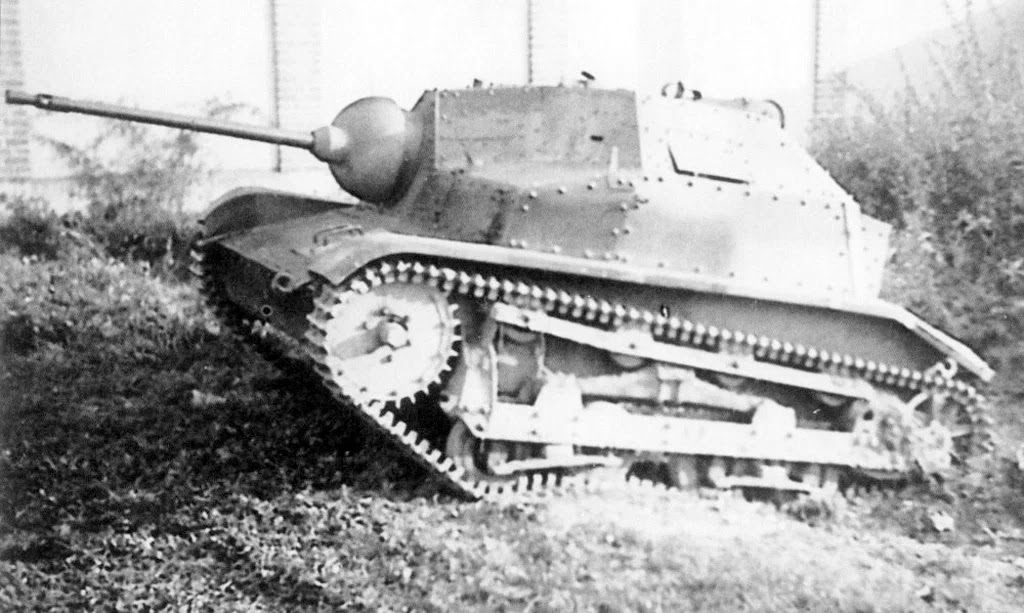
Polish Tank Destroyer

The growth of tactical-technical requirements is a normal phenomenon for any army in the world. The brass also often doesn't know when to stop, which results in a strange metamorphosis. This happened to the tankette class of vehicles. Initially, the concept was something akin a mobile machine gun nest: a machine gun with a shield, engine, and tracks. Early tankettes were one-man vehicles, but experiments in the early 1920s showed that you need at least two crewmen. The Carden-Loyd Mk.VI is a classic example of this concept. Nevertheless, many nations quickly started treating it as a tank, albeit a small one. Requirements for these tankettes grew until they were more suited to tanks, and so the tankette withered away. 

TK-S tank destroyer, a great example of a successful modernization of an obsolete vehicle.

Monday, 27 December 2021

A Trophy from Pilsen

Germany invaded Czechoslovakia on March 15th, 1939. This was the final step in the process kicked off by the Munich Agreement in the fall of 1938. France and Britain were not prepared for war, and their appeasement policy handed Czechoslovakia to the Germans. The first step was annexation of the Sudetenland, then the rest of the country. Slovakia declared independence, but Jozef Tiso's government was loyal to Germany. The Germans assumed direct control of Czechia, its advanced industry, and its armoured vehicles, including the LT vz.35. These tanks were designated Pz.Kpfw.35(t) in the German army and played a big role in 1939-1941.

Saturday, 2 February 2019

Modernization, Polish Style

The 7TP, a Polish modernization of the Vickers Mk.E, was the pride of Polish tank building in the interwar period. Skilfully combining products of the Swiss Saurer company (who made the engine) and the Swedish Bofors company (who made the gun), Polish designers significantly improved the characteristics of the initial tank. The 7TP design also included a number of Polish creations, including the excellent Mk.IV periscope. Polish tanks fought German tanks as equals in the 1939 campaign, and many of them later served in the German army. A number of the tanks ended up in the USSR as trophies, where they were studied.

Saturday, 10 November 2018

Pz.Kpfw.III Ausf.E through F: The First Mass Medium

In the 1930s only the USSR and Japan managed to spin up mass production of medium tanks, producing several hundred of their respective types. In other armies the creation of medium tanks hit significant difficulties. For instance, the main German Z.W. tank had big problems, primarily with the suspension. As a result, the production of the tank, accepted into service as the PzIII, slipped. The situation changed only in the fall of 1939 when German factories began producing the PzIII Ausf. F. This was the first German medium tank that was produced in the amount of over 400 units. At the same time, it was the first German tank that was produced by six factories at the same time.

Monday, 2 July 2018

A Timely Purchase

Soviet trials of the PzIII medium tank, purchased in the summer of 1940, are frequently discussed by military history enthusiasts. The conclusions that various authors make from these trials seem rather mixed. Let us try to figure out the real influence of the study of a PzIII Ausf.G tank purchased at the dawn of war using archive documents.

Sunday, 29 January 2017

Pz.Kpfw.III Ausf B-D

The PzIII, the main German tank for the first half of WWII, was at the same time its most problematic tank. Even though the PzII also had problems with its suspension, it was only seriously redesigned once. The PzIII, on the other hand, used five (!) different types of suspension, all of which went into production. Today, we will focus on the "intermediate" PzIII Ausf. B, C, and D. Even though none of these tanks were made in large numbers, they managed to see battle, and some of them remained on the front lines for a long time.

Saturday, 21 January 2017

Pz.Kpfw.IV Ausf. A through C

In December of 1936, the German military signed a contract with the Krupp conglomerate for a batch of 35 Begleitwagen tanks. This tank was designed to fight as a direct fire support tank, as its name suggests. The tank's main targets were going to be enemy infantry and light fortifications. Ironically, this vehicle became Germany's most numerous medium tank by the start of WWII. Later, the PzIII became more numerous, but only for a short time. By 1943, the Begleitwagen, known as the PzIV, retook the lead. The Pz.Kpfw. IV was the only German pre-war tank that never went through a radical chassis modernization.

Thursday, 30 January 2014

Penetrating French Tanks

"Land forces high command
November 11th, 1939

Army Group A: 2000 copies
Army Group B: 2000 copies
Army Group C: 1000 copies
Reserve command: 1000 copies

Tests of a captured French heavy tank showed that, despite 40 mm of sturdy armour, it can be easily penetrated by our anti-tank guns. This is explained by the fact that the upper part of the hull and the turret are made of cast armour, and only the sides of the hull of rolled armour.

Tests indicate that penetration may be achieved:

  1. By shooting at the front and observation slits:
    1. Anti-tank rifle model 1938: 0-100 meters
    2. 20 mm AP shell: 0-100 meters
    3. 37 mm AP shell: 0-700 meters
  2. Side armour (40 mm rolled steel)
    1. Anti-tank rifle model 1938: 0-100 meters
    2. 20 mm AP shell: 0-100 meters
    3. 37 mm AP shell: 0-350 meters
  3. Turret side (45 mm cast steel)
    1. Anti-tank rifle model 1938: 0-100 meters
    2. 20 mm AP shell: 0-100 meters
    3. 37 mm AP shell: 0-350 meters
Fire at the observation slit covers is most effective. They were penetrated and knocked out with a 37 mm gun at 700 meters. 

The enclosed diagram shows the effectiveness of the anti-tank guns of one infantry regiment. The effects of splashing lead from mounted machineguns firing heavy sharp-tipped bullets is described.

Since penetration decreases significantly with distance, choosing your engagement distance correctly is decisive in battle. Opening fire too early leads to a gun's discovery, which decreases its combat value.

By the order of (signature illegible)

Translated by Technician-Intendant 1st grade, Rosumova

Captured in the region of the Vysokoye village, 52 km north of West Livna.
April 23rd, 1942"

By the date (the Germans were in Poland at the time) and assessment of "French heavy tank", Yuri Pasholok estimates that the tank in question is a Renault R-35. However, there is no explanation why a German unit in the USSR in 1942 needs an instruction for fighting an obsolete French tank.

Sunday, 22 December 2013

The Last TK


These are photographs of a Polish TK-3 tankette. Fans of this particular type of vehicle might recognize it as serial number 194, with the proper name "szwadron śmierci" ("Death Squadron"). It was built on July 20th, 1936. Initially, it was used by the 10th Armoured Cavalry Brigade (10 Brygada Kawalerii Pancernej), but then it was captured by Soviet forces, along with 18 other Polish tanks and tankettes, and 2 German tanks. Two TK-S tankettes were sent to Kiev, where #194 was restored for testing, and eventually ended up in Hangar #7 (captured vehicles) at the Kubinka Tank Museum. 

CAMD RF 38-11355-12

"Technical Inspection Act

On January 14th, 1941, a commission consisting of chairman Military Engineer 2nd Grade comrade N.S. Salmin, and members Intendant-Technician 1st Grade comrade I.I. Stepanov, and Junior Military Technician comrade V.P. Gornih, as a result of orders from the assistant chief of the proving grounds, Military Engineer 1st Grade, comrade Gluhov, inspected a TK-3 (Polish tankette, #1621/109) for the purpose of recycling it as special metal and removing it from the proving grounds inventory. 

After familiarizing themselves with the proper documents and inspecting the vehicle, it was discovered that:
  1. The TK-3 Polish (captured) tankette that arrived at the proving grounds from repair base #7 was disassembled for parts in order to repair two TK-3 tankettes, #194/1725 and #128. The following parts were removed:
    1. Engine
    2. Side friction clutches
    3. Two fan covers
    4. Water cooling radiator
    5. One fan
    6. Driver's hatch
    7. Towing equipment
  2. The commission concludes that the hull of the tankette may be sent to the factory as coloured metal and removed from the inventory of the GABTU KA proving grounds."
#194 remains the only TK tankette with all original parts.

Saturday, 30 November 2013

World of Tanks History Section: PzKpfw I

On June 28th, 1919, Germany and the Entente signed the Treaty of Versailles, ending WWI, the largest conflict in the history of humanity at that point. A portion of German territory was annexed by the victorious nations, its colonies were also appropriated, it was forced to pay reparations. There were also harsh limits on Germany's military force. The land army was limited to 100 000 men, drafts were not allowed, a portion of Germany's warships were handed over to the victors, and the tonnage of new ones was strictly limited. Armoured vehicles (aside from outdated police cars) and aviation were forbidden. The conditions were such that their goal was, apparently, not to maintain peace in Europe, but to humiliate Germany and force them to take revenge.

Years before the nazis, Germany already started to, step by step, violate the conditions of the treaty. Aside from theoretical developments, which were not forbidden, the manufacturing base of the country slowly but surely accumulated experience. In 1925, a tank codenamed Großtraktor (large tractor) was developed. Leichttraktor (small tractor) followed in May of 1928.

The first mass produced German tank was the PzKpfw I. Work on this tank started in 1931, when the Directorate of German land forces drafted the requirements for a teaching tank, 5 tons in mass. The vehicle was officially named Landwirtschaftlicher Schlepper (agricultural tractor), which was not unusual in Germany at the time. Friedrich Krupp AG, Rheinmetall-Borsig, MAN, and Daimler-Benz AG received orders for this new tank.

Each company produced a prototype with more or less the same characteristics. The military liked Krupp's LKA tank the most. The best thing about it was not its technical characteristics, but that it was the project that could be built the fastest, and the cheapest. Five of Krupp's tanks, still without armament, were tested at Kummersdorf in the summer of 1933. The tests demonstrated insufficient reliability of the transmission and suspension, forcing Krupp's engineers to make some changes. After that, 15 more vehicles were given the green light. The vehicles were assembled at multiple factories. This unorthodox decision was made to distribute the tank building experience.

The hull and turret were developed by Daimler-Benz. A welded hull protected the crew and components from bullets. The turret, also welded, was placed to the right of the tank's axis. The maximum armour thickness was 13 mm. The tank was equipped with a Krupp 57 hp engine, theoretically making it capable of accelerating to 37 kph. The tank's armament consisted of two 7.92 mm MG-13 machine guns.

The first mass produced chassis were made in December of 1933. In July of 1934, the tank started mass production. In the same year, the first tanks started arriving at training centers. By October 1935, Germany's first tank divisions were formed. That is when the tank received its name: PzKpfw I. According to foreign historians, there were about 1100 vehicles of the first configuration built.

When the tank entered the army, its downsides quickly showed themselves. Its engine was too weak. Instead of the ideal 37 kph, it could only reach 28 kph. Work started on an improved PzKpfw I Ausf. B. Retroactively, all existing tanks were named PzKpfw Ausf. A.

In 1935, the new six cylinder water cooled Maybach NL 38 TR engine was chosen for the tank. The new engine was more powerful, at 100 hp. Because it was larger than the engine compartment of the PzKpfw I, the tank became longer by 40 cm. The tank gained another road wheel, and an idler was lifted to make turning easier.

Interestingly enough, no work on improving armament was conducted. First "B" tanks were equipped with the same MG-13s, and later, dual MG-34s. These machine guns fired a little faster, but had the same rifle caliber. If the firepower was improved, it was so miserly, that it is not worth mentioning.

The PzKpfw I Ausf. A remained in production until 1937, and the chassis until 1941. The PzKpfw I was seen as a strictly training tank. However, as it often happens, reality interfered. Until 1937, the PzKpfw I was the main tank of the German army. Germany started WWII with over 1000 PzKpfw I of both modifications.

The tank saw its first combat in Spain, during the Spanish Civil War. Various sources record 32-41 tanks shipped along with the German volunteers of the Condor legion, fighting on the side of Franco. These tanks formed the Drohne tank group. Despite the fact that the group's main function was to teach Spanish tankers, the group frequently saw combat. The very first battles showed the superiority of Soviet T-26 tanks, armed with cannons. Armour piercing bullets could penetrate the T-26 at 120-150 meters, but it was hard to close in to that distance, as the T-26's 45 mm gun could destroy the PzKpfw I at any range.

In order to somehow improve the situation, there was an attempt to install the Breda 20 mm autocannon. In order to fit the gun into the turret, it had to be modified with a cylindrical addition. There is no data on the combat use of this "homebrewed" vehicle.

In 1938, Germany started expanding its territory. PzKpfw I took part in the Anschluss of Austria. Here is where the PzKpfw I showed its poor reliability. At least 35% of both types of tank broke down and were abandoned by the side of the road during the march. In order to conserve the negligible number of tanks, they were delivered to the Sudetenland by trucks.

During the Polish campaign in 1939, most tanks in the German army were still PzKpfw Is. Weak armour and armament were apparent. 320 tanks were lost, but most were repaired by the Germans.

At the time of Germany's advance in the West, only 550 PzKpfw I tanks remained, and they were assigned secondary roles. Even then, the losses were very great, and 182 units were lost irreparably.

As time went on, the amount of PzKpfw I tanks declined. In the West, as well as the East, they were used until 1944, primarily to combat partisans.

Small amounts of PzKpfw Is were shipped to China, Hungary, Spain, and, according to some sources, Croatia.

Original article available here.

Thursday, 3 October 2013

BT-7s in Poland

Archive materials on both the Western Ukraine and Belarus campaign and combat use of BT tanks are rare, so when I see a combination of the two, it's a good day.

"Top Secret
To the chief of the Mechanized and Armoured Forces of the Red Army
Hero of the Soviet Union, Corps Commander comrade Pavlov

September 29th, 1939

This is a report on the actions of the 25th Tank Corps in defeating elements of the Polish army between September 17th and 25th, 1939.

On the first day of action, September 17th, the corps crossed three water barriers (rivers Zhvanchik, Zbruch, and Seret, the latter being especially difficult), and performed a 60 km march. At the end of the day, the corps arrived at Chortkuv and Zhidkuv, took Chortkuv with battle, and captured 129 men prisoner, two of them colonels, 4 officers, up to 200 rifles, 20 pistols, up to 50 motorcycles, cars and bicycles, as well as the military warehouses. Up to 30 men of the enemy, one of them a colonel, are killed or wounded.

Second day of action, September 18th. The 25th tank corps marched 70 km, and the 4th light tank brigade 80 km, and took Bugach. The river Strypa was forded at Bugach, as the bridge was destroyed by the enemy. Monasteshiska was taken, where the 54th infantry regiment and the headquarters of the 12th infantry division and the 8th Independent Poznan Motorized Infantry Squad were defeated and captured, in total 5300 men, 172 of them officers. At the end of the day, we reached the Podgaitse-Gorozhanka line, and advance units reached the eastern outskirts of Galich.
The scout battalion of the 5th light tank brigade, pursing the retreating enemy, reached Stanislavuv. The 4th and 5th Cavalry Corps fell behind the 25th Tank Corps. The commander and commissar of the scout battalion entered Stanislavuv.

Third day of action, September 19th. At dawn, elements of the 5th light tank brigade suddenly captured Galich, and crossings of the Dnestr river that the enemy was preparing for demolition. 500 officers and up to 2000 soldiers were captured at Galich. All of them were parts of a mine-anti-tank company with 6 guns and an AA battery with 5 guns, two airfield crews, wartime censorship bureau #56, #6 intelligence, members of the war ministry and Polish army general staff. Additionally, an infantry regiment that was being composed from various units was disarmed west of Galich.
On the same day, 54 officers of the Polish flight school were captured while trying to escape to Romania by car.
The 1st battalion of the 5th light tank brigade captured up to a battalion of infantry in the region of Zavadka (35 km west of Galich) by 16:00. The objectives set by the South Group Army Commander were completed. The 1st Motorized Rifle Brigade, acting to the right, captured Svistelniki and Burshtyn, 500 officers, soldiers, and gendarmiere, up to 60 cars, 4 guns. The corps traveled 65 km that day. Advance elements of the 5th CC only approached Galych by 18:00. Main forces only arrived at 24:00.
The cavalry fell behind on many one day marches. Additionally, we had to quell a large uprising in Galich, with officers, gendarmiere, and Poles, up to 300 people, which the corps soldiers and commanders also disarmed using tanks and armoured cars at 18:00 on September 19th.

On the 4th day, September 20th, having received the Army Commander's orders to take Striy, elements of the 25th Tank Corps approached Striy by 16:00, where they met German forces, and stopped, according to the orders of the People's Commissar of Defense.

On September 21st, according to the Army Commander's orders, the corps marched eastwards and readied at Zhuravno for striking at the Lvov group of the enemy. The corps traveled 30 km.

On the night from September 22nd to September 23rd, the corps marched from Zhuravno to Komarno through Striy, covering 100 km. The corps met the 2nd mountain infantry division of the German army and stopped.

From September 16th to 23rd, the 25th Tank Corps was constantly in motion, without one day's break. In total, it traveled about 450 km. On September 17th, 1939, it was 8 km north-east of the cavalry units of the South Group, and continued to get further away from them every day. Communication with the South Group was done exclusively using the corps' methods.

In total, the corps captured Chortkuv, Buchach, Monastezhiska, Galich, Burshtyn, Bolshovtse. As a result of the battles fought to capture these cities, the corps captured up to 1100 officers, 81 gendarmiere, about 12000 soldiers, up to 10000 rifles, 150 machineguns, 20 guns, 300 cars, and 12 airplanes.

We lost 8 men dead and 24 injured.

The corps traveled 400-450 km from the state border, and an additional 200 km in two night marches up to Yarmolintsy. This march loaded the unit's materiel heavily, not to mention the training performed by the whole corps prior to the march. In total, the vehicles traveled 700-800 km from August 30th to today. Despite the pressure and high speeds of the march, only 30 BT-7 tanks fell behind due to technical problems, part of which required very light repairs.

These numbers, without exaggeration, indicate an honest will of the corps to fulfill the mission set by the party and by the government.

I also find it necessary to report that, in the time of the most serious fighting, we resolved the issues with fuel supply. Over 120 tons of gasoline were captured at the Podshumlyane and Bolshovtse stations, 165 tons at Zhuravno, 25 tons at Stanislavuv, 70 tons at Galich, 380 tons in total.

Only capturing this fuel allowed the unit to complete its mission. The corps was supplied by 5 days worth of supplies from headquarters, and from local sources. 

Currently, the 25th Tank Corps has 1.5 refills of lubricants and fuel, 2 ammunition loadouts, and two days of supplies (except for sugar). 

The unit requires men and materials to increase strength to wartime levels. 80 BT-7s are located at Berdichevo (the 3rd battalion of the 5th light tank brigade is replacing one that left for the Far East, and a part of its tanks were repaired in its own workshops), and just need to be sent to us by rail.
Currently, we have 367 (one brigade minus one battalion) BT-7s."

The rest is fluff about the party and comrade Voroshilov and all that political jazz.