This blog is dedicated to bringing World War II era documents to the general public, with an overall focus on armoured warfare.
Questions? Requests? Comments? Email me at tankarchives@gmail.com or find me on Twitter @Tank_Archives.
One of the topics that resurfaces in arguments about armoured vehicles is classification. It wouldn’t be so bad if people far from the science of armoured vehicles made mistakes, but quite notable historians also throw fuel on the fire. The T-28 is one of the most misunderstood vehicles. There is a certain group of people who draw modernisations onto the T-28 that would allegedly make it a suitable replacement for the T-34. After all, both have a 76 mm gun, similar weight, two tracks, basically the same thing! The fact that the T-34 was built to replace the BT doesn’t bother them, neither does the fact that it was the SMK that was first supposed to replace the T-28 and then the KV. The T-28 tank was included in heavy tank brigades. This seems like a very strange fact if one is not familiar with the Red Army’s system of classifications. Similar mistakes are made regarding tanks of other nations. For instance, the Panther is often called a heavy tank, but it’s enough to look at where these tanks went and what vehicles they replaced. Today we will cover the Soviet tank classifications, touching foreign vehicles a little for context. Keep in mind that the same names can mean different things in different times.
Classification of tanks in the Red Army. Bronevoye Delo magazine, March 1921.
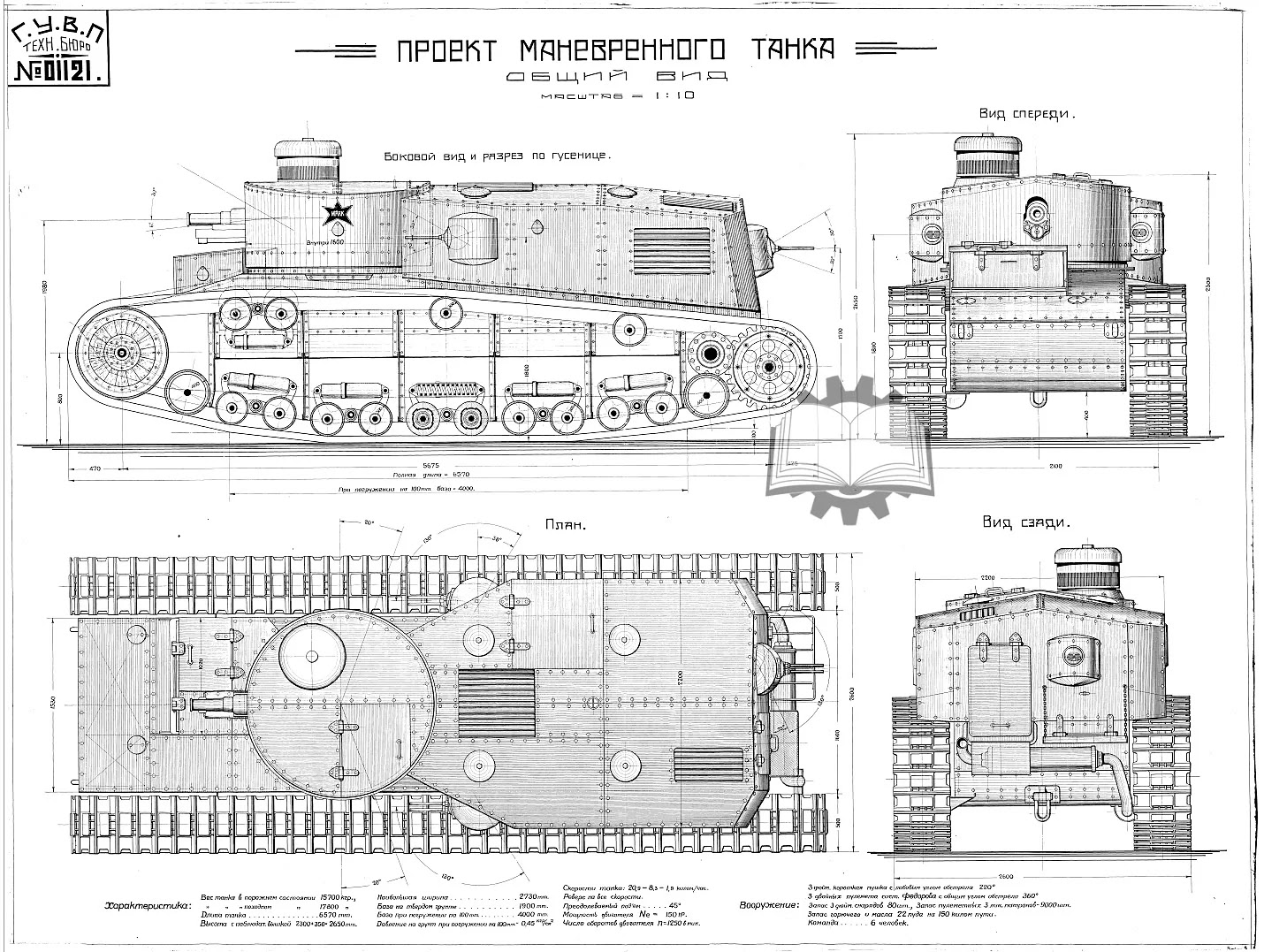
A 16 ton maneuver tank designed by the GUVP. No one ever called this tank "medium".
The most famous Soviet tanks of the interbellum era at BT light tanks. Their high mobility, convertible drive feature, and a certain photogenic quality made them the best known Soviet tank series. One popular theory classified the BT tanks as "highway aggressor tanks" that indicated the offensive nature of the Red Army and popularized the idea that the BT tanks were the Red Army's main tanks. This is only an indicator of how wrong that theory is.
T-26 tanks armed with either only machine guns or both a cannon and a machine gun on parade in Moscow.
When one lists Soviet tank designers, M.I. Koshkin is usually remembered first as one of the main authors of the T-34. He is usually followed by A.A. Morozov, who succeeded Koshkin as the Chief Designer of factory #183 in Kharkov and in Nizhniy Tagil after the evacuation. Zh.Ya. Kotin, the author of many tanks from the KV-1 to the IS-2, also ranks highly. N.A. Astrov, the creator of the T-40, T-60, T-70, and other light vehicles is slightly less famous. However, if one explores an earlier period of Soviet tank building, one will see many other much less known names. Their obscurity is largely due to their complicated history.
One such history belongs to the main character of today's article, Semyon Aleksandrovich Ginzburg. He oversaw the creation of the most numerous and most successful Soviet tanks of the interbellum era: the T-26, BT, T-28, and T-35. As the Chief Engineer at factory #185 he directed the creation of a number of tanks and SPGs. His designs include the T-50 light tank and SU-12 (SU-76) SPG, which played a fatal role in his career. Let us recall this man, whose contribution to Soviet tank building was truly immense. The war for his tanks began back in 1936 and finished in August of 1945 in the Far East.
The 1920s were a transitional time for worldwide tank building. The end of the First World War resulted in a radical decrease of military budgets. Many vehicles were created as designers and commanders ruminated on the experience from the previous war, but most of them remained prototypes.
Italy joined the tank builders' club with its Fiat 3000 light tank, as did Sweden (with what really were German tanks). The USSR continued to develop tanks as well. The Russian Renault, a copy of the Renault FT, was followed by an original tank: the T-18, aka MS-1.
Works on Soviet tank building are published with striking regularity. Some are the results of many years of archival research, but many are based on prior works. There is nothing shameful about this, as skillful compilation is an art of no lesser value than writing from scratch. However, an issue with credibility may arise when picking secondary sources, and even primary documents can contain mistakes often caused by a lack of information. As a result, dozens of myths were built around Soviet tank building over the course of decades that live on today. This article will discuss such myths connected to pre-war tank building in the Soviet Union.
Now that my latest book is off to the publisher and I have some more free time, I decided to experiment a little and put my YouTube channel to good use. Enjoy!
The Red Army accepted the T-18 infantry support tank, better known as the MS-1, into service on July 6th, 1927. This tank was developed by Soviet specialists and was the first truly mass produced domestic tank. The T-18 was the most numerous tank of the 1920s. More of them were built in the USSR than every other country produced tanks altogether.
To People's Commissar of Defense, Marshal of the Soviet Union, comrade Voroshilov
...
Using existing tanks in the Red Army
Existing 862 T-18 tanks should be used as mobile anti-tank guns in fortified regions in the event that modernization results in satisfactory results. Modernization work is currently being performed. If the modernization is unsuccessful, the T-18s should be removed from service and melted down. There are no spare parts for the T-18, and they are not being produced.
Unfortunately, the source doesn't say what year this budget came from. There are some hints though. The T-33 is a precursor of the T-37A tank. A prototype was built in the spring of 1932, but the tank did not do well in trials and was not accepted for mass production. Presumably, this budget was composed shortly before the decision to not produce the tank was made. The T-41 was also an amphibious reconnaissance tank, which underwent trials in the fall of 1932. The fact that Grotte's TG-1 tank is absent from the list altogether and the T-24 is only listed in the spare part production section agrees with this timeframe. This seems about the right time that something like a superheavy tank that cost twice as much as a T-35 would still be considered viable.
Some nuances in record keeping tend to introduce confusion into history. For instance, here we have reports from the 150th Tank Brigade of a tank called T-16 in their ranks.
"1st Tank Battalion, consisting of 3 T-26s, 1 T-16, 2 T-40...
...
2nd Tank Battalion, consisting of 11 BTs, 1 T-16..."
Seems about right. With such a mishmash of vehicles in this unit, some T-16s taken out of storage don't seem too far fetched.
The first tank built in the young Soviet Republic was the "Russian Renault", a poor copy of the most numerous and probably best tank of WWI. It is also known as "Freedom Fighter Comrade Lenin", after the name of the first tank of the batch. There were 15 Russian Renaults built in total at the Krasnoye Sormovo factory in Nizhniy Novgorod under the supervision of visiting engineers from the Putilov and Izhor factories. This group was headed by Sergei Petrovich Shukalov. The Putilov and Obukhov factories were pioneers of the Russian Empire when it came to mastering complicated machinery, and the Izhor factory specialized in producing armoured plates and parts for the Imperial army.
"To Lieutenant-General of the Tank Forces, comrade Fedorenko
Report
I report to you on the current status of armoured telemechanics:
Various organizations (NII-10, NII-20, Red Army NIST) performed work regarding telemechanization of tanks since 1929 under the orders of Red Army US and ABTU. Experimental prototypes of Renault, T-18, T-24, T-37, T-26, T-28, T-20, T-38, and BT-7 teletanks were produced.
By 1935, the issues of automation of the suspension and chemical armament of the tank were resolved, and a commission selected the TOZ-26 T-26 teletank developed by NII-20 as the most suitable teletank out of three experimental T-26 teletanks. This prototype was accepted for mass production. In 1936-37, factory #192 produced 35 groups and another 30 groups in 1938-39, slightly modernized vehicles with the index TOZ-8. In total, 130 special tanks were built, 65 control tanks and 65 teletanks (65 groups).
The Bolshevik factory writes to you with a proposal to produce armoured hulls for the T-18 according to blueprints and technical requirements from the Bolshevik factory. The order can be fulfilled in whichever of two variants you prefer:
"Minutes of the technical meeting of the Technical Department, December 8th, 1930
Topics
Completion of the shock worker quota on experimental mechanization projects.
Planning for 1931. Criteria for experimental tank building for 1931 must be established.
Complete work strictly on time: project approval, completion of blueprints, production of parts.
Blueprints: in the first half of the production period, blueprints should be prepared for the following components:
Engine: case, crankshaft, piston rods, cylinders, countershafts and distribution mechanisms, cylinder heads, covers, tray.
Hull: all parts that need to be riveted.
Suspension: road wheels, idler rim, drive wheels, etc.
The overall drawings should be prepared by the start of production work, component drawings should be finished during production, before assembly.
Intermediates: as agreed.
Production work:
Equipment should be provided by January 15th, 1931.
The work force should be as follows:
Machinist: 20, 4-6th class
Finisher: 1, 5th class
Driller: 1, 5th class The above are the general minimum requirements. If they are not met, the program for 1931 will be downsized or cancelled.
Calculation of work of the experimental tank-tractor group for 1931, production effort (after January 1st, 1931). Note: includes vehicles only, excluding suspension and engines.
Vehicle
Work description
Work pre-production
Work post-production
T-19 with factory engine and suspension
1 vehicle, 1 engine
2000
3000
T-19 with GKB engine and suspension
1 vehicle, 1 engine
10000
200
Motorized 76 mm SPG on T-19 chassis
1 vehicle, 1 engine
3000
1000
76 mm SPG with shortened recoil on T-19 chassis
1 vehicle, 1 engine
3000
1000
Quad 37 mm Rheinmetall AA SPG on the T-19 chassis
1 vehicle, 1 engine
3000
1000
Medium tractor with T-19 suspension and reworked engine
7 suspensions from the 2nd experimental production batch, 4000 each = 28000
6 engines from the 2nd experimental production batch, 5000 each, 30000
1 modernized T-19 engine, 6000
Total 2nd batch: 91000 pre-production, 12000 post-production
Total T-19s: 103000 pre-production, 16000 post-production, 119000 Produce engines with the following schedule:
First engine finished by January 15th
Two months are allotted for trials, until March 15th
Trials of the first T-19 hull and suspension should be done by April 15th
Rolling over from last year:
T-20 engine from the Main Design Bureau
T-12 engine, 180 hp
3.5 ton tractor with a T-18 engine
AMB-700 engine
T-23 tankette
Individual vehicles:
Halftrack tankette with T-20 engine
76 mm mod. 1927 regimental gun on a T-18 chassis
Tank destroyer on a T-18 chassis
T-24 increased power engine
There are 12 months, 14000 man-hours each, from January 1st 1931 to January 1st, 1932. As of December 1st, the engine plant can give us 9000 hours. The addition of 7 lathes, 2 milling tools, and 1 drill press will increase that by 500 hours (in two shifts).
"Minutes of a meeting with the Chief of the Mobilization Planning Directorate of the RKKA
October 24th, 1925
Present:
Directorate chief, comrade Volpe
Special Artillery Department chief, comrade Tonilov
Artillery committee member, comrade Rozhkov
GUVP Tank Bureau chief, comrade Shukalov
Chair: comrade Volpe.
Secretary: comrade Pleshkov.
Topic: on supplying the Red Army with tanks. Presenter: Volpe.
It is necessary to define measures and deadlines to equip the Red Army with tanks. Suggestions:
Rely on domestic production, using imports as auxiliaries.
Investigate the following parts of the issue separately:
Importing tanks: capabilities, types, amount.
Existing domestic tanks and domestic tank building.
Design and the future of tank building.
On the issue of importing tanks, comrades Shukalov and Tonilov:
Last year (1924) we received an offer from Italy to buy no less than 10 Fiat-3000 tanks. Regarding France and England, the issue of buying tanks cannot be resolved due to political reasons.
As a result of preliminary preparations by the GUVP Tank Bureau and Artillery Committee with the Artillery Inspectorate, consider the following models compatible with technical requirements of the Red Army:
Support tank, Fiat-3000, Italy
Support tank: Meniliet, France
Maneuver tank: V-9, England.
Consider it necessary to purchase one or two of each tank from abroad as experimental machines for study by GUVP engineers. In case of a denial, buy only minimal amounts of Fiat-3000 and V-9 tanks, in the amount of an RKKA tank unit, with an additional tank for use by GUVP.
Ask the Revolutionary Military Council to give orders to the People's Commissariat of External Trade to determine the ability to purchase these tanks, the minimal amount, cost, and time of fulfilling that order.
Buy two Card motors (America) as samples for installing in a maneuver tank and for design work to produce a domestic tank engine.
On domestic tanks and tank designs, comrade Shukalov:
A support tank has been designed (air cooled, 37 mm gun), and is currently being examined by the Artillery Committee. Blueprints and descriptions have been given to the Obukhov factory, with the aim of producing an experimental prototype by August 1925. The issue of mass production of these tanks can be resolved by Spring of 1927.
Decision: GUVP ensures that the work at the Bolshevik factory on a support tank is completed in time. The Artillery Committee finishes the examination of blueprints and descriptions, and sends the results promptly to the GUVP Tank Bureau.
On domestic design work, comrade Shukalov:
Work is being done to equip the support tank with a water cooled engine.
A maneuver tank with a 45 mm gun is being designed.
The design of a positional tank is postponed due to a lot of work at the Tank Bureau.
Decision: Taking into account difficulty with supplies and variety of armament, the GUVP Tank Bureau and Artillery Committee should build a support tank that uses a regimental gun (three units).
Continue work on a maneuver tank, and finish it by June of 1926.
Aim for unification of armament. Define a positional tank in general terms only. Determine the most suitable tank we can produce.
As usual, the indices are a little obscure, so let's go through them. The V-9 (9-ton Vickers) is a Vickers Medium Tank Mk. I. No idea what a Meniliet is (maybe they meant Chenillette), but the "support tank" is quite obviously an MS-1, leading me to believe that the "support tank with a regimental cannon" is a SU-18. The "maneuver tank" is a T-12, which was eventually finished and went through trials in December of 1929 (unsatisfactorily). A "positional tank" is a heavy tank. One was indeed designed at the Bolshevik factory in the coming years (T-30), but was considered too complicated to build.
Another interesting part of the document is the reference to the Bolshevik factory by its old name: "Obukhov factory". The name changed in 1922, but it looks like some people were still slipping up and using the old name.
In 2002, he initiated a search for an MS-1 hull near the Russian-Chinese border, where several of these tanks were installed and then torn out of the ground when they became completely obsolete even as bunkers. He succeeded, although the brutal treatment of the tank was evident: the roof of the fighting compartment and turret were missing.
Major Igor Maltsev is the MS-1 hull. Top: Evgeniy Rybakov, Rafik Kudzhayev, Captain Vitaliy Zykov.
The tank is being dug out during April of 2003.
The turret was found separately, in another border zone, spotted accidentally from the window of a moving car. The turret is equipped with a mantlet for two DT machineguns instead of a cannon.
The hull and turret, dug up in and indoors.
In order to avoid the abominations linked to above, new road wheels must be made. If you want to see how to make MS-1 road wheels out of T-55 shock absorbers, look no further than these blueprints.
And here's what the finished product looks like:
Many photographs and materials are examined to recreate the track precisely. Here is a wooden mockup.
The original engine is long gone, but a Komatsu excavator offers a suitable replacement.
While tracks are out for casting, the restoration team is working on the hull. There is a new roof and engine compartment bulkhead.
The hull roof is ready, and the turret ring is populated with ball bearings. The turret spins when placed on top, but not freely. The bearings are not lubricated, and the underside of the turret is still covered in debris.
The suspension is nearly complete! There were financial difficulties in the process of casting an entire new set of tracks, and so it was necessary to use the excavator track.
The front idlers and axles are being put in place.
The tank is ready for a test drive!
The most important part is done, now to spice up the interior.
Insides are done, but the armament still needs some finishing touches.
interest86 writes about his completed vehicle: "After installing the gun and machinegun, the turret became very cramped, and it was not a place for someone with my frame. The vehicle is very inconvenient for the crew in general. The driver has no back to his seat, and this is very difficult. One immediately gets the idea to insert an improvised back after a few minutes out of something like a board, which can be easily inserted between the shelves and fighting compartment bulkhead.
After years of labours, the tank is up and running!
More words from the man responsible for this feat: "The work took about three years, but preparing for the restoration took even more time. We needed to retain all technical subtleties, so it was not just a copy, but as close to possible to the original. It is known that this tank participated in the events at Lake Hasan. To this day, no more than 5 tanks of this kind remain. Experts already admit that our tank is the closest to the original."
"Report of the Artillery Directorate of the Supplies Directorate on achievements from 1925 to 1928
Part 2: Scientific research work on improving armament (Artkom)
Moscow, 1929
The army's technical strength is a consequence of the technical and cultural condition of the country.
Between exiting the World War in 1917 and until the end of the Civil War, the USSR was completely cut off from the West for four years. This, as well as the destruction of industry and a lack of materials and production capacity impeded any development of an armament improvement program.
Artkom places three principles into the development of artillery technology, same as in the West: surprise, mass, and depth.
The principle of surprise is achieved in the following ways:
Increasing mobility, primarily operational mobility (wide use of mechanical transport, development of railroad artillery).
Development of methods that permit opening lethal fire immediately (such as use of land or air observers).
The principle of mass involves admitting that artillery can only be effective when used in massed amounts. It is necessary to strengthen artillery as a type of forces and establish a powerful Supreme Command reserve, as well as centralized control of artillery in battle.
The principle of depth is achieved by increasing the range of all guns and increasing the horizontal and vertical field of fire.
Requirements for new artillery systems that solve the issues of modern war are composed considering the following factors:
Widespread use of aircraft.
Group infantry tactics and use of defense in depth, using both natural terrain and artificial fortifications.
Widespread use of tanks.
Use of chemical weapons.
Considering the above, it is suggested that a new system of armament should be developed and taken as the baseline.
Existing weapons should be evaluated from the point of view of the new system.
A realistic plan of improvements should be adopted, and weapons that cannot be adapted to the new system must be found out.
A realistic plan for development of new designs that satisfy the new system must be created. However, this path is long, so the first stage is defined by Artkom to be:
Modernization of existing designs.
Creation of new designs, made necessary by tactics of modern battle.
Modernization is defined by Artkom as changes made to a design that improve its characteristics according to the new tactical-technical requirements without interfering with production and acceptable according to economic and supply considerations.
In order to better describe work performed in the past years on modernization and development of new designs, let us briefly describe the state of armament in 1925, analyze it, and attempt to evaluate the modernization work based on this analysis.
...
In 1925, support tanks with a special domestic tank motor were sent to the Bolshevik factory with the aim of producing the first batch in 1928. Work proceeded mostly as follows:
1926: working blueprints were finished, production began.
1927: trials were performed, the first production batch was organized.
1928: mass production of the MS-1 began, working blueprints of the T-12 maneuver tank were completed, work on a one-man tank began.
Modernization of existing B and M tanks was scheduled.
Existing tank
Modernization
Replacement
B tank (breakthrough)
Planned
T-12
S tank (maneuver)
M tank (support)
Planned
One-man tank
Foreign achievements
Maneuver
Support
England
USSR
Czechoslovakia
USSR
Vickers
T-12
KN convertible drive
MS-1
Mass (tons)
12.2
16
8.5
5.9
Crew
5
4-5
2
2
Fuel capacity (liters)
410
-
100
100
Range (hours)
10
8
8
11
Cannons
1
1
1
1
Machineguns
4
3 coax
1
1
Maximum speed
25
25.5
14.2
16
Front and side armour (mm)
14
22
13
16
Roof armour (mm)
8
12
10
8
Maximum traversible trench width (meters)
1.83
2.6
1.8
1.8
Maximum fording depth (meters)
1.2
1.2
0.8
0.8
Maximum grade (degrees)
40
40
35
40
Armament of tanks and armoured cars
In 1926, the following weapons were available:
37 mm Hotchkiss tank gun
57 mm Hotchkiss tank gun
0.303 inch Hotchkiss machinegun
The last two weapon types were captured.
As a result of proving grounds trials, it was discovered that existing cannons and machineguns were hard to use, and a series of improvements for the 37 mm Hotchkiss gun was defined.
Orders were made for a 45 mm tank gun that could replace captured armament. Work began on using Fedorov machineguns instead of captured ones.
1927:
A special shoulder stock was designed for the 37 mm Hotchkiss gun, with sights and a trigger mechanism, and production started for existing tanks. At the same time, changes were made to the gun mantlet to increase horizontal traverse range.
A new mount for 37 mm Hotchkiss guns was designed and tested for new tanks and armoured cars.
A mount for two coaxial Fedorov Avtomats was tested, and a mount for the Degtyaryev machinegun was designed. Orders were made for a high power 37 mm tank gun.
1928:
The Degtyaryev tank machinegun mount was designed and entered production for both new vehicles and replacement of machineguns captured vehicles. Production of a special 37 mm tank gun started.
A 45 mm gun is being tested for maneuver tanks and replacement of captured B tanks.
A universal stock for 37 mm Hotchkiss guns with an optical sight was designed.
Supplies of tank columns:
Aside from battle vehicles, it is necessary to equip tank units with tracked tractors and trailers, capable of following a tank unit on marches and transporting personnel (commanders, scouts, communications personnel, support personnel) with their belongings and supplies (ammunition, fuel, lubricant, etc). The speed of these tractors should be no less than that of tanks, and their off-road performance should allow them to follow tanks on any terrain.
It is necessary to limit the number of different types of these tanks due to our limited manufacturing capacity and to reap the benefits of having one chassis. This suggests that such a tractor should use as many existing tank components as possible.
Initially, a light tractor based on the standard MS-1 tank was developed, with a maximum speed that is equal to the maximum speed of the tank, even when it is towing a trailer. The trailer is in development, with the aim to make it compatible with existing trailers in order to provide mechanized transport for artillery.
Conclusions
By 1929, after four years of research, design, construction, and trials, tank building work is underway at three factories. The RKKA will receive its first domestically designed support tank, smallest in its weight class, with an air cooled engine, with high off-road performance, high speed that allows it to support infantry and cavalry on marches and in battle, armour that is invincible against regular riflemen, with armament that allows it to complete objectives for the tanks of this type (fighting infantry and enemy positions at ranges of effective fire during tank attacks). Tanks are capable of fighting against tanks with analogous armour at straight shot ranges. Experimental 37 mm guns that are more appropriate for a modern battlefield are in development, and orders for production will be made after they finish trials. Simultaneously with production of the tank, the issue of tractors and auxiliary vehicles is being solved.
An experimental maneuver tank has been designed and is being assembled.
The first tankette is finishing trials. Its components and design, first used in our industry, will be studied in the summer of 1929 to obtain data required for a design to be assembled in 1930 that will be acceptable for use by the army.
When the three required types of tanks are completed, the issue of arming the RKKA with tanks that match our closest enemies will be resolved.
The path of motorization of the RKKA is inevitable, as we cannot afford to provide an advantage to our enemies. This challenges the AU to design new tanks that fully match the requirements provided by the RKKA, which need significant technical and tactical research to define.
Artkom's current priority is increasing the movement speed of support tanks without decreasing other combat characteristics.
The issues of radio communications, AA defenses, poison gas protection, smokescreens, and transport on wheeled trailers on roads will be solved in the near future."