
Fosters of Lincoln Ltd. built tanks during the First World War, but returned to peaceful products after its conclusion, as the military no longer needed new tanks. When the situation began to change and the Mechanical Warfare Board was established in 1928, Sir William Tritton offered his help, but was rudely rejected. The reverse took place a few years later: when approached for help, Tritton refused. Fosters was doing fine without the army. Its factories were loaded with orders for consumer goods, and it was not worth his time to deal with the military for miserly contracts. However, peace did not last forever. 1939 came and with it, war.
A colossus from yesterday’s war
Talk of bringing seasoned tank designers out of retirement began in the summer of 1939. Words became actions in the fall. On September 5th, the Director of Mechanization Major General Davidson invited Sir Albert Stern, the designer of the famous British rhomboid tanks, to develop a “special tank”. On October 12th, 1939, the Minister of Supply Leslie Burgin created the Special Vehicle Design Committee within his fledgling ministry. The committee included Tritton, Ricardo (the developer of WWI era tank engines), and Major General Sir Ernest Swinton, among other engineers and soldiers. As many of these men had experience in designing tanks during the First World War, the committee was nicknamed TOG (The Old Group or The Old Gang).
The committee’s task was to develop a tank that could cross a 16 foot (4.9 meter) wide trench, climb 7 foot (2.1 m) tall wall, and have enough armour around the perimeter to protect from 37 and 47 mm anti-tank guns and 105 mm howitzers at 100 yards (91 m). The estimated mass of such a vehicle was 70-75 tons. This colossus would be armed with 2-pounder guns in sponsons and a field gun in the front of the hull capable of penetrating up to 7 feet (2.1 meters) of reinforced concrete as well as machine guns and smoke bomb launchers. The crew was composed of “just” 8 men. According to Sir Edmund Ironside, the Chief of the Imperial General Staff, this tank would be needed at least a year from now, but work on it should start immediately. This project was designated “superheavy tank - land battleship”.
The tank was not created in an information vacuum. Members of the SVDC spent November 24th-30th in Paris, familiarizing themselves with the latest advances in French tank technology. Representatives of the British General Staff and others from the military were also present. The draft project of the new tank was ready soon after, on December 19th, 1939. Stern expected his tank to require 2.5-4“ (63-102 mm) of cemented armour and inquired at the admiralty about producing it.
The designers presented a model of their new tank to a military commission on December 21st. The tank was quite original for a group of old men, although not entirely satisfactory. The tank had a fairly large turret that could fit a 3” AA gun or 25-pounder. The tracks passed through an armoured conduit, which protected them from damage. The tank was rejected. The military requested a more conservative vehicle closer to old “rhombus” tanks. The new tank needed tracks that wrapped around the whole hull. No turret was needed; all armament would be installed in sponsons. The requirement for a field gun was removed, and no effort would be taken to equip the tank with a more powerful gun.
The designers began working on a new tank on January 11th. A model of the new vehicle was ready on February 29th. This is when the tank received a name: TOG 1. This tank weighed 55-60 tons with 2-4”(51-102 mm) thick armour. The armour was attached to a mild steel skin ⅜” (9.5 mm) thick. The committee estimated that such a tank could be built by June. Since the SDVC presented itself as a group of designers rather than manufacturers, there was no plan to build this tank at Fosters. The SVDC estimated that production of these tanks could reach 40 per month by November and a sufficient amount would be available “for the 1941 campaign”. No mention was made of what factory or factories was supposed to build them.
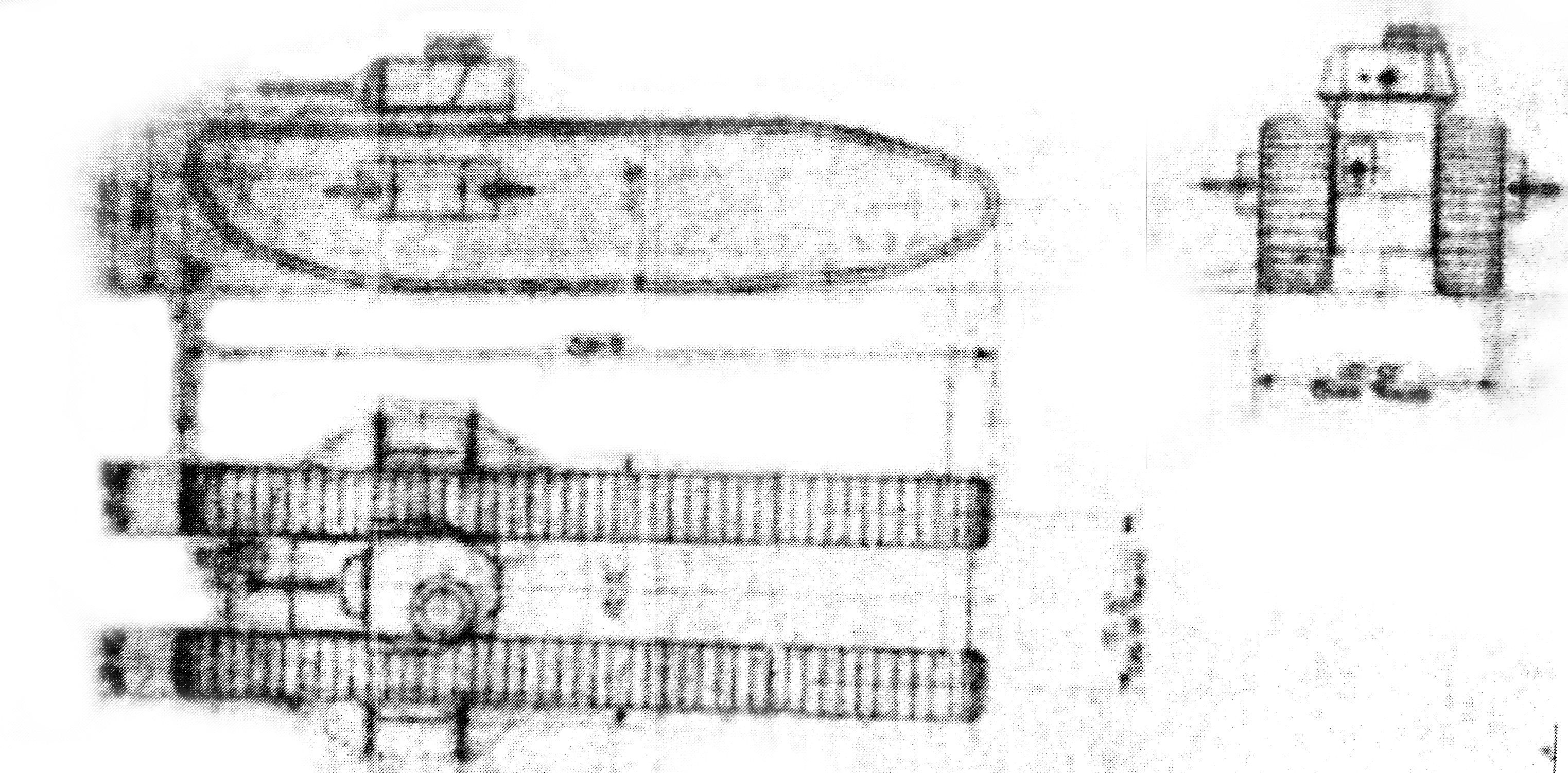 |
| The TOG 1 was quite archaic. A 75 mm cannon was located in the front and 2-pounder guns in sponsons. The turret was not required by the customer. |

