Showing posts with label Valentine. Show all posts

Monday, 17 November 2025

Russo-American Tank Destroyer

One of the key problems with using foreign tanks is keeping a steady supply of spare parts and ammunition. This problem is not exclusive to captured tanks. A similar situation often took place with vehicles that were sent willingly. For example, a lack of ammunition delayed the arrival of American tanks on the battlefields of the Eastern Front by several months. These shortages happened more than once. It is not surprising that arming foreign tanks with domestic guns was a frequently suggested solution.

S-1 (SU-76I), the first design of the TsAKB. The bureau had some experience in re-arming foreign chassis.

It just so happened that the best results in rearming foreign tanks were achieved by the design bureaus of factory #92 and factory #592. The first only offered experimental solutions, but the latter built a small batch of SG-122 SPGs. Specialists from both bureaus were later united in one organization: the Central Artillery Design Bureau (TsAKB). Their first project, the S-1, was a part of rearming a foreign tank (SU-76I). It’s not surprising that new rearmament projects followed, including grassroots proposals.

Wednesday, 12 November 2025

Video: Best Foreign Tank of the Red Army

The Red Army operated a number of foreign tanks, but only one was the clear favourite of Soviet tank units for the majority of the war. See which one it was in my latest video, the answer may surprise you!


Tuesday, 27 February 2024

Foreign Tanks in Winter

 "Report on the tactical use of English made MK-2 and MK-3 tanks as well as domestic T-60 tanks in combat

1. The 23rd Tank Brigade was engaged in nonstop fighting from December 16th to December 31st, 1941, and has experience in using MK-2, MK-3, and T-60 tanks in battle.

2. Driving in a tank column made of MK-2, MK-3, and T-60 tanks on a road does not pose a problem if the road was previously used by horse-drawn transport. If the road was not used, the MK-2 and MK-3 can push their way through 40-45 cm deep snow losing speed (the MK-2 can drive well in 3rd gear, the MK-3 in 1st or 2nd gear). The T-60 can't drive in snow this deep without following a path made by horse-drawn transport or medium tanks. It is impossible to drive individual tank columns made only of T-60 tanks in snow this deep. 

There is no particular difficulty when tanks of these types drive on country roads, the specifics of their driving remain the same. 

Thursday, 21 December 2023

British Tanks in 1943

 "Report on use of foreign MK-2 [Matilda] and MK-3 [Valentine] tanks in combat

1. General characteristics

Since the brigade was created on March 25th, 1942, it was armed with MK-2 and MK-3 tanks. The latter showed themselves well in battle as infantry support tanks in all sorts of battles. There were also cases of using them to combat enemy tanks (Pz.Kpfw.III, Pz.Kpfw.IV) at close ranges (200-600 meters), especially from ambush in defensive fighting.

The off-road mobility and maneuverability of the MK-2 and MK-3 tanks is insufficient compared to the T-34 in all types and periods of battle. The MK-2 tank in particular is not very mobile even on even terrain. In cases where it needs to turn 360 degrees, its turning radius is 15 meters. The tracks often fall off on sharp turns. The limit of the slopes it can climb or descend in winter, rainy, or damp weather is 15-18 degrees. 

The dimensions of the MK-3 tank allow it to get up close to the enemy using terrain features as cover and take them by surprise. In winter, the depth of the snow conceals it from enemy fire. MK-2 and MK-3 tanks have a clearance of 420 mm with a ground pressure of 0.60 [kg/cm²] when the tracks are submerged by 100 mm. In the winter, they can drive through 50-60 cm deep snow, which allows them to drive on country roads and off-road. If anti-tank obstacles need to be crossed, they can cross a 0.75 m tall wall, ford a one meter deep stream, cross an anti-tank trench [figure missing] wide. In the winter they can handle 18 degree slopes, in the summer and in dry weather they can handle 30 degree slopes.

Monday, 31 July 2023

Soviet Armour for the British Valentine

History knows many tanks that were created from a grassroots initiative and treated with scepticism by the army, but evolved to become some of the most popular tanks. There are at least two such tanks that made their mark in the Second World War. The first was the Pz.Kpfw.IV. Krupp was originally only entrusted with the turret, but the conglomerate successfully pushed for permission to build two prototypes. As a result, the B.W. (Kp) easily demolished the B.W. (Rh) and survived several attempts to take it out of production. The first battles showed that the Pz.Kpfw.IV was the best tank Germany. had. In 1942 it also turned out that the Pz.Kpfw.IV could take on a long 75 mm gun, but the Pz.Kpfw.III could not. As a result, the Pz.Kpfw.IV became Germany's most numerous tank.

The second example is the Infantry Tank Mk.III or Valentine. Its creation was entirely opposed by the British army but in the end were forced to order it anyway. It turned out that Leslie Little, Vickers' main tank designer, made the right decisions. He successfully fought off the War Ministry's attempts to "improve" his creation and avoided overloading the chassis. The result was the most numerous British tank of the war. Formally, the British withdrew it from the front lines in the spring of 1943, but in reality it kept fighting until May of 1945, again against the army's best attempts.

A Soviet Valentine lost to a hit from a 75 mm Pak 40. The appearance of this gun was a big contribution to work on improving the tank.

Wednesday, 26 April 2023

Canada's Valentines

The British War Ministry had no illusions about how the situation in Europe would develop, even in 1938. The policy of appeasement was adopted to postpone the inevitable large conflict, which the kingdom’s military was not prepared for. The situation continued to escalate in the summer of 1939, but the British were still not ready for a full blown war. Cruiser tanks only entered service in 1939, and infantry tanks, with the exception of the Infantry Tank Mk.I, were not even in production. Meanwhile, observers from across the Atlantic Ocean monitored the situation in Europe carefully. The United States began production of the Medium Tank M2 and trials of the Light Tank M2A4. They knew that if a war broke in Europe, they would be drawn into it sooner or later.

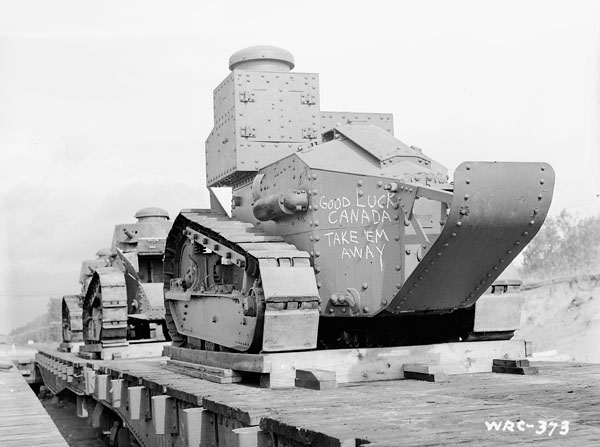
Similar sentiments were not uncommon in Canada, but hardly any preparations were being made for war. Unlike the United States or Great Britain, Canada had no tank building tradition. The Canadian armoured battalions that were established during the First World War came too late to take part in the fighting. The Canadian army was not mechanized during the interbellum, and had almost no tanks of its own at the start of the Second World War. Nevertheless, a proposal was made to create a Canadian tank force once more after the fall of Poland in 1939. Mechanization of cavalry units, both of the Permanent and the Non-Permanent Active Militia, was on the table. It quickly became clear that it would be impossible to arm a tank force without setting up domestic tank production. 219 obsolete M1917 light tanks that were purchased from the United States at scrap value, but they were useful for training and not much else.

Facing a shortage of armoured vehicles of every kind, Canada purchased worn out and obsolete M1917 Light Tanks from the US at scrap value. These tanks were worth little more than scrap.

Wednesday, 15 March 2023

Tanks Worth Their Weight in Gold

Ways in which Germany could have been victorious in WW2 are still a popular topic of discussion in some circles. One can often hear the claim that the war on the Eastern Front would have ended in 1941 with the fall of Moscow if not for the timely appearance of Lend Lease tanks, issued to the USSR free of charge. As common as this argument is, it has little basis in the truth. Let us see what Western tanks appeared in the USSR and when, and what effect these vehicles had on the course of the war.

Before Lend Lease

For starters, let us clarify what Lend Lease actually was and what it had to do with military assistance to the USSR. The Act to Promote the Defense of the United States was signed into law by the 77th Congress of the United States on March 11th, 1941. It gave the president of the still neutral country the ability to supply weapons, transport, tools, raw materials, agricultural or industrial machinery to any nation whose protection was considered vital to the defense of the United States. The term “lend lease” was derived from the ability to “sell, transfer title to, exchange, lease, lend, or otherwise dispose of” any of the aforementioned items to these nations granted by this act. While the president of the United States had the power to give them away for free, that was far from his only option.

Matilda tanks earmarked for the USSR.

Monday, 30 January 2023

Tanks in Snow 1941-42

Winter is a difficult time for any kind of vehicle, including tanks. Since the Russian winter is long, the USSR paid a lot of attention to how tanks put up with it. This applied in full to mobility in winter. Driving through deep snow banks was a mandatory part of testing every armoured vehicle starting with the MS-1. The MS-1 showed insufficient traction in snow, which is a part of the reason why the "Eagle's Claw" track was introduced. Winter tests of the Vickers Mk.E tank in the USSR were also a key factor in accepting the tank into production

T-34 tanks were often the only Soviet tanks that could move outside of roads in winter.

Friday, 7 October 2022

Deliveries

 "Table of arrivals of tanks at the front lines in 1941, by type

Type

Domestic

British

American

Total

Month

KV

T-34

T-60

T-70

Mk.II

Mk.III

Mk.IV

M3 S

M3 L

Total 1941


20,740

Jan

126

206

348

-

-

16

-

-

-

696

Feb

165

420

260

-

-

-

-

-

-

845

Mar

105

338

84

-

-

-

-

-

-

527

Apr

320

702

576

-

134

144

-

14

32

1922

May

350

1003

898

-

255

171

-

30

16

2723

Jun

199

698

657

103

-

74

-

144

222

2091

Jul

299

1177

746

371

86

44

-

66

91

2880

Aug

178

1378

250

583

10

63

-

35

98

2595

Sep

45

598

-

439

-

72

-

54

43

1251

Oct

160

1100

75

640

-

10

-

24

5

2024

Nov

215

1312

-

838

85

163

-

187

61

2861

Dec

239

1678

48

1026

-

-

42

23

16

3072

Total 1942

Total domestic:  20,957

Total foreign: 2530

23,487

"

Via Alexey Isayev

This data is interesting on its own, but it's also interesting to compare to deliveries of foreign tanks. The first Matilda and Valentine tanks began arriving during the Battle for Moscow and were thrown into battle with little preparation. As you can see in the above table, once the situation stabilized a little bit it took some time before new units with British tanks could be properly outfitted. Large deployments of Matildas and Valentines only take place in April, four months after deliveries began.

A similar picture can be seen with American tanks. The first shipments arrived in January of 1942 and we start seeing a small number of these tanks on the battlefield in April-May, 4-5 months later. Once the pipeline was set up, it was not as hard to deploy new tanks. A bump shipments that came in May hits the front lines in June. A lot of tanks were tied up in delivery by the end of the year: 3875 foreign tanks were delivered to the USSR in 1941-1942, but only 2530 were actually fielded before the end of 1942.

You can see the same pattern with Soviet tanks. Evacuation of factory #183, the USSR's largest producer of the T-34 tank, began in September of 1941. The factory began to set up in the Urals in December-January, and by May of 1941 you see a spike in deliveries of T-34 tanks. Similarly, production of the T-70 was authorized in March of 1942 and we see these tanks begin to arrive on the front lines in July.