Showing posts with label KV-8. Show all posts

Friday, 25 November 2022

Firebreathing KV from Chelyabinsk

Flamethrower tanks were not a rarity in the Red Army. Work on chemical tanks began in the early 1930s. Initially, they were meant to deploy chemical weapons, but “universal” chemical tanks appeared soon after that. The first of them was the KhT-26, a vehicle on the T-26 tank chassis that could fire both poison substances and flame. As a result of trials, the flamethrower mode became the priority. The KhT-26 was succeeded by the KhT-130 based on the single turreted variant of the tank. The last variant was the KhT-133, the same vehicle but based on a T-26 with a conical turret and sloped turret platform sides. The last tanks were delivered in 1940 when the concept of a “universal” chemical tank had already died. The requirements for flamethrower tanks also changed.


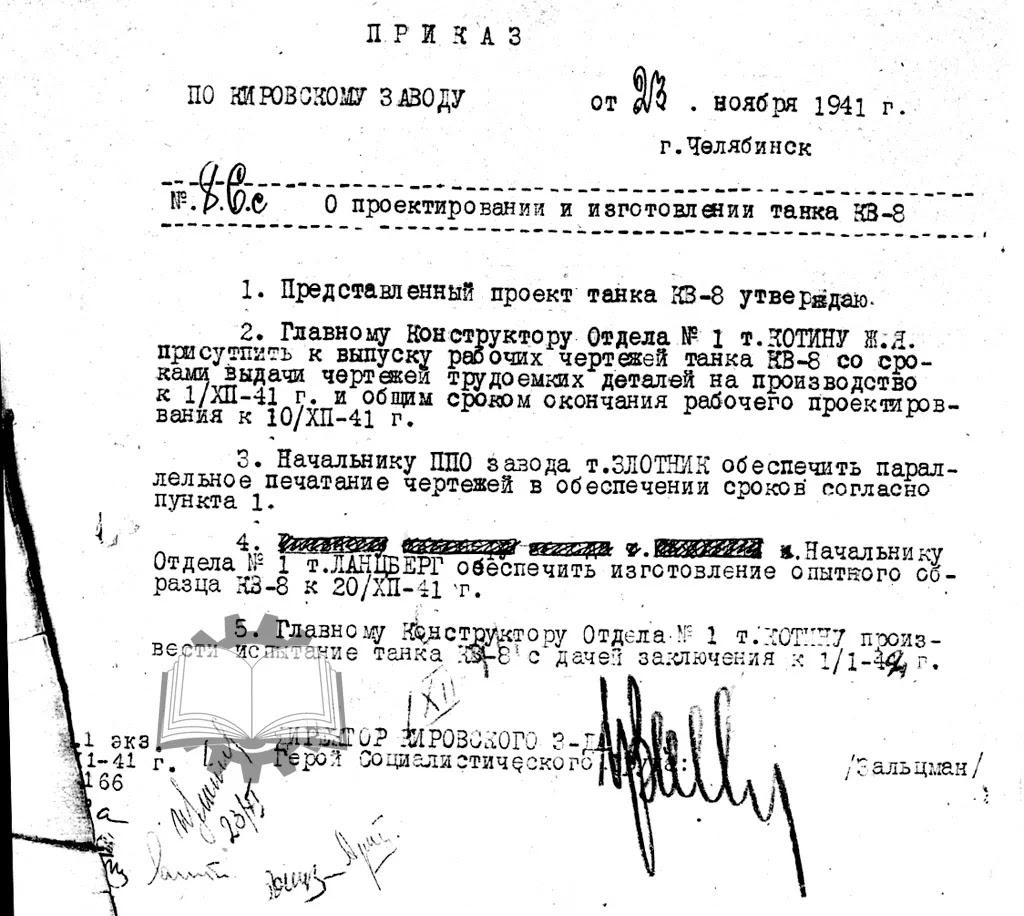
The KV-8 formed by the end of November of 1941 alongside the KV-7.

The experience of using chemical tanks showed that the concept had many drawbacks. In addition to a short range of the flamethrower, a lack of main gun proved to be a problem. The flamethrower could be a secondary weapon, but not a primary one. Starting in 1940, development switched to tanks with flamethrowers in the hull and a cannon in the turret. There were several variants developed, but it ended up on the upper front hull. The gunpowder flamethrower developed by factory #174 by a group led by I.A. Aristo. The flamethrower was supposed to be installed in the T-34, KV, and T-50, but flamethrowers in the T-34 and KV-1 were incredibly rare in 1941. At this point work on flamethrowers split. The T-34 and KV-1 had their own approaches to the flamethrower.

A prototype was ready by the end of December of 1941.

Wednesday, 4 November 2020

Flamethrower Tanks

"Excerpt from the trip report to the Volkhov Front

The 502nd and 503rd Independent Tank Battalions used flamethrower tanks rarely, but the commanders and crews still praise highly the effect of flamethrowers in battle. For instance, the commissar of the 502nd ITB stated that the flamethrowers were used rarely only because the terrain got in the way and that German infantry flees in advance of the tanks to keep out of range. The effectiveness is high. When flamethrowers are used, the enemy runs from dugouts and abandons everything.

A driver of a KV-8 tank, comrade Paturnak, tells had he made only 4 shots from his flamethrower. An anti-tank gun fired at the tank, but as soon as a flamethrower burst was fired towards the gun the gun crew fled and two Germans fell down in shock and were then crushed by the tank's tracks.

The commander of the 503rd ITB, Captain Drozdov, stated that when using flamethrowers near Gontovaya Lipka the fuel did not reach the enemy positions, but they fled in panic. However, he considers it unreasonable to use flamethrowers in forested swamps.

The commander of the 507th ITB, Major Nikolayevtsev, tells that a KV-8 tank commanded by political coordinator Osatyuk fired 15 shots at infantry hidden in bushes. The infantry fled in panic. A portion of the fascists ran while on fire. One KV-8 tank used flamethrowers at night. The Germans ran in panic, tearing off burning clothes and even underwear.

The commanders of the 507th ITB reported to the 8th Army that "the flamethrowers fulfilled their mission" and later, after a description of drawbacks encountered during exercises near Kuzminka, writes that "after these drawbacks are corrected, this will be an excellent weapon to use against the enemy."

Another report to the same organization states that "the flamethrower is an excellent weapon for use against counterattacking infantry in forested swamps... practice shows that the effect on the enemy at night is terrifying. During an attack on the night of August 30th-31st near point 40.4 and in the sector of the 24th Guards Rifle Division the Germans fled in panic, throwing off their equipment and underwear".

All flamethrower battalions on the Volkhov Front mainly used KV-8 tanks. T-O34 tanks used their flamethrowers rarely."


Tuesday, 6 November 2018

Winding Down

"To comrade V. Molotov

In accordance with your decree on May 15th, 1943, on the letter from GAU Chief comrade Yakovlev regarding reducing the supply of tank guns for SU-122 and SU-76 SPGs in the second quarter of 1943, I report the following:

The GAU (comrade Yakovlev) asks to reduce the quota for the second quarter compared to what was approved by the GOKO #3292 on May 6th, 1943, for production of the SU-76, SU-122, and KV-8S:
  • 76 mm ZIS-3 divisional guns: from 350 to 250
  • 122 mm M-30 mod. 1938 howitzers: from 400 to 340
Cancel the order for 30 45 mm guns with the ZIS-5 elevation mechanism completely.

Regarding the reduction of 122 mm howitzers, comrade Yakovlev refers to the closeness of factory #9 and the Uralmash factory, for which it is satisfactory to have a two-week buffer of howitzers, no more than 65 units, but the factory does not have that many.

The People's Commissar of Tank Production (comrade Zaltsmann) does not disagree with comrade Yakovlev's proposal.

The GBTU (comrade Afonin) disagrees only with the reduction of M-30 howitzer supplies to Uralmash, as the reserve at Uralmash as of May 1st is only 12 units. Given that the quota for SU-122 SPGs in the second quarter of 1943 is 315, the reduction of howitzer supplies to 340 is excessive, especially since it does not fill the GAU's reserve for two weeks of production in the amount of 65 units.

I consider it reasonable to accept the proposal of comrade Yakovlev, with the exception of maintaining the amount of M-30 howitzers at 400 units.

E. Kruglov."

Monday, 4 January 2016

Kirov Factory 1941-1945

Any company likes to toot its horn about its accomplishments, and the Kirov Factory is no exception. Here are posters commemorating their work during the Great Patriotic War:


"Kirov factory in the Patriotic War. Ural, 1941-1945"


"During the war, the factory created 13 types of heavy tanks and SPGs.
  • KV-2 tank, 1940, before the war.
  • KV-1 tank, 2371 produced in 1941-1942
  • KV-1S tank, 1106 produced in 1942-1943
  • KV-8 flamethrower tank, 42 produced in 1942 


  • KV-8S flamethrower tank, 25 produced in 1942
  • SU-152, 671 produced in 1942-1943
  • KV-85 tank, 148 produced in 1943
  • T-34 tank designed at factory #183, 5094 produced
  • IS-85 tank, 107 produced in 1943
  • ISU-152, 1875 produced in 1943-1945


  • ISU-122, 1435 produced in 1944-1945
  • ISU-122S, 475 produced in 1944-1945
  • IS-2 tank, 3380 produced in 1944-1945
  • IS-3 tank, 130 produced in 1945
  • 701 tank, 1944-1945, recommended for adoption by the army
In total, the factory built 16859 tanks and SPGs during the war."

Thursday, 20 August 2015

KV-7 and KV-8 Trials

"Act of Examination and Practical Gunnery Trials of Experimental KV-7 and KV-8 Prototypes produced by the Kirov Factory

The examination of tanks happened on January 5th, 1942, at the factory #8 proving grounds at Mytishi. Present: [long list of names]

KV-7 Tank

The experimental KV-7 breakthrough tank has a suspension and transmission identical to the production KV-1 tank. Instead of a turret with 360 degrees of traverse, it has an immobile casemate with three guns, two of which are 45 mm guns and one of which is 76 mm (F-34). The guns have horizontal traverse of +/- 7.5 degrees, -5 degrees of depression, and 15 degrees of elevation. The guns have separate triggers. There are also two DT machineguns.
Ammunition: 200 45 mm shells and 93 76 mm shells.
The front armour is 100 mm thick, the turret armour is 105 mm thick, and the gun mantlet is 100 mm thick.
Crew: 6.
After inspection and trials, the following was observed:
  1. The driving performance is satisfactory.
  2. The armour of the hull and turret is insufficient.
  3. The practical rate of fire (5-6 volleys per minute) is satisfactory.
  4. The layout of the guns is satisfactory.
  5. The precision is unsatisfactory.
It is necessary to:
  1. Increase the turret armour thickness to 115-120 mm, increase the front hull armour to 110 mm.
  2. In order to improve gun precision, rework the turning mechanism of the gun mount. Improve the optical sight installation. Improve the firing mechanism in order to fire from all three guns at once.
  3. Consider it necessary to subject one of the January-February production tanks  to further trials according to the UVNA GAU KA standards in order to evaluate the correction of aforementioned flaws in the pre-production batch.
    Trials must be performed before February 15th, 1942.
KV-8 tank

The experimental KV-8 flamethrower tank has a suspension, transmission, and armour identical to the production KV-1 tank. The tank turret has a 45 mm gun with an ATO-1 flamethrower and a DT machinegun instead of a 76 mm gun with a DT machinegun.
The angle of elevation of the armament is 20 degrees. The angle of depression is -5 degrees. The turret can rotate 360 degrees.
Ammunition: 85 45 mm shells. 90 shots (10 meter range) for the flamethrower.
Crew: 4.

After inspection and trials, the following was observed:
  1. The driving performance is satisfactory.
  2. The flamethrower range is satisfactory.
  3. The design of the flamethrower and ammunition storage is satisfactory.
It is necessary to:
  1. Turn off the ignition flame between shots.
  2. Prevent the penetration of gasoline and fire through the gun mantlet into the tank.
  3. Guarantee at least 60 shots from the flamethrower given a normal rate of fire and full tanks.
  4. Check and correct all defects in the ATO-1 automatic mechanism design.
  5. Consider it necessary to provide a January-February production KV-8 tank for trials in order to evaluate the correction of the aforementioned flaws in the pre-production batch.
The commission considers it necessary to develop and install a twin 76 mm gun system on the KV-7, as well as develop more powerful 85 and 122 mm gun systems for this tank.

The design bureau of the Kirov factory is tasked with the design of these experimental SPGs."


The commission's suggestion was taken, and on the next day, Stalin issued decree #1110ss ordering the replacement of the three gun system on the KV-7 with a two-gun system. The same decree approved the KV-8 for production and ordered the development of a KV-1 with a 122 mm howitzer (later indexed KV-9).