Is the T-34 better than the Sherman? Yes. No. Maybe? It depends on how you're measuring it. In my latest video I compare how fast and how effectively these two tanks can strike a target and how a direct comparison might be harder than you might think.

This blog is dedicated to bringing World War II era documents to the general public, with an overall focus on armoured warfare. Questions? Requests? Comments? Email me at tankarchives@gmail.com or find me on Twitter @Tank_Archives.
Showing posts with label T-34. Show all posts
Showing posts with label T-34. Show all posts
Monday, 22 June 2026

Sunday, 17 November 2024
Track Bashing
Changing tracks on T-34 and T-34-85 tanks at the Museum of National Military History
As the saying goes, there is no such thing as a light tank. Many operations that seem quite simple are actually very difficult to perform on a machine weighing several dozen tons. Many vehicles from the Great Patriotic War era were anything but light, and servicing them requires a lot of effort.
 |
| Changing tracks is a routine but difficult procedure. |
The vehicles at the Museum of National Military History are not empty boxes, but rather fully functional military vehicles. This includes the museum's T-34 tanks. Both of them are used in various events. This involves swapping out the tracks from the stock ones to special parade tracks and back. This article will cover the details of this process.
Wednesday, 4 September 2024
Video: The Myth of the Disposable T-34
You often hear that the T-34 was a disposable tank that was never intended to survive for very long on the battlefield, so there was no reason to make it particularly reliable, but how true is that really? I run through the numbers to compare where the Red Army wanted its T-34 tanks to be in terms of reliability and how far the tank could actually be expected to travel.
No T-34s were harmed in the making of this video.
Sunday, 21 April 2024
Single Hatch for Tank Turrets
The interwar period was a time of new technical solutions, and tanks were no exception. Even though tank development was allocated a limited budget, experiments never stopped. The budgets began to swell in the early 1930s, which coincided with a rapid growth of tank characteristics. Various improvements were implemented, including those that improved the crew's working conditions.
 |
| T-34 in Crimea, 1944. Factory #112 was the last to keep the turret with a single hatch in production. One of their tanks can be seen in the foreground. |
One of the characteristic features of Soviet tanks and armoured cars in the late 1930s was the conical turret that came to replace the earlier cylindrical shape. Some vehicles also received a single hatch for their two-man turret. The T-34 tank was the most famous vehicle with this solution. This idea was dropped only to resurface in post-war designs. Let us discuss why this hatch appeared in the first place and why it disappeared.
Tuesday, 2 April 2024
Video: Evolution of the T-34's Armour
The T-34 tank might look like it started and ended the Second World War with more or less the same level of armour protection, but things are more complicated than they first appear. In this video, I take a look at how the tank's armour evolved to deal with new threats on the battlefield.
Friday, 10 March 2023
How to Kill a T-34
Tank design is an endless battle not just against existing enemy tanks, but also prospective ones. No tank can stay at the top of the food chain forever. Even a vehicle with the most powerful gun and thickest armour will sooner or later face a weapon capable of penetrating this armour or an adversary that proves too tough for its gun to crack. Barring that, the enemy will come up with some clever tactics to overcome the tank’s technical advantages. This is what happened with the legendary T-34 tank that the Germans ran into in the summer of 1941.
Tough nut to crack
The Germans already had experience successfully fighting “invincible” tanks by the summer of 1941. The outcome of their first encounter with Matilda tanks in France was not what one would predict from looking at the order of battle on paper. Failure of communications resulted in British tanks going into battle without proper organization or infantry support. The German 3.7 cm Pak was of little use against these new tanks, but there were other weapons available. Some tanks ran into 8.8 cm Flak batteries that had no issue with the Matilda’s thick armour, others were immobilized by field artillery and had to be abandoned. British infantry arrived too late and could not hold ground without support from their tanks. As a result, no evacuation could be organized and the tanks were lost.
The first encounters of the German army with the T-34 tank were not too different in outcome, but left a different impression. German tank ace Otto Carius met these tanks in July of 1941 and remembered them like this:
“Another event hit us like a ton of bricks. The Russians showed up for the first time with their T-34s! The surprise was complete. How was it possible that those at the top hadn’t known about the existence of this superior tank?The T-34 with its good armour, ideal shape, and magnificent 76.2 mm long-barreled cannon was universally feared and a threat to every German tank up until the end of the war. What were we supposed to do to these monstrosities that were being committed in quantity against us? We could only knock at the door with our cannons, inside the Russians were able to play an undisturbed hand of cards. At that time, the 37 mm Pak was still our strongest armour defeating weapon. If lucky, we could hit the T-34 on the turret ring and jam it. With a whole lot more luck, it became combat ineffective. Certainly not a very positive situation!Our only salvation was the 88 mm Flak. Even this new Russian tank could be effectively engaged with it. We thus started paying the utmost respect to the Flak troops who previously had sometimes received a condescending smile from us.”
88 mm AA guns were indeed an effective weapon against the T-34. German instructions suggested firing the AP shell (Pzgr.Patr.) at the T-34’s turret from 1000 meters and at the hull from an even closer range: 100-800 meters. Other instructions suggested firing at 500-600 meters to be sure. 105 mm Flak 38 and Flak 39 guns could fire at the turret from 1200 m and at the hull from 800 m. The 105 mm leFH 18 howitzer and Kanone 18 gun could fire HE shells from any range. Smaller caliber guns had only a small chance to penetrate the turret armour and were only useful for suppressing inexperienced crews. 75 mm HE or larger had a chance of disabling the running gear.
 |
| Guide on dealing with a T-34 tank. Guns smaller than 88 mm in caliber could do little against its armour. |
Friday, 17 February 2023
T-34 on Tour
A tank’s history does not end with the nation that created it. If possible, it is desirable to familiarize oneself with opinions from other nations, both allies and enemies. Much has been written about the history of T-34 and KV-1 tanks in the Red Army, but even though this a popular topic of discussion, relatively little is known about the evaluation of these tanks in Great Britain. Let us cut through the fog of war with Soviet and British primary sources that describe how the British learned about the legendary Soviet tank.
The next generation of tanks
Finland was the most trustworthy source of information on Soviet tanks available to the British before the start of the Great Patriotic War. Great Britain sent the Finns weapons and received information about their use in return. This information also included descriptions of enemy armament, not that the British were in much need of it. These reports noted that Soviet armoured vehicles were based on British ones: Carden-Loyd tankettes, amphibious Vickers light tanks, and the famous “6-tonner” Vickers Mk.E. The British also knew about the BT tanks. In their opinion, these were identical to the same M1931 Christie tank that inspired a new generation of British Cruiser tanks. Proponents of the theory that the T-35 was a copy of the A1E1 Independent would be disappointed by these reports, as the British saw the T-28 and T-35 as descendants of the Vickers 16-tonner, but larger and with more powerful armament.
The T-34 and KV-1 were shrouded in secrecy, and so the British knew nothing about these tanks until September of 1941. Surprisingly, the source of information about the tanks was German propaganda. Of all foreign nations, Germany perhaps had the best idea of what new Soviet armour looked like before the war. For instance, by June 1941 the Germans knew about a tank called T-35C. According to the attached drawing, it appears that the Germans received accurate information about the SMK tank from Finland, but decided that it was a variant of the known T-35 tank rather than a brand new design.
 |
| “T-35C heavy tank” depicted in German intelligence summaries |
The appearance of the T-34 tank did not shock the British at all. They correctly identified it as a further development of Christie designs, comparing it to their own Cruiser Tank Mk.VI. Like the T-34, this tank had one more road wheel per side than its ancestor. Even with next to no information, it was decided that both the T-34 and KV-1 are superior to the Pz.Kpfw.IV, considered to be the best German tank at the time.
Friday, 3 February 2023
T-34 as an Ersatz APC
The Red Army began to explore the issue of transporting infantry around the battlefield in special vehicles in the 1930s. A number of vehicles were developed for this purpose, primarily on the chassis of the T-26 tank. Most of the time, the result was not what the army needed. The vehicles ended up too bulky and uncomfortable, and so work did not progress past prototypes. A program to develop an APC on a tracked chassis (T-40 tank) and wheeled chassis (GAZ-62 truck/LB-62 armoured car). This work reached the technical requirements stage before priorities shifted in the summer of 1941.
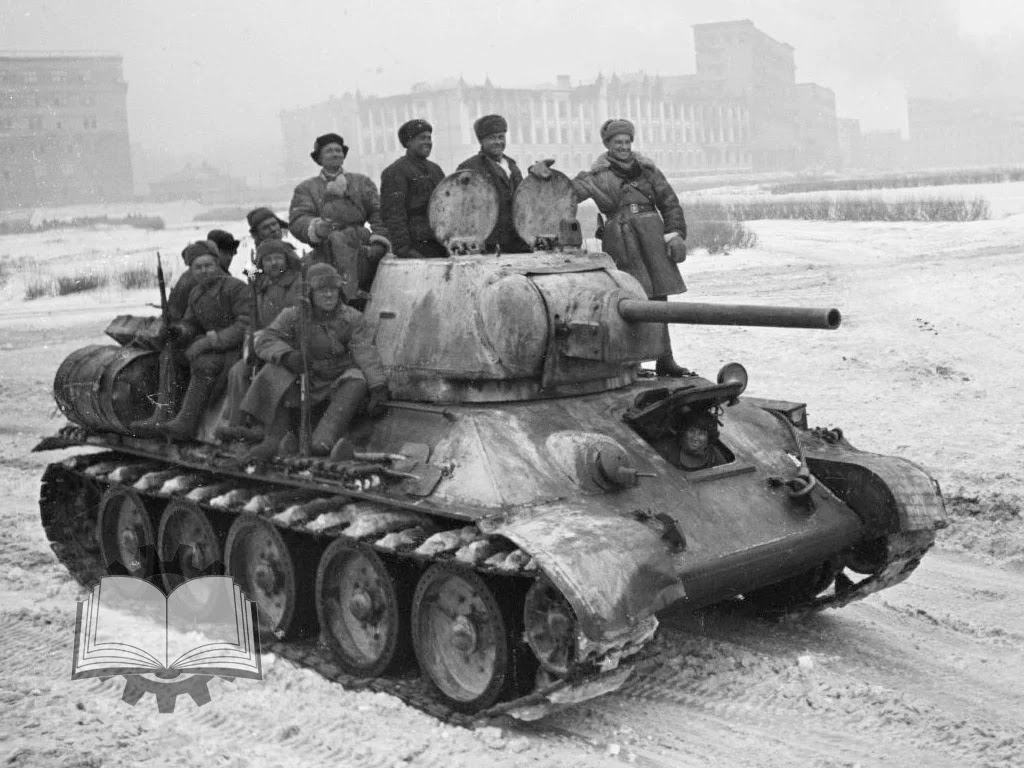 |
| Handrails were added to the T-34 and KV-1 tanks to help carry infantry riders. |
Monday, 30 January 2023
Tanks in Snow 1941-42
Winter is a difficult time for any kind of vehicle, including tanks. Since the Russian winter is long, the USSR paid a lot of attention to how tanks put up with it. This applied in full to mobility in winter. Driving through deep snow banks was a mandatory part of testing every armoured vehicle starting with the MS-1. The MS-1 showed insufficient traction in snow, which is a part of the reason why the "Eagle's Claw" track was introduced. Winter tests of the Vickers Mk.E tank in the USSR were also a key factor in accepting the tank into production.
 |
| T-34 tanks were often the only Soviet tanks that could move outside of roads in winter. |
Monday, 2 January 2023
Video: Did T-34 tanks really carry transmissions on their back?
The myth that T-34 tanks had to carry spare transmissions on their back into battle is a persistent one. In this video, I take a look at what evidence is available to support this claim and the many reasons why this alleged practice wasn't actually possible. Thanks to Francis Pulham for providing photographs and information used in this video.
Friday, 16 December 2022
Tougher Armour
"Order of the People's Commissar of Tank Production #562s
Moscow
July 31st, 1942
The meeting called by the People's Commissariat of Tank Production in Moscow on the topic of improving quality of hulls produced from high hardness armour reviewed and approved the draft technological process guidelines for all stages of armoured component production and hull welding presented by the 3rd Main Directorate of the NKTP. In order to rapidly bring these processes to production and improve the quality of armour and armoured hulls, I order that:
- Directors of the following factories: UZTM (comrade Muzrukov), #200 (comrade Sochivko), #264 (comrade Suvorov), #112 (comrade Rubinchik), #183 (comrade Maksarev), #174 (comrade Katsnelson), #176 (comrade Fedotov), #177 (comrade Volkov), #178 (comrade Skiba), #180 (comrade Orlov), #37 (comrade Frezerov), and #38 (comrade Yakovlev) must develop production instructions based on the approved technological process guidelines and send them to the 3rd Main Directorate of the NKTP after approval by the factory chief engineers. Develop all instructions within ten days of receiving this order or no later than August 15th of this year.
- Factory directors must provide the 3rd Main Directorate of the NKTP with reports on the quality of armour plate and armoured hulls with reports of rejected components by reason of rejection.
- Factory directors must keep in mind the necessity of highlighting the importance of quality assurance at every stage of production as well as the strengthening of laboratories and metallurgical departments.
- Director of TsNII-48 A.S. Zavyalov must:
- Compose and publish a list of minimal technical qualifications for workers of all specialties that are connected to production and finishing of armour within one month.
- Compose and publish directions for engineering-technical workers connected to production, finishing, and welding of armour within two months.
- Directors of all factories must compose a list of minimal technical qualifications for all technical processes among foremen, foremasters, and technologists. Put all welders and cutters through exams. Only permit welders and cutters with appropriate diplomas to work on armour.
- Director of factory #183 comrade Maksarev must order his design bureau to work on the T-34 hull with the aim of reducing the amount of welding, components welded onto armour, change in dovetails, reduction of the welding seam length within possible limits. Check these developments with NII-48.
Deputy People's Commissar of Tank Production, Zernov"
Friday, 4 November 2022
Widespread Welding
"Order of the People's Commissar of Tank Production of the USSR #200s
Moscow
March 28th, 1943
The meeting gathered in response to my order given on December 18th, 1942 in Nizniy Tagil at factory #183 on the issue of widespread introduction of automatic welding explored the issues raised and came to the following conclusions regarding automatic welding.
Wednesday, 2 November 2022
Engagement Ranges
"Conclusions
As a result of examination of materials covering tanks and SPGs knocked out in battle in 1942, 1943, and 1944, one can consider the following assertions to hold firmly:
- German tanks and anti-tank artillery currently consists almost exclusively of 75 and 88 mm guns. The enemy uses 88 mm guns predominately against our heavy tanks and SPGs and 75 mm guns against medium tanks and SPGs.
- The main type of shell used by German artillery against our tanks and SPGs is an armour piercing sharp tipped shell with a powerful cap and small HE effect. More than 90% of all hits in July of 1944 were delivered by these types of shells.The use of subcaliber shot and Faust or Ofenrohr type shells against our tanks and SPGs is negligible.
- German 75 mm guns typically fire at ranges from 100 to 700 meters and rarely exceed 1000-1100 meters.
- German 88 mm guns typically fire at ranges from 600 to 1300 meters and rarely exceed 1600-1700 meters.
- 75 mm guns mostly fire at T-34 tanks at ranges from 100 to 600 meters and 88 mm guns fire from 400 to 1100 meters.
- 88 mm guns mostly fire on IS tanks from 600 to 1300 meters.
- When firing at SPGs, ranges increase by about 200-300 meters compared to tanks of the same type.
[...]
Chief Engineer of the NII-48 MF A.F. Stogov
Deputy Chief of the 4th Department and Project Lead, V.V. Larchenko"
RGAE F.8752 Op.7 D.045 L.33-34
Friday, 7 October 2022
Deliveries
"Table of arrivals of tanks at the front lines in 1941, by type
|
Type |
Domestic |
British |
American |
Total |
||||||
|
Month |
KV |
T-34 |
T-60 |
T-70 |
Mk.II |
Mk.III |
Mk.IV |
M3 S |
M3 L |
|
|
Total 1941 |
|
|
|
|
|
|
|
|
|
20,740 |
|
Jan |
126 |
206 |
348 |
- |
- |
16 |
- |
- |
- |
696 |
|
Feb |
165 |
420 |
260 |
- |
- |
- |
- |
- |
- |
845 |
|
Mar |
105 |
338 |
84 |
- |
- |
- |
- |
- |
- |
527 |
|
Apr |
320 |
702 |
576 |
- |
134 |
144 |
- |
14 |
32 |
1922 |
|
May |
350 |
1003 |
898 |
- |
255 |
171 |
- |
30 |
16 |
2723 |
|
Jun |
199 |
698 |
657 |
103 |
- |
74 |
- |
144 |
222 |
2091 |
|
Jul |
299 |
1177 |
746 |
371 |
86 |
44 |
- |
66 |
91 |
2880 |
|
Aug |
178 |
1378 |
250 |
583 |
10 |
63 |
- |
35 |
98 |
2595 |
|
Sep |
45 |
598 |
- |
439 |
- |
72 |
- |
54 |
43 |
1251 |
|
Oct |
160 |
1100 |
75 |
640 |
- |
10 |
- |
24 |
5 |
2024 |
|
Nov |
215 |
1312 |
- |
838 |
85 |
163 |
- |
187 |
61 |
2861 |
|
Dec |
239 |
1678 |
48 |
1026 |
- |
- |
42 |
23 |
16 |
3072 |
|
Total 1942 |
Total domestic: 20,957 |
Total foreign: 2530 |
23,487 |
|||||||
This data is interesting on its own, but it's also interesting to compare to deliveries of foreign tanks. The first Matilda and Valentine tanks began arriving during the Battle for Moscow and were thrown into battle with little preparation. As you can see in the above table, once the situation stabilized a little bit it took some time before new units with British tanks could be properly outfitted. Large deployments of Matildas and Valentines only take place in April, four months after deliveries began.
A similar picture can be seen with American tanks. The first shipments arrived in January of 1942 and we start seeing a small number of these tanks on the battlefield in April-May, 4-5 months later. Once the pipeline was set up, it was not as hard to deploy new tanks. A bump shipments that came in May hits the front lines in June. A lot of tanks were tied up in delivery by the end of the year: 3875 foreign tanks were delivered to the USSR in 1941-1942, but only 2530 were actually fielded before the end of 1942.
You can see the same pattern with Soviet tanks. Evacuation of factory #183, the USSR's largest producer of the T-34 tank, began in September of 1941. The factory began to set up in the Urals in December-January, and by May of 1941 you see a spike in deliveries of T-34 tanks. Similarly, production of the T-70 was authorized in March of 1942 and we see these tanks begin to arrive on the front lines in July.
Subscribe to:
Posts (Atom)