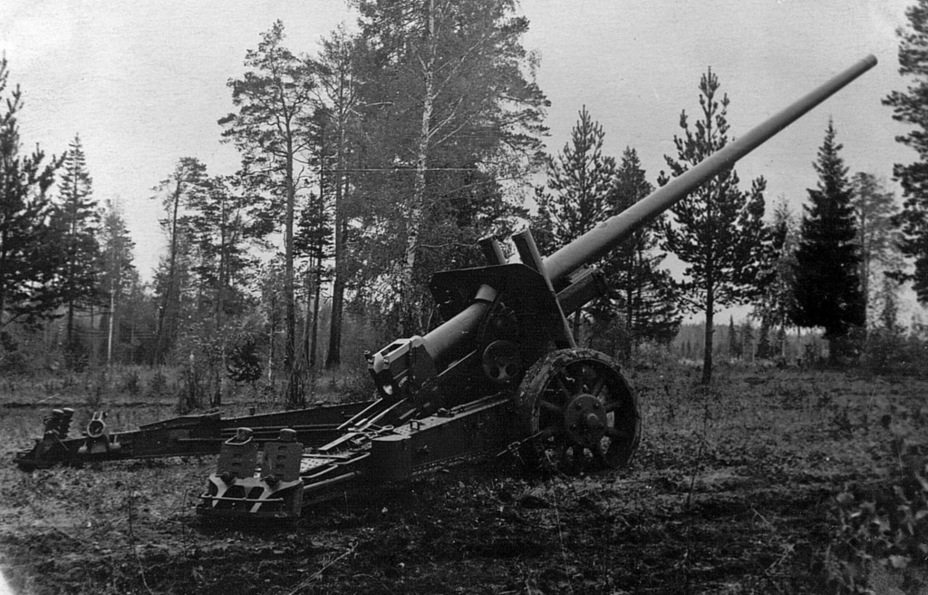
Showing posts with label B-13. Show all posts

Monday, 10 July 2017

Experimental Tank Guns in 1940, part 2

We saw some Soviet pre-war prospective guns in a previous article, let's take a look at the rest of the list.

Name
Mass
Oscillating part mass
Top speed (kph)
Practical rate of fire RPM
Horizontal range
Vertical range
Max. range (km)
Muzzle velocity
m/s
Shell mass (kg)
Effect/
Notes
152 mm M-10 tank howitzer in the KV tank
53 tons
1890
Up to 20
1-2
360
-3
+12
6
436
51.07
Penetrates 90 mm of armour at 1000 m
122 mm corps gun for the KV tank
54 tons
3200
Up to 20
2-3
360
-3
+15
13
800
25.2
Penetrates 130 mm at 30 degrees at 1000 m (calculated)
85 mm SPG on T-34 chassis (tank destroyer)
26 tons
1200
Up to 40
15
360
-5
+45
17
800
9.2
Penetrates up to 88 mm at 30 degrees at 1000 m (calculated)
130 mm SPG (B-13) for the SMK
64 tons
-
Up to 20
2
6
+12
15
870
33.5
Penetrates 130 mm of armour and 40 mm of iron liner at 4400 m. Ready by September 1st, 1940.
152 mm SPG (Br-2) for the SMK
64 tons
4200
Up to 20
0.5
6
+12
13
860
51.07
Penetrates 130 mm of armour at 30 degrees at 5000 m and 150 mm of armour at 0 degrees at 1100 m. Ready by September 1st, 1940.
55-60 mm anti-tank gun
1000 kg
-
Up to 50
15
60
+25
13
At least 1000
Up to 3
Penetrates 70 mm of armour at 1000 m at 30 degrees (calculated)
76 mm anti-tank gun based on the USV or F-22
Up to 1800 kg
1200
Up to 50
15
55
+45
15
813
6.5
Penetrates 70 mm of armour at 30 degrees at 1000 m. Uses shells from the mod. 1931 AA gun. Ready by October 1st, 1940

The first entry is pretty self explanatory: this is the KV-2. By this time, 4 KV-2s have been assembled, but it has not gone into production quite yet, so it still shows up on the experimental list. The second entry is quite interesting: some kind of proto-IS-2. It's interesting to see such a powerful gun in a rotating turret so early in the war.

Next, we have something my readers should already be familiar with. The 85 mm gun on a T-34 chassis is the U-20 tank destroyer. 

Now here's something a little more obscure. Fans of Soviet tank history will know that the T-100, SMK, and KV faced off for the title of the Red Army's next heavy tank during the Winter War. By the summer of 1940, when this list was composed, the KV had already won. However, it seems that the SMK wasn't quite dead yet. Two SPGs, one with a 130 mm gun and one with a 152 mm gun, are still being pitched. The tank may have never moved forward, but the idea of SPGs with these guns remained. The 130 mm S-26, based on the B-13, was used in the ISU-130 SPG. The 152 mm Br-2 on a self propelled chassis was a long-lived dream of Soviet artillerymen, with several attempts, like the U-19, and S-51.

The 55-60 mm anti-tank gun is another familiar sight. This is, quite obviously, the ZIS-2. The 76 mm anti-tank gun, however, is more interesting. There were attempts to build guns for the KV (ZIS-5, first iteration) and T-34 (S-54) with the ballistics of this gun, so it's only logical that a towed version would also be made. This particular implementation looks similar to the Pak 36(r), with the existing F-22 being adapted for a more powerful round.

Sunday, 10 July 2016

SPG #212: Pillbox Hunter

The war between the USSR and Finland that broke out on November 30th, 1939, revealed a ton of deficiencies in the organization and management of the Red Army. Naturally, questions regarding materiel also arose. It was finally clear that the Red Army needs tanks that can withstand cannons. The need for a specialized SPG that could destroy fortifications was also obvious. The KV-2 was one such vehicle, and even had time to fight the Finns, but it was destined to be replaced by the 212 SPG with an even more powerful gun.

Saturday, 30 April 2016

Stalin's Maus Killers

Gun design is driven by the desire to be at least half a step ahead of its opposition. The creators of tank armour aim to provide tank crews with maximum possible protection from all existing weapons, and gun designers aim to create a gun that would penetrate the armour of any modern tank. In the spring of 1941, work on a new 107 mm anti-tank gun began in the Soviet Union, a gun that would not see a worthy adversary for several years. Both these guns and their likely enemies were built in metal, but neither one ended upon the battlefield.

Shooting at Shadows

At the start of 1941, Soviet anti-tank artillery evolved simultaneously in several directions. The most promising weapon was the 57 mm F-31, later indexed ZiS-2. This gun was developed at factory #92 under the direction of V.G. Grabin. In parallel, a "powerful 76 mm AT gun on the USV base" was developed, with the factory designation F-26. It was plagued with difficulties. Due to problems with the recoil brake, the gun was redesigned several times. Finally, in early January of 1941, under Grabin's initiative, an 85 mm anti-tank gun was also developed. It was based on the mount of the experimental 95 mm F-25 divisional gun with lengthened trails. In January, it fired 225 shots.

On March 11th, 1941, the chief of the Red Army General Staff Intelligence Directorate, Lieutenant-General F.I. Golikov, prepared a special report "On the direction of development of the armed forces of Germany and changes in its status". According to this document, German industry began constructing three new types of tanks. The most powerful one, called "Type VII" allegedly weighed 90 tons and was armed with a 105 mm gun. The military treated this information very seriously. The T-150, which was supposed to enter production as the KV-3, was cancelled. Instead, a new vehicle was developed on the basis of the KV-220. The new KV-3 would have a 107 mm gun, have armour about 120 mm thick, and weigh 67-68 tons. In addition, KV-4 and KV-5 tanks were developed in parallel.

Tanks weren't the end of it. By April 18th, 1941, a Council of Commissars decree titled "On tank armament, new anti-tank gun, artillery SPGs, and armour piercing ammunition" was prepared. The sixth point of the decree is most relevant:

"6. On the powerful 107 mm corps gun.
Order the NKV to develop and produce at factories #172 and #92 experimental guns with a 107 mm barrel with the muzzle velocity of 1100 m/s on the mount of the 152 mm mod. 1937 gun-howitzer mount.
Due date for delivery of experimental prototypes to the NKO: July 1st, 1941
By the same due date, produce a tank destroyer with a 107 mm gun of the aforementioned ballistics. The NKTM must build this tank destroyer on a lengthened KV-4 chassis with 60 mm of armour.
The NKB must develop and produce by that date 3000 armour piercing shells with tracer, phlegmatizer, and decopperer in the propellant."

The tank destroyer mentioned in the decree was to be developed in parallel with the SU-B-13 and "212" SPG. According to project documentation, development of the SU-B-13 began, a project was drafted, tactical-technical requirements were made, and the project stalled. The production of the 212 SPG ended during construction of the hull. Unlike these two, the project of the tank destroyer did not even reach the tactical-technical requirements stage. However, the "powerful 107 mm corps gun" made it further.

Preliminary calculations showed that the new powerful gun with a muzzle velocity of 1100 m/s would penetrate 188 mm of armour at a 30 degree angle at 1000 m. By early May, the characteristics changed. According to calculations for the 107 mm anti-tank gun, the muzzle velocity was reduced to 1020 m/s and the length of the barrel would be about 60 calibers. Even this data was not final.

Meanwhile, Grabin displayed his initiative and began developing a lighter alternative for the ZiS-24. This gun, indexed ZiS-23, used the mount from the 107 mm M-60 divisional gun, and its muzzle velocity would be 1150 m/s with a 70 caliber barrel.

The development of tactical-technical requirements for the new guns dragged on. The GAU Artillery Committee reviewed them only on May 22nd, 1941. According to the characteristics, the velocity of the 18.8 kg 107 mm armour piercing shell was kept at 1020 m/s and the penetration was decreased to 160 mm at 30 degrees. The barrel length was limited to 70 calibers. The rate of fire was set at 10 RPM with one piece rounds. The mount from the 152 mm ML-20 would be used as much as possible during development, including the sight. In addition to its AT duties, the gun would act as a corps gun, which is why it would also have an 18.8 kg HE shell fired at 730 m/s.

Draft project of the 107 mm M-75 antitank gun.

On the same day, requirements for a "special purpose 85 mm anti-tank gun" were approved. The gun would also serve as a divisional gun, and have a 9.2 kg 800 m/s HE shell. As for the AP shell, it was fired at 1150 m/s and weighed 10.5 kg, letting it penetrate 160 mm of armour at 1000 m at a 30 degree angle. The requirements included the use of the M-60 107 mm gun mount. Changes would be minimal and would include the gun shield.

Heavyweight Competitor

Until early June of 1941, design of high power AT guns proceeded only at factory #92, even though the decree mentioned two factories. This can be explained by Grabin's initiative, which was noticed at the top. Either way, factory #172 was too busy: it still had a large order for howitzer artillery and Supreme Command Reserve artillery to complete.

The requirements kept changing throughout the end of May and the beginning of June. The final variant was only sent to the factories on June 7th. By that time, factory #172 finally began the development of its own 107 mm gun. The latest changes put the factory in a difficult position, as they included the use of a mechanical rammer and variable rifling. In a letter to the chair of the Artillery Committee, Major-General Hohlov, acting director Kudryavtsev wrote that the design bureau would design a gun without these features. According to the bureau, the rate of fire of 10 RPM was attainable without a mechanical rammer. The gun designed at factory #172 was indexed M-75. According to preliminary calculations, its muzzle velocity was 1020 m/s and its penetration matched the requirements.

The gun shield that would be installed on all high power anti-tank guns.

Interestingly enough, development of an 85 mm gun began in Molotov (modern day Perm), and only fragmented information survives to this day. Information on it first comes in up mid June of 1941. Correspondence between factory #172 and the People's Commissariat of Ammunition reveals that not enough test rounds were produced for the ZiS-23 to also test the factory #172 gun. As a result, another 300 shells would have to be made: 50 by July 5th and the remaining 250 by July 15th. Further letters reveal the index of this gun: M-76. The letters also state that factory #172 received permission from the state to build a prototype. 

No tactical-technical characteristics for the M-76 were found. As for its competitor, the ZiS-23, its characteristics were finally confirmed in early July of 1941. To develop a muzzle velocity of 1150 m/s, the gun barrel was 96.8 calibers (8228 mm) long. The ZiS-24 also did not meet its barrel length restrictions. According to the final characteristics, the overall length of its barrel was 73.5 calibers, or 7843 mm.

The characteristics document dated July 4th, 1941, also mentions that factory #92's guns were finished and were currently at the stage of prototype assembly. Whether or not assembly was ever completed is not known. By June 31st, 1941, both guns were still being designed. Factory #92 had to send off two ZiS-23 prototypes (priority of the ZiS-24 was reduced) by August 15th. This did not happen, and furthermore, both guns are absent from a report on factory #92's experimental work. No additional information appears in subsequent documents. It is very likely that the ZiS-23 and ZiS-24 were never built.

Unexpectedly, a third competitor entered the race. On July 7th, 1941, a letter from Sverdlovsk arrived, addressed to the chief of the Orders and Production of Land-based Artillery Directorate (UVNA). The authors of the letter were the chief engineer of the Ural Heavy Machinebuilding Factory (UZTM) and F.F. Petrov (one of the creators of the ML-20 gun). In the letter, they described a draft of an anti-tank gun indexed UML-20.

Draft project of a 107 mm UML-20 anti-tank gun, July 1941.

The main feature of the project was that the gun was as unified as possible with existing guns, the ML-20 and A-19. The screw breech lock and barrel case were taken from the A-19. The breech and mount came from the ML-20. The A-19 also donated its shell casing. The possibility of using M-60 shells was mentioned, but it was not known if the shell would survive the higher pressure. The muzzle velocity was estimated at 1050 m/s with a barrel length of 59.5 calibers. In order to compensate for the altered center of mass, the barrel was extended by 235 mm.

Calculations for the UML-20 barrel. Unlike this gun, documentation for the ZiS-23 and ZiS-24 did not survive to this day.

UZTM's proposal was very reasonable. Thanks to the use of existing parts, development and, most importantly, production could have been completed quickly. However, the UML-20 project did not move past the design proposal stage.

In the end, the only high power anti-tank gun that reached the trials stage was S.N. Dernov's M-75.

Without a Worthy Target

Technical documentation for the 107 mm M-75 anti-tank gun was prepared by factory #172 by the end of June of 1941. The start of the Great Patriotic War did not influence its development. Unlike work on the KV-3, KV-4, and KV-5 tanks, no one cancelled work on the high power gun. Factory #172 began production of two prototypes in early July, and factory trials began by the end of the month. Muzzle velocities between 1017 m/s and 1047 m/s were recorded, which met requirements. The driving bands were not torn. Penetrations in the plate were in the form of a circle, meaning that the shells were stable in flight. The biggest problem during trials was the work of the semi-automatic mechanism. This was caused by the materials that were used to make the breech and breechblock.

M-75 on trials, October 1941.

On July 15th, a technical project was sent to UVNA chief, Military Engineer 1st Grade Komarov, developed in parallel with the production of prototypes. Overall, the gun met requirements. Its muzzle velocity was 1020 m/s, the barrel was 70.5 calibers long (7550 mm), and the design used the ML-20 mount. Nevertheless, the project was met with the following response:

"Instead of installing the new 107 mm barrel on the ML-20 mount, the factory performed an unfortunate "modernization" of the mount."

A more complete version of this appraisal was sent to factory #172 on July 28th, 1941, signed by GAU chief General-Colonel Yakovlev.

The same gun in firing position.

This reaction was caused by changes made at factory #172 to the design of the mount. Instead of the stock system to move the barrel from travel to firing position, a pulley was used, like the M-60. Aside from the change, GAU made a reasonable complaint about whether or not the addition would increase the speed at which the barrel could be transferred to and from the firing position. The designers of the M-75 also changed the recoil system and designed an almost completely new limber. In the conditions of war when German heavy tanks were expected any day, this was deemed unacceptable. Mass production M-75 had to be built on an ML-20 mount with a stock limber.

Despite a requirement to use the ML-20 mount as much as possible, the M-75 prototypes had may changes in their design.

Further trials of the M-75 were performed at the Ural Artillery Proving Grounds (today the Nizhniy Tagil Metals Research Institute, NTIIM). The trials program was approved on August 16th, 1941. The robustness of the system, its ballistics, and penetration were tested. Gun #1 had a barrel #4 with 25 caliber rifling and gun #2 had a barrel #7 with 32 caliber rifling. Barrel #5 was shipped with the guns, also with 32 caliber rifling.

Gun in travel position. Instead of the stock system for moving the barrel from travel to firing position, a pulley like on the M-60 was used.

Documentation for the gun was delivered on August 28th, but trials only began one month later, on September 29th. The first stage of the trials was disassembly and reassembly, during which the guns switched barrels. Trials were complicated by a lack of equipment at the Ural proving grounds for various necessary work.

The first shots were fired only on October 5th from gun #1. On October 16th, after 105 shots, trials were stopped due to a suggestion from factory #172. This was caused by the need to make a new breechblock and several other components. Trials resumed on November 3rd. After 402 shots, barrel #5 was replaced with barrel #4 due to significant wear of the rifling. Firing trials ended on December 11th, but due to the busyness of the proving grounds staff with other guns, the report was only composed on January 2nd, 1942.

Gun in firing mode, from the front.

The results of the trials were not encouraging. Fist, the lifespan of one barrel was estimated at 250-300 shots, which was not enough. Second, there were serious problems with penetration. The gun penetrated 152 mm of armour, but only at 100 meters. No attempt was made to fire at one kilometer due to the weakness of the shell hulls. This was a problem with many Soviet shells already in production, and it was not solved immediately. The real rate of fire of the gun was 5-6 RPM. There were significant problems with extraction. The M-75 failed trials.

Shells for the 107 mm M-75 gun.

Factory #172 had the potential to improve the M-75. Many guns, including anti-tank guns, showed these drawbacks. Trials showed what had to be corrected. Also, as mentioned above, the Ural proving grounds were not properly equipped for trials, and many problems could easily be solved at the factory. Nevertheless, on April 22nd, 1942, a decree was issued cancelling work on high powered anti-tank guns.

"Since the experience of modern war did not confirm the need for such guns to fight tanks, further work on the M-75 gun and its ammunition is considered unreasonable. Reporting on the above, I ask for your permission to cease all work on the 107 mm M-75 gun and similar work on 85 mm and 107 mm ZiS-23 and ZiS-24 guns at Order of Lenin factory #92.

107 mm shells could penetrate armour, but cracked on impact.

The People's Commissar of Armament, Colonel-General Volkov, did not know that right when he signed that letter, Ferdinand Porsche's design bureau began work on the super-heavy tank that super-powered anti-tank guns were made for. Of course, neither the VK 100.01 nor the Maus ever reached the front lines. Nevertheless, the gun cropped up once more in 1943.

M-75 gun #1 on display at the future site of the Armed Forces Museum of the Republic of Kazakhstan, in Astana.

In July of 1943, at Ponyri, another brainchild of Porsche K.G. entered battle: the Ferdinand SPG. Its appearance was treated seriously by the Red Army. The M-75 appeared once more in the list of work on tank, anti-tank and self-propelled artillery dated September 15th, 1943. One of the reasons that the project was buried in 1942 was the use of the ML-20 mount. The idea of a tank destroyer with the M-75 had another chance at life two years after it was first discarded in 1941, especially now since it had a worthy target. 

The return to 107 mm artillery was brief. In the same letter that mentioned the M-75, Major-General Hohlov proposed discarding a number of projects, replacing them with a much more promising 122 mm gun with the muzzle velocity of 1000 m/s.

Thursday, 15 October 2015

Experimental Guns

"Decree of the State Committee of Defense #4851ss
December 27th, 1943
Moscow, Kremlin

On the design, production, and trials of experimental guns for tanks and SPGs.

The State Committee of Defense decrees that:
  1. On the 85 mm tank gun: GAU chief comrade Yakovlev and Armoured Forces commander comrade Fedorenko must perform trials of the 85 mm S-53 and S-50 guns installed in T-34 tanks (S-53 in a T-34 with a stock 1420 mm turret ring, S-50 in a tank with a widened turret ring) and the 85 mm LB-1 gun designed by factory #92 in a T-34 with a widened turret ring before December 30th, 1943.
    Report to GOKO on results by January 2nd, 1944.
  2. On the 100 mm tank gun (comrade Grabin):
    1. NKV (comrade Ustinov) and TsAKB (comrade Grabin) must provide the S-34 100 mm tank gun for trials by January 1st, 1944.
      GAU chief (comrade Yakovlev) and Armoured Forces commander (comrade Fedorenko) must perform trials by January 5th, 1944.
      Report to GOKO on results by January 7th, 1944.
    2. NKV (comrade Ustinov) and factory #92 director comrade Yelyan must produce two S-34 100 mm guns according to blueprints from TsAKB, one for the IS tank and one for an SPG on the T-34 chassis to factory #100 by January 25th, 1944.
    3. NKTP (comrade Malyshev) and factory directors of Kirov factory (comrade Zaltsmann), factory #100 (comrade Kotin) and Uralmash (comrade Muzrukov) must design and produce an IS tank and an SPG on the T-34 chassis with 100 mm guns.
      Perform factory trials of the IS tank and SPG with 100 mm guns by February 20th and provide the tank and SPG for proving grounds trials by February 25th.
    4. GAU (comrade Yakovlev) and the Armoured Forces commander (comrade Fedorenko), in cooperation with NKTP and NKV, must, within five days, perform trials of the IS tank and SPG with 100 mm guns and deliver a conclusion to GOKO by March 5th, 1944.
    5. TsAKB (comrade Grabin) must include the possibility to install an 85 mm barrel into the S-34 mount to achieve a muzzle velocity of 1000-1100 m/s and begin the production of this gun with the aim of producing an experimental prototype for government trials by April 1st, 1944.
    6. People's Commissariat of Ammunition (comrade Vannikov) must produce ammunition (casing, propellant, AP and HE shells) for the 85 mm TsAKB gun with a muzzle velocity of 1000-1100 m/s and provide 1000 proof rounds as well as 250 each HE and AP rounds.
  3. On the 130 mm tank gun (comrade Grabin):
    1. NKV (comrade Ustinov) and TsAKB (comrade Grabin) must design by January 5th 1944 and produce by March 1st 1944 an experimental prototype of a 130 mm gun, with the ballistics of the 130 mm B-13 naval gun, to be used in an SPG on the IS chassis.
    2. Director of factory 232, comrade Zakharyin, must produce a barrel with breech and other components, as well as cast and forged components, and deliver them to TsAKB by the aforementioned date.
    3. NKV (comrade Ustinov) and TsAKB (comrade Grabin) must send one 130 mm SPG gun to factory #100 by March 10th, 1944.
    4. NKTP (comrade Malyshev) and directors of factory #100 and Kirov factory must design an SPG on the IS tank chassis to use a 130 mm gun.
      Begin factory trials of the 130 mm SPG by April 1st, 1944, and provide it for proving grounds trials by April 5th, 1944.
    5. GAU (comrade Yakovlev) and the Armoured Forces commander (comrade Fedorenko), in cooperation with the NKTP and NKV, must complete proving grounds trials in five days' time and report to GOKO with their conclusions by April 10th.
    6. People's Commissar of Ammunition (comrade Vannikov) must produce 500 each of HE shells for the 130 mm SPG, AP and HE shells for the 122 mm gun with a muzzle velocity of 1000 m/s, and deliver them by March 20th, 1944 for trials.
  4. On the increased muzzle velocity of the 122 mm tank gun:
    1. NKV (comrade Ustinov), TsAKB (comrade Grabin), OKB-172 (comrade Ivanov) and factory #172 director (comrade Bykhosvkiy) must design and produce two prototypes of a 122 mm gun with a muzzle velocity of at least 1000 m/s using a 25 kilogram shell (one designed by TsAKB and one by OKB-172) to be used in an IS SPG.
      Submit finished prototypes to factory #100 for installation in vehicles by March 10th, 1944.
    2. NKTP (comrade Malyshev), Kirov factory director (comrade Zaltsmann) and factory #100 director (comrade Kotin), in cooperation with TsAKB and OKB-172, must design IS SPGs with TsAKB and OKB-172 122 mm guns.
      Finished SPGs must be submitted for proving grounds trials by April 1st, 1944.
    3. GAU (comrade Yakovlev) and the Armoured Forces commander (comrade Fedorenko), in cooperation with the NKTP and NKV, must complete proving grounds trials of the SPGs within 10 days and submit their conclusions to GOKO by April 15th, 1944.
Chair of the Committee of Defense, I. Stalin."

Tuesday, 30 September 2014

IS model 1940

"USSR NKSM
Order of the Labouring Red Banner Voroshilov factory #174, department #1
July 22nd, 1940

#3794, Top Secret

To the Deputy of the People's Commissar of Medium Machinebuilding, comrade A.A. Goreglyad
Copy to the Chief of the NKSM Glavspetsmash, comrade Surenyan

On the issue of the heavily armoured IS tank.

I propose this heavy IS tank project, composed according to the orders of the NKSM.

Our factory agrees to produce the project, working blueprints, and experimental prototype, and considers it possible to produce up to 30 vehicles annually using the capabilities of the experimental division (formerly factory #185). In order to ensure such volume, cooperation among a series of factories is necessary, both from our Commissariat and others which supply our factory with raw materials and components. Additionally, the factory will need more equipment. An approximate calculation of required equipment and cooperation plans are included in the attachment.

Reply with your decision.

Attachment: explanatory note to the NKSM (two copies), to Glavspetsmash (one copy) and for the archive.
Preliminary cooperation plan for the NKSM (two copies), for Glavspetsmash (one copy) and for the archive.

Blueprints (two copies) for the NKSM

Factory director Markin
Chief engineer Zasovenko
Chief designer Ginsburg

Explanatory note for the heavily armoured IS tank project

The project completed by Voroshilov factory #174 fills the need of a breakthrough tank in a positional war.

The main tasks of this tank are the destruction of long-term reinforced concrete artillery emplacements, artillery, and heavy enemy tanks. These tanks can also serve as a powerful coastal defense gun, aiding in deflecting enemy landing attempts. The armour (main thickness: 110 mm) is thick enough to withstand all artillery installed in concrete emplacements, from 37 mm to 88 mm inclusive.

For instance, Germany uses an 88 mm AA gun with the muzzle velocity of 820 m/s. It is possible that this gun can be put in a bunker. It is unlikely that larger caliber guns will be placed in bunkers due to low rates of fire and difficulty in hitting moving targets up close. Additionally, high caliber artillery has no armour piercing shells, and its long barrels will reveal its location.

The tank is armed with a powerful 130 mm B-13 gun with a muzzle velocity of 880 m/s, using a 36 kg shell. Due to its powerful penetration (the gun can penetrate 150 mm of armour from a kilometer away), a shot that hits a bunker or pillbox will destroy it.

When firing a concrete piercing shell, up to two meters of concrete can be breached, with a fragmentation power approaching that of the 152 mm ML-20 shell.

The turret can spin in a full circle, and has a 2400 mm turret ring.

The presence of a semi-automatic breech, loading tray, gun rammer, and bore evacuator increase the rate of fire and make the crew's working conditions better. The hull can be made of rolled or cast armour. The tank has four machineguns for protecting itself from enemy infantry. Two of these are in turrets, which can quickly shift fire between land and airborne threats. One of these turrets solves the issue of granting the commander 360 degree vision. It's possible to use the turret for observation only, but then the advantage of rapidly shifting fire is lost. The tank can carry 50 shells for its main armament, which allows it to operate on the battlefield for a long span of time.

Instead of a B-13 gun, a 122 mm A-19 corps gun can be installed, with a muzzle velocity of 820 m/s and a 25 kg shell, or a 152 mm ML-20 corps gun with a muzzle velocity of 650 m/s and a 44.5 kg shell. The rate of fire of the 122 mm gun is close to that of the 130 mm gun and is significantly higher than of the 152 mm gun.

The vehicle uses the 24-cylinder V-24 engine, 1100-1200 hp, composed of a pair of V-2 engines in one unit. This engine uses parts produced by factory #75, and an experimental prototype can be built in 4-5 months.

Aside from the above engine, the tank can use the 12-cylinder MN-1 1000 hp engine, a batch of which was already produced by Ts.I.A.M. or a turbocharged V-2 engine at 850 hp, with a lower top speed.

The engine can grant the vehicle a speed of up to 35 kph, and the ability to traverse light obstacles and very rough terrain. As for off-road performance, it is difficult to achieve in this class of vehicle, as the ground pressure is limited by the size of railroads, maximum possible width, and internal volume.

With 800 mm wide tracks and 110 mm thick armour, given zeroth volume category (width: 3400 mm), the internal width of the hull ends up being 1560 mm, which is less than that of the light T-26 tank, where it is 1625 mm. This project has the ground pressure of 0.9 kg/cm^2.

In order to reduce the ground pressure on soft terrain, it is possible to replace the 800 mm wide tracks with 1 meter wide tracks, at which point ground pressure decreases to 0.75 kg/cm^2. The narrower tracks can be equipped for railroad transport and use on solid ground or in winter conditions. The size of the vehicle fits within the zeroth category. According to NKPS instructions (TransZhelDorIzdat, 1938), a load of these dimensions can be transported without restrictions on Soviet railroads.

The combat mass of the tank is 75 tons. Considering that the mass of the vehicle without ammunition, equipment, fuel, and crew is no more than 70 tons, they can be transported on 60 ton train cars with acceptable overloads. If the turret and hull are transported separately, existing platforms (even 50 ton ones) fully enable the transport of this tank.

The project is completed with two variants.

Variant 1 (blueprints IS-S1, IS-S2, IS-S3, IS-S4, IS-S5, IS-S6, IS-S7) has the classical tank layout.

The transmission and engine group is in the rear of the tank. The cooling fan is on the axis of the crankshaft, and is the two-stage axle type. The air is sucked in at the top of the vehicle, and exhausted on the bottom, near the tracks. The transmission is mechanical, with five speeds forward and one back.

In order to make the transmission as small as possible, the friction clutches are inverted and placed behind the final drives above the suspension, in a box that is the continuation of the turret platform. The turret is in the middle of the vehicle. The ammunition is placed in the perimeter of the turret, in the hull, and in the turret bustle.

Fuel tanks are located in the fighting compartment, and act as a floor for the gun crew. The engine and transmission can be accessed through special hatches and passages.

As it is difficult to protect the suspension from artillery fire, there is a divide between the protection of the hull and suspension.

Variant 2. This variant has significant differences in its design (blueprints IS-S-1, IS-S2-1, IS-S3-1, IS-S4-1). In order to protect the suspension, a separate track is used. Each side has two independent tracks, each of which is driven independently. To achieve this, the transmission and engine group is in the middle of the vehicle, and each side has two drive wheels. If one track per side is destroyed, the tank can still continue on its course. In addition, the front idler can be modified to be used as a mine roller. If the front track is hit and falls off, it protects the rear track from being damaged by explosives. In order to obtain a sufficiently large surface, the tank's hull is increased in length by 600 mm. That and the increase in weight due to the suspension results in a tank weight of 79 tons. In order to achieve the desired weight of 75 tons, the main armour thickness must either be reduced to 100 mm or the turret must be transported separately.

Due to a reduction in track surface area, the ground pressure increases to 1.05 kg/cm^2 without sinking and 0.85 kg/cm^2 when sunken by 100 mm.

The crew is separated, and can exit trough two emergency hatches underneath the tank.

Characteristic
Two-track Variant
Four-track Variant
Mass (tons)
75
79
Size (mm)
Length of tracks
7400
8020
Width
3400
3400
Height (to roof)
3150
3158
Height (to highest point)
3500
3500
Clearance
540
540
Length of the track's gripping surface
5250
4440
Track width
800
800
Distance between track centers
2600
2600
Armour (mm)
Sides, turret platform, front and rear, turret side
110
100
Floor
40
40
Roof
40
40
Armament
Main gun
130 mm B-13
Muzzle velocity (m/s)
880
Shell mass (kg)
36
Horizontal traverse range (deg.)
360
Gun elevation (deg.)
+12
Gun depression (deg.)
-5
Turret ring diameter (mm)
2400
Optional armament
45 mm gun
Machineguns
4
Machinegun bullets
5000
Gun shells
50
58
Mobility
Engine power (hp)
1100-1200
Speed, kph
5th gear
32.3
4th gear
20.4
3rd gear
13.5
2nd gear
9.2
1st gear
4.8
Reverse gear
5.6
Traversible obstacles
Trench width (meters)
3.5
3.7
Grade (deg.)
40-42
Water depth (meters)
1.6
Ground pressure (kg/cm^2)
0.9
1.05
L/B ratio
2.02
2.24
Crew
6

The cost of the vehicle when produced in small batches is no more than 3 million rubles, which compares favourably to the cost of the 100-Y vehicle (the cost of one is 3.3 million rubles).

If the project is approved immediately, the first prototype will be ready by June-July of 1941, and the first batch will be ready in the first quarter of 1942.

Factory director Markin
Chief engineer Zasovenko
Chief designer Ginsburg"

V. Lehn Collection