Showing posts with label flamethrower. Show all posts

Wednesday, 24 May 2023

The Last of Stalin's Robots

Unfortunately, museums frequently mislabel their own exhibits. The biggest problem with that is an incorrect information from a museum label is going to propagate. For example, Kubinka seriously thought that they had two BA-6 armoured cars, even though one was actually a BA-3M. The collection of the Patriot Park museum which used to be displayed at Kubinka has many downright unique exhibits, some of which were also misidentified. For example, this tank is called OT-130, but that is not the case.

TT-26 tank as displayed today.

In reality, the tank currently displayed in the pavilion depicting the war against Japan is the only surviving TT-26 teletank. This tank was once the subject of Yuri Pasholok's volunteer painting team. Let us tell the tale of this unique tank with a unique combat history.

Friday, 25 November 2022

Firebreathing KV from Chelyabinsk

Flamethrower tanks were not a rarity in the Red Army. Work on chemical tanks began in the early 1930s. Initially, they were meant to deploy chemical weapons, but “universal” chemical tanks appeared soon after that. The first of them was the KhT-26, a vehicle on the T-26 tank chassis that could fire both poison substances and flame. As a result of trials, the flamethrower mode became the priority. The KhT-26 was succeeded by the KhT-130 based on the single turreted variant of the tank. The last variant was the KhT-133, the same vehicle but based on a T-26 with a conical turret and sloped turret platform sides. The last tanks were delivered in 1940 when the concept of a “universal” chemical tank had already died. The requirements for flamethrower tanks also changed.


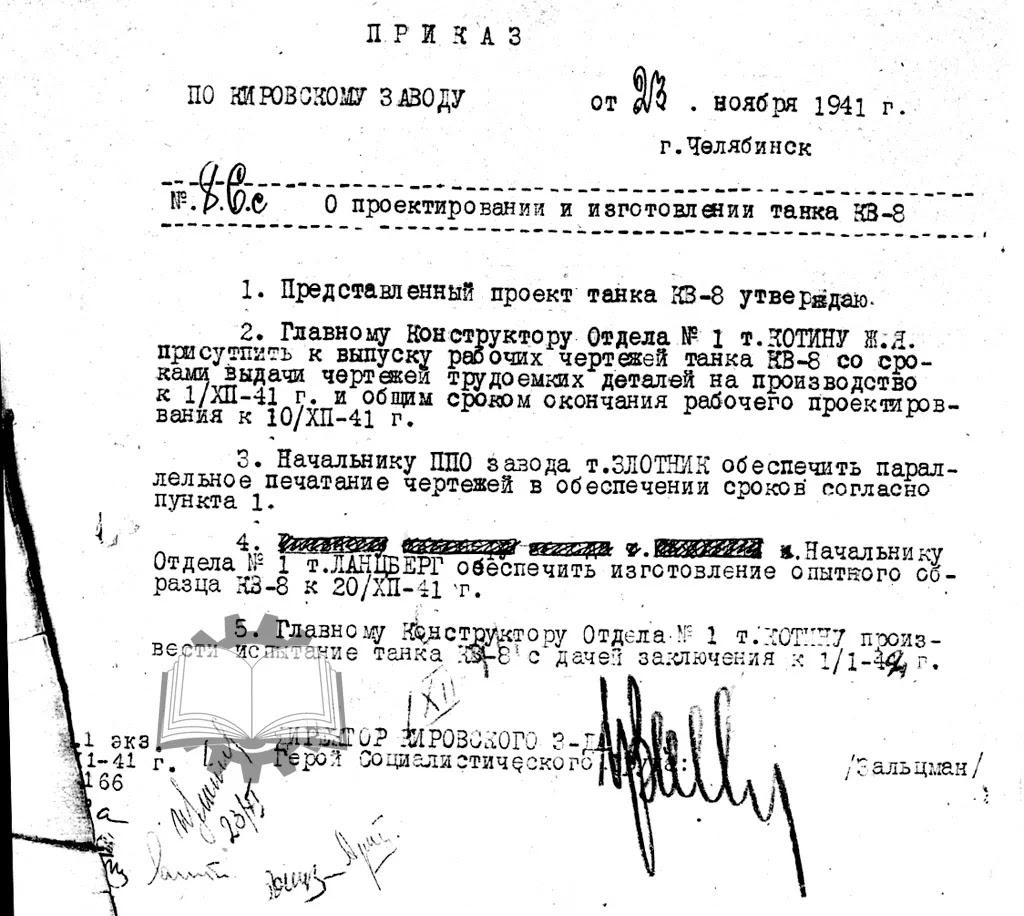
The KV-8 formed by the end of November of 1941 alongside the KV-7.

The experience of using chemical tanks showed that the concept had many drawbacks. In addition to a short range of the flamethrower, a lack of main gun proved to be a problem. The flamethrower could be a secondary weapon, but not a primary one. Starting in 1940, development switched to tanks with flamethrowers in the hull and a cannon in the turret. There were several variants developed, but it ended up on the upper front hull. The gunpowder flamethrower developed by factory #174 by a group led by I.A. Aristo. The flamethrower was supposed to be installed in the T-34, KV, and T-50, but flamethrowers in the T-34 and KV-1 were incredibly rare in 1941. At this point work on flamethrowers split. The T-34 and KV-1 had their own approaches to the flamethrower.

A prototype was ready by the end of December of 1941.

Friday, 23 September 2022

The First Firebreathing KV

The USSR was the first country to mass produce flamethrower tanks. Initially these were chemical tanks, whose primary purpose was to deploy chemical weapons. Nevertheless, the KhT-26 chemical tank accepted into service in the summer of 1932 was already a dual purpose vehicle. It could still deploy chemical weapons, but now its main weapon was a flamethrower. The KS-2 flamethrower developed by the Compressor factory was the first mass produced tank flamethrower. The pneumatic system could spew fire 30-45 meters away, not too far, but not too bad for a first try. The KhT-26 was the USSR’s first mass produced flamethrower (chemical) tank. The KhT-130 on the chassis of the T-26 tank with a cylindrical turret and KhT-133 based on the T-26 with a conical turret and turret platform followed. The T-46-1, the T-26’s replacement, was also supposed to be a chemical tank, but it never went into production. The flame throwing range gradually increased, but still was not enough. Other platforms were considered for flamethrower tank production, but the chemical BT never took off.

Wednesday, 2 February 2022

A Flame Throwing Alternative

The USSR was one of the few nations that seriously explored tank flamethrowers in the 1930s. Initially there were plans to install a flamethrower on the T-18 (MS-1) tank, but the adoption of its replacement, the T-26, led to a real breakthrough. The result was the KhT-26, the most numerous chemical (flamethrower) tank. Unlike the two-turreted T-26, which was produced relatively briefly, the KhT-26 created on its chassis was in production until 1936. It was replaced by the KhT-130, an improved version based on the single turreted T-26, and then the KhT-133, the same type of vehicle based on the T-26 with a sloped turret and hull superstructure. In total, over 1200 chemical tanks on the T-26 chassis were built, not including the KhT-27 and KhT-37. However, a considerable flaw in these tanks was discovered even before the war. Their bulletproof armour made them too vulnerable.

Wednesday, 4 November 2020

Flamethrower Tanks

"Excerpt from the trip report to the Volkhov Front

The 502nd and 503rd Independent Tank Battalions used flamethrower tanks rarely, but the commanders and crews still praise highly the effect of flamethrowers in battle. For instance, the commissar of the 502nd ITB stated that the flamethrowers were used rarely only because the terrain got in the way and that German infantry flees in advance of the tanks to keep out of range. The effectiveness is high. When flamethrowers are used, the enemy runs from dugouts and abandons everything.

A driver of a KV-8 tank, comrade Paturnak, tells had he made only 4 shots from his flamethrower. An anti-tank gun fired at the tank, but as soon as a flamethrower burst was fired towards the gun the gun crew fled and two Germans fell down in shock and were then crushed by the tank's tracks.

The commander of the 503rd ITB, Captain Drozdov, stated that when using flamethrowers near Gontovaya Lipka the fuel did not reach the enemy positions, but they fled in panic. However, he considers it unreasonable to use flamethrowers in forested swamps.

The commander of the 507th ITB, Major Nikolayevtsev, tells that a KV-8 tank commanded by political coordinator Osatyuk fired 15 shots at infantry hidden in bushes. The infantry fled in panic. A portion of the fascists ran while on fire. One KV-8 tank used flamethrowers at night. The Germans ran in panic, tearing off burning clothes and even underwear.

The commanders of the 507th ITB reported to the 8th Army that "the flamethrowers fulfilled their mission" and later, after a description of drawbacks encountered during exercises near Kuzminka, writes that "after these drawbacks are corrected, this will be an excellent weapon to use against the enemy."

Another report to the same organization states that "the flamethrower is an excellent weapon for use against counterattacking infantry in forested swamps... practice shows that the effect on the enemy at night is terrifying. During an attack on the night of August 30th-31st near point 40.4 and in the sector of the 24th Guards Rifle Division the Germans fled in panic, throwing off their equipment and underwear".

All flamethrower battalions on the Volkhov Front mainly used KV-8 tanks. T-O34 tanks used their flamethrowers rarely."


Wednesday, 28 November 2018

Factory #183 Experiments

"August 1st, 1940
#382s

To Chief of the 8th Department of the ABTU
Military Engineer 1st Class, Afonin

Report on experimental work for the month of July at factory #183
  1. Design bureau
    1. Two variants of a T-34 with a flamethrower have been developed. Presently, working blueprints are being composed. The deadlines outlined in the agreement are not being met.
    2. A technical project of a tractor on the T-34 chassis has been completed. Working blueprints of several components have been sent to production. The established deadlines are not being met. Production of blueprints is running 15-20 days late.
  2. Experimental plant #540
    1. Trials of the V-3 engine on an A-5 tank were performed. Trials began on July 17th, but the first outing showed that 250 hp is not enough for an A-5 tank. The engine only reached 1400 RPM in 4th gear on level terrain. After that, the engine was removed and adjusted to 300 hp. Trials resumed on July 24th. The mobility of the vehicle improved with an increase in power. The engine reaches 1800-1900 RPM on level terrain.
      As of July 31st, the engine had worked for 30 hours, after which it broke due to gas penetration.
    2. Assembly of two T-34 tanks with M-250 engines was performed. One tank was completed, and trials will begin on August 1st. The second vehicle is due for completion on August 10th.
    3. Voroshilovets tractor trials with components made with substitutes were performed. The tractor went through 1000 km of high speed trials. Towing trials remain, which will be performed in August.
    4. Two Voroshilovets tractors were assembled for installation of pneumatic controls. Installation of pneumatic controls will begin on August 1st and complete in the first half of August.
Acting regional engineer, Captain Rusakov"

Tuesday, 11 September 2018

Flamethrower Tanks

"Order
To the People's Commissariat of Medium Machinebuilding
Moscow
March 15th, 1941

In carrying out the decree of the Council of Commissars and the Central Committee of the VKP(b) issued on March 13th titled "On arming KV, T-34, and T-50 tanks with gunpowder flamethrowers", I order that:
  1. Deputy Chief of Special Industry comrade Hlamov, director of factory #174 comrade Markin, and Chief Engineer of factory #174 comrade Ginzburg must work alongside the GABTU, People's Commissariat of General Production (Lubertsy factory), and the designers of factory #183 and Kirov factory to:
    1. By March 25th, 1941, test a prototype of the 10 Litre gunpowder flamethrower and present blueprints and technical requirements for approval by the NKSM by April 2nd, 1941, matching tactical-technical requirements in attachment #1.
    2. By April 28th, 1941, complete all work on the four flamethrower mounts for the KV-1, KV-3, T-34, and T-50, as well as present technical requirements and blueprints to the NKSM, including corrections made as a result of the trials.

Wednesday, 27 September 2017

Flamethower Tanks, 1940

"Report on the current and prospective equipment of tanks with flamethrowers and chemical trailers

1. Mass production

1. Purpose of KhT-130 and KhT-133 tanks:
  1. Burning out strongholds
  2. Destroying personnel
  3. Putting up smokescreens to hide movements of mechanized forces
  4. Can be used to place persistent poisonous substances
2. The following are armed with KhT-130 and KhT-133 tanks:
  1. Independent flamethrower battalions in tank regiments (27 tanks)
  2. Independent flamethrower battalions in tank brigades (51 tanks)

Tuesday, 10 February 2015

Chemical T-46

"August 19th, 1935
To: Director of the S.M. Kirov Experimental Machinebuilding Factory

When the T-46 flamethrower was examined, the following conclusions were made:
  1. The 50 L fuel tank (40 L usable volume) can make 10-12 shots at a range of 25 meters and 5-6 at a range of 40 meters. It is easy to work with this device.
    However, the volume is insufficient, and needs to be increased to 100 L.
  2. The flamethrower equipment cannot be used to emit smokescreens.
  3. If ABTU accepts this flamethrower, the following changes must be made:
    1. Replace the flexible hose with a metal pipe, turning will be enabled with a ball joint.
    2. Replace the hose nozzle with a more modern type, like on BT and T-37 tanks.
    3. Add a pressure meter to measure the pressure inside the fuel mixture tank.
    4. The pressure meter and reductor should be placed on a panel in the front of the turret. Use the M-34 reductor.
    5. In order to hold the fuel mixture tank, weld a ring of iron with openings for bolts to the bottom.
  4. It must be noted that the conversion of the T-46 to a chemical tank is more difficult than the conversion of the T-26. The chemical T-26 has a 400 L tank. If possible, the T-46 needs to have equipment of equivalent power.
  5. A place for a 80-100 L smoke mixture tank is desirable.
Chief of the Chemical Department of NIHI RKKA
Minkov"

Wednesday, 25 June 2014

Flamethrower Tanks

"Memo on the use of the single-shot flamethrower and pistol flamethrower on the T-34 tank.
March 3rd, 1942

A. On single-shot gunpowder flamethrowers.
  1. Single-shot flamethrowers were developed according to the SNK decree #5830 from July 26th, 1941.  Kirov factory, on its own initiative, promised to produce and install 250 flamethrowers on KV tanks in August of 1941 (military representative Shpitalov's report #703 file 9 p.25 1941).
  2. Trials of single-shot flamethrowers on KV tanks (file 14 p.11 1940) were executed according to orders from Lieutenant-General comrade Fedorenko (file 120-2 p.13 1940 to #063 on August 5th, 1941). Trials commissions found the flamethrowers satisfactory and recommended their immediate production and installation on KV and T-34 tanks.
    In the first days of October of 1941, a document was addressed to Deputy Chair of the SNK, comrade Malyshev, saying that due to increase in automatic ATO-41, the need for single-shot tank flamethrowers waned. The document was shown to Major-General comrade Lebedev, and he agreed that the need for single-shot flamethrowers has passed. 
  3. As a temporary measure before the production of flamethrower tanks,  high explosive flamethrowers on T-34 tanks and single-shot flamethrowers on trawls are used.
  4. As the production of ATO-41 flamethrowers is delayed and HE flamethrowers mounted on T-34 tanks are heavy, clumsy, and uncomfortable to use, single-shot flamethrowers must be converted to be used on regular T-34 tanks. For this it is necessary to:
    1. Remove the defects of single-shot flamethrowers mentioned in the trials acts.
    2. Instruct the People's Commissariat of Tank Production to install 400 single shot flamethrowers on T-34 tanks in the second quarter of this year, specifically 150 tanks at factory #183, 150 tanks at STZ, and 100 tanks at factory #112.
  5. No less than a month is needed for production of single-shot flamethrowers to ramp up.
B. On trench flamethrower pistols (TOP)
  1. The automatic flamethrower design proposed by comrade Novikov is not novel. The proposed design is not worked out and is incomplete. For example, it lacks a receiver, air reductor, and valves.
  2. The flamethrower pistol produced at GVHU KA is already mastered by production lines.
  3. The weakest link of the system is the consumption of diesel vapours from the engine cylinders. The use of these vapours to reach a pressure of 30-40 atmospheres is complicated. These vapours contain oil and incompletely combusted fuel, which will reduce the reliability of the valve. Factory #183 engineers are at work on this issue, but no satisfactory answer has been found. The author proposes a diagram, and not a solution. He has no valve blueprints. 
  4. The production of a prototype using comrade Novikov's designs is premature. It is necessary to instruct the People's Commissariat of Tank Production to develop and test such a valve that would regulate the collection of vapour in order to produce the pressure of 30-40 atmospheres in a reservoir."

Note that as last time, the index "KV-6" does not appear anywhere in regards to a KV-1 with a flamethrower. 

Saturday, 21 June 2014

KV-1 Modernization

"To the chief of GABTU, Lieutenant-General Fedorenko

KO decree #428 instructs Kirov Factory to make a series of design and technological changes to the KV tank starting on March 1st, 1941.

A detailed investigation of the changes revealed that:
  1. The changes require redesigning the entire vehicle, some of which require externally produced assemblies, not yet delivered to the factory, as some have not reached prototype stages, let alone mass production.
  2. The requirements for new parts are not compatible with the ability of the factory's parts suppliers' output, and ignore the current stages of readiness for mass production:
    1. By 1941, 200 model 1940 hulls and turrets were required of Izhor factory, which is greater than how many vehicles we assemble in four months.
    2. The installation of a new commander's cupola and an F-34 gun require the redesign of the turret, and a complete rearrangement of the ammunition rack, gun mount, crew placement, and the design of many large components in the vehicles. Blueprints will only be passed to Izhor factory on February 1st, 1941, for the production of a first sample to be approved by ABTU and AU.
      For mass production of this new turret, Izhor factory needs many new complicated stamps, instruments, and devices. By estimates of Izhor factory, supplies of new turrets can start no sooner than July of 1941.
    3. According to KO decree, trials of a 700 hp engine must be finished by March 15th, 1941. Preliminary estimates indicate that the production, correction, and adaptation of the engine for mass production will take no less than four months.
      Aside from this, as a result of the increased power, Kirov factory needs to perform investigations in the area of strengthening components and improving cooling.
    4. The decree requires the possibility of installing a flamethrower with a range of 90 meters and reservoir for 10-12 shots. Kirov factory cannot do this, since according to our data, no such flamethrower exists or is currently in development.
    5. The decrease in mass form 46 tons to 42.5 tons with the simultaneous increase of warranty range from 2000 to 6000 km, increased ammunition capacity, installation of a flamethrower and more powerful engine requires the increase of robustness of parts and mechanisms along with a reduction of their weight, which requires redesigning many components.
    6. According to the Chief of Radio Production, the installation of a KRSTB radio can be achieved no sooner than July. Additionally, according to a letter from the supplier, the dimensions of the device have not yet been finalized.
    7. The requirement for installing an optical sight on the radio operator's machinegun cannot be satisfied, as optical sights for machineguns are not produced, and the PJa sight is available in small amounts and has not yet been adopted by the army.
Based on the aforementioned facts, I must warn you that the deadlines specified by decree #428 cannot be met. We have informed the Committee of Defense and the People's Commissar of Heavy Machinebuilding, comrade Yefremov.

Zaltsmann."

Saturday, 24 May 2014

Odd One Out

Here's a picture of the inside of a flamethrower modification of the T-34.


As you can see, the seat of the hull gunner/radio operator is replaced with the flamethrower device. So how many crewmen does this tank have? Three? Wrong.


"Composition and duties of the flamethrower T-O34 tank.

1. Composition and locations of the crew of the T-O34

1. The crew of the tank consists of 4 men. The commander of the tank is placed in the turret, to the left of the gun, near the aiming mechanisms. The driver is placed in the driver's compartment. The turret commander is placed in a seat to the right of the gun, and the flamethrower technician, located outside the tank."

The flamethrower technician does not run after the tank into battle, of course, but is tasked with refilling and repairing the device.

Friday, 28 June 2013

Missing Index: KV-6

Everyone knows the KV-1 and KV-2, and I have previously written about KVs 3 through 5, as well as KV-7. But where is the KV-6? Wikipedia will tell you that it was an experimental tank with a flamethrower in the hull. Let's see what the archives have to say about this.  According to CAMD RF 38-11355-958:

"June 1941 [Date was recorded with a pencil and has since worn off]

On the production of tanks at the Chelyabinsk Tractor Factory in 1941, the Committee of Defense has decided:
  1. The People's Commissar of Medium Machinery (comrade Malyshev), and the Chelyabinsk Tractor Factory (comrade Shor) must, starting with January 1st, 1942, produce KV-1 tanks with 90 mm of armour, according to the requirements in attachment 1, indexed KV-6.
  2. NKTM (comrade Kazakov) and the Kirov factory (comrade Zaltsmann) must restore the tank with 90 mm of armour and a 76 mm model 1940 gun (created according to Order #1288-495), and, with three sets of blueprints, send it to ChTZ.
  3. ChTZ and NKSM must send a group of engineers and technologists to the Kirov factory to establish details of production and acceptance of the KV-6 blueprints.
  4. Allow ChTZ and People's Commissar of Medium Machinery to
    1. Begin producing KV-6 tanks in 1941, as a part of their annual quota.
    2. Independently develop KV-1 and KV-6 blueprints.
    3. Install cast or stamped turrets with the same turret ring as the KV-1 and KV-2.
    4. Conduct experimental developments of tank mechanisms.
  5. Allow NKSP (comrade Nosenko), HKB (comrade Goremykin) and factory #78 (comrade Yermolayev) to produce KV-6 hulls and turrets as a part of their 1941 tank production quota.
  6. In order to create a mobilization reserve for KV-6 tanks, NKTM (comrade Kazakov) and Kirov factory (comrade Zaltsmann) must ready blueprints, instruments, equipment, and instruments for producing the KV-6.
  7. The NKB (comrade Goremykin) must, working with NKEP, within a month, deliver a proposal for equipping factory #78 with equipment for hardening armour with high frequency electrical current."
90 mm of armour, with the implication that it wil be surface hardened. Nothing about a flamethrower. Now, 'let's look at CAMD 38-1135-67:

"...
  1. Receive, by April 1st 1941, dimensional blueprints of a flamethrower installation on the KV-1 and KV-3 at the Izhor factory, and determine where they can be installed.
  2. When developing a flamethrower, factory #174 must keep the following in mind:
    1. The flamethrower must not impact the driver's visibility to the side.
    2. The flamethrower must be equivalently armoured to the front plate (75 mm on the KV-1, 90 mm on the KV-3).
    3. The driver will control the flamethrower. Due to this, the controls must be simple and easy.
    4. The magazine must be horizontal, and removable.
    5. The dimensions of the flamethrower, and its location, must match the attached sketch."
Sketch of a flamethrower on the KV-1. CAMD RF 38-11355-67

Blueprints of a flamethrower on the KV-3. CAMD RF 38-11355-344

Flamethrowers for the KV-1 and KV-3...but where is the KV-6? It's possible that it was renamed sometimes later, but CAMD RF 38-11355-36 dashes those hopes. The document, a list of shipments to the Leningrad front, from September of 1941, lists "KV-1 with a flamethrower mounted and the V-2K engine, #5156, #5157, #5158, plus one flamethrower mount for repairs." Again, not a KV-6, despite the KV-6 index having been established in June.