![]() |
| T-26 crews near Lake Hasan, summer 1938. |
Monday, 24 June 2024
Experience in the Far East
Sunday, 21 April 2024
Single Hatch for Tank Turrets
![]() |
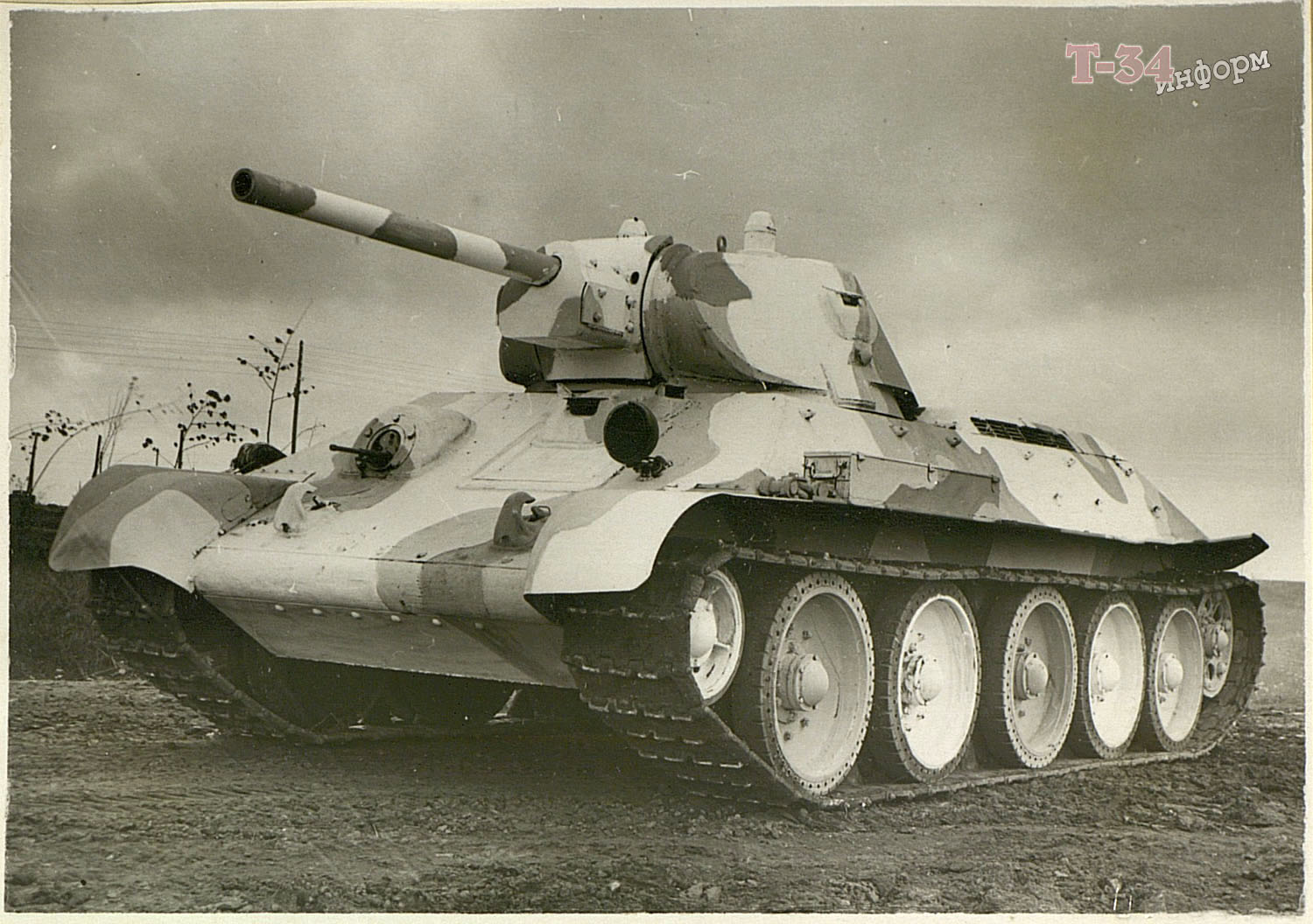
| T-34 in Crimea, 1944. Factory #112 was the last to keep the turret with a single hatch in production. One of their tanks can be seen in the foreground. |
One of the characteristic features of Soviet tanks and armoured cars in the late 1930s was the conical turret that came to replace the earlier cylindrical shape. Some vehicles also received a single hatch for their two-man turret. The T-34 tank was the most famous vehicle with this solution. This idea was dropped only to resurface in post-war designs. Let us discuss why this hatch appeared in the first place and why it disappeared.
Monday, 18 September 2023
Copper Horns
![]() |
| The rail antenna was a characteristic feature of Soviet tanks in the 1930s. |
Monday, 7 August 2023
Shermans in "August Storm"
In Soviet historiography, the Soviet-Japanese War of 1945 is overshadowed by grandiose operations against Berlin and Vienna earlier that year. However, Western historians pay close attention to this campaign and debates on whether it was the A-bombs or the Soviet invasion that forced the Japanese to surrender rage on to this day. Famous historian David Glantz even invented a grandiose name for this operation: August Storm. The Red Army's advance was indeed lightning fast, in part thanks to foreign vehicles. This included the M4A2(76)W HVSS, the most advanced Sherman variant sent to the USSR.
Clouds gather
Stalin promised to enter the war against Japan within three months of Germany's defeat at the Yalta conference in February of 1945. Colonel-General Alfred Yodl signed an order for unconditional capitulation of all German forces on May 7th, 1945, coming into effect at 23:01 on May 8th. This kicked off the countdown for a Soviet offensive against Japan. The Red Army had three months to move an enormous force to the other side of an equally enormous country.
![]() |
Concentration of the 6th Guards Tank Army in the vicinity of Tamsagbulag. The army included the 9th Guards Mechanized Corps that used Sherman tanks. |
The 6th Guards Tank Army was one of the units that was destined to transfer to the far east. On June 26th, 1945, the unit was reallocated to the Transbaikal Front. It would have to cover a distance of 9000 km to cross from Czechoslovakia to Choibalsan. 88 trains of 60 cars each were allocated for this journey. The full transfer took 30 days, but the first elements began to form up by July 17th. New tanks awaited them there: 100 M4A2(76)W including the latest tanks with HVSS suspensions. These tanks were described in documents as "M4A2 with wide tracks". The 46th Guards Tank Brigade was fully equipped with these vehicles. One company from each of the tank regiments of the 18th, 30th, and 31st Guards Mechanized Brigades that made up the 9th Guards Mechanized Corps also received new tanks.
From Choibalsan, the tanks would make a 300 km march to Tamsagbulag, where the army would prepare for the upcoming offensive. This march took place in extreme conditions. The temperature reached 45 C during the day, as a result of which marches took place only at night to avoid overheating the engines and running gear. This also helped hide the tanks from air reconnaissance, as there was nowhere to conceal them in the desert. The army's documents describe the M4A2 as less sensitive to hot weather than the T-34-85. The American tanks could cover more ground every day, but at the cost of increased fuel consumption. The Shermans normally burned 40 kg of fuel per hour, but this went up to 60 kg in Mongolia. Each tank could only run 90-100 km before refuelling instead of 150 km. The T-34-85 burned only 26 kg of fuel per hour.
![]() |
| M4A2(76)W HVSS, the newest tanks of the 9th Guards Mechanized Corps. |
Wednesday, 24 May 2023
The Last of Stalin's Robots
Unfortunately, museums frequently mislabel their own exhibits. The biggest problem with that is an incorrect information from a museum label is going to propagate. For example, Kubinka seriously thought that they had two BA-6 armoured cars, even though one was actually a BA-3M. The collection of the Patriot Park museum which used to be displayed at Kubinka has many downright unique exhibits, some of which were also misidentified. For example, this tank is called OT-130, but that is not the case.
![]() |
| TT-26 tank as displayed today. |
Monday, 30 January 2023
Tanks in Snow 1941-42
Winter is a difficult time for any kind of vehicle, including tanks. Since the Russian winter is long, the USSR paid a lot of attention to how tanks put up with it. This applied in full to mobility in winter. Driving through deep snow banks was a mandatory part of testing every armoured vehicle starting with the MS-1. The MS-1 showed insufficient traction in snow, which is a part of the reason why the "Eagle's Claw" track was introduced. Winter tests of the Vickers Mk.E tank in the USSR were also a key factor in accepting the tank into production.
![]() |
| T-34 tanks were often the only Soviet tanks that could move outside of roads in winter. |
Monday, 24 October 2022
Ever-Changing Tank Nomenclature
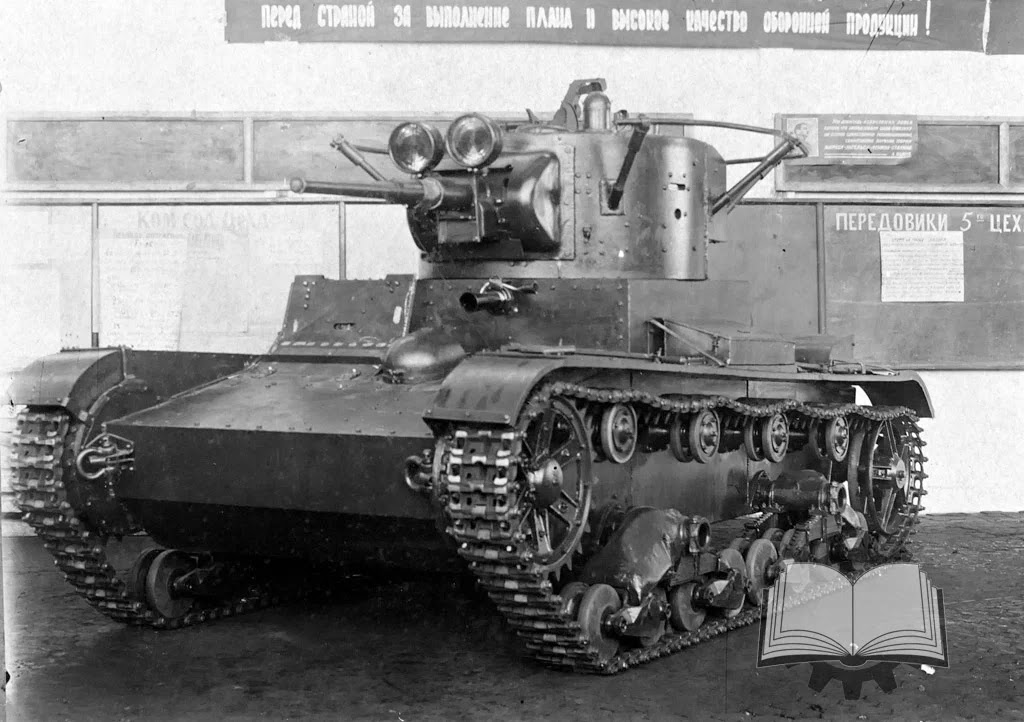
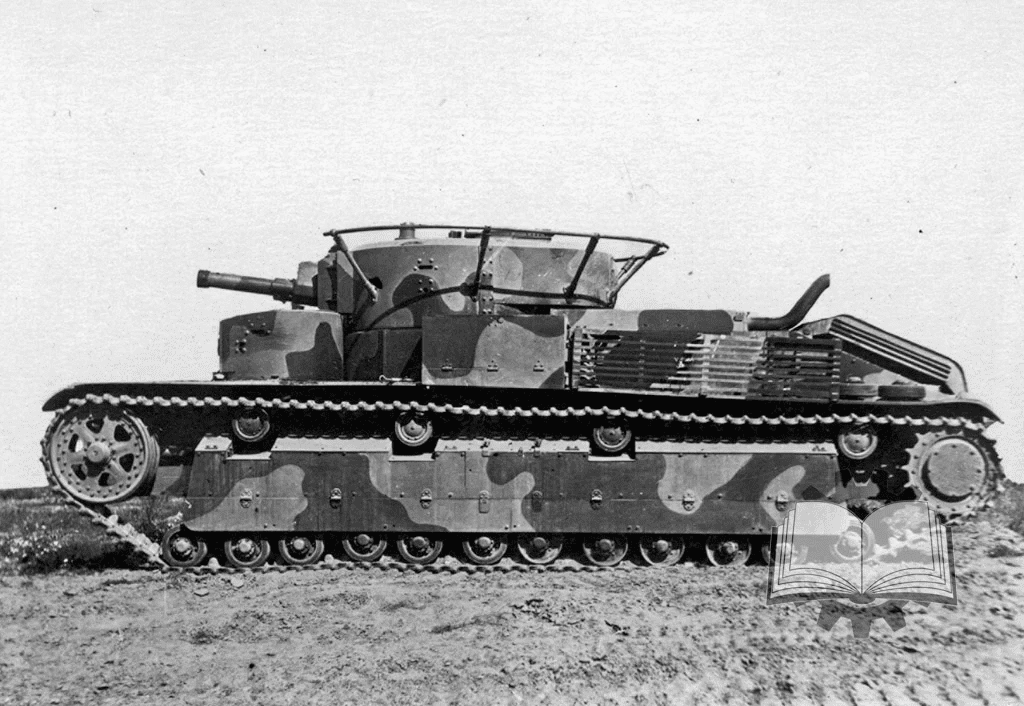
One of the topics that resurfaces in arguments about armoured vehicles is classification. It wouldn’t be so bad if people far from the science of armoured vehicles made mistakes, but quite notable historians also throw fuel on the fire. The T-28 is one of the most misunderstood vehicles. There is a certain group of people who draw modernisations onto the T-28 that would allegedly make it a suitable replacement for the T-34. After all, both have a 76 mm gun, similar weight, two tracks, basically the same thing! The fact that the T-34 was built to replace the BT doesn’t bother them, neither does the fact that it was the SMK that was first supposed to replace the T-28 and then the KV. The T-28 tank was included in heavy tank brigades. This seems like a very strange fact if one is not familiar with the Red Army’s system of classifications. Similar mistakes are made regarding tanks of other nations. For instance, the Panther is often called a heavy tank, but it’s enough to look at where these tanks went and what vehicles they replaced. Today we will cover the Soviet tank classifications, touching foreign vehicles a little for context. Keep in mind that the same names can mean different things in different times.
![]() |
Classification of tanks in the Red Army. Bronevoye Delo magazine, March 1921. |
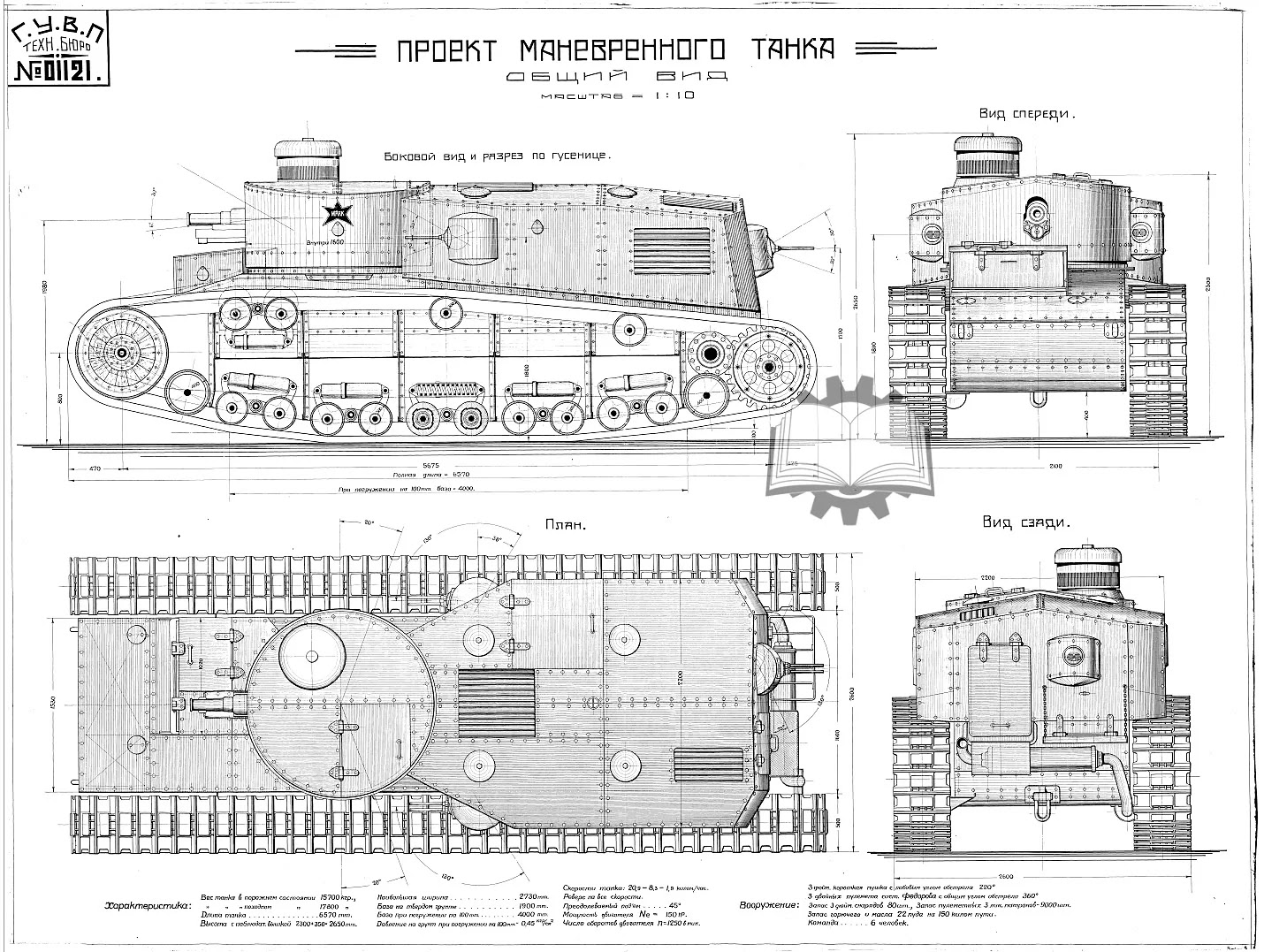
![]() |
| A 16 ton maneuver tank designed by the GUVP. No one ever called this tank "medium". |
Monday, 17 October 2022
The Main Soviet Pre-War Tank
Monday, 18 July 2022
Two Turrets from Leningrad
The creation of the two-turreted T-26 tank
The most famous Soviet tanks of the interbellum era at BT light tanks. Their high mobility, convertible drive feature, and a certain photogenic quality made them the best known Soviet tank series. One popular theory classified the BT tanks as "highway aggressor tanks" that indicated the offensive nature of the Red Army and popularized the idea that the BT tanks were the Red Army's main tanks. This is only an indicator of how wrong that theory is.
![]() |
| T-26 tanks armed with either only machine guns or both a cannon and a machine gun on parade in Moscow. |
Monday, 4 April 2022
Regimental Support Gun
The history of vehicles and weapons developed and produced in Leningrad in the summer of 1941 and during the blockade is an interesting topic for researchers. One of the most interesting parts are the improvised armoured cars, guns, and SPGs. Some of them are widely known, but others remain in obscurity. One such vehicle that became the foundation of the blockade SU-26 SPG will be covered in this article.
Friday, 7 January 2022
Starshina Commanders
"In 1941 order #0433 signed by then Deputy People's Commissar of Defense comrade Fedorenko ordered the assignment of Lieutenants and Junior Lieutenants as the commanders of medium and light gun tanks.
Based on this order, commanders of T-26 and BT tanks also have to be officers.
Considering the shortage of officers and less demanding training for commanders of T-26 and BT tanks compared to modern vehicles, I consider it possible and reasonable to appoint well prepared troops with the rank of Starshina who have a lot of experience in these tanks.
I ask for your decision.
Attached: order of the People's Commissar of Defense.
Deputy Commander of Armoured and Motorized Forces of the Red Army, Colonel-General of the Tank Forces, B. Korobkov
Member of the Military Council of the Armoured and Motorized Forces of the Red Army, Colonel-General of the Tank Forces, N. Biryukov"
CAMD RF F.38 Op.11355 D.1518 L.35
Printed in Glavnoye Bronetankovoye Upravleniye Lyudi, Sobytiya, Fakty v dokumentakh, 1944-1945 p.421
Wednesday, 15 December 2021
Video: Tanks in Snow, Winter 1941
It's winter again, and with it comes a sequel to my Tanks in Snow video. This time I narrow the scope a little bit and talk about how tanks in the Red Army performed in the winter of 1941-42, specifically about the T-26, T-60, Valentine, and Matilda tanks.
Wednesday, 10 November 2021
The Zenith of AA Machine Guns
The USSR began working on the issues of protecting armoured vehicles from air attack in the early 1930s. The first plans were to create specialized self propelled anti-aircraft guns, but work on these topics did not pan out. Instead, the Red Army received tanks with AA machine gun mounts. This mount was developed at experimental factory #185. It was accepted into service as the P-40 in 1935 and entered production a year later. M.A. Shufrin was the lead engineer on this project. Ironically, his initials were rarely seen in association with factory #185, even though this was one of the few products of factory #185 that truly saw widespread use. Mass production of the mount began in 1937. Variants were installed on the T-26, BT-7, T-28, and T-35. At its inception it was the best anti-aircraft gun mount in existence. It allowed the DT machine gun installed on it to rotate a full 360 degrees. The DT machine gun was equipped with AA sights.
![]() |
| The KV-1 was the only new generation Soviet tank equipped with an AA machine gun, although it was not used frequently. |
Monday, 6 September 2021
Soviet Camo that Came Too Late
The appearance of tanks on the battlefield in September of 1916 quickly forced many to reconsider some preconceived notions about their use. The first to make changes were the British, who pioneered the concept on the battlefield. The pair of wheels that aided in turning the tank was quickly dropped. There were two other important changes: one was the use of fascines and logs for crossing obstacles, the second was camouflage. WWI marked a turning point in the use of camouflage. Previously uniforms were bright and colourful, but now being hidden was very important. Camouflage was used in uniforms, artillery, and military vehicles. This did not mean that camouflage would entirely displace single tone paint schemes, but tanks were repainted soon after they were involved in their first battles. The use of camouflage decreased after the end of WWI. Most major tank building nations dropped the idea of widespread camouflage, with the exception of the French, who kept on using it. The Germans also returned to three colour camo in the late 1920s. A second wave of camouflage swept through all nations in the mid-1930s. Some tanks remained in camouflage at the start of WWII, but the Germans dropped it, moving from Feldgrau Nr.3 (don't be misled, this is actually a shade of olive green) and then black-gray RAL 70121 as the base coat.
![]() |
| A T-28 tank with three colour camouflage developed for the Middle Asian Military District, summer of 1939. |
Friday, 20 August 2021
Winter Camo
"GABTU Scientific Research Proving Grounds
Approved:
Proving Grounds Chief Colonel Romanov, December 15th, 1941
Approved
Proving Grounds Commissar, Regimental Commissar Dolgov, December 16th, 1941
Conclusions regarding experimental winter camouflage of armoured vehicles
Introduction
On orders from the GABTU, T-34, T-50, BT, T-26, and T-40 tanks were painted in winter camouflage patterns between September 19th and October 2nd, 1941. The trials were performed at the GABTU proving grounds.
The goal of the trials was to:
- Establish the pattern that was the most effective at breaking up the outline and shape of the tanks.
- Establish the shade of colours that blend together with the surroundings in winter.
- Develop a formula for paint that is sufficiently resilient and easy to produce.
Monday, 9 August 2021
Light Turretless Artillery Tank
The first work on SPGs began in the USSR in the 1920s. They began as just projects, but prototypes began appearing in the early 1930s. The first such vehicles were built in 1931, generally light ones. Even though the results were negative, this was not a complete failure. Soviet SPGs were produced in series, although small ones, and some of them still saw battle. This also applies to the "artillery tank", the AT-1. Much was expected of it, and the vehicle was indeed quite decent, but it had one serious issue: the AT-1 ended up without a gun.
Monday, 2 August 2021
Chief Designer of the 1930s
When one lists Soviet tank designers, M.I. Koshkin is usually remembered first as one of the main authors of the T-34. He is usually followed by A.A. Morozov, who succeeded Koshkin as the Chief Designer of factory #183 in Kharkov and in Nizhniy Tagil after the evacuation. Zh.Ya. Kotin, the author of many tanks from the KV-1 to the IS-2, also ranks highly. N.A. Astrov, the creator of the T-40, T-60, T-70, and other light vehicles is slightly less famous. However, if one explores an earlier period of Soviet tank building, one will see many other much less known names. Their obscurity is largely due to their complicated history.
One such history belongs to the main character of today's article, Semyon Aleksandrovich Ginzburg. He oversaw the creation of the most numerous and most successful Soviet tanks of the interbellum era: the T-26, BT, T-28, and T-35. As the Chief Engineer at factory #185 he directed the creation of a number of tanks and SPGs. His designs include the T-50 light tank and SU-12 (SU-76) SPG, which played a fatal role in his career. Let us recall this man, whose contribution to Soviet tank building was truly immense. The war for his tanks began back in 1936 and finished in August of 1945 in the Far East.
Monday, 7 June 2021
Armoured Confusion: Start of the Great Patriotic War
One of the most popular topics of discussion in Soviet tank circles is their use in the Great Patriotic War. As strange as this may sound, the production and use of Soviet tanks during the war is not a very well studied topic. This is caused by shallow surface level research and resilience of "common knowledge", little of which overlaps with any facts. There are so many of these myths that it's impossible to cover them all in a single article. Let's examine only the first half of the Great Patriotic War and misconceptions linked to this period.
Wednesday, 2 June 2021
War Plans
The Red Army was undergoing a pretty radical reorganization in the summer of 1941. Fans of the theory that the USSR was about to attack Germany and Hitler merely delivered a preemptive strike will be disappointed to find out that not only did the Red Army not consider itself in any situation to fight a war in 1941, 1942 wasn't looking much better either. Compare the number of tanks on hand to the number of tanks required according to authorized strength.
|
Tank type |
Authorized strength |
On hand as of Jan 1st, 1941 |
% Authorized strength as of Jan 1st, 1941 |
Expected inventory as of Jan 1st, 1942 |
% Authorized strength as of Jan 1st, 1942 |
|||
|
Peacetime |
Wartime |
Peacetime |
Wartime |
Peacetime |
Wartime |
|||
|
KV |
2100 |
2100 |
243 |
11.5 |
11.5 |
1093 |
52 |
52 |
|
T-34 |
4200 |
4200 |
350 |
8.3 |
8.3 |
2850 |
67.8 |
67.8 |
|
BT |
5487 |
8273 |
7752 |
141.5 |
93.7 |
7752 |
141.5 |
93.7 |
|
T-26 |
13,802 |
15,872 |
9987 |
72.3 |
62.9 |
9987 |
72.3 |
62.9 |
|
T-50 |
|
|
|
|
|
500 |
|
|
|
T-37/ T-38 |
2420 |
3681 |
3596 |
152 |
100 |
3596 |
182 |
116.7 |
|
T-40 |
|
|
100 |
|
|
800 |
|
|
|
Armoured cars |
5298 |
6853 |
4461 |
84.2 |
65 |
6271 |
118 |
91.7 |
Total as of January 1st, 1941: 22,530 tanks (of those 59 T-35 and 443 T-28), 4461 armoured cars
Monday, 15 March 2021
Snow "Shoes"
The tank was born on the battlefields of WWI where it had to combat not only enemy fortifications, but also mud. Tanks were often lost not from enemy fire, but from being stuck on cross country terrain. Engineers and the military first started thinking about how to improve mobility of their vehicles. Further improvements focused on improving mobility in general, but advanced methods of driving on soft terrain did not progress past experiments. Engineers returned to the issue of improving off-road mobility in WWII. In addition to mud, tanks got a new enemy: snow. This issue was most prevalent on the Soviet-German front where there was more snow than anywhere else for obvious reasons.