Saturday, 17 December 2022

Tank Archives is now on Mastodon

With the current migration away from Twitter, I decided to cover all my bases and open an account on Mastodon. The content there will be similar to what I already post on Twitter, but the added benefit of a much longer character limit. See you there!


Friday, 16 December 2022

Tougher Armour

 "Order of the People's Commissar of Tank Production #562s
Moscow

July 31st, 1942

The meeting called by the People's Commissariat of Tank Production in Moscow on the topic of improving quality of hulls produced from high hardness armour reviewed and approved the draft technological process guidelines for all stages of armoured component production and hull welding presented by the 3rd Main Directorate of the NKTP. In order to rapidly bring these processes to production and improve the quality of armour and armoured hulls, I order that:

  1. Directors of the following factories: UZTM (comrade Muzrukov), #200 (comrade Sochivko), #264 (comrade Suvorov), #112 (comrade Rubinchik), #183 (comrade Maksarev), #174 (comrade Katsnelson), #176 (comrade Fedotov), #177 (comrade Volkov), #178 (comrade Skiba), #180 (comrade Orlov), #37 (comrade Frezerov), and #38 (comrade Yakovlev) must develop production instructions based on the approved technological process guidelines and send them to the 3rd Main Directorate of the NKTP after approval by the factory chief engineers. Develop all instructions within ten days of receiving this order or no later than August 15th of this year.
  2. Factory directors must provide the 3rd Main Directorate of the NKTP with reports on the quality of armour plate and armoured hulls with reports of rejected components by reason of rejection.
  3. Factory directors must keep in mind the necessity of highlighting the importance of quality assurance at every stage of production as well as the strengthening of laboratories and metallurgical departments.
  4. Director of TsNII-48 A.S. Zavyalov must:
    1. Compose and publish a list of minimal technical qualifications for workers of all specialties that are connected to production and finishing of armour within one month.
    2. Compose and publish directions for engineering-technical workers connected to production, finishing, and welding of armour within two months.
  5. Directors of all factories must compose a list of minimal technical qualifications for all technical processes among foremen, foremasters, and technologists. Put all welders and cutters through exams. Only permit welders and cutters with appropriate diplomas to work on armour.
  6. Director of factory #183 comrade Maksarev must order his design bureau to work on the T-34 hull with the aim of reducing the amount of welding, components welded onto armour, change in dovetails, reduction of the welding seam length within possible limits. Check these developments with NII-48.
Deputy People's Commissar of Tank Production, Zernov"


Monday, 12 December 2022

A Shortage of Guns

Practice shows that processes in the army that flow slowly tend to rapidly accelerate after the first combat engagements. This observation applies to the German SPG program. The Germans began working on these vehicles in the second half of the 1920s, but achieved very little by the start of the Second World War. This was in part due to unrealistic expectations, particularly in the case of tank destroyers. The Germans army dreamed of high speed tank destroyers with a fully rotating turret on a halftrack chassis. Such vehicles were even built, but only as prototypes and small production batches. As a result, the Germans quickly had to build tank destroyers out of whatever was available after the war began.

Vehicles of the 128th Tank Destroyer Battalion. The vehicle in the front is the best known conversion of a Pz.Kpfw.II tank carrying a 50 mm Pak 38 gun.

Friday, 9 December 2022

Well Fed Sherman

In 1942 the British asked the Americans to develop a tank based on the Sherman with improved armour. The Americans gave them the Assault Tank T14, but didn’t take much interest in the idea themselves. However, the idea of such a tank returned in 1944 and eventually culminated in the M4A3E2 or Sherman Jumbo.

Assault tank in a hurry

Until 1944 the American army was certain that the ordinary Sherman was more than capable of facing German medium tanks. Sure, the Germans had Tigers and Panthers, but based on experience in Africa and Italy these dangerous tanks were very rare. Nevertheless, the Americans decided to play it safe and develop a heavily armoured tank. It was clear that the Heavy Tank M6 was not suitable for battle and the Medium (future Heavy) Tank T26 would not be ready until the end of 1944 at the latest. US Army Ground Forces command proposed three temporary solutions in February of 1944.

The first idea consisted of a basic Medium Tank M4 with thicker armour. An extra 2 inches (50 mm) was welded to the front and 1 inch (25 mm) to the sides. This kind of modernization took 200 man-hours to complete and increased the weight of the tank by 6870 lbs (3.1 tons). This conversion could be performed in a field workshop.

An M4A1 Sherman with additional armour drives past a knocked out Pz.Kpfw.IV. This kind of additional armour was installed in field workshops and its design varied from vehicle to vehicle.

Wednesday, 7 December 2022

Panzerfaust Usage

 "To commanders of formations and units of the 1st Mechanized Krasnograd Corps
Copy to: 37th MBr

Recent battles showed that the enemy is using "Faust" grenade launchers against our tanks and SPGs. In street fighting they are used against infantry, firing positions, etc.

When the enemy retreats, the "Fausts" are left behind in large amounts in working condition and can be used to combat enemy tanks, SPGs, personnel, and objects fortified for long term defense.

However, most commanders do not allocate the necessary attention to collecting, storing, studying, and using this simple and highly penetrating weapon.

Monday, 5 December 2022

The Doomed Victorious AA Tank

The T-90 AA tank developed by the Molotov GAZ factory that won the tender but never entered mass production.

The situation in Soviet tank production changed radically in the second half of 1942. The experience in 1941 and the first half of 1942 clearly indicated new priorities. It was clear that T-34 production had to increase, as this tank turned out to be the optimal combat vehicle. It had the necessary mobility, decent armour, and powerful armament. The T-34 was often the only tank that could move cross-country in later 1941 and early 1942. The KV-1 was too heavy and the T-60 was too weak. The T-70 light tank that appeared in early 1942 was better than the T-60, but Soviet leadership had no illusions about it. It was clear by the spring of 1942 that the T-70 would not be built at as many factories as the T-60 was. The situation was difficult in the summer, and a decision was made to even spin up T-34 production in Chelyabinsk at the cost of decreasing KV production. Additionally, a decision to build the T-34 in Sverdlovsk at the site of the former factory #37 was made. Only two factories remained for the T-70: the Molotov GAZ in Gorky and factory #38 in Kirov. They would also have been used for T-34 production, but they proved unsuitable.
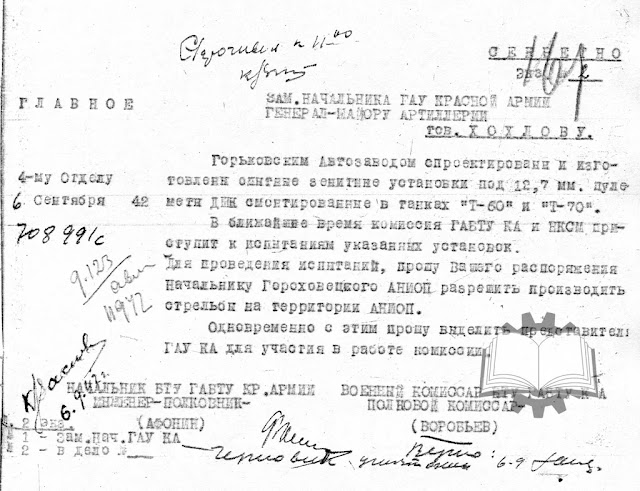
Status of the work on AA tanks at the GAZ as of September 1942. AA tanks on the T-60 and T-70 chassis are mentioned. In reality, they only worked on the future T-90.

Front line experience in 1942 showed that the decision to change priorities was correct. The first use of the T-70 tank revealed that it had issues when it came to crew comfort and, most importantly, armour. This was not a surprise. The age of light tanks was coming to an end, and the Germans also ceased production of these vehicles in the summer of 1942. Soviet light tanks clinged on for longer, but it was clear that their time had come. This did not mean that light vehicles would disappear altogether. The chassis of light tanks was necessary for the creation of SPGs, which were not obsolete until the very end of the war. Self propelled guns with powerful armament than the tank they were based on were in demand at the front, which experience proved time and time again as the war went on. The development of Soviet self propelled artillery did not differ much from the path it took abroad, even considering that the first SPGs went into production in the summer-fall of 1941 (including SPAAGs).
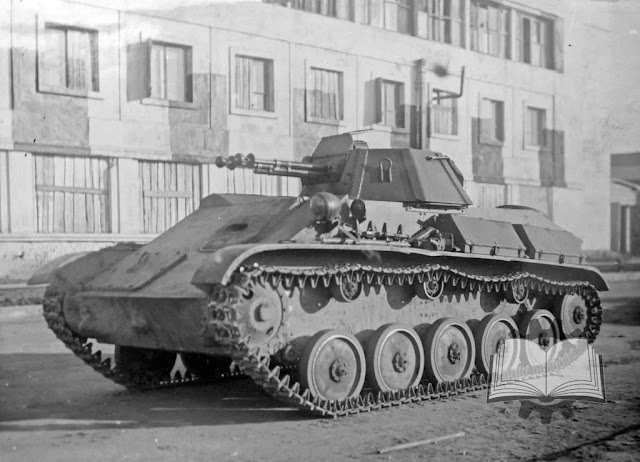
The T-90 tank prototype, September 1942.

Friday, 2 December 2022

Americans at the Right Place, at the Right Time

The first foreign tanks sent to the USSR as military aid arrived in the fall of 1941. These were British Matilda III and Valentine II tanks. They arrived in time to briefly take part in the defensive fighting of late November-early December of 1941. It's hard to say that they played a key part, but it would be incorrect to dismiss their contribution. The situation with American tanks was similar. They first convoy arrived at the end of December of 1941, but shortages of ammunition and other problems delayed their debut to May of 1942. It is often said that the 114th Tank Brigade achieved almost nothing at Kharkov, but that is not correct. The American tanks took part in the offensive on Chepil, which temporarily penetrated the encirclement. An evacuation was organized thanks in part to Soviet tankers fighting in American tanks.

Tanks of the 258th Independent Tank Battalion before battle, early September 1942.

Wednesday, 30 November 2022

Video: Soviet Anti-Tank Dogs

The anti-tank dog is one of the least researched weapons in the Red Army's anti-tank arsenal. Few publications dedicate more than a few paragraphs to this unusual weapon. In my most recent video, I explain how these weapons were used and discuss some of the most common myths associated with them.


Sunday, 27 November 2022

Anti-Tank Dog Instructions

Check the equipment of both the soldiers and the dogs.

 "Instructions on using anti-tank dogs in various types of combat 
1942

A. Main points

  1. Anti-tank dogs are an auxiliary weapon for infantry in anti-tank defenses, but they can be used in all types of combat.
  2. Anti-tank dog units are subordinate to the Army command. Individual companies or platoons are subordinated to infantry divisions as reinforcements of anti-tank defenses.
  3. The reserve and rear line elements of the anti-tank dog unit are located in the rear of the Army. There the personnel and the dogs systematically train and prepare themselves for service.
  4. An anti-tank dog company has 81 anti-tank dogs. The company is split into three platoons of 27 dogs. The platoon is split into three squads of 9 dogs each.
  5. The main method of destroying tanks is by releasing the dog from cover at a range of up to 200 meters from the enemy tank.
  6. If correctly used at a close range of 100-150 meters, the anti-tank dog is an effective weapon for the destruction of enemy tanks.
  7. A dog will dive under the front part of the enemy tank. The lever touches the floor of the tank and the tank is destroyed by an explosion.
  8. Anti-tank dogs work precisely and flawlessly only if the dogs are systematically trained and correctly fed. To achieve this, anti-tank dog platoons and companies must be removed from forward positions every ten days and recalled to the rear for training.
  9. The infantry division commander allocates one functional tank, preferably a captured one, for training the anti-tank dog company.
  10. For additional maneuverability, the anti-tank dog company commander must be allocated two GAZ-AA (1.5 ton) trucks to move one anti-tank dog platoon rapidly.
  11. Soldiers of anti-tank dog platoons chiefly fight individually, and thus must display initiative, courage, discipline, decisiveness, and calmness.
  12. The anti-tank dog soldier is armed with an anti-tank dog, an automatic rifle, an anti-tank grenade, and two bottles of incendiary fluid
  13. Having released his dog, the anti-tank dog soldier continues to fight with his rifle, anti-tank grenade, and bottles with incendiary fluid as a part of his squad.
  14. Anti-tank dog soldiers that released their dogs return to the rear after the completion of the battle to continue service according to their speciality.

Friday, 25 November 2022

Firebreathing KV from Chelyabinsk

Flamethrower tanks were not a rarity in the Red Army. Work on chemical tanks began in the early 1930s. Initially, they were meant to deploy chemical weapons, but “universal” chemical tanks appeared soon after that. The first of them was the KhT-26, a vehicle on the T-26 tank chassis that could fire both poison substances and flame. As a result of trials, the flamethrower mode became the priority. The KhT-26 was succeeded by the KhT-130 based on the single turreted variant of the tank. The last variant was the KhT-133, the same vehicle but based on a T-26 with a conical turret and sloped turret platform sides. The last tanks were delivered in 1940 when the concept of a “universal” chemical tank had already died. The requirements for flamethrower tanks also changed.


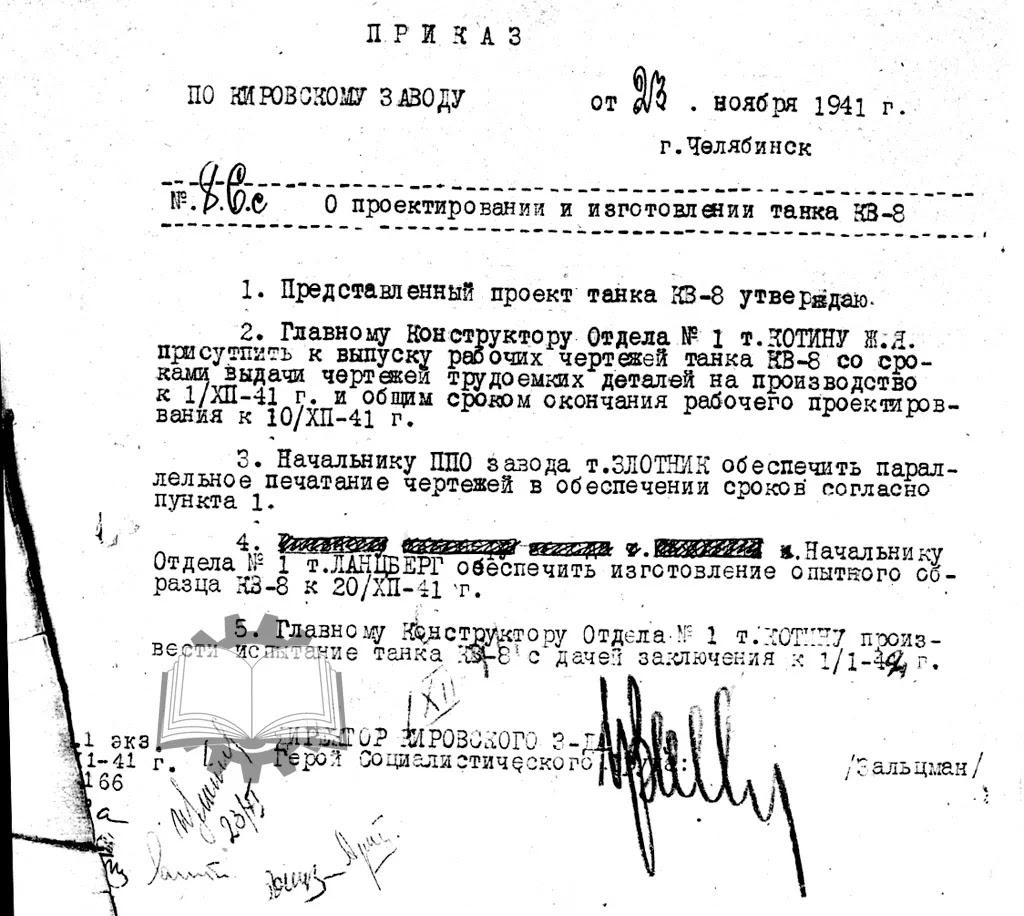
The KV-8 formed by the end of November of 1941 alongside the KV-7.

The experience of using chemical tanks showed that the concept had many drawbacks. In addition to a short range of the flamethrower, a lack of main gun proved to be a problem. The flamethrower could be a secondary weapon, but not a primary one. Starting in 1940, development switched to tanks with flamethrowers in the hull and a cannon in the turret. There were several variants developed, but it ended up on the upper front hull. The gunpowder flamethrower developed by factory #174 by a group led by I.A. Aristo. The flamethrower was supposed to be installed in the T-34, KV, and T-50, but flamethrowers in the T-34 and KV-1 were incredibly rare in 1941. At this point work on flamethrowers split. The T-34 and KV-1 had their own approaches to the flamethrower.

A prototype was ready by the end of December of 1941.