The American movie Fury, which came out in 2014, was memorable, in part, due to the unusual exterior of the tank, which effectively became one of the main characters. Even though Fury's equipment was, at best, "based on a true story", and the M4A2E8 never fought with the American army, the creators of the movie managed to capture the overall idea of field improvisations. These modifications of American tanks in Europe were a widespread phenomenon, and came about out of necessity.

This blog is dedicated to bringing World War II era documents to the general public, with an overall focus on armoured warfare. Questions? Requests? Comments? Email me at tankarchives@gmail.com or find me on Twitter @Tank_Archives.
Friday, 25 August 2017

Thursday, 24 August 2017
GVG Machinegun
The Red Army started WWII with two infantry machineguns: the light magazine fed handheld DP and heavy belt fed mounted Maxim. Both were quite aged designs by the time, so a replacement was considered. The GVG was one such replacement, eventually morphing beyond all recognition into the SG-43.
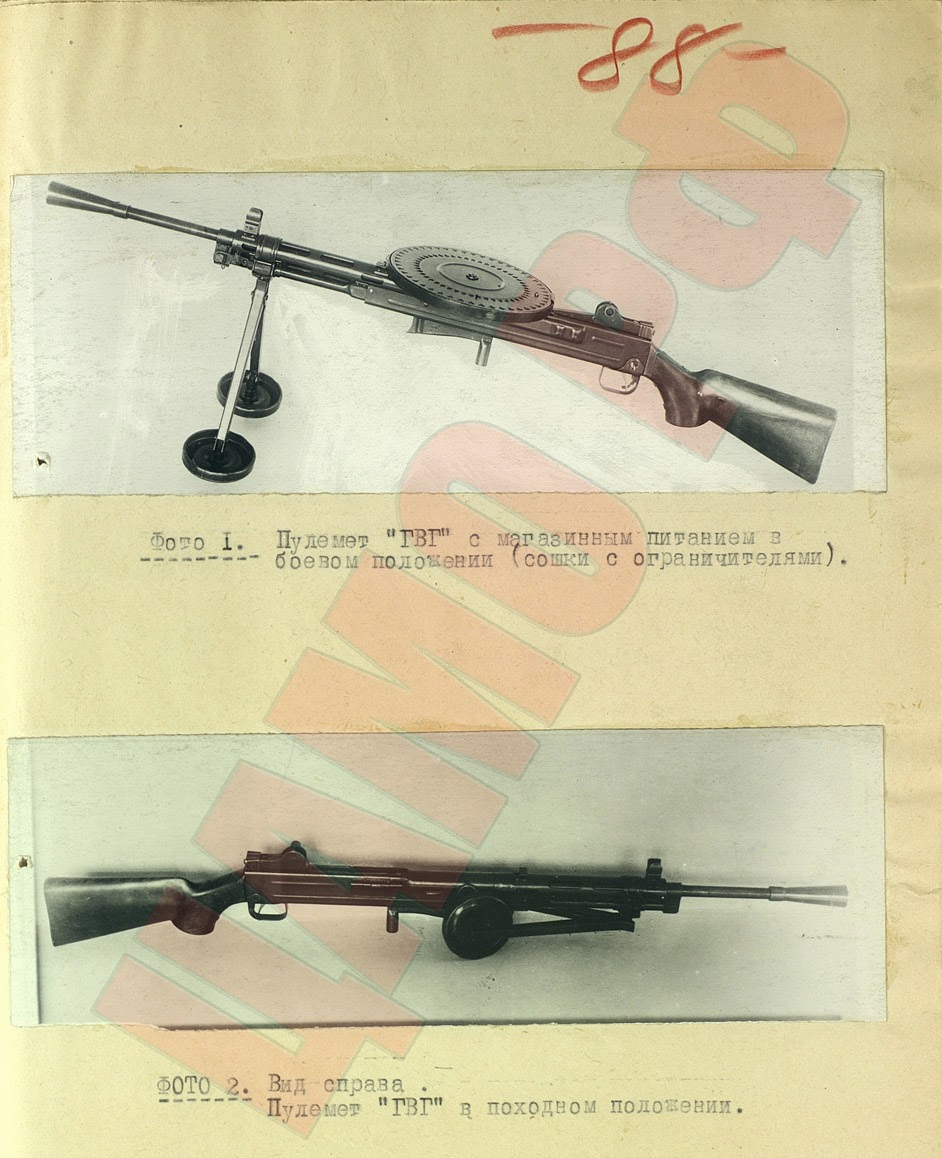
Photo #1. Magazine fed GVG machinegun in combat position (bipod with limiters)
Photo #2. View from the right. GVG machinegun in transport position.
Wednesday, 23 August 2017
KS-77: M-8 on T-40 Chassis
"Meeting minutes for the technical meeting on the issue of producing the first batch of the KS-77 vehicle.
Moscow, Compressor factory, October 7th, 1941
Present:
- Factory director, M.I. Boganov
- NKOM TO Chief, P.F. Ostapchuk
- NKOM TO Deputy Chief, I.S. Zakharov
- Deputy director for special production, I.A. Dorozhkin
- Chief engineer, V.P. Barmin
- Chief of the 1st Section, 3rd Department of the GUVMCh, Military Engineer 2nd Class, comrade Kopylov
- Central Committee of the VKP(b) instructor, comrade Volkov
- Military Repersentative from the GUVMCh, Military Technician 1st Class, comrade Usachev
Conclusions:
Tuesday, 22 August 2017
SG-122 Conversion
"To the Chief of the Red Army GAU, Colonel-General comrade Yakovlev
Report on the SG-122 SPGs
In December of 1942, factory #40 produced 20 SG-122 SPGs on the chassis of German PzIII and StuG vehicles. Production was later stopped due to defects of the gun mount.
Of the overall number produced, 12 SG-122s were passed on to equip the 1435th SPG Regiment. During fighting on the Western Front, all 12 SG-122s were disabled: of them, 3 were lost irreparably and 9 need factory repairs. Out of those that need factory repairs, 6 vehicles arrived at factory #37 on February 8th, 1943.
Report on the SG-122 SPGs
In December of 1942, factory #40 produced 20 SG-122 SPGs on the chassis of German PzIII and StuG vehicles. Production was later stopped due to defects of the gun mount.
Of the overall number produced, 12 SG-122s were passed on to equip the 1435th SPG Regiment. During fighting on the Western Front, all 12 SG-122s were disabled: of them, 3 were lost irreparably and 9 need factory repairs. Out of those that need factory repairs, 6 vehicles arrived at factory #37 on February 8th, 1943.
Monday, 21 August 2017
Reliability and Repairs in the 2nd Tank Army
At the beginning of the 2nd Tank Army's offensive during the Battle of Kursk, on July 16th, the army's technical services performed an inventory of their vehicles' remaining service life.
Type
|
Number
|
Of those, functional
|
Remaining engine hours
|
|||
under 50
|
50-100
|
150-200
|
over 200
|
|||
T-34
|
276
|
238
|
-
|
167
|
71
|
-
|
T-70
|
109
|
92
|
-
|
67
|
25
|
-
|
T-60
|
17
|
16
|
-
|
16
|
-
|
-
|
Saturday, 19 August 2017
Marder II: Light Tank Destroyer
By the end of 1941, the Germans began to understand that the time of light tanks was over. This also applied to the PzII tank. By that time, it's main enemy was medium tanks with shellproof armour, against which the 20 mm autocannon was useless. Production of light tanks ended in Germany in the summer of 1942, but that doesn't mean that the PzII chassis was done for. Work on light SPGs on its chassis began in the spring. One of them was a tank destroyer that is best known as the Marder II.
Friday, 18 August 2017
An Aryan From Poland
The Red Army GABTU had a very vague idea about the armoured vehicles of its potential enemy at the start of World War II. The same could be said about the other members of what would become the Allies. For obvious reasons, there was very little available information about tanks made by Germany and its allies. Mainly, it could be obtained from encyclopedias, which were full of errors. The ability to properly study the foreign tanks was only possible after combat began. In this respect, the USSR was ahead of the rest of the world. The first trophies began arriving from Spain: a captured PzI Ausf. A and an Italian L3/35. In the summer of 1939, a Japanese Ha-Go tank was captured in the Far East. The list of trophies grew with the start of WWII. The German PzII Ausf. C was among them.
Thursday, 17 August 2017
Armoury of the Moscow People's Militia
In September of 1941, things weren't looking so good for the Red Army. The possibility of the German army reaching, and even taking, Moscow was on the horizon. A People's Militia was formed to defend the city if necessary. At the same time, an inventory of obsolete weapons was taken, to see what they could be equipped with if the regular army consumes all of the currently produced guns. Numbers of functional guns and those in need of repairs are given, the latter in brackets.
Any modern collector would be envious of the result:
Wednesday, 16 August 2017
Exotic Trophies
"September 15th, 1945
To the commander of the Armoured and Mechanized Forces of the Red Army, comrade Fedorenko
I present to you brief descriptions of the "Maus" superheavy tank, a self propelled AA gun, and a "Tiger-mortar" 380 mm SPG. I report that the aforementioned vehicles, as well as an 88 mm tank destroyer, were sent to Moscow to the Kubinka Scientific Research Tank Proving Grounds.
Tuesday, 15 August 2017
Stuart Commander
"Award Order
- Name: Karev, Yuriy Nikiforovich
- Rank: Major
- Position, unit: commander of the 258th Independent Tank Battalion, Northern Group, Transcaucasian Frontis nominated for the Order of the Red Star.
Subscribe to:
Posts (Atom)