Tuesday, 19 September 2023

Smokescreens in the 31st Tank Corps

"Report on the use of smokescreen by the 31st Tank Corps in January of 1945

A. Preparation of tank and SPG crews to use neutral smokescreens in battle

Strong attention to the use of smokescreens was paid during training of all types of forces in the corps. Personnel of tanks, SPGs, and motorized rifle units was taught the rules of using smoke equipment and its tactical-technical data.

The following topics were practices during tactical training exercises held in November-December 1944:

  1. The use of the RDG and DSh smoke bombs by a single tank or SPG to conceal its maneuver in combat.
  2. The use of smoke launchers by infantry and tanks to signal aircraft.
  3. Deployment of a tank battalion under the cover of a smokescreen set by an advance force.
  4. Attack by a tank battalion through a corridor in the smokescreen created by MDSh bombs lit by flanking tanks as cover from anti-tank gun fire.
  5. Concealing anti-tank obstacles in front of a defending rifle battalion with smoke to make crossing them more difficult.

Monday, 18 September 2023

Copper Horns

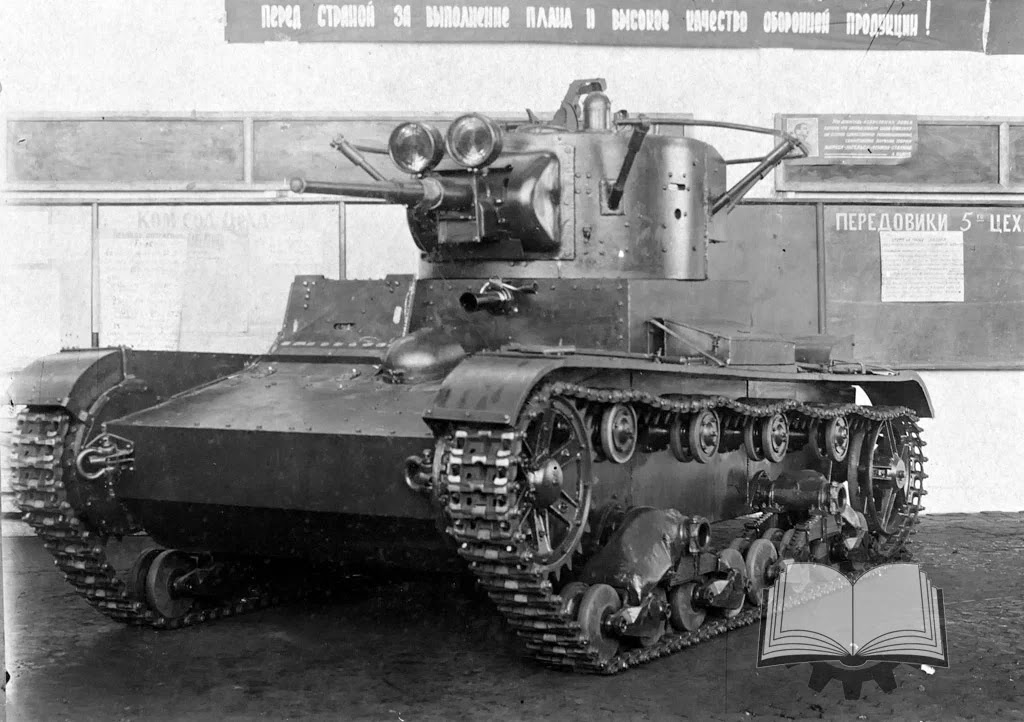
The need for communications equipment in armoured vehicles became clear soon after their creation. Semaphores and signal flags were just a half measure. It was necessary to equip tanks with radios, but the road to equipping even a part of them was a long one. The modern system with a radio in the turret and a whip antenna was also far from the initial norm. There were many alternative visions of how a tank radio antenna should look.

The rail antenna was a characteristic feature of Soviet tanks in the 1930s.
 
Rail antennas became one of the characteristic features of Soviet tanks in the interwar years. "Horns" around the turret became a calling card of this generation of tanks. Few people stop to consider where such a strange antenna came from and how it works, especially since their age was brief. They were no longer used by Soviet industry after 1939, as opposed to the nation that came up with them originally.

Monday, 11 September 2023

Italian Cruiser Tank

Italian tank building developed along a fairly usual trajectory. Once a direction was identified, the Italian military tried to stay on course. Under their close guidance, Ansaldo developed a series of combat vehicles: first a tankette, then a light tank, a medium one, and a breakthrough tank. In almost all cases, success was based on a foreign idea, primarily the British one. At first the Italians further developed the idea of the Carden-Loyd Mk.VI tankette and then the Vickers Mk.E support tank. 

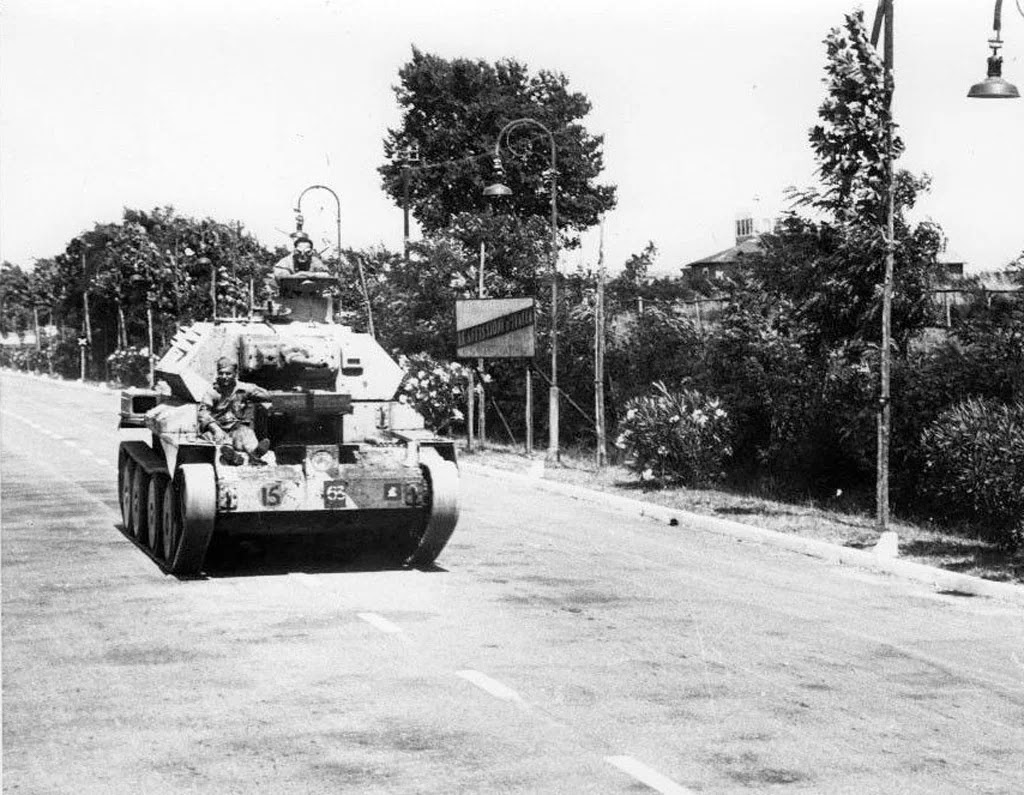
Captured Cruiser Tank Mk.IVA at trials in Nettuno. This tank was the inspiration for a "colonial" tank.

Combat in North Africa revealed a series of deficiencies, including insufficient characteristics of Italian medium tanks. One of the biggest issues was their low mobility. The increase in engine power was not an accident. British vehicles were studied in parallel. A Cruiser Tank Mk.IVA was among those examined. This was not the most successful tank, but it was fast. A captured tank was tested at Nettuno in May of 1941. The idea of creating an Italian cruiser tank came about around the same tank. This tank was later called Carro M Celere Sahariano.

Monday, 28 August 2023

Alternative Heavy Tank

Factory #183 in Kharkov was the center of Soviet heavy tank development in the interwar period. The T-35 powerful (heavy) tank developed in Leningrad by N.V. Barykov was produced here. Production was set up with the participation of I.S. Ber, who was appointed as the head of HPZ (factory #183) Diesel Department design bureau T-35K. Iosif Solomonovich Ber played a key role in the fate of the T-35 tank. It was he who produced the technical documentation for the tank and further development of the design was done under his direction. Work to replace the T-35 moved to Leningrad in 1938 and Ber was promoted to the position of deputy chief of the KB-520 design bureau. Work on heavy tanks in Kharkov ended, but not for long.

I.S. Ber, a key player in the creation of T-35, T-34M, and T-44 tanks.

Tuesday, 22 August 2023

Failed Modernization of the KV-1S

Evolutionary development is a common sight in tank development. The fact that engineers do not seek to make work for themselves should not be mistaken for laziness. This is often a necessary requirement set by the customer, especially when it is necessary to keep up the rate of production. For this reason, revolutionary projects were often vetoed from above. This happened with the KV-13 and T-34M in 1942 when both were put away until better days.

Object 238 on trials, August 1943.

Saturday, 19 August 2023

Video: Almost an Hour of the T-34-85 at Capel

Didn't get enough of the T-34-85 tank shown at Capel? Enjoy almost an hour of glorious 4K footage from the event:


Monday, 7 August 2023

Shermans in "August Storm"

In Soviet historiography, the Soviet-Japanese War of 1945 is overshadowed by grandiose operations against Berlin and Vienna earlier that year. However, Western historians pay close attention to this campaign and debates on whether it was the A-bombs or the Soviet invasion that forced the Japanese to surrender rage on to this day. Famous historian David Glantz even invented a grandiose name for this operation: August Storm. The Red Army's advance was indeed lightning fast, in part thanks to foreign vehicles. This included the M4A2(76)W HVSS, the most advanced Sherman variant sent to the USSR.

Clouds gather

Stalin promised to enter the war against Japan within three months of Germany's defeat at the Yalta conference in February of 1945. Colonel-General Alfred Yodl signed an order for unconditional capitulation of all German forces on May 7th, 1945, coming into effect at 23:01 on May 8th. This kicked off the countdown for a Soviet offensive against Japan. The Red Army had three months to move an enormous force to the other side of an equally enormous country.

Concentration of the 6th Guards Tank Army in the vicinity of Tamsagbulag. The army included the 9th Guards Mechanized Corps that used Sherman tanks.


The 6th Guards Tank Army was one of the units that was destined to transfer to the far east. On June 26th, 1945, the unit was reallocated to the Transbaikal Front. It would have to cover a distance of 9000 km to cross from Czechoslovakia to Choibalsan. 88 trains of 60 cars each were allocated for this journey. The full transfer took 30 days, but the first elements began to form up by July 17th. New tanks awaited them there: 100 M4A2(76)W including the latest tanks with HVSS suspensions. These tanks were described in documents as "M4A2 with wide tracks". The 46th Guards Tank Brigade was fully equipped with these vehicles. One company from each of the tank regiments of the 18th, 30th, and 31st Guards Mechanized Brigades that made up the 9th Guards Mechanized Corps also received new tanks.

From Choibalsan, the tanks would make a 300 km march to Tamsagbulag, where the army would prepare for the upcoming offensive. This march took place in extreme conditions. The temperature reached 45 C during the day, as a result of which marches took place only at night to avoid overheating the engines and running gear. This also helped hide the tanks from air reconnaissance, as there was nowhere to conceal them in the desert. The army's documents describe the M4A2 as less sensitive to hot weather than the T-34-85. The American tanks could cover more ground every day, but at the cost of increased fuel consumption. The Shermans normally burned 40 kg of fuel per hour, but this went up to 60 kg in Mongolia. Each tank could only run 90-100 km before refuelling instead of 150 km. The T-34-85 burned only 26 kg of fuel per hour.

M4A2(76)W HVSS, the newest tanks of the 9th Guards Mechanized Corps.

Wednesday, 2 August 2023

Crewing the T-34-85 at Capel 2023

A month ago I joined the Capel Military Show as a T-34-85 tank crewman. With a full crew, hatches shut, and cannons firing outside, it was a great chance to experience what I've only read about. Watch my latest video for my impressions. 


Monday, 31 July 2023

Soviet Armour for the British Valentine

History knows many tanks that were created from a grassroots initiative and treated with scepticism by the army, but evolved to become some of the most popular tanks. There are at least two such tanks that made their mark in the Second World War. The first was the Pz.Kpfw.IV. Krupp was originally only entrusted with the turret, but the conglomerate successfully pushed for permission to build two prototypes. As a result, the B.W. (Kp) easily demolished the B.W. (Rh) and survived several attempts to take it out of production. The first battles showed that the Pz.Kpfw.IV was the best tank Germany. had. In 1942 it also turned out that the Pz.Kpfw.IV could take on a long 75 mm gun, but the Pz.Kpfw.III could not. As a result, the Pz.Kpfw.IV became Germany's most numerous tank.

The second example is the Infantry Tank Mk.III or Valentine. Its creation was entirely opposed by the British army but in the end were forced to order it anyway. It turned out that Leslie Little, Vickers' main tank designer, made the right decisions. He successfully fought off the War Ministry's attempts to "improve" his creation and avoided overloading the chassis. The result was the most numerous British tank of the war. Formally, the British withdrew it from the front lines in the spring of 1943, but in reality it kept fighting until May of 1945, again against the army's best attempts.

A Soviet Valentine lost to a hit from a 75 mm Pak 40. The appearance of this gun was a big contribution to work on improving the tank.

Monday, 24 July 2023

Between the Pz.Kpfw.III and the Panther

 German medium tanks that could not replace the Pz.Kpfw.III or IV

One might think that tank building developed very sluggishly in the interwar years. This is a mistake. Development continued even in the most difficult years when there was no money for tanks. Every 3-4 years tactical-technical requirements were revised and development of new prototypes began. Germany did not differ from the rest of the world in this regard. Since Germany was bound by the terms of the Treaty of Versailles, this cycle was concealed, but the mask was dropped in the early 1930s even before the Nazis came to power. This is when the tanks that Germany entered the war with began to form.

A broken Pz.Kpfw.III Ausf.F. Frequent gearbox failures were the reason why production of the Z.W.38 fell behind schedule and the relationship between Daimler-Benz and Heinrich Kniepkamp was ruined.

There are many cases in tank building where a nation manages to catch one wave of trends and miss the next. The USSR managed to create a successful series of tanks in the early 1930s but failed to do so in the mid-30s. On the other hand, German tanks developed in the early 30s were failures, but the designers redeemed themselves a few years later. Subsequently, while the USSR got the successful T-40, T-34, and KV-1 at the end of 1939, the Germans entered the new decade with a completely different result. One example is the story of the tanks that was supposed to replace the Pz.Kpfw.III and the Pz.Kpfw.IV: the VK 20.01 and its relatives.