Last weekend I had the pleasure of assuming the role of a T-34-85 tank commander during Aquino tank Weekend at the Ontario Regiment Museum. In this video, I cover what we know about the history of this particular tank and briefly show it in action.

This blog is dedicated to bringing World War II era documents to the general public, with an overall focus on armoured warfare. Questions? Requests? Comments? Email me at tankarchives@gmail.com or find me on Twitter @Tank_Archives.
Tuesday, 13 June 2023

Monday, 12 June 2023
Firefighters of the Fiery Salient
Supplies of M4A2 tanks to the USSR began in late 1942. Unfortunately due to technical defects (chiefly to do with injectors) they did not see service right away. Only a few units received these tanks in the spring of 1943, but one of them ended up fighting in the most famous tank battle of the Great Patriotic War.
Firefighters of the fiery salient
The 229th Independent Tank Regiment was one of the first Soviet tank units to receive the new American medium tanks. 31 tanks of this type were issued to the unit on April 10th, 1943, and by the start of July the regiment had 38 functional Medium Tanks M4A2. The regiment was assigned to the 48th Army at the time. As of July 1st it was located in reserve in the village of Perehozheye. The regiment was commanded by Lieutenant Colonel Merkulov with Major Bogatyrev serving as the Chief of Staff.
 |
| A very early M4A2 tank in Soviet service. This vehicle still has the return roller in the middle of the bogey, M34 gun mount with a narrow external mantlet, and direct vision ports |
The regiment was moved to the vicinity of Kazakovka by July 5th, 1943. At the start of the Battle of Kursk the regiment had 1.2 loads of fuel per tank, three refills of ammunition, and 4 days worth of rations on hand. The Shermans got lucky, as the German spearhead struck west of them.
Friday, 9 June 2023
SU-76 Requirements
"Approved by the Deputy People's Commissar of Defense, Colonel General of Artillery Voronov
October 17th, 1942
Tactical-technical requirements for a 76 mm assault SPG
1. Purpose of the SPG
The 76 mm SPG is designed to support moto-mechanized units to combat firing emplacements, tanks, and personnel both with direct and indirect fire.
2. Requirements for the artillery component of the SPG
The SPG uses the stock rotating part of the ZIS-3 76 mm model 1942 gun. The ability to install a 57 mm IS-1 gun must also be retained.
The SPG must meet the following requirements:
- Practical rate of fire of no less than 12 RPM in direct fire and at small elevations.
- Gun elevation of at least +15 degrees.
- Gun depression of at least -5 degrees.
- Traverse range of 30 degrees (15 in either direction).
- The rate of traverse must be about 1.5 degrees per turn of the flywheel. The effort on the flywheel must not exceed 4 kg.
- The rate of elevation must be about 1 degree per turn of the flywheel. The effort on the flywheel must not exceed 4 kg.
- The recoil brake must be armoured. The armour must be 8-10 mm thick.
- The oscillating part of the gun and the recoil brake armour must be fully balanced.
- The bore axis height must be no more than 1650 mm.
- The gun position must allow for comfortable loading at all angles of elevation and traverse.
- The gun sight must be a mass production type either from the 76 mm regimental gun or the ZIS-3.
- Crew of 4 (including the driver).
During travel, collapsible seats for three men must be installed in the fighting compartment. - The gun must be rigidly fixed in travel and not move vertically or horizontally.
- The SPG must carry two PPSh SMGs.
- The SPG must carry 60 rounds of ammunition for the gun and 1000 PPSh rounds.
The ammunition must be stored in places that make it comfortable for the loader to work with, fix securely in its slots, and be easy to unlatch and retrieve.
Monday, 5 June 2023
First Among Equals
The defeat of the British Expeditionary Force in France in 1940 was a wake-up call for British tankers. It was clear that their tanks were not suited for modern war. Light tanks had no chance to survive on a battlefield saturated with anti-tank guns, and even heavier infantry tanks were more vulnerable than expected. The Infantry Tank Mk.I armed only with a machine gun was discarded immediately. The Infantry Tank Mk.II proved itself better, but was still far from perfection. German forces were expected to cross the Channel any minute, and Britain had no modern tanks to repel them with. The only choice was to develop a new tank, and quickly. This tank was called the Infantry Tank Mk.IV or Churchill I.
A tank of compromises
Work on the new tank began in July of 1940. The A20 tank, a potential replacement for the Infantry Tank Mk.II, looked quite archaic compared to its German adversaries. However, the British were not prepared to give up on the concept just yet. Harland & Wolff built one prototype, but there were many issues with it, not the least of which was the insufficiently powerful Meadows DAV engine.
 |
| Experimental A20 tank, the Churchill’s predecessor. |
The British were in a tough situation when it came to tank engines. The army didn’t want to spend money on engine development, expecting to be able to adapt an engine already in production. This is what happened in this case: the DAV was initially meant to go into the much lighter Cruiser Tank Mk.V. The Vauxhall company proposed their own engine, the Bedford Twin Six, to replace the troublesome Meadows DAV. As the name implies, it was composed of two six-cylinder engines produced by Bedford, a subsidiary of Vauxhall. These engines showed themselves well on trucks. Vauxhall’s proposal was so enticing that they ended up with a contract not just for the engine, but for the entire tank.
Wednesday, 31 May 2023
Landships Left In Port
Fosters of Lincoln Ltd. built tanks during the First World War, but returned to peaceful products after its conclusion, as the military no longer needed new tanks. When the situation began to change and the Mechanical Warfare Board was established in 1928, Sir William Tritton offered his help, but was rudely rejected. The reverse took place a few years later: when approached for help, Tritton refused. Fosters was doing fine without the army. Its factories were loaded with orders for consumer goods, and it was not worth his time to deal with the military for miserly contracts. However, peace did not last forever. 1939 came and with it, war.
A colossus from yesterday’s war
Talk of bringing seasoned tank designers out of retirement began in the summer of 1939. Words became actions in the fall. On September 5th, the Director of Mechanization Major General Davidson invited Sir Albert Stern, the designer of the famous British rhomboid tanks, to develop a “special tank”. On October 12th, 1939, the Minister of Supply Leslie Burgin created the Special Vehicle Design Committee within his fledgling ministry. The committee included Tritton, Ricardo (the developer of WWI era tank engines), and Major General Sir Ernest Swinton, among other engineers and soldiers. As many of these men had experience in designing tanks during the First World War, the committee was nicknamed TOG (The Old Group or The Old Gang).
The committee’s task was to develop a tank that could cross a 16 foot (4.9 meter) wide trench, climb 7 foot (2.1 m) tall wall, and have enough armour around the perimeter to protect from 37 and 47 mm anti-tank guns and 105 mm howitzers at 100 yards (91 m). The estimated mass of such a vehicle was 70-75 tons. This colossus would be armed with 2-pounder guns in sponsons and a field gun in the front of the hull capable of penetrating up to 7 feet (2.1 meters) of reinforced concrete as well as machine guns and smoke bomb launchers. The crew was composed of “just” 8 men. According to Sir Edmund Ironside, the Chief of the Imperial General Staff, this tank would be needed at least a year from now, but work on it should start immediately. This project was designated “superheavy tank - land battleship”.
The tank was not created in an information vacuum. Members of the SVDC spent November 24th-30th in Paris, familiarizing themselves with the latest advances in French tank technology. Representatives of the British General Staff and others from the military were also present. The draft project of the new tank was ready soon after, on December 19th, 1939. Stern expected his tank to require 2.5-4“ (63-102 mm) of cemented armour and inquired at the admiralty about producing it.
The designers presented a model of their new tank to a military commission on December 21st. The tank was quite original for a group of old men, although not entirely satisfactory. The tank had a fairly large turret that could fit a 3” AA gun or 25-pounder. The tracks passed through an armoured conduit, which protected them from damage. The tank was rejected. The military requested a more conservative vehicle closer to old “rhombus” tanks. The new tank needed tracks that wrapped around the whole hull. No turret was needed; all armament would be installed in sponsons. The requirement for a field gun was removed, and no effort would be taken to equip the tank with a more powerful gun.
The designers began working on a new tank on January 11th. A model of the new vehicle was ready on February 29th. This is when the tank received a name: TOG 1. This tank weighed 55-60 tons with 2-4”(51-102 mm) thick armour. The armour was attached to a mild steel skin ⅜” (9.5 mm) thick. The committee estimated that such a tank could be built by June. Since the SDVC presented itself as a group of designers rather than manufacturers, there was no plan to build this tank at Fosters. The SVDC estimated that production of these tanks could reach 40 per month by November and a sufficient amount would be available “for the 1941 campaign”. No mention was made of what factory or factories was supposed to build them.
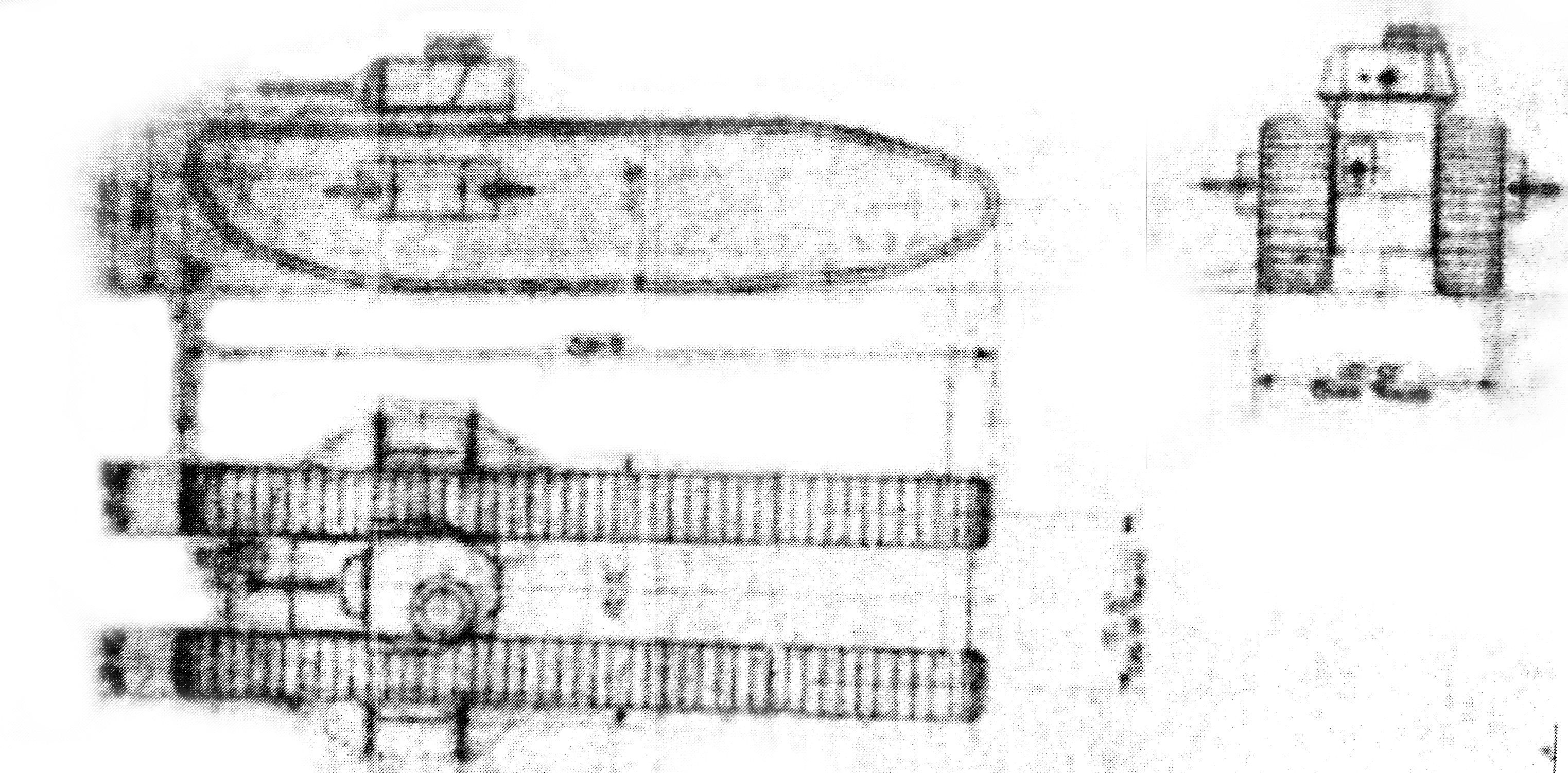 |
| The TOG 1 was quite archaic. A 75 mm cannon was located in the front and 2-pounder guns in sponsons. The turret was not required by the customer. |
Friday, 26 May 2023
German Tank Tactics, 1945
"April 9th, 1945
#0417
To the commander of the Armoured and Mechanized Forces of the 2nd Shock Army
RE: #08562 dated March 20th, 1945
Report of the 46th Independent Guards Order of the Red Banner Order of Suvorov Tank Breakthrough Regiment on the study of tactics and combat use of heavy tank regiments in the Red Army as well as enemy tank tactics and use of tanks in combat from January 1st to April 1st, 1945. Map scale 1:50,000
...
2. Tactics and use of enemy tanks in combat
Recently, enemy anti-tank defenses rely more and more on close combat weapons, especially Panzerfausts, which are continuously improved. This is explained by the growth of the Red Army tank fleet and heavy enemy losses in tanks and anti-tank artillery. Because of this, the enemy compensates for a shortage of anti-tank weapons (especially tanks and anti-tank guns) with mass use of Panzerfausts. As before, the enemy creates ambushes using tanks and SPGs, chiefly heavy ones, which combat our tanks and SPGs in most likely directions of advance. The proportion of heavy and superheavy King Tiger tanks compared to the overall number of tanks continues to increase.
In areas where the enemy could prepare anti-tank defenses, they include anti-tank ditches (Ciechanow, Mława, Graudenz, Danzig) minefields (bridgehead west of Narew), and anti-tank guns. Passive anti-tank obstacles were covered with direct fire artillery, tanks and SPGs, as well as small arms fire.
More recently, the enemy foregoes using tanks and SPGs in the front of their defenses and only uses them in the depth in order to avoid heavy losses.
During the mud season, the enemy expected our tanks to be bound to roads and constructed defenses around forks, crossroads, and major settlements, leaving anti-tank combat between these strongholds to Panzerfausts.
In the January operation, up to 12 enemy tanks and SPGs were spotted in front of the regiment, most of them Tiger and Ferdinand types.
In the operation near Danzig up to 10 tanks and SPGs were spotted, of them 6 were Ferdinand type SPGs.
The enemy clearly works on improvements and modernizations to the Panzerfaust to improve its effect and make it more convenient to use. Expect to see new Panzerfausts in action.
Commander of the 46th Independent Guards Order of the Red Banner Order of Suvorov Tank Breakthrough Regiment, Guards Lieutenant Colonel Parshev
Chief of Staff, Major Bannov"
Wednesday, 24 May 2023
The Last of Stalin's Robots
Unfortunately, museums frequently mislabel their own exhibits. The biggest problem with that is an incorrect information from a museum label is going to propagate. For example, Kubinka seriously thought that they had two BA-6 armoured cars, even though one was actually a BA-3M. The collection of the Patriot Park museum which used to be displayed at Kubinka has many downright unique exhibits, some of which were also misidentified. For example, this tank is called OT-130, but that is not the case.
 |
| TT-26 tank as displayed today. |
In reality, the tank currently displayed in the pavilion depicting the war against Japan is the only surviving TT-26 teletank. This tank was once the subject of Yuri Pasholok's volunteer painting team. Let us tell the tale of this unique tank with a unique combat history.
Friday, 12 May 2023
Heavies in Action
"April 9th, 1945
#0417
To the commander of the Armoured and Mechanized Forces of the 2nd Shock Army
RE: #08562 dated March 20th, 1945
Report of the 46th Independent Guards Order of the Red Banner Order of Suvorov Tank Breakthrough Regiment on the study of tactics and combat use of heavy tank regiments in the Red Army as well as enemy tank tactics and use of tanks in combat from January 1st to April 1st, 1945. Map scale 1:50,000
1. Tactics and combat usage of heavy tank regiments
From January 1st to April 1st, 1945, the 46th regiment took part in three operations. From January 15th to January 23rd it penetrated the enemy defenses around the bridgehead on the river Narew jointly with other units of the 2nd Belorussian Front.
From March 2nd to March 5th, 1945, the regiment fought to destroy the enemy garrison in Graudenz and take the city.
From March 17th to March 31st, 1945, the regiment fought to liquidate the encircled Danzig group and capture Danzig.
Wednesday, 10 May 2023
SU-122 Requirements
"Approved by Deputy People's Commissar of Defense, Colonel General of Artillery, Voronov
October 17th, 1942
Tactical-technical requirements of a 122 mm self propelled howitzer on the chassis of the T-34 tank
1. Purpose of the self propelled howitzer
The self propelled howitzer is designed to accompany infantry and tank units, destroying dugouts and fortified firing positions with direct fire from short range or with indirect fire.
2. Requirements for the artillery component
The artillery component of the SPG is provided by the stock rotating part of the M-30 122 mm model 1938 howitzer. The mounting must meet the following requirements:
- Practical rate of fire of no less than 10 RPM in a direct fire role.
- Elevation of 25-35 degrees.
- Depression of -3 degrees.
- Traverse of +/- 10 degrees.
- The recoil buffer must be armoured. The armour must be at least 12 mm thick.
- The oscillating part of the howitzer with the recoil buffer armour must be completely balanced. Increase in effort required to aim cannot surpass 10%.
- The height of the bore axis must be no more than 1500 mm. To achieve this, a cutout in the front of the SPG is permitted.
- The gun port must be completely covered at a gun elevation of up to 12 degrees.
- The gun mount must allow for comfortable loading at all angles of elevation and traverse.
- The sight is the stock sight from the 122 mm M-30 howitzer with a Hertz panoramic sight.
- The gunner's seat must rotate with the gun. The seat's rotation in relation to the panoramic sight and aiming flywheels must allow for comfortable operation.
- The crew consists of five men, including the driver. All crewmen must have comfortable seats.
- The gun must have the ability to be reliably fixed for travel, preventing horizontal and vertical movement.
- Two PPSh submachine guns must be carried as auxiliary armament.
Monday, 8 May 2023
Sherman's African Debut
The Medium Tank M4A1 that arrived in the UK in the summer of 1942 was much more promising than the Medium Tank M3 that had arrived shortly prior. The layout of the armament was much more conventional, the armour was tougher, and the crew's workspaces were more comfortable. Before too long, these tanks were on their way to North Africa, where they would have to fight against the harsh environment in addition to an experienced enemy. The Sherman's career was not going to be an easy one.
First blood on the sand
The tanks that arrived in North Africa were not prepared for desert warfare. They were modernized in field workshops, where British technicians added dust shields, brackets for the Sunshield camouflage tarps, racks for canisters with water and fuel, stowage bins, and other equipment necessary for life in the desert. Desert camouflage was applied over top of the olive drab paint. 252 Shermans were ready by the Second Battle of El Alamein: 92 in the 1st Armoured Division, 124 in the 10th Armoured Division, and 36 in the 9th Armoured Brigade.
The situation with the delivery was far from ideal. The tanks arrived only weeks before the planned offensive. The lack of time to train had an impact not only on the skills of the crews, but also on the cohesion with the forces fighting alongside the tanks. Since the Shermans were going to attack at night through minefields, cooperation with infantry and engineers was quite important.
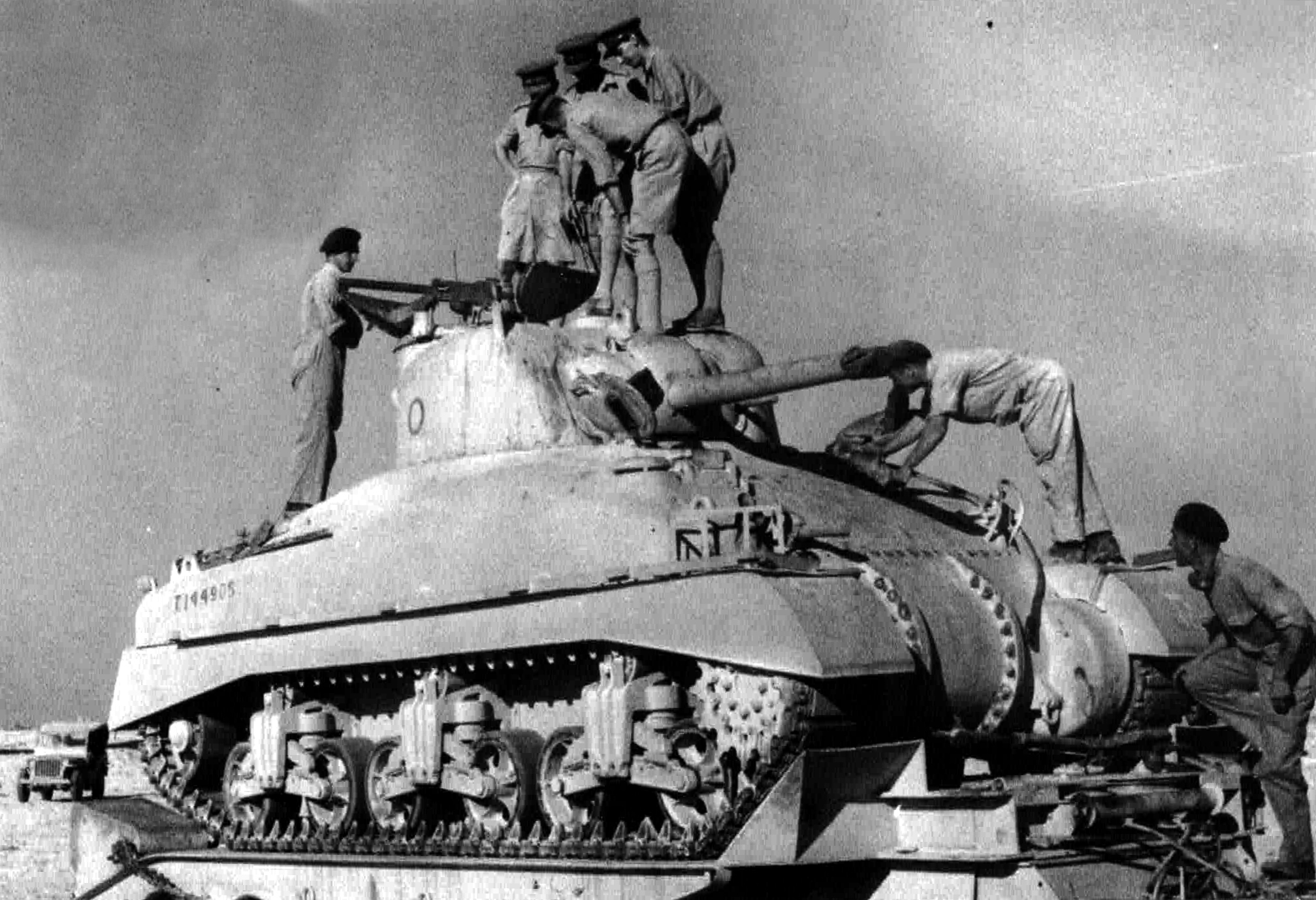 |
| Shermans of the 9th Hussars, 9th Armoured Brigade, September 15th, 1942. The tank is likely already painted in desert yellow, but disruptive camouflage has not yet been applied. |
Subscribe to:
Posts (Atom)