Friday, 19 August 2022

Trials SNAFU

 "Conclusions on the report on firing the M7 gun on the American M10 SPG

The GBTU Chief and GBTU SPG Directorate instruction #149068 issued on October 18th, 1943, by the GBTU proving grounds (Kubinka railway station, Western railway) conducted trials of the M7 gun installed in the American M10 SPG. According to the trials program, the following characteristics of the gun were to be recorded:

  1. Size:
    1. Barrel length (total)
    2. Rifled section length
    3. Diameter between opposing grooves and between opposing lands
    4. Land width
    5. Chamber size
    6. Shell and casing size
  2. Ballistic data:
    1. Pressure
    2. Muzzle velocity
    3. Maximum range
    4. Precision
The proving grounds did not record the most important ballistic data (muzzle velocity, maximum pressure, maximum range) and dimensions (diameter between grooves or lands, land width, chamber size), as as result of which the tactical-technical data provided in the report does not give characteristics of the gun. 

Wednesday, 17 August 2022

First Anti-Tank Rifles

"To the Chairman of the State Committee of Defense, I.V. Stalin
August 9th, 1941

Trials of the German 7.92 mm Pz.B.39 rifle conducted by the Scientific Research Small Arms Proving Grounds of the Red Army showed the following results:
  • Muzzle velocity: 1189 m/s
  • Weight: 12.12 kg
  • Bullet weight: 14.8 grams
  • Chamber size: 17.06 cm³
The rifle penetrates a 20 mm surface hardened plate at 20 degrees at a range up to 500 m inclusive, a 30 mm surface hardened plate at 20 degrees from up to 300 meters inclusive.

Monday, 15 August 2022

Surprises in the Snow

Trials of foreign materiel, including captured vehicles, were quite limited before the war. This had a lot to do with the technical condition of the vehicles that fell into the hands of the Red Army. As a rule, this condition was far from ideal, meaning that the scope of possible trials was limited. Full scale trials were rare. For example, the Pz.Kpfw.I Ausf.A tank captured in the fall of 1936 in Spain arrived more or less intact, and therefore could be used for many trials, including trials against various obstacles. It's hard to say that these trials were very useful since Soviet tanks of that era were already more than a match for this tank. The T-26 that fought against the Pz.Kpfw.I Ausf.A in Spain surpassed it in all parameters. Nevertheless, there was a certain value in these trials.

Pz.Kpfw.III Ausf.H tank "Isabella" during winter trials, January-March 1942.

Friday, 12 August 2022

Development Trends Abroad

 "October 5th, 1945

Armament:

  1. Germany
    1. Gun caliber increased from 37 mm to 128 mm, a factor of 3.5.
    2. Muzzle velocity increased from 720 m/s to 1000 m/s, a factor of 1.4.
    3. Magazine fed machine guns were replaced with belt fed ones.
    4. AA protection at the start of the war was limited to the MG 34 7.92 mm caliber machine gun. At the end of the war, the Germans began installing 20 mm autocannons on tank chassis.

Wednesday, 10 August 2022

Thicker Roof

"May 8th, 1943
Conclusions of the 16th Department of the GAU Artillery Committee

1. General part:

On April 27th, 1943, the Artillery Committee received a proposal from the Uralmash factory to transition from producing the roof of the 122 mm SU-122 SPG out of 20 mm thick high hardness armour to 30 mm thick medium hardness armour.

The Uralmash factory motivates this proposal with the fact that due to many cutouts and welds of various components the roof is overloaded and cracks appear, which have to be covered with 20 mm thick applique armour.

Monday, 8 August 2022

The Unluckiest Next Generation Tank

The history of mass production and use of Soviet T-50 infantry tanks and why it was doomed to fail

Initially, small tanks (later support tanks and then combined arms tanks) became the most numerous of their kind in the USSR. The MS-1 (T-18) and then T-26 became the most numerous tanks of the Red Army. The T-26's abilities were quite sufficient to escort infantry, and its relatively low speed compared to the BT also made it a more stable firing platform. Since the T-26 had nearly no oscillations after a sudden stop, it could conduct aimed fire much more accurately than the BT, which would rock back and forth. The T-26 was also 1.5 times cheaper and produced in larger volumes.

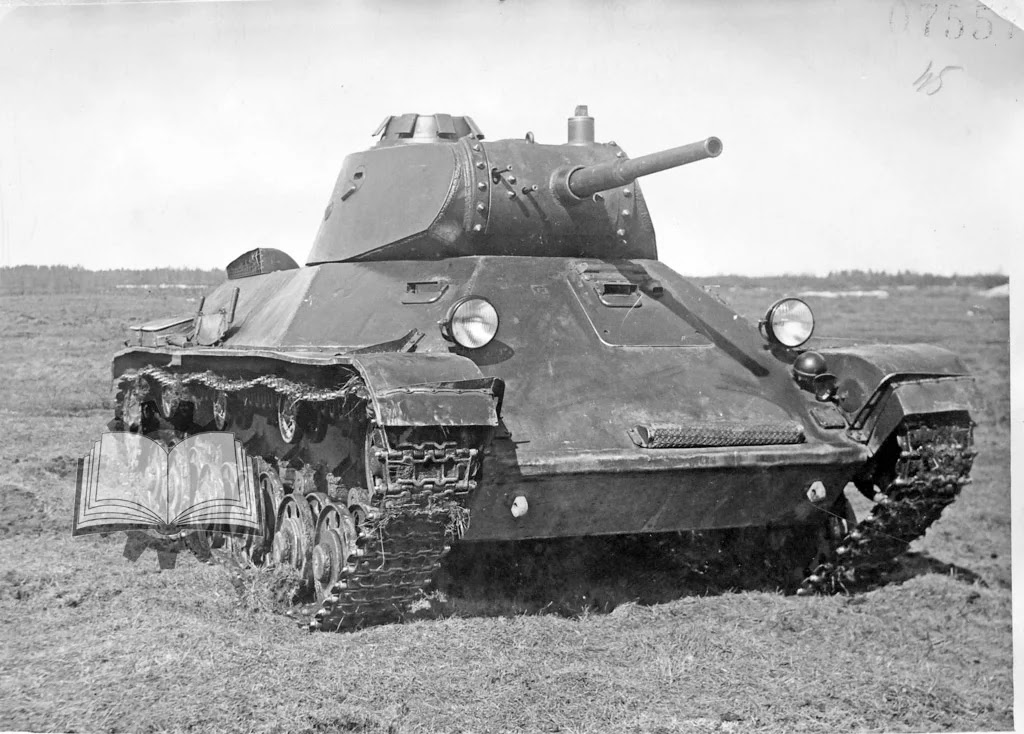
First prototype of the T-50 after improvements, spring 1941.

Thursday, 4 August 2022

Room Clearing Guide

Assault group - forward!

Your submachine gun is around your neck, 10 grenades are at hand, and courage is in your heart. Act!

Be bold and take initiative! Believe in your strength!

Move unseen and without noise!

Close with the enemy using hidden paths: trenches, travelways, holes in buildings or fences. Crawl, use bomb craters and ruins. You can hide well here. And then - a brave rush forward.

Wednesday, 3 August 2022

Rise and Shine

 "22nd Guards Tank Brigade
March 22nd, 1944

Active army

Training held on March 21st, 1944, showed that assembly for action after an alarm takes a long time. The 208th Tank Battalion assembled in 42 minutes. The mechanized machine gun battalion assembled in an hour and 10 minutes. The command company assembled in 40 minutes. The anti-tank battalion assembled in 10 minutes, the AA company in 10 minutes.

Back to Battle

 "On the actions of liberated POWs and repatriated citizens in the 47th Guards Tank Regiment between January 18th and February 8th, 1945.

On January 14th, 1945, after the 9th Guards Tank Corps was introduced into a breach, the 47th Guards Tank Brigade fought at the vanguard of the corps.

In battles for Grójec, Mszczonow, and Sochaczew the brigade took heavy losses in the motorized riflemen submachine gunner battalion.

When Sochaczew (January 18th), Bromberg (January 22nd), and Kutzer (January 28th) were liberated, Russian POWs and repatriated citizens were freed from camps.

Monday, 1 August 2022

Soviet Upgrade for an American Tank

Modernization of a fighting vehicle over the course of production is a normal phenomenon. This was not the case from the very beginning, but modernization rather than creation of whole new designs was the norm by the 1920s. In Soviet practice, a good example of this is the MS-1. The first and fourth series differ significantly, and even so the full plans for improving the characteristics of the tank were not realized as it had become obsolete and did not satisfy the military's requirements even with changes. The MS-1's successor, the T-26 light tank, shows a much fuller spectrum of modernization. It started out with two turrets, one with a cannon and one with a machine gun. The first major modernization took place in 1933, and the tank that was produced at the end of its production run differed considerably from the first vehicle. Similar processes were not unusual for tank building of the era.

The first M4A2 tanks arrived in the USSR in the fall of 1942, but true mass deliveries began closer to the end of 1943. By that point the tank's armament was a bit weak.