Monday, 9 May 2016

Capitulation in Courland

May 9th on the roads of Courland.

The house in Ezer where the unconditional surrender was signed.

Colonel-General Hilpert of Army Group Courland arrived at the HQ of the Leningrad Front after signing the unconditional surrender.

Front Commander Marshal of the Soviet Union comrade Govorov interrogates German General of the Mountain Forces Volckamer.

The Germans put down their arms, raised a white flag, and asked for surrender.

Representatives of the Red Army accept German military vehicles.


German ships in a Liepāja port.


"Report on military vehicles and possessions of the surrendered Courland group collected by elements of the 123rd Infantry Corps
  1. Germans
    1. Officers: 227
    2. NCOs: 1237
    3. Privates; 6125
  2. Lithuanians:
    1. Officers: 31
    2. NCOs: 184
    3. Privates: 1344
  3. Vlasovites: 329
  4. Poles: 210
  5. Local civilians aged 16 to 60: 2175
  6. Total: 11862
  7. Horses:
    1. Riding horses: 95
    2. Artillery horses: 311
    3. Draft horses: 702
  8. Armament:
    1. 210 mm guns: 1
    2. 155 mm guns (coastal): 3
    3. 150 mm guns: 1
    4. 105 mm guns: 3
    5. 75 mm guns (coastal): 11
    6. 20 mm AA guns: 37
    7. 37 mm AA guns: 3
    8. Mortars: 7
    9. Rifles: 4325
    10. Submachineguns: 193
    11. Machineguns: 151
    12. Flare guns: 3
    13. Gas masks: 245
    14. Pistols: 198
  9. Vehicles:
    1. Tanks: 0
    2. SPGs: 2
    3. Tractors: 45
    4. APCs: 9
    5. Passenger cars: 122
    6. Trucks: 376
    7. Special vehicles: 6
    8. Motorcycles: 28
    9. Fuel trucks: 4
    10. Draisines: 0
    11. Buses: 0
    12. Airplanes: 9
  10. Equipment:
    1. Filter: 1
    2. Electric generator: 3
    3. Lathes: 1
    4. Electric motors: 1
    5. Drill presses: 1
  11. Ammunition:
    1. Rifle rounds: 295,000
    2. Rifle rounds (Russian): 500,000
    3. 13 mm rounds: 1606
    4. 15 mm rounds: 0
    5. 20 mm rounds: 3560
    6. 50 mm mortar rounds: 1500
    7. 82 mm mortar rounds: 3500
    8. 120 mm mortar rounds: 5280
    9. 37 mm rounds: 3300
    10. 45 mm rounds: 780
    11. 75 mm rounds: 34867
    12. 105 mm rounds: 6068
    13. 155 mm rounds: 962
    14. 210 mm rounds: 3066"

Victory Day


Sunday, 8 May 2016

IS-7: a Titan Late for the War

The IS-7 was born in a strange time for the Soviet tank industry. The raising of the Red Banner over the Reichstag marked not only the glory of victory, but the problems of rebuilding for peace. Cities had to be rebuilt, factories returned from evacuation, defense industry repurposed.

Saturday, 7 May 2016

Halfway to the Hellcat

In late 1941, design of a new light tank destroyer on the Light Tank M3 chassis began in the USA. Work on equipping the T56/T57 GMC with a 76 mm gun game to a dead end. It turned out that the M3's light chassis is unsuitable for such vehicles. By the time the T56 arrived at Aberdeen, the T49 was already undergoing trials. Even though it also never made it to production, further development of its design resulted in one of the best known American tank destroyers of WWII.

Upward Trend

In May of 1941, Marmon-Herrington Company Inc. received an order for an airborne tank. In August, a full sized model of the newly indexed Light Tank T9 was ready. Further development of this project resulted in the M22 airborne tank, referred to as "Locust" by the British. This was the only airborned tank used for its intended purpose in WWII.

Light, low, and fairly long, the Light Tank T9 interested the military as a chassis for a tank destroyer. Unlike the Light Tank T3 chassis, the goal here was not to include a large caliber. The year was 1941, and the 37 mm gun was sufficient to fight most enemy tanks. The American military did not know about the Soviet T-34 and KV-1 or that the Germans were hard at work on tanks with thick, anti-shell armour.

In the fall of 1941, the 37 mm Gun Motor Carriage T42 project was launched. The draft project was ready by October 27th. The initial concept of the vehicle differed little from the Light Tank T9. The biggest difference was in the roomier turret with an open to. This turret contained the same 37 mm M5 gun and a Browning M1919 machinegun. Another machinegun was installed in the hull.

This concept did not stick around for long. Calculations showed that this design would not work. The new turret would need a longer hull, and the suspension had to be lengthened to make the vehicle more stable. On November 7th, 1941, a document was prepared listing improvements in the T42's design. The hull and tracks were to be lengthened by 30 cm and the clearance increased from 28 cm to 35.5 cm. The suspension would also be redesigned.

37 mm Gun Motor Carriage T42 as of December 1941

The redesigned T42 Gun Motor Carriage was ready on December 11th, 1941. Its hull grew to 3917 mm in length, and each road wheel received its own individual spring suspension. The turret was taken from the wheeled T22 Gun Motor Carriage, which would later become the M8 armoured car. Even with these changes, the military did not see the T42 GMC as a stable platform for an anti-tank gun. The recommendations prepared after studying this new design changed it even more.

The final design of the T42 GMC differed noticeably from the initial project.

The first draft of the modified T42 GMC was ready by December 29th, 1941, and Marmon-Herrington presented an improved version on January 5th. The front and rear of the hull were not changed, but the overall length grew to 4715 mm. The hull of the new tank destroyer was now longer than that of the Light Tank M3, and thus a more stable platform. The turret was also changed slightly, but overall it was analogous to what was installed on the T22 GMC. 

The suspension was redesigned much more radically. Gladeon Barnes had his revenge on Harry Knox and his design deservedly won out. Some sources say that the vehicle used a Christie suspension, but that is not the case. Barnes used the suspension that he developed in 1933 for the Combat Car T4 and Convertible Medium Tank T4. It was based on the Christie suspension, but it was more compact and more effective. The T42 GMC had 4 road wheels with a diameter of almost 840 mm per side. The drive sprockets were also changed. Very little was left of the Light Tank T9 in this vehicle, only parts of the hull and the engine.

According to calculations, the combat mass of the T42 GMC would be about 6.5 tons. Its armour would be 33 mm thick in the front of the hull and the turret, and the sides and rear were 9.5 mm thick. This armour was the cost of high maneuverability.

All Anew

These radical changes to the initial 37 mm Gun Motor Carriage T42 cast doubt on the assignment of the project to the Marmon-Herrington Company. The small company was busy with work on the Light Tank T9, which had to be seriously changed in accordance with the military's requirements. A logical solution was to transfer the project to another contractor: Buick, one of the divisions of the automotive giant General Motors. By that time, Buick completely ceased producgion of cars and focused on military needs. Its main product was aircraft engines, but the conveyor belts could be filled with something else.

76 mm Gun Motor Carriage T50, on the T49 chassis. This was the initial T49 hull as developed by Buick.

On April 1st, when Buick's design bureau had just started work on their own version of the T42 GMC, the Ordnance Committee made another radical change to the requirements. The 37 mm M5 gun was no longer considered sufficient for a light tank destroyer. This conclusion was made after analysing the British experience of using American tanks in North Africa and information on new tanks obtained by intelligence. The proposed solution to this problem was the use of the British 6-pounder (57 mm) QF Mk.III gun. The mount for such a gun was already being worked on since winter of 1942 for the Light Tank T7E2.

Full size model of the 57 mm Gun Motor Carriage T49, June 1942.

The new gun, approved by Barnes, made the T42 unacceptable in its current form. The use of a more powerful gun meant a significant increase in weight, which meant that the chassis had to be strengthened and a bigger engine had to be used. The T42 GCM vanished into the aether. Instead, Buick received an order to develop and produce two prototypes of the T49 Gun Motor Carriage T49. By the way, this vehicle was sometimes called Christie GMC in documents, which could confuse researchers.

Assembly of a T49 GMC experimental prototype at Buick. Captain Allerton Cushman, supervisor of tank destroyer work, is standing in the vehicle.

In May-June of 1942, an alternative 76 mm Gun Motor Carriage T50 was discussed, which would use elements of the T49 GMC design. The turret was removed, and instead, a 76 mm AA gun with a 15 degree horizontal traverse to each side was added. Using this project, one can trace the evolution of the T49 GMC.

While the suspension remained a copy of the T42, the hull changed radically. It is not listed in the documents, but the engine was likely changed. Examining the project, the Ordnance Committee rejected it. In its current state, the center of mass was too high, which would have negatively impacted the stability of the platform. It was also unsatisfactory that the gun had no shield. The limited traverse also negatively impacted the maneuverability of fire.

An experimental prototype of the T49 GMC after installation of the gun.

Significant changes made to the design meant that the model presented by Buick in June of 1942 no longer had anything to do with the T49 GMC. The hull was lengthened to 5280 mm, increasing the amount of road wheels to 5. The turret was designed anew, and the hull was also a new design. The crew was increased to five men. Even the suspension was different: while it was still based on the Christie design, the springs were now outside. This solved one problem of the Christie suspension: taking up a large amount of space in the hull.

Initially, the military met the new Buick design coolly. A list of necessary changes was made. It was proposed that the driver's compartment be changed to be more like the M8 armored car, the hull machinegun be removed, the communications system changed, the turret be made open, and the crew reduced to 4. Nevertheless, in the middle of June of 1942, approval was given to produce the T49 GMC in effectively the same configuration as was presented.

A telling comparison. The T49 GMC was not only lower than the Medium Tank M4, but lower than medium tank destroyers.

The experimental 57 mm GMC T49 was ready in July of 1942. Rock Island Arsenal was developing the gun, and it was not yet ready when the experimental vehicle was built. The GMC with registration number USA 6029910 began its trials without a gun.

The mass of the vehicle was 14.4 tons, more than twice as much as the T42 GMC. To compensate, the vehicle used two Buick Series 60 engines. Each of these 8-cylinder engines had a volume of 5.24 L and output 165 hp. Earlier, these engines were used in passenger cars. Due to their automotive origins, launching the T49 GMC into production would not have been a problem.

T49 during trials

In theory, the pair of motors would have been enough to accelerate to 55-60 mph (88-96 kph). but in practice achieved only 53 mph (84.8 kph), which was still an impressive result. At the time, no tracked tank was capable of such speed. Loss of power in the hydraulic torque converter further reduced that to 38 mph (60.8 kph). It was proposed that the problem could be resolved by using a hydraulic transmission.

Engine compartment of the T49 and T67 tank destroyers.

Despite all of its problems, the vehicle turned out far superior to the T56 GMC. The use of a fully rotating turret gave the vehicle high maneuverability of fire. The modified Christie suspension proved itself, again showing the preference for an allegedly bad coiled spring suspension. The report on T49 GMC carriage trials says that the suspension worked better than Knox's alternative.

Mobility trials showed that the T49 starts off slower than the Light Tank M5, but then breaks out ahead, noticeably surpassing the M5 at the finish line. In other words, the vehicle had potential.

Almost Accepted

While the T49 was undergoing trials, Tank Destroyer Command was thinking about how useful the M1 57 mm gun was. The difference in penetration was not that high. The result was the decision to build a second prototype of the T49 with a 75 mm M2A3 gun. According to the initial decision, the tank destroyer was built with a the same turret, since the gun could fit. Later, this idea was rejected, since the closed turret had problems extracting gases during shooting.

The final decision regarding the conversion of the T49 GMC was made by the Ordnance Committee on October 10th, 1942. The 75 mm M2A3 gun was installed in the open top turret borrowed from the T66 GMC wheeled tank destroyer. The second vehicle was build from scratch, but the first was built on the chassis of the T49 from Aberdeen, sent back to Buick. During the conversion, the hull machinegun was removed, as requested in the June 1942 requirements. The new vehicle was indexed 75 mm Gun Motor Carriage T67, and was finished in November of 1942. Technically, both vehicles were identical. Sadly, no photos remain of them in the original configuration.

76 mm Gun Motor Carriage T67 at Aberdeen Proving Grounds.

The T67 GMC arrived at the Aberdeen Proving Grounds in November of 1942. Despite its increased mass, its characteristics remained about at the same level as the T49 GMC. Gunnery trials showed that the direction given by Tank Destroyer Command was correct. The chassis had enough wiggle room to put on a more powerful gun with satisfactory precision of fire.

The successful gunnery trials showed that the T67 GMC could be used for a more powerful gun, like the M1 76 mm tank gun with AA ballistics. It was installed in late November of 1942, and surviving photos of the vehicle show this configuration. To compensate for the increased mass, the suspension was reinforced. Trials showed that the use of a more powerful gun had little impact on the precision of fire and mobility. These results were a death sentence for the T56/T57 GMC, which was a nightmare for its crew. Compared to that vehicle, the T67 GMC provided satisfactory comfort to its 5 man crew and did not raise any questions about its role on the battlefield.

Barring the lack of the hull machinegun, the T49 and T67 were almost identical.

All of the above indicates that the T67 GMC with a 76 mm gun could have gone into production with minimal changes. Nevertheless, the story of this tank destroyer does not have a happy ending. The official version of events states that the transmission had to be redesigned due to problems, and the engine changed as well. In reality, the T70 GMC accepted into service as M18 GMC, also known as Hellcat, was a completely different vehicle. Conceptually a successor to the T67 GMC, it had a different hull, turret, suspension, and engine, and the new transmission was at the front. It's hard to agree that only a transmission redesign makes all those changes necessary.

The Christie springs as seen clearly on this photo. The T67 GMC was the last American vehicle built in metal to use this type of suspension.

It's possible that one of the goals of the modernization was the unification of the future T70's engine with that of the M4 Medium Tank. Both used the Continental R-975 engine, but slightly different modifications of it. The new engine was about 25% more powerful than the Buick Series 60 pair, and allowed the fighting compartment to be larger, with the turret shifted backwards. On the other hand, the cost of all these changes was about half a year spent on the design and trials. There was no major conceptual difference between the T67 and T70. In the conditions of war where the enemy is constantly upgrading his vehicles, half a year is a long time.

Friday, 6 May 2016

World of Tanks History Section: Odd Grenades

Those who saw the movie "Saving Private Ryan" likely remember the unusual method with which American soldiers planned to defeat German tanks. They planned to destroy their track with "sticky bombs". This weapon could be made in several minutes from a soldier's sock stuffed with explosives and coated in grease. This bomb should stick to a tank if thrown. As one of the characters in the movie says: "Think of a better way to knock out the tracks, I'm all ears."

No one knows if a weapon like this ever destroyed a tank in real life, but both Great Britain and the USSR performed extensive experiments with sticky bombs.

Sticky, Soft, British

One of the first Britons to work on this subject was Millis Jefferis. In 1938, he started working on an anti-tank grenade for irregular warfare. His goal was to make a powerful anti-tank weapon that even poorly trained men could use. The weapon used the "squash head" principle, which dictates that the destructive effect of explosives increases if they are flattened against a flat surface. This is the same principle that drives HESH shells.

In his first experiments, the inventor used a resin based glue. Trials, however, showed that if the bombs stuck to metallic surfaces, it was purely by chance.

Meanwhile, the Second World War began, the Allies were beaten in France, and an effective anti-tank grenade was needed yesterday. Inventor Stuart Macrae joined in. Trials showed that so called "bird glue" used in bird traps performed best. Nitroglycerin with a thickening agent was chosen as the filler for the bombs. The resulting compound was similar to Vaseline in consistency.

The grenade was designed as follows. A light two-piece metal case was mounted on a handle. Pulling one pin made the hull fall apart, revealing a glass case. A second pin activated the trigger mechanism. Now the grenadier had to throw the grenade with such force that the glass would break and the filler stuck to the armour, at which point he would get away as far as possible: only five seconds elapsed between throwing the grenade and an explosion.

Winston Churchill personally took an interest in these grenades. In October of 1940, he made a note in his diary: "Sticky bombs. Make one million." However, trials that were taking place about this time did not cause excessive optimism. The grenade would not stick to the armour if it was wet or covered in even a thin layer of mud. Recall that being dirty is a tank's usual state.

Nevertheless, the "sticky bomb" was adopted by the British army under the name "grenade #74". 2.5 million were made before 1943.

Many were dissatisfied with the new grenade. One of them was Captain Gammon from the 1st Airborne Regiment. He proposed a simpler and more reliable explosive device. The "Gammon Bomb" consisted of an elastic fabric sack filled with plastic explosive. A detonator was located on top, under a metal cap. It was activated in mid-air by a fabric ribbon that freed a metal pin, like in some German or Soviet grenades.

This bomb was used mainly by paratroopers and other special forces. First of all, they had a lot of deficit plastic explosives. Second, they had many objects other than tanks in their path that made a good target for a serving of powerful explosives.

Another British grenade, "#75" or the Hawkins Grenade, seems ordinary by comparison. The rectangular device with a metal cap looked more like a canteen than a grenade. It could also be used like an anti-tank mine.

Soviet Experience

In late 1941, as a part of cooperation between the Allies, samples of British grenades were sent to the USSR. Soviet military specialists deemed them worthy of attention. The Nitrogen Institute began developing domestic sticky bombs.

On April 21st, 1942, at the proving grounds of the Stalin Armour Academy, dummy Soviet sticky bombs were tested, thrown at moving and stationary T-34 and T-26 tanks. Reports said that the bombs stuck to smooth vertical surfaces. If the surfaces were at an angle or dirty, the grenades slid off.

On June 15th, 1942, trials of "GIA anti-tank armour piercing grenades" began at the artillery proving grounds of the Middle Asia Military District. The tests were against 15 mm thick armour plates and a 14 mm thick tank turret. There was no full description, but the target was likely a blown apart T-26.

All tested grenades flawlessly stuck to the armour and blew up. 400 grams of explosive was enough to cave in 15 mm of armour. A 30 mm target was made for an 800 gram charge by leaning a 15 mm plate against the turret. The result was promising: a dent was made in the plate, the contact point between the turret and the plate was destroyed, and the turret itself was thrown off the turret ring and flipped over.

As the creator of the grenade, engineer Kalinin, wrote in his report, it was desirable to test the effect of the grenade on thicker armour plates or better yet, captured tanks. However, the Middle Asia Military District had neither.

The USSR had domestic grenades that could rival the sticky bomb if not in method of operation, then in sheer oddity. For example, in late 1941, factory #96 developed an anti-tank grenade using the KD liquid explosive (a mix of dichloroethane and nitric acid). Despite the savings that the inventors promised compared to TNT and regular grenades, the military treated this idea with scepticism, especially since experimental batches of grenades leaked in storage. Factory representatives made the excuse that the problem is in poorly made hulls and quality control should resolve it, but GAU officers understood that in the conditions of war, evacuation, and inexperienced workers (mostly women and teenagers), it is naive to hope for high quality. Soldiers at the front lines were already leery about picking up standard bottles of incendiary fluid, and one can imagine the popularity of a grenade that could start leaking acid at any moment.

Meanwhile, the era of HE anti-tank grenades was coming to an end in 1942. While these strange grenades were being tested on proving grounds, the next last-ditch weapon against tanks was already being tested: HEAT based hand grenades.

Original article available here.

Thursday, 5 May 2016

T-34 Additional Armour

T-34s with additional armour were a common sight in early 1942. However, few know that this was the second attempt to improve the armour of the T-34. Another one was made right after the start of the war, in July of 1941.


The hull and turret were covered with 15 mm armoured plates. On newer T-34s, the cast connector between the UFP and LFP was not covered. On older tanks where the UFP and LFP were made from one bent armour plate, it was covered up with a separate 15 mm screen.


This extra armour proved too time consuming and was only ever installed on two tanks.

Wednesday, 4 May 2016

Train Rammer

"Award Order
  1. Name: Komarov, Dmitriy Evlampievich
  2. Rank: Guards Lieutenant
  3. Position, unit: T-34 tank commander, 2nd Tank Battalion, 15th Guards Rechitsa Order of the Red Banner Tank Brigade
    is nominated for the title of Hero of the Soviet Union.
  4. Year of birth: 1922
  5. Nationality: Russian
  6. Party affiliation: none
  7. Participation in the civil war and subsequent actions in defense of the USSR, Patriotic War: Bryansk Front since July of 1943, Belorussian then 1st Belorussian Fronts since November 1943.
  8. Wounds or concussions in the Patriotic War: wounded on January 14t, 1944 near Kalinovichi, wounded on June 25th, 1944, at Cherniye Brody station, 1st Belorussian Front.
  9. In the Red Army since: 1941
  10. Recruited by: Shahumskiy recruitment office, Gorkiy oblast
  11. Prior awards: Order of the Red Star
Brief and specific description of heroism or achievements: T-34 tank commander, Guards Lieutenant Komarov demonstrated exceptional courage and heroism in single combat with an enemy armoured train in the region of the Cherniye Brody station on June 25th, 1944.

Guards Lieutenant Komarov's tank exhausted its ammunition loadout during its mission to take and hold the Cherniye Brody railway station, destroying up to a platoon of infantry and four machinegun nests. Moving forward along the station, comrade Komarov discovered a departing enemy armoured train. At that moment, Komarov's tank was hit and caught fire, and Komarov himself was wounded. Guardsman Komarov made a bold decision: to ram the train in order to delay it. In his burning tank, he slammed into an armoured train car. As a result, three cars were disabled (one lost an axle, two were overturned). The enemy ran in panic and abandoned the station.

For his exceptional courage, heroism, and self-sacrifice in the name of the Motherland during the fight with German invaders, Guards Lieutenant Komarov is worthy of the title of Hero of the Soviet Union.

Commander of the 2nd Tank Battalion, Guards Captain Trushenko"

Tuesday, 3 May 2016

Ergonomics of the ST-I

The ST-I tank had some fairly interesting innovations regarding the rate and accuracy of fire, especially on the move. Let's see if the ergonomics of the tank supported this objective.


The Soviet ergonomic standards guide requires a standing loader to have 1750-1800 mm of standing space. The height allotted by the ST-I is only 1680 mm, but 1750 mm standing room is a pipe dream: out of all WWII era tanks listed in the guide, only the Churchill comes close with 1700 mm. 1680 mm is superior to all other vehicles in the table. The breech axis is a little high, at 1130 mm, but the gun does not have a horizontally sliding breech like the manual suggests it should for a height of 950-1000 mm or more.

The data for the gunner's seat is not given, but the proportions of the loader's position allow us to overlay the ideal gunner position over the drawing.


Looks like an almost perfect match, with the sight being a tad too high. Unlike his loader friend, the gunner would have found this tank comfortable to use.

Monday, 2 May 2016

LB-62 Armoured Car

As the ageing T-37 and T-38 tanks were replaced with the more advanced T-40 that had a bigger machinegun, so why not do the same with armoured cars? That was the idea with the LB-62, a new armoured car on the GAZ-62 chassis with a T-40 turret.

"Conclusions regarding proving grounds trials of the LB-62 armoured car
  1. The LB-62 armoured car satisfies technical-tactical requirements, aside from its weight of 5250 kg as opposed to 4200 kg.
  2. This armoured car has much more powerful armament and carries more ammunition than the light BA-20 armoured car, is greatly superior to it in off-road performance, and has somewhat more armour than the medium BA-10 armoured car.
  3. The LB-62 armoured car's firepower, armour, and off-road performance matches modern standards and it must be accepted into the Red Army.
  4. Molotov factory must continue to test the presented prototypes in order to figure out all defects in the vehicle and obtain a warranty period of 10,000 km.
  5. The commission considers it necessary to begin production of the LB-62 immediately and build a pilot batch of armoured cars for military trials in the spring-summer period (May-June 1941).
  6. The pilot batch must have all defects mentioned in the report resolved.
    The couplings and starters must be domestically produced.
    The wheels must have bulletproof tires and "Ground Grip" type protectors.
    The weight of the vehicle must not be more than 5250 kg.
    The steering wheel must be properly attached (like on vehicle #714).
  7. The necessary number of wheels will be decided during military trials."

Sunday, 1 May 2016

Fastest Gun Alive

The post-war program to create a Swedish SPG lasted more than 10 years over the initial estimates, but the resulting vehicle, the Bandkanon 1, was anything but obsolete, as it often happens with projects that drag on like this. This heavy artillery system equipped with an automatic loader could fire with a speed that some rocket artillery systems would envy.

In the beginning, there were technical requirements

The pre-history of Swedish heavy self propelled artillery began in 1949 when Bofors was ordered by the Army to create a working prototype of a 155 mm gun for an SPG. This SPG had several names in documents: 15 cm kv fm/49,  Akv 1949, and VK 152 S 49 (the last index was used internally within the company).

It was planned that the new SPG would weigh up to 30 tons and production of two units per month would begin in the spring of 1956. In the end, everything went differently: the production SPG entered service in 1967 and its mass grew to 52 tons. The increase in mass can be explained by the increasing need for more armour and protection of the fighting compartment and ammunition from weapons of mass destruction.

As for the significant delay, the problem here was the choice of an appropriate chassis. Additionally, as stated in a memo on April 1st, 1960, delays were caused by constant changes of requirements, a lack of qualified engineers, and doubt regarding the viability of the project as a whole.

Initially, three variants were considered from the tracked chassis: the existing Strv m/42 with a Volvo A8B engine supercharged to 450 hp and a VL 420 gearbox, and two more options, neither of which existed at the time. The first was an experimental project based on the suspension of the American M4 Sherman tank. The second was an unnamed future heavy tank. Perhaps this was a project by the Royal Administration of Military Factories (Kungliga Arméförvaltningens Tygavdelning, KAFT), later named EMIL, but it was a paper project at the time; its development began only in 1949.

A drawing of the Krv EMIL tank.

Among various plans for guns of many calibers in minutes of a meeting held at Bofors on May 30th, 1951, there are plans for a 15 cm SPG. According to them, design work would finish in 1952, a model will be build in 1954, and trials would begin in 1956. These minutes are interesting, as Bofors was working on many medium and high caliber artillery systems. The company was flooded with major new projects to the point that the Swedish armed forces had to purchase 96 French M50 155 mm howitzers to cover their needs for heavy artillery. In the Swedish army, this foreign guest earned the name Fransyskan: "French woman".

There is another interesting fragment of the minutes, evidence of an "IS-phobia" that gripped Europe at the time. Technical specifications for a future 105 mm AT gun (one of the options for EMIL's armament) included not only hypothetical millimeters and degrees, but "Joseph Stalin-vagn" in person.

Fragment of meeting minutes at Bofors, May 30th, 1951.

Turretless EMIL

In early 1952, Bofors chose their chassis: the Strv m/42. The project schedule written on November 24th, 1952, contains the requirements for the SPG in detail. In general, they were the same as the ones given by the military in 1949. The main armament of the vehicle would be a semi-automatic 152 mm gun with hydraulic recoil brakes and a rate of fire of 15 RPM. It also had to retain the ability to load the gun by hand. The length of the gun would be 50 calibers, or 7.62 meters. The gun would be equipped with a muzzle brake that absorbed 25% of the recoil. The maximum range with a 51 kg shell was 25 kilometers, with the elevation angles ranging from 0 to 45 degrees.

The tracked chassis needed to reach a speed of 30 kph off-road, and a maximum speed of 40 kph. The same Volvo A8V was used as the engine, but the ordinary 420 hp version. The overall mass of the vehicle would be under 33 tons, which gave it an effective horsepower of 12.7 hp/ton. The 55 cm wide tracks provided a ground pressure of no more than 0.65 kg/cm^2.

As you could have guessed, attempts to mount a heavy and rapid firing gun in an armoured turret on a medium tank chassis remained on paper. However, one other variant described in 1949 had more luck. Work on the aforementioned EMIL went on as planned. The development of this tank was high priority. The project was classified as "secret, vital importance to the safety of the state", while the 15 cm SPG documents were just "secret". Due to the secrecy, the heavy tank wasn't indexed Strv (Stridsvagn, tank), but Krv (Kranvagn, self propelled crane).

A model of one of the EMIL variants.

The tangled history of the EMIL deserves its own article. In short, the Swedes initially did not wish to build their own tank, opting instead to purchase a batch of Centurions. A request for a purchase was sent to Great Britain. The British replied that they could provide the tanks, but with a caveat: they would do it only after covering their own army's needs. This could take anywhere from five to fifteen years.
Meanwhile, across the Baltic sea, phantom hordes of IS tanks still shimmered in the distance. After the British refusal, KAFT began developing a Swedish heavy tank to repel them. The EMIL had three possible guns: a 105 mm L/67 rifled gun and 120 or 140 mm L/40 smoothbore guns. Regardless of the gun, ammunition would be loaded by a loading mechanism from two drums: one with armour piercing and the other with high explosive rounds.

Development of a heavy tank is not a fast process, especially when you have no prior experience and the end result has to be good. In parallel, negotiations were going on with France about purchasing the light but well armed AMX 13 tanks. Sensing the loss of Swedish money to the French, the British tank builders changed their priorities, and Great Britain agreed to sell the Centurions in December of 1952. Many excuses had to be made to the French, who were the first to answer Sweden's requests without any gotchas, and a difficult time began for the EMIL project. The first Centurion MkIII tanks arrived in 1953, and by 1954 work on the Swedish heavy tank ceased.

The consortium made of Bofors, Landswerk, and Volvo, who were developing the EMIL together, proposed it for the 1958 purchase, but the tank lost again to the cheaper S-tank

Front part of an EMIL hull with an IS-3 style pike.

Nevertheless, the especially important project as not fruitless. Until the blueprints were shipped to the archive, two EMIL hulls were built. One chassis (with four road wheels per side) was reminiscent of the IS-3 and IS-7 due to the characteristic pike nose.

The second chassis had six road wheels per side and had a more traditional shape of its front armour. Both chassis had a rear transmission. Trials of the turretless EMILs showed decent performance, and the second, larger, chassis was chosen for the 15 cm SPG base. It was changed radically: the front and rear switched places, putting the drive sprocket in the front and the fighting compartment in the back. The engine and transmission were placed in the middle of the hull, and the front housed the driver and his assistant. The idlers were equipped with a mechanism to lower them during firing so they could absorb a little bit of the recoil.

SPG like a Rocket Launcher

The features of the suspension weren't what made this SPG exceptional, the armament was.

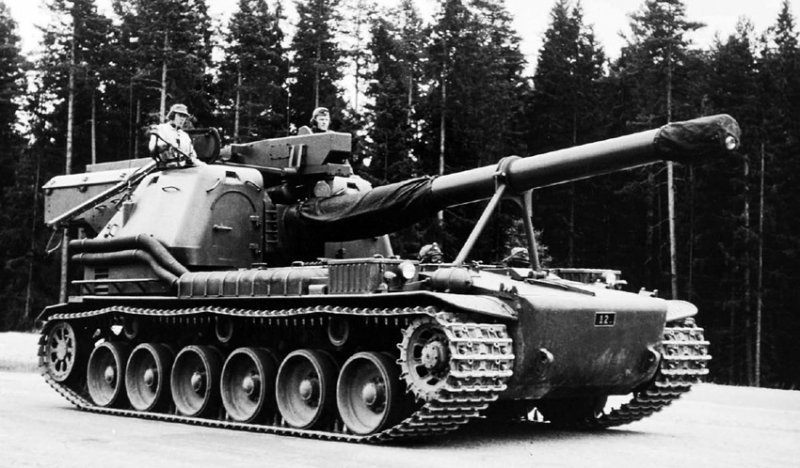
Since the building of the prototype Artillerikanonvagn 151 (this happened around 1960), the gun caliber changed. Now the requirements were for the 155 mm NATO caliber. The main features of the 155 mm gun was the automatic loading mechanism. The designers placed it in the oscillating part of the turret, hanging between two armoured compartments for crewmen on the turntable.

Rear of the Artillerikanonvagn 151 during magazine installation. Note the lowered idler.

Here, in the rear of the turret, the 14 round replaceable magazine was housed. It took several minutes to load a new magazine, but the Artillerikanonvagn 151 could empty it in 45 seconds. As mentioned above, the ROF requirement was 15 RPM. If one shell was loaded into the barrel, the full ammunition load was indeed 15 rounds, and the Akv-151 was capable of firing them all in one minute.

The mass of the prototype was 51 tons. The 700 hp engine allowed it to accelerate to a speed of 55 kph. The crew consisted of 7 men. The only assembled prototype of the Artillerikanonvagn 151 can be seen at the Arsenalen military museum near the small city of Strängnäs.

Artillerikanonvagn 151 SPG. The gun and idlers are in travel position.

The Artillerikanonvagn 151 was not destined to make it to mass production. By the time the prototype was built, work was already underway on the famous turretless S-tank, whose unique chassis was suitable for the Bofors artillery system. The idea of unifying parts of the tank and the SPG was tempting, and the Bandkanon 1 SPG on the Strv 103 chassis went into production.

The resulting vehicle surpassed its prototype in mass: the Bandkanon 1A weighs 52 tons and the Bandkanon 1C weighs a tone more. The engine was the same as the 39 ton tank, which was not enough. The effective power of 10-11 hp/ton allowed it to accelerate to 28 kph. Nevertheless, the exceptionally fast large caliber gun capable of firing 15 47 kg shells per minute at a range of 25 kilometers remained in service from 1967 to 2003. 70 vehicles of this type were planned, but the budget was only enough for 26.

Swedish heavy SPG Bandkanon 1A.

When talking about Swedish SPGs, rumours that surround them must be addressed. There are opinions that they were created, first and foremost, as WMD delivery platforms. On one hand, the Swedes certainly had a serious domestic nuclear armament program. In addition, both the US and the USSR had nuclear shells of similar calibers (152 and 155 mm). However, this hypothesis is not supported in documentation, unlike Swedish rocket or aircraft based delivery systems.