Showing posts with label painting. Show all posts

Friday, 22 July 2022

Ammunition Storage

 "#01725
June 9th, 1945

In accordance with your letter #843079s dated May 25th of this year, we present the following ideas regarding rational locations of ammunition in ammunition racks and painting of the racks with the goal of prevention of explosions.

For the SU-76

  1. Given 35 round of HE, 15 AP, and 10 APCR, place:
    1. 11 rounds of HE on the right side, 17 on the left side, 7 under the gun cradle.
    2. 15 rounds of AP in the upper bustle.
    3. 10 rounds of APCR in the lower bustle.

Wednesday, 22 December 2021

Winter Camo

"November 27th, 1944
#524909

According to an order of the Commander of the Armoured and Mechanized Forces, imported tanks that arrive in military acceptance departments in winter time are painted in white winter camouflage.

Tanks are then transferred to training regiments where the guns are tested and the tanks are used to train crew cohesion.

Experience from last winter showed that the camouflage is wiped off the tanks during firing and training, and the regiments are forced to paint the tanks again, which expends an excess of labour and paint.

I ask you to order the commanders of the 16th and 27th Independent Training Tank Regiments to request unpainted tanks from the GBTU Tank Directorate. Paint the tanks in the regiments before they are sent to the front.

Inform me of your decision

Deputy Chief of the GBTU Tank Directorate, Engineer-Colonel Muravich
Chief of the 5th Department of the GBTU TU, Engineer-Major Biletkin"

CAMD RF F.38 Op.11355 D.2190 L.254
Printed in Glavnoye Bronetankovoye Upravleniye Lyudi, Sobytiya, Fakty v dokumentakh, 1944-1945 p.229

Friday, 20 August 2021

Winter Camo


 "GABTU Scientific Research Proving Grounds

Approved:
Proving Grounds Chief Colonel Romanov, December 15th, 1941

Approved
Proving Grounds Commissar, Regimental Commissar Dolgov, December 16th, 1941

Conclusions regarding experimental winter camouflage of armoured vehicles

Introduction

On orders from the GABTU, T-34, T-50, BT, T-26, and T-40 tanks were painted in winter camouflage patterns between September 19th and October 2nd, 1941. The trials were performed at the GABTU proving grounds.

The goal of the trials was to:

  1. Establish the pattern that was the most effective at breaking up the outline and shape of the tanks.
  2. Establish the shade of colours that blend together with the surroundings in winter.
  3. Develop a formula for paint that is sufficiently resilient and easy to produce.
After the pattern, colour, and formula are selected, the proving grounds will apply it to samples of all vehicles used by the Red Army. After experimental camouflage is applied, an instruction manual on winter painting will be composed and requirements will be distributed to factories.

Wednesday, 11 August 2021

Friend or Foe

Soviet armoured forces never established a uniform system of tactical markings, leaving individual commanders to create their own. When it came to friend or for markings, there was an even greater variety, as they were changed often. One example is this schedule used by the 9th Army in July of 1941.

Friday, 25 June 2021

Pre-War Markings

The Red Army had no universal system of tank markings used during the Great Patriotic War, and commanders developed their own systems, sometimes changing them frequently to prevent the enemy from figuring them out. This was not the case before the war, as a standard system of markings was used.

Saturday, 11 August 2018

Red Army's White Tanks

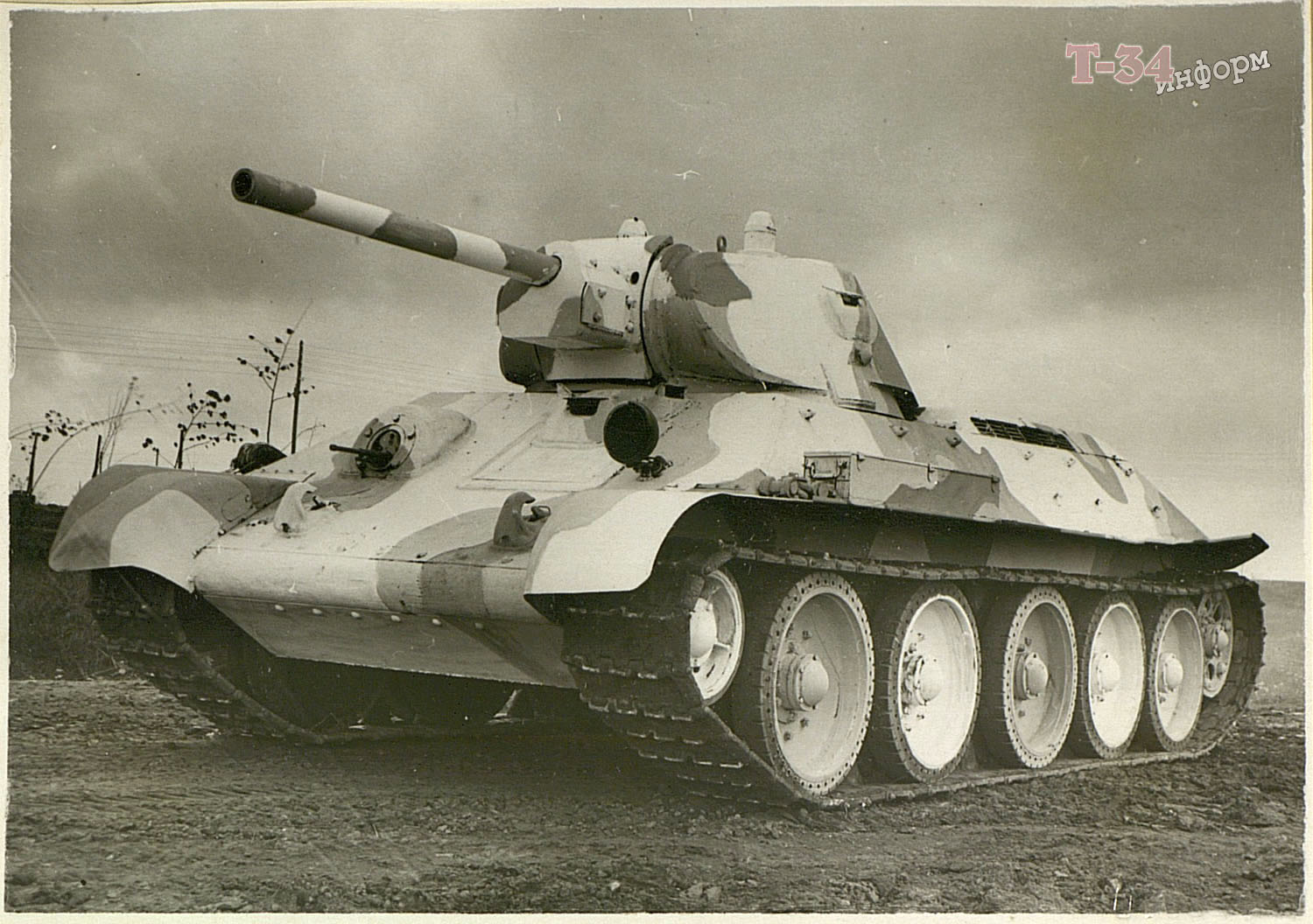
Issues with reducing visibility of armoured vehicles arose as soon as these vehicles were first used. Like 100 years ago, opposing sides aim to locate enemy vehicles in motion, during stops, and during combat, determine their type and number, and also make the same as difficult as possible for the enemy. It's not easy to conceal a tank from the enemy, especially in winter. Areas covered in snow make dark objects (such as tanks in basic camouflage) very noticeable. How was the issue of camouflaging tanks in winter handled in the Red Army?

Wednesday, 5 July 2017

KV Tank Markings

"To the chief of the "Balance" operational department

In order to more easily control and identify fighting and transport vehicles, the Commander of the Army's Armoured Forces gave the following order:
  1. For tank units, introduce the following identification marks:
    1. 1st TC and 8th G.TBr: Rhombus
    2. 26th TC: Circle
    3. 4th TC: Square
      drawn on in white paint on the side and rear of the turret. The size of the marks is 50 cm, with a 5 cm thick outline.

Sunday, 26 January 2014

Soviet Camouflage

When people think of a Soviet tank, they typically imagine its colour olive drab, perhaps with lots of red stars all over. While pre-war doctrine did put easy identification over concealment, that line of thinking began to change in the late 1930s.

"In 1939, as a result of ABTU's initiative, NIIIT developed a deforming colour scheme for tanks and armoured cars.

Between August 15th and 29th, 1939, ABTU's proving grounds (Kubinka station) performed research on deforming large-spotted colour schemes of wheeled and tracked vehicles. ABTU Chief, Hero of the Soviet Union, Colonel-General of the tank forces comrade Pavlov and IU KA Chief, Major-General comrade Mihailin took part in the trials.

As a result of the trials, it was determined that it is beneficial to replace the olive drab factory paint with a multi-coloured deforming paint scheme. The report with blueprints and photographs was sent to ABTU on August 11th, 1939 (source #38).

NIIIT KA proposed performing field trials in 1941 and provide GABTU with results in June of this year. Currently, NIIIT is performing laboratory tests of deforming paints, in order to finally establish the patterns and composition of the paint. Trials are scheduled for May 10-25th at the ABTU proving grounds (Kubinka station). NIIIT has ordered sufficient amounts of paint for this task.

Chief of the NIIIT KA, Military engineer 1st grade, Zheleznih
Chief of the 2nd Department, Military engineer 2nd grade, Sheglov
January 1st, 1941"
CAMD RF 38-11355-1

However, war does not wait politely for trials to end, and the tankers took matters into their own hands.

"From reports coming to GVIU, it can be seen that active army units apply a deforming colour scheme to their tanks and vehicle, in order to hide them more effectively. However, due to a lack of appropriate colours and poor execution reduce the effect of the paint. I think it is necessary to apply camouflage paint in factory conditions, and hurry the preparation of instructional posters.

Chief of the Red Army GVIU
Major-General of Engineering Forces Kotlyar

August 27th, 1941"
CAMD RF 38-11355-1

Here's a picture of one of those custom-painted tanks. The pattern is very unusual, with tactical markings hurriedly painted over top.


Here are proper instructions for summer camouflage (for artillery):

CAMD RF 81-12104-327

"To the military representative at the Red Profintern factory

In order to mask the material possessions of the artillery units among the terrain, and to ease its concealment by improvised means in the field, a camouflage paint scheme is being implemented. 

The camouflage scheme is to be applied to guns, limbers, ammunition crates, and carts that were previously painted olive drab, barrels of 76 mm model 1938 mountain guns, and artillery transportation methods (tractors, cars, trailers), tarps, tents, and large cases. 

On August 25-28th, we will send you the "Instructions for camouflage painting" and samples of 5K (dark brown), 7K (yellow earth), and 4BO (olive drab), which you must pass on to the factory, retaining 1-2 samples.

In order to fulfil this order, the Council of People's Commissars issued order #5667 on August 7th, 1941, ordering the People's Commissar of Chemical Production to ship 6K and 7K paint using part of the budget for 4BO paint.

It is imperative that camouflage paint be applied immediately, as soon as paint and instructions are received.

Report on delays in this transition, and report as soon as you complete transition to this new camouflage scheme.

Deputy Chief of the GAU KA, Military Engineer First Class, Lipanovich
Military Commissar of the GAU KA, Regimental Commissar Kozlov
August 16th, 1941"

The colours were defined as follows (from Kolomiets and Moshanskiy, Camouflage of Red Army Tanks 1930-1945):
  1. "Green - 4BO (medium colour) works with all green vegetation backgrounds, and is the main, dominant colour. This colour covers 45-55% of the surface area of the object.
  2. Yellow-earth - 7K works with bare earth backgrounds (plowed soil, roads, rock slides, etc). This colour covers 15-30% of the surface area of the object.
  3. Dark brown - 6K works with dark spots on various backgrounds and with tree trunks. This colour covers 15-30% of the surface area of the object.
The following requirements were given when painting:
  1. Spots must imitate natural shapes, must have wobbly contours, and must vary in shape and size.
  2. Spots must be arranged in such a way as to alter the appearance of the object as much as possible. Recognizable parts of the object, such as straight lines and angles, shields, gun barrels, wheels, etc, must be painted with spots of various colours. The direction of elongated spots must not be parallel to the outline of the object, and must intersect with it at various angles. Spots of one colour and similar size should not be placed symmetrically. Spots may be enclosed in one part of the object, or cut off by the outline of the object. "Open" spots must "travel" on to adjacent surfaces, i.e. be painted on at least two surfaces. Angles that are sticking out must be painted in predominately dark colours. The top of an angle must not coincide with the center of a spot. Permanently shaded areas of the object must have highly contrasting yellow and brown spots.
  3. As a general rule, using stencils is unacceptable.
    The spot locations must vary in accordance with the above rules. Alternatively, it is necessary to vary the colours in the included drawings, replacing all or some of the yellow spots with brown, and brown spots with yellow.
Unpainted elements of the barrel, breech, and other mechanisms, sights, and labels are not painted over."

The book also includes instructions. The spots must be first outlined in chalk, and labelled with a letter signifying the colour. In the event that the tank is already painted green, only non-green spots are labelled and painted. When converting summer camouflage to winter camouflage, paint over the green spots with solid white, and over the yellow and brown spots with a hashed pattern. Depending on how open the terrain is, increase or decrease the density of white stripes. Captured vehicles coloured in monochrome grey must be painted in the same fashion.

Unlike tanks, artillery was very commonly painted in camouflaged colours, even artillery in the Reserve of the High Command, which theoretically wouldn't have much use for it.
RGK artillery in camouflage.

M6 AT gun on trials. You can see a camouflage pattern on the gun trailer.


Here's how the tanks dried after being painted at the factory:

Sherman drying after being painted

Also, winter instructions:

CAMD RF 38-11355-107

"Conclusions of the report from the NI proving grounds of the Red Army GABTU on the winter camouflage paint of armoured forces.

Experiments performed on six kinds of paint schemes shows that the best contour and relief masking is achieved with a three-colour paint scheme, with a white image based on the method of optical displacement, a mesh pattern, and spots with a wobbly contour. 

Downsides of this method include a large amount of time needed (14 man-hours), and the necessity to draw an image on the tank before painting.

Recommend the camouflage scheme outlined above for factories. For tanks currently assigned to a unit, paint the whole tank in one shade of white. 

The NI proving grounds must distribute drawings and paint recipes to factories."

The camouflage scheme in question doesn't exactly have three colours. The different types of surfaces are flat white, a white mesh on an olive drab background, and plain olive drab. Something like this:


"MEMO
On camouflage of combat vehicles in winter conditions

1. Type of paint.

A chalk mixture is used in order to paint. During frost, use warm water to prepare it.
Amount: approximately 1200 kg for a two regiment tank brigade, or 5-6 kg per vehicle.

In cases where there is not enough chalk, it is possible to use slaked lime. Lumped lime is completely unsuitable for this task. Disadvantages of using lime: the paint will gradually turn brown, the lime acts as an irritant. Both types of paint can wash off, and are not resistant to snow and rain.

2. Directions on application of camouflage paint.

The order to paint is given out in the winter, right before the vehicles will be used. The order is given by the same unit that orders the use of combat vehicles.

The painting is done by the crews themselves, as close as possible to headquarters (where warm water is available).

Brushes used for washing cars may be used for painting, as well as any containers (buckets, etc). The time to paint a vehicle is 2-3 hours."

CAMD RF 3098-1-2

The Red Army also had a large amount of unofficial winter camouflage schemes.


The next photograph is very interesting. The tanks in it are rather rare T-30s. The T-30 was a simplified T-40 with a better gun and no amphibious ability, but not quite as simplified as a T-60. The tanks have a strange pattern applied to them. One tank like this might be an indication of scorched paint due to an engine fire, but several in one place clearly show that this was the camouflage pattern applied to the tanks of this entire unit.


Elements of the terrain were also used to aid in camouflaging vehicles.


Monday, 6 January 2014

Tank Inscriptions

Along with sponson guns and engine rooms, WWI British tanks inherited another thing from battleships: proper names. The first series of Soviet tanks continued that tradition. The practice of naming each tank waned as tanks became significantly more common than battleships, but returned in the time of war. The following photograph, for instance, is pretty famous.


That is a T-34 model 1942 #212-570, with an inscription that reads "Leningradets" (citizen of Leningrad). The tank belongs to the 1st Red Banner Tank Brigade, other members of which were also awarded titles.

"Order to the 1st Red Banner Tank Brigade #0124
November 4th. 1943

An announcement of order #0111 of the Commander of the Amoured and Mechanized Forces of the Leningrad Front follows:

"In order to preserve the proud traditions of great Russian commanders, whose names were cemented in the history of the art of war, in honour of the leaders and organizers of the heroic struggle of the Russian people against German fascism, in honour of our best soldier and officer tankers, loyal sons of the Soviet people, who demonstrated bravery, courage, and heroism, I order the naming of heavy and medium tanks in frontline units.
I am certain that the crews of the war machines that bear these glorious names, and their commanders, will exterminate the fascist scum with their skill in battle, and will write new pages of victory in the history of the Red Army, pages that are worthy of those names that serve as a symbol of selfless and heroic war of our people against a hated enemy.

I order the naming of these medium tanks of the 1st Red Banner Tank Brigade:
  • T-34 tank #212-309: For the Motherland
  • T-34 tank #212-342: Alexandr Suvorov
  • T-34 tank #212-640: Sergei Kirov
  • T-34 tank #212-570: Leningradets
  • T-34 tank #212-691: Petr Kraizelburg, after a courageous tanker, commander of the 1st Red Banner Tank Brigade, and later a Guards Breakthrough Tank Regiment, who died the death of brave men in defense of our Motherland.
  • T-34 tank #212-90: Vladimir Kiryanov, after a courageous sergeant, posthumously awarded an Order of the Red Banner, whose crew destroyed two field guns, 2 AT guns, 2 mounted machineguns, a mortar battery, two motorcycles, and up to 50 soldiers and officers of the enemy, who died the death of brave men defending the city of Lenin.
  • T-34 tank #212-303: Nikolai Ovchinnikov, after a cavalier of the Order, a courageous tank officer that skilfully combined his personal courage with excellent command of his unit, who died the death of brave men in defense of our Motherland.
  • T-34 tank #212-611: Alexandr Nevskiy
  • T-34 tank #212-737: Semyon Dulkin, after a loyal son of the Soviet people, twice cavalier of the Order, commander of a tank battalion, who skilfully and remorselessly defeated German invaders and gave his life for the Motherland and its people.
  • T-34 tank #212-150: Mihail Sokolov, after a fearless and wilful tank officer, cavalier of the Order, radiating honour and glory, a loyal Bolshevik, who committed his life to defending the Motherland and died the death of brave men in defense of the city of Lenin.
  • T-34 tank #340-33: For the Soviet Ukraine
The application of inscriptions should be done in accordance with an order that was sent out earlier (order #017 from April 15th, 1943).

The vehicles with the aforementioned names should be handed over to the crews according to appendix #2 of the Combat Manual of the Armoured and Mechanized Forces of the Red Army.

Commander of the Armoured and Mechanized Forces of the Leningrad Front, Hero of the Soviet Union, Major-General of the tank forces, Baranov
HQ Chief of the Armoured and Mechanized Forces of the Leningrad Front, Colonel Plevoy"

The commanders of the 1st and 2nd battalions should transfer the vehicles to the crews according to the manual. I am certain that the crews of these tanks that carry the names of brave warriors and loyal sons of the Russian people, fearless defenders of the Motherland, will be examples of endurance and defiance, skill, courage, and bravery, and will multiply the glory of their comrades that gave their lives for happiness of our people and independence of our country.

Commander of the 1st Red Banner Tank Brigade, Colonel Volkov
HQ Chief of the 1st Red Banner Tank Brigade, Lieutenant-Colonel Afanasyev"

Tank names were in no way unique. Kirov's name previously was assigned to the SMK tank (Sergei Mironovich Kirov), and "For the Motherland" was the name of another prototype heavy tank, the KV-220. Alexander Suvorov and Alexander Nevskiy also had their names on captured StuGs in the 1228th Guards Self-Propelled Artillery Regiment. "Suvorov" was also written on the side of a KV-1 from the 10th tank brigade.

LKZ manufacture KV-1, belonging to company commander Markov.

A tank's name wasn't just some paint on the side of the turret, but a proper name. For example, Markov's KV above is identified as "Suvorov tank" in his Hero of the Soviet Union award order.

Of course, you didn't have to die for the Motherland to name a tank. You could always buy your way in. A few examples are described in Wargaming's article, "Small parts of a large victory".

"The war with fascist forces was fought not only at the front, but in the rear. Millions of people of many professions that have never before held a rifle grabbed the levers of a tank or an airplane, pulled victory closer and closer with their labours. Many did not end there, and spent their own savings on the needs of the front. Over the four years of the Great Patriotic War, Soviet citizens donated money for several thousand tanks, about 2500 airplanes, 8 submarines, many guns, mortars, hundreds of thousands of shells and bombs.

The money was collected in factories, farms, various government offices. For example, in 1943, a T-60 named "Malyutka" (child) fought at Stalingrad. The tank was built using money donated by kindergartens. The tank was driven by a woman named Ekaterina Petlyuk.

Many individuals bought entire vehicles. Mariya Oktyabrskaya, who bought a T-34 tank, fought in it as a part of the 26th Guards Brigade of the 2nd Tatsin Tank Corps. A peasant named Ferapont Golovatiy sent two fighters to the front, a Yak-1 and a Yak-3. A performer named Vladimir Yakhontov purchased an IS-2, and named it after his favourite poet: Vladimir Mayakovskiy. There are a great deal of these examples. We would like to remember some lesser known people that made their contribution to a great deed.

Vehicles were frequently purchased for specific soldiers, about which people read in newspapers. In February of 1944, a railroad worker named G.M. Kozyrev bought a Yak fighter for A. Bulgakov, using money he was saving for a house. Bulgakov made 136 sorties with that fighter, shooting down 14 enemy airplanes.

The story of one T-34-85 of the 36th Guards Tank Brigade is interesting. The head of a farm, Y. Shulga, sent it as a gift to his adopted son, Lieutenant I. Kisenko. The inscription on the tank read "From father Shulga to son Kisenko". The tank participated in liberation of Shulga's home village, and then fought in Yugoslavia and Hungary.

Another T-34, titled "Gift to my son", was given to A. Shirmanov by his parents, Ilya Andreevich and Maria Fillipovna on the day of the 25th anniversary of the Red Army. This tank fought starting on June 1943. A. Shirmanov died during battles for the Zhitomir region.

In many cases, tankers and pilots bought vehicles that they themselves fought in. The T-34 named "Amur Avenger" was paid for by N. Agapov, L. Rudnichenko, and I. Binyukov. The vehicle was used by the 12th Guards Tank Bridage. Agapov and Rudnichenko fought as a part of its crew, but Binyukov could not, due to an injury. Pilot L. Chaiko, gunner K. Shishkin, and mechanic P. Bobrov purchased an Il-10 airplane, and then fought in it as a part of the 2nd Baltic Front. Shishkin's father helped with the purchase of this expensive vehicle.

It is impossible to list all such cases in a short article, but every person that sacrificed their earnings for the front contributed to the victory over the most menacing enemy humanity has ever known."

Kolomiets and Moshanskiy add to the list of named tanks in Camouflage of Red Army Tanks 1930-1945, Zeughaus, 2007, grouped by year, but even the vast collection in the book does not fully exhaust the proper names of all tanks used by the Soviet Union in WWII.

The vehicles that survived the war in a condition suitable for further service had their names unceremoniously painted over during refurbishment.

Saturday, 21 December 2013

German Paint

We've seen trials of German tanks, trials of German guns, now it's time for something a little different. A trial of German...paint!

CAMD RF 38-11355-4

"To the chief of the Directorate of Armoured and Tank Forces of the Red Army, Military Engineer 1st class, comrade Korobkov.

As a part of a series of foreign purchases by the Red Army UVHZ, we received three types of oil and fat resistant "R-series" paints for armoured cars from the Herbig-Haarhaus factory:
  • Red-brown R-1 for primer
  • Khaki
  • Ivory R-13 for surfaces
Of these paints, we can allot the following amounts to BTU KA:
  • R-1: 2550 kg
  • Khaki: 1260 kg
  • R-13: 1258 kg
Attached are the Conditions of Delivery and instructions for using these paints. Please reply with your confirmation and indicate which warehouse to send the paints to.

Attachment: 3 pages of German text.

Deputy Chief of the Red Army NIHI, brigade engineer Korolev
Chief of the information division, military engineer 3rd class, Kondratyev
November 27th, 1940"