The Tiger and Panther had wide tracks and powerful engines that should, at least in theory, have given them good performance in heavy mud and other difficult terrain. I look at whether or not this was actually the case in my latest video.

This blog is dedicated to bringing World War II era documents to the general public, with an overall focus on armoured warfare. Questions? Requests? Comments? Email me at tankarchives@gmail.com or find me on Twitter @Tank_Archives.
Showing posts with label mobility. Show all posts
Showing posts with label mobility. Show all posts
Monday, 30 March 2026

Tuesday, 27 February 2024
Foreign Tanks in Winter
"Report on the tactical use of English made MK-2 and MK-3 tanks as well as domestic T-60 tanks in combat
1. The 23rd Tank Brigade was engaged in nonstop fighting from December 16th to December 31st, 1941, and has experience in using MK-2, MK-3, and T-60 tanks in battle.
2. Driving in a tank column made of MK-2, MK-3, and T-60 tanks on a road does not pose a problem if the road was previously used by horse-drawn transport. If the road was not used, the MK-2 and MK-3 can push their way through 40-45 cm deep snow losing speed (the MK-2 can drive well in 3rd gear, the MK-3 in 1st or 2nd gear). The T-60 can't drive in snow this deep without following a path made by horse-drawn transport or medium tanks. It is impossible to drive individual tank columns made only of T-60 tanks in snow this deep.
There is no particular difficulty when tanks of these types drive on country roads, the specifics of their driving remain the same.
Thursday, 21 December 2023
British Tanks in 1943
"Report on use of foreign MK-2 [Matilda] and MK-3 [Valentine] tanks in combat
1. General characteristics
Since the brigade was created on March 25th, 1942, it was armed with MK-2 and MK-3 tanks. The latter showed themselves well in battle as infantry support tanks in all sorts of battles. There were also cases of using them to combat enemy tanks (Pz.Kpfw.III, Pz.Kpfw.IV) at close ranges (200-600 meters), especially from ambush in defensive fighting.
The off-road mobility and maneuverability of the MK-2 and MK-3 tanks is insufficient compared to the T-34 in all types and periods of battle. The MK-2 tank in particular is not very mobile even on even terrain. In cases where it needs to turn 360 degrees, its turning radius is 15 meters. The tracks often fall off on sharp turns. The limit of the slopes it can climb or descend in winter, rainy, or damp weather is 15-18 degrees.
The dimensions of the MK-3 tank allow it to get up close to the enemy using terrain features as cover and take them by surprise. In winter, the depth of the snow conceals it from enemy fire. MK-2 and MK-3 tanks have a clearance of 420 mm with a ground pressure of 0.60 [kg/cm²] when the tracks are submerged by 100 mm. In the winter, they can drive through 50-60 cm deep snow, which allows them to drive on country roads and off-road. If anti-tank obstacles need to be crossed, they can cross a 0.75 m tall wall, ford a one meter deep stream, cross an anti-tank trench [figure missing] wide. In the winter they can handle 18 degree slopes, in the summer and in dry weather they can handle 30 degree slopes.
Monday, 20 March 2023
Prime Minister on the Front Lines
In 1941 it became clear to British tankers that the Churchill I armed with a 40 mm 2-pounder and 3” howitzer won’t remain competitive for long. Due to difficulties with developing a new weapon, the Churchill III armed with the more powerful 57 mm 6-pounder only entered production in March of 1942. These tanks gradually forced out the Churchill II, but some units kept the Churchill I as close support tanks. The low reliability of these tanks did not allow the British to test them in the desert, but an opportunity for a trial by fire soon arose.
If at first you don’t succeed…
The Churchill tanks first went into battle on August 19th, 1942, during the infamous Dieppe raid. A raid against German coastal defenses was risky, but after a series of raids including the famous raid on Saint-Nazaire, Lord Mountbatten’s Combined Operations Headquarters had all but carte blanche when it came to planning.
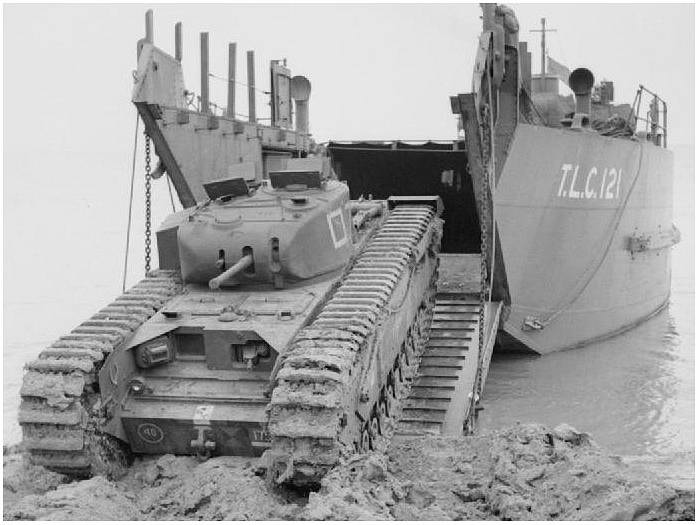 |
| A Churchill II tank used in a practice amphibious landing. |
Monday, 30 January 2023
Tanks in Snow 1941-42
Winter is a difficult time for any kind of vehicle, including tanks. Since the Russian winter is long, the USSR paid a lot of attention to how tanks put up with it. This applied in full to mobility in winter. Driving through deep snow banks was a mandatory part of testing every armoured vehicle starting with the MS-1. The MS-1 showed insufficient traction in snow, which is a part of the reason why the "Eagle's Claw" track was introduced. Winter tests of the Vickers Mk.E tank in the USSR were also a key factor in accepting the tank into production.
 |
| T-34 tanks were often the only Soviet tanks that could move outside of roads in winter. |
Monday, 7 November 2022
Shermans in Mud
The Medium Tank M4 showed itself as an effective weapon over the course of decades of service. Tanks from the Sherman family successfully fought in every corner of the world in WW2 and after. However, these tanks still had a number of design drawbacks that American engineers had to fight to solve while the tank was already in production. One of these drawbacks was poor mobility in soft soil.
Attachments of every kind
One of the reasons why the Sherman’s off-road mobility left much to be desired was the high ground pressure. Even the prototype Medium Tank T6 didn’t have particularly wide tracks, and every subsequent variant of the Sherman became heavier and heavier. Ground pressure increased along with weight.
 |
| A Medium Tank M4A1 that sank in mud, Miturno, Italy, 1944. The high weight and narrow tracks of this vehicle meant that off-road mobility was low. |
Friday, 30 September 2022
Not Quite a Swallow
An attempt to "speed up" the Soviet KV-1 heavy tank in March of 1942
Tanks getting heavier during production is a normal phenomenon. Several factors are at play here. One is that requirements for protection increase over time. This is the primary factor for increased mass. Growing mass is also often a consequence for increased requirements for armament. This is usually not a huge increase, but can result in a weight gain of a ton or two. Simplification of the design, especially in wartime, also plays an effect. The T-34 is a typical example. The tank's battle weight was on the order of 27 tons in 1941. The start of the war and subsequent evacuation to the Urals resulted in a large number of simplifications. The T-34 ended up using a large amount of cast components that were much heavier than rolled ones. The tank's mass crossed the 30 ton mark in 1943, but it gained neither better armour nor better armament.
Wednesday, 18 May 2022
Object 701 Trials
"February 8th, 1945
- The Object 701 tank was designed on the initiative of the Kirov factory with participation of the Bauman Institute transmission design group and TsAKB arms designers, and produced according to GOKO decree #5583 issued on April 8th, 1944.
- According to order #368/01 of the Commander of Armoured and Mechanized Forces and the People's Commissariat of Tank Production, the commission led by Lieutenant General of the Tank Forces comrade Vershinin conducted proving grounds trials of the Object 701 heavy tank in June-July of 1944.The NIBT proving grounds held penetration trials of two variants of the hull and turret in July-August of 1944.
Wednesday, 15 December 2021
Video: Tanks in Snow, Winter 1941
It's winter again, and with it comes a sequel to my Tanks in Snow video. This time I narrow the scope a little bit and talk about how tanks in the Red Army performed in the winter of 1941-42, specifically about the T-26, T-60, Valentine, and Matilda tanks.
Monday, 15 March 2021
Snow "Shoes"
The tank was born on the battlefields of WWI where it had to combat not only enemy fortifications, but also mud. Tanks were often lost not from enemy fire, but from being stuck on cross country terrain. Engineers and the military first started thinking about how to improve mobility of their vehicles. Further improvements focused on improving mobility in general, but advanced methods of driving on soft terrain did not progress past experiments. Engineers returned to the issue of improving off-road mobility in WWII. In addition to mud, tanks got a new enemy: snow. This issue was most prevalent on the Soviet-German front where there was more snow than anywhere else for obvious reasons.
Saturday, 4 July 2020
Dead End on Wheels
The 1930s were a time of experiments in the field of armoured vehicles. Some of these experiments were successful, some not so much. Some tanks passed trials and were even accepted into service, but failed to enter mass production. For instance, the convertible drive T-29 tank was supposed to replace the T-28. It was accepted into service, but not mass produced for a variety of reasons. The T-46 was its comrade in sorrow. This tank was supposed to become the most numerous in the Red Army, but only four were built. That was the end, the idea of replacing the T-26 failed.
Monday, 3 February 2020
Lend Lease Review
"Report of the 92nd Tank Brigade on the use of American M3 medium and M3 light tanks.
- Advantages, from a tactical point of view.
- High density of fire.
- Good observation (a commander's cupola is present).
- The light tank is very mobile.
- The engines are quite while driving.
- The sights and ballistics of the 75 mm and 37 mm guns are good.
- The crews on the M3s and M3l are well placed.
Saturday, 2 February 2019
Modernization, Polish Style
The 7TP, a Polish modernization of the Vickers Mk.E, was the pride of Polish tank building in the interwar period. Skilfully combining products of the Swiss Saurer company (who made the engine) and the Swedish Bofors company (who made the gun), Polish designers significantly improved the characteristics of the initial tank. The 7TP design also included a number of Polish creations, including the excellent Mk.IV periscope. Polish tanks fought German tanks as equals in the 1939 campaign, and many of them later served in the German army. A number of the tanks ended up in the USSR as trophies, where they were studied.
Monday, 25 June 2018
Tanks in the Snow

Crossing of the snow obstacle by the German PzIII tank
Photo #25: Crossing the snow obstacles. The PzIII tank punches through the first obstacle.
Photo #26: Crossing the snow obstacles. The PzIII tank punches through the second obstacle.
The tank penetrated the first obstacle and reached the second in 7 minutes. After the eighth attempt, both obstacles were passed after accelerating in 3rd gear from 50-60 meters. Total time taken was 16 minutes.
Wednesday, 13 June 2018
Prewar Prototypes
"November 11th, 1939
#0830/s
#0830/s
To the Chief of the 8th Department of the ABTU, Military Engineer 1st Class comrade Afonin
Report on the trials of the A-32 (weight down) and preparations for trials of the A-20 and Voroshilovets tractor
- The A-32 (second prototype) weighed down to the weight of an A-34 has travelled 1047 km. During the third march, the average moving speed off-road was no more than 20-23 kph. This was caused by terrible conditions of the terrain (mud). Typically, the vehicle can only drive in second gear off-road. The transmission is working well in these conditions, there haven't been any defects. A trip on a highway is planned on November 10th to test the running gear.
- Presently, A-20 components (improving the wheeled drive transmission) are undergoing mechanical finishing.
- Despite our insistence, Voroshilovets tractors are not being worked on at all. Management of department 500 claims that its equipment is occupied with other projects (A-7, D-3, D-5, etc). This situation may result in the Voroshilovets tractor not being ready for mass production by January 1st, 1940.
Military representative of the RKKA, Military Engineer 3rd Class, Baikov."
Sunday, 29 April 2018
Where Infantry Can't Pass
History enthusiasts are familiar with Winterketten and Ostketten track links for PzIII and PzIV tanks. The use of these track links was a necessary measure to increase mobility in the snow and on wet, soft soil. The history of these track links did not particularly attract historians, but at the very least their existence is widely known. There are photos of German tanks with these track links and they are fond in the ground on battlefields. However, nothing is known of equivalent development in the Red Army. Let us try to fill this gap.
Monday, 19 March 2018
Pershing: Heavy by Necessity
The British Churchill tank was the only one supplied to the USSR by the Western Allies en masse. The US had bad luck with heavy tanks. Work on the Heavy Tank M6 hit a dead end. Nevertheless, heavy tanks did arrive in the American army by the end of the war. These were Heavy Tanks T26E3, standardized as M26 Pershing. However, the T26E3 was rather arbitrarily classified as heavy. In practice, this was a medium tank. Only its mass made it a heavy, and even then, it returned to medium after the war. This article is dedicated to the trials of the T26E3 in the USSR, during which it was compared to heavy tanks.
Monday, 19 February 2018
Shermans in the Mud
Few people interested in WWII armoured warfare haven't seen this video depicting Swedish trials of a Sherman, a Churchill, and a Panther in difficult off-road conditions. Many people, after having seen this video, readily claim that the Sherman had inferior off-road mobility to the Panther. Certainly, it's hard to argue with the video, but there is a caveat. There were many different kinds of Shermans, and the video only tests one of them. I thought I'd take a look at some trials performed by the Western Allies in Europe to see if they arrived at the same results.
Saturday, 4 November 2017
British Tank for Soviet Infantry
On September 29th, 1941, the first regular Arctic convoy departed from Britain to the USSR. It was indexed PQ-1. On October 11th, 11 transport ships arrived at Arkhangelsk, where they delivered 193 Hawker Hurricane fighters and other military cargo. Among it were 20 Matilda III and Valentine II tanks. So began the delivery of the Valentine tank, which became the most numerous British tank in the Red Army.
Monday, 23 October 2017
Sherman Engines
Things like fuel efficiency and average speed don't really come up much in most tank encyclopedias, which is a shame, since these are very important characteristics in the real world. The Americans, in their investigations of a new engine, were kind enough to provide these figures for a few Sherman tanks for us.

RG 24 C-2 vol 12290 1/TK CRUISER/1
These numbers are interesting on their own, but let's compare them numbers obtained in Soviet trials.
Subscribe to:
Posts (Atom)