
This blog is dedicated to bringing World War II era documents to the general public, with an overall focus on armoured warfare. Questions? Requests? Comments? Email me at tankarchives@gmail.com or find me on Twitter @Tank_Archives.
Tuesday, 27 October 2026
Video: T-35: Misunderstood or Useless?

Sunday, 21 April 2024
Single Hatch for Tank Turrets
 |
| T-34 in Crimea, 1944. Factory #112 was the last to keep the turret with a single hatch in production. One of their tanks can be seen in the foreground. |
One of the characteristic features of Soviet tanks and armoured cars in the late 1930s was the conical turret that came to replace the earlier cylindrical shape. Some vehicles also received a single hatch for their two-man turret. The T-34 tank was the most famous vehicle with this solution. This idea was dropped only to resurface in post-war designs. Let us discuss why this hatch appeared in the first place and why it disappeared.
Monday, 28 August 2023
Alternative Heavy Tank
Factory #183 in Kharkov was the center of Soviet heavy tank development in the interwar period. The T-35 powerful (heavy) tank developed in Leningrad by N.V. Barykov was produced here. Production was set up with the participation of I.S. Ber, who was appointed as the head of HPZ (factory #183) Diesel Department design bureau T-35K. Iosif Solomonovich Ber played a key role in the fate of the T-35 tank. It was he who produced the technical documentation for the tank and further development of the design was done under his direction. Work to replace the T-35 moved to Leningrad in 1938 and Ber was promoted to the position of deputy chief of the KB-520 design bureau. Work on heavy tanks in Kharkov ended, but not for long.
 |
| I.S. Ber, a key player in the creation of T-35, T-34M, and T-44 tanks. |
Friday, 27 January 2023
Overrated Soviet Medium Tank
Soviet tank building began to fall behind worldwide trends in the early 1930s. In part, this was because even prospective tanks were designed based on mid-1920s ideas while the rest of the world moved on. The UMM (Directorate of Mechanization and Motorization) created in November of 1929 found a solution to this problem. Fitting vehicles were purchased abroad in 1930-31. Initially the plan was to buy samples for familiarization, but all this changed after Khalepskiy's commission went abroad. It was obvious that Soviet tanks in development were incapable of reaching required characteristics and mass production would be accompanied with a mass of troubles.
 |
| The T-28 was the best known original Soviet tank of the 1930s. |
Wednesday, 11 January 2023
Building KVs
"Addendum to agreement #B1-081 signed between the GABTU and Kirov factory for the year 1941
This addendum is signed on [rubbed out] June July 1941 between the GABTU (Customer) represented by Deputy Chief of the GABTU Major General of the Technical Forces I.A. Lebedev and Chelyabinsk factory (Vendor) represented by Deputy Director comrade Obrant and is based on State decree #525-224 issued on March 13th, 1941.
The Vendor accepts the responsibility of producing and delivery of 500 33 KV-3 tanks and increase of monthly delivery of KV-1 tanks by 10 units and the Customer accepts these vehicles and pays the previously agreed price of 740 thousand rubles for each one.
Delivery of KV-3 tanks is conducted in accordance with blueprints and technical requirements developed by the Kirov factory and the tactical-technical requirements approved by the State.
Blueprints and technical requirements are subject to final approval by the GABTU after the prototype is tested.
The agreed upon price of one KV-3 tank with parts and instruments is established at 740,000 rubles and is subject to adjustment according to calculations in reports delivered in October of this year. All calculations to establish the price of the KV-3 are subject to revision based on these reports.
In accordance to State decree #548-232s issued on March 15th, 1941, the amount of KV-1 tanks build according to agreement B1-081 is reduced by 100 units, as a result of which the cost of the contract is reduced by fifty two million three hundred thousand (52,300,000) rubles.
The overall cost of the KV-3 tanks is established by this addendum to equal three hundred and seventy million rubles (370,000,000).
The final cost of contract B1-081 including the addendum is therefore six hundred and thirty five million rubles (635,000,000).
The Vendor accepts the responsibility of producing a manual for the KV-3 vehicle by November 1st, 1941 and a catalog of spare parts by November 1st, 1941.
All other sections of the contract B1-081 remain in force.
[Signatures]
June 5th, 1941"
|
Item |
Amount |
Unit cost (thousand) |
Total (thousand) |
|
|
KV-1 tank |
400 |
523 |
209,200 |
|
|
KV-2 tank |
100 |
558 |
55,800 |
|
|
KV-3 tank |
500 |
740 |
370,000 |
|
|
Total |
1000 |
- |
635,000 |
|
|
KV-1 |
KV-2 |
KV-3 |
|||
|
|
Amount |
Cost |
Amount |
Cost |
Amount |
Cost |
|
January |
40 |
20,920 |
- |
- |
- |
- |
|
February |
45 |
23,535 |
- |
- |
- |
- |
|
March |
50 |
26,150 |
- |
- |
- |
- |
|
Q1 Total |
135 |
70,605 |
- |
- |
- |
- |
|
April |
65 |
33,995 |
- |
- |
- |
- |
|
May |
- |
- |
70 |
39,060 |
- |
- |
|
June |
50 |
26,150 |
30 |
16,740 |
- |
- |
|
Q2 Total |
115 |
60,145 |
100 |
55,800 |
- |
- |
|
July |
100 |
52,300 |
- |
- |
- |
- |
|
August |
50 |
26,150 |
- |
- |
55 |
40,700 |
|
September |
- |
- |
- |
- |
105 |
77,700 |
|
Q3 Total |
150 |
78,450 |
- |
- |
160 |
118,400 |
|
October |
- |
- |
- |
- |
110 |
81,400 |
|
November |
- |
- |
- |
- |
110 |
81,400 |
|
December |
- |
- |
- |
- |
120 |
88,800 |
|
Q4 Total |
- |
- |
- |
- |
340 |
251,600 |
Monday, 9 January 2023
Kirov Factory's Light Alternative
The appearance of Zhosef Yakovlevich Kotin as the chief of the Kirov factory's SKB-2 design bureau in 1937 launched a number of interesting processes. Under O.I. Ivanov before him, the bureau sat quietly and worked on ideas that came from the top. There were few original projects, and the ones that were weren't seriously considered. The situation radically changed when Kotin arrived on the scene. A fierce competition broke out with experimental factory #185 that previously held a monopoly. The monopoly on breakthrough tanks was the first to crumble. This was Kotin's achievement, as he created first the SMK-1 then the KV. Factory #185 wanted to build their alternative to the KV with the index 050, but while the KV was accepted into service the 050 was not even built. At this point the experimental factory was reaching the end of its life.
 |
| An experimental hull of the T-221, Kirov factory's first support tank. |
Monday, 14 November 2022
HPZ’s Unlucky First
August 20th, 1920, can be considered the starting point for Soviet tank building. It progressed pretty quickly. By 1921, the Red Army already had classifications for its new tanks. Captured British Mark V tanks were assigned to category B, or breakthrough tanks. Mk.A Whippet and Mk.B Hornet tanks were assigned to category S, manoeuvre tanks. Finally French Renault FT tanks and the Russian Renault were assigned to category M, support tanks. For obvious reasons, development of category B tanks was not expected until the future. They were too heavy and complicated for the nascent Soviet industry. A decision was made to focus on manoeuvre and support tanks. Work was conducted by the GUVP (Main Directorate of Military Industry) headed by Senior Engineer Shukalov as of August 1921. Until 1924, this department largely stood idle, since no decision was reached on who would build these tanks and how. There were various ideas discussed, including letting factories design their own tanks. There was already one such instance, although the development of the Teplokhod AN at the Izhora factory was never completed.
 |
| Final iteration of the 16 ton manoeuvre tank developed by the GUVP. This was a predecessor of the T-12 tank. |
Wednesday, 9 November 2022
Super T-50
"Memo
Out of the two T-50 tanks developed by factory #174 and the Kirov factory, the one developed by factory #174 was accepted into service.
The Kirov factory proposes increasing the thickness of the armour on its tank to 60 mm and installing a 76 mm gun. This should increase the weight to 25.5 tons. The top speed will be 40 kph with a 300 hp V-4 engine.
Factory #183 reviewed the T-34 tank and is proposing building it with a torsion bar suspension. With 45 mm thick armour it would weigh 25 tons, or 28 tons with 60 mm of armour. It would be armed with a 76 mm gun and have a top speed of 50 kph with a 600 hp V-2K engine.
Comparing the two tanks, one can see that they have identical armour and armament. The difference in weight between the two tanks is not great. The T-34 is faster and has a greater power to weight ratio: 21.4 hp/ton vs 11.7 hp/ton.
It is senseless to have two tanks with the same purpose in production at the same time. This will make issues of usage and spare parts more complicated. The factory #174 T-50 tank already exists as a means of infantry support.
I consider it impractical to develop and produce a T-50 tank with 60 mm of armour, since:
- The T-34 tank with a torsion bar suspension has better characteristics.
- It's senseless to introduce additional types of vehicles into service.
- This work will distract the Kirov factory from its primary work.
Wednesday, 26 October 2022
Tanks at Khalkhin-Gol
"To the Chief of the RKKA ABTU
August 19th, 1939
Directorate of the People's Commissar, 1st Department
#755895ss
On orders of the Deputy People's Commissar of Defense, Army Commander 1st Class comrade Kulik, I send you a copy of the act on the inspection of combat and training in the 1st Army Group for your inspection and execution of necessary measures.
Deputy Chief of the 1st Department,
Major Bibikov
Act [to certify that] I conducted an inspection of the combat and training in the 1st Army Group fighting in the region of Khalkhin-Gol during the period of July 11th-24th, 1939
1. Permanent units
[...]
Armoured units:
The 7th, 8th, and 9th Armoured Brigades are essentially armoured cavalry, more suitable for guarding borders and internal security. They did not train to fight alongside infantry and don't know how to do this. These units played a big role in the initial stages, but took heavy losses. The arrival of poorly trained reinforcements weakened them, they need to train and re-equip.
Monday, 24 October 2022
Ever-Changing Tank Nomenclature
One of the topics that resurfaces in arguments about armoured vehicles is classification. It wouldn’t be so bad if people far from the science of armoured vehicles made mistakes, but quite notable historians also throw fuel on the fire. The T-28 is one of the most misunderstood vehicles. There is a certain group of people who draw modernisations onto the T-28 that would allegedly make it a suitable replacement for the T-34. After all, both have a 76 mm gun, similar weight, two tracks, basically the same thing! The fact that the T-34 was built to replace the BT doesn’t bother them, neither does the fact that it was the SMK that was first supposed to replace the T-28 and then the KV. The T-28 tank was included in heavy tank brigades. This seems like a very strange fact if one is not familiar with the Red Army’s system of classifications. Similar mistakes are made regarding tanks of other nations. For instance, the Panther is often called a heavy tank, but it’s enough to look at where these tanks went and what vehicles they replaced. Today we will cover the Soviet tank classifications, touching foreign vehicles a little for context. Keep in mind that the same names can mean different things in different times.
 |
Classification of tanks in the Red Army. Bronevoye Delo magazine, March 1921. |
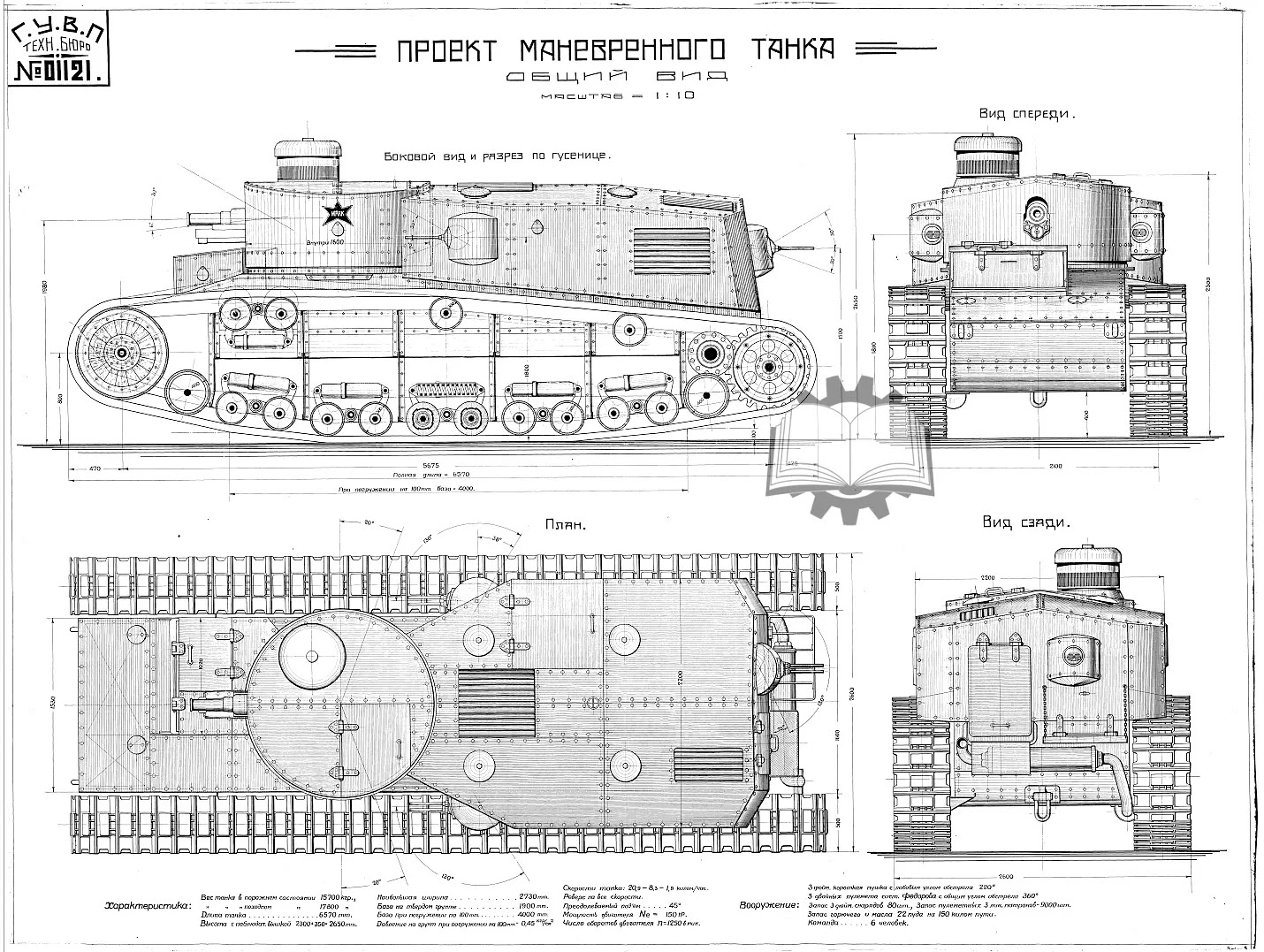 |
| A 16 ton maneuver tank designed by the GUVP. No one ever called this tank "medium". |