Showing posts with label T-50. Show all posts

Tuesday, 2 May 2023

Long Living T-50

1941 was a year of great calamity for the Red Army and for the USSR. The war that broke out on June 22nd was not at all like the war that was predicted. The Germans and their allies tore deep into the USSR with the Red Army suffering defeat after defeat. However, through great effort, the flywheel of the Blitzkrieg lost momentum. The enemy continued to move forward, but not at the rate predicted by Plan Barbarossa. The Germans were supposed to have reached the Archangelsk-Astrakhan line by September-October of 1941 at the latest, but they were far from their goal at that point. They were so sure in their victory that they did not even prepare for the arrival of winter, which then turned into complaints about "General Frost". Soviet tank forces also played a big role in stopping the Germans. At the cost of heavy losses, they managed to stop the German divisions moving towards Moscow and allowed a counteroffensive to begin on December 5th, 1941. Tank brigades played a key role in these battles.

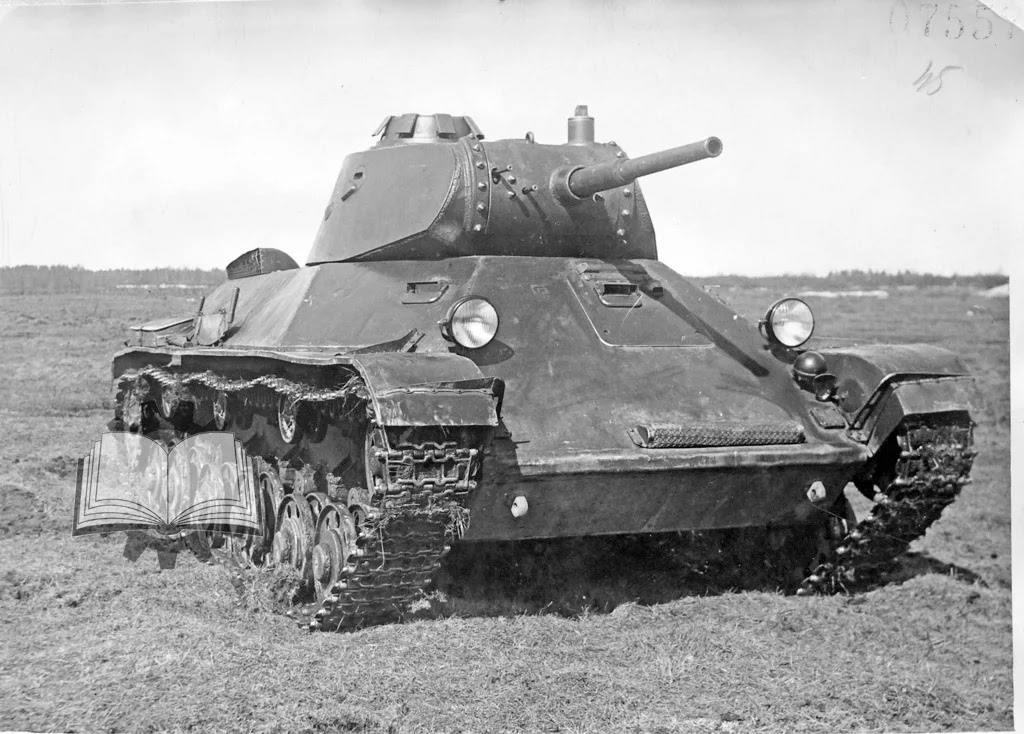
One of the nine T-50 tanks delivered to Kubinka, fall 1941. It was used to test winter camouflage.

Monday, 9 January 2023

Kirov Factory's Light Alternative

The appearance of Zhosef Yakovlevich Kotin as the chief of the Kirov factory's SKB-2 design bureau in 1937 launched a number of interesting processes. Under O.I. Ivanov before him, the bureau sat quietly and worked on ideas that came from the top. There were few original projects, and the ones that were weren't seriously considered. The situation radically changed when Kotin arrived on the scene. A fierce competition broke out with experimental factory #185 that previously held a monopoly. The monopoly on breakthrough tanks was the first to crumble. This was Kotin's achievement, as he created first the SMK-1 then the KV. Factory #185 wanted to build their alternative to the KV with the index 050, but while the KV was accepted into service the 050 was not even built. At this point the experimental factory was reaching the end of its life.

An experimental hull of the T-221, Kirov factory's first support tank.

Factory #185 was also losing territory to factory #174. In 1939-1940, the latter did more than the former achieved in a very long time. This only happened due to the arrival of S.A. Ginzburg at factory #174. Ginzburg had an excellent understanding of a vehicle's lifecycle.

Wednesday, 9 November 2022

Super T-50

 "Memo

Out of the two T-50 tanks developed by factory #174 and the Kirov factory, the one developed by factory #174 was accepted into service.

The Kirov factory proposes increasing the thickness of the armour on its tank to 60 mm and installing a 76 mm gun. This should increase the weight to 25.5 tons. The top speed will be 40 kph with a 300 hp V-4 engine.

Factory #183 reviewed the T-34 tank and is proposing building it with a torsion bar suspension. With 45 mm thick armour it would weigh 25 tons, or 28 tons with 60 mm of armour. It would be armed with a 76 mm gun and have a top speed of 50 kph with a 600 hp V-2K engine.

Comparing the two tanks, one can see that they have identical armour and armament. The difference in weight between the two tanks is not great. The T-34 is faster and has a greater power to weight ratio: 21.4 hp/ton vs 11.7 hp/ton. 

It is senseless to have two tanks with the same purpose in production at the same time. This will make issues of usage and spare parts more complicated. The factory #174 T-50 tank already exists as a means of infantry support.

I consider it impractical to develop and produce a T-50 tank with 60 mm of armour, since:

  1. The T-34 tank with a torsion bar suspension has better characteristics.
  2. It's senseless to introduce additional types of vehicles into service.
  3. This work will distract the Kirov factory from its primary work.
GABTU Chief, Lieutenant General of the Tank Forces, Fedorenko"

Monday, 8 August 2022

The Unluckiest Next Generation Tank

The history of mass production and use of Soviet T-50 infantry tanks and why it was doomed to fail

Initially, small tanks (later support tanks and then combined arms tanks) became the most numerous of their kind in the USSR. The MS-1 (T-18) and then T-26 became the most numerous tanks of the Red Army. The T-26's abilities were quite sufficient to escort infantry, and its relatively low speed compared to the BT also made it a more stable firing platform. Since the T-26 had nearly no oscillations after a sudden stop, it could conduct aimed fire much more accurately than the BT, which would rock back and forth. The T-26 was also 1.5 times cheaper and produced in larger volumes.

First prototype of the T-50 after improvements, spring 1941.

Monday, 6 September 2021

Soviet Camo that Came Too Late

The appearance of tanks on the battlefield in September of 1916 quickly forced many to reconsider some preconceived notions about their use. The first to make changes were the British, who pioneered the concept on the battlefield. The pair of wheels that aided in turning the tank was quickly dropped. There were two other important changes: one was the use of fascines and logs for crossing obstacles, the second was camouflage. WWI marked a turning point in the use of camouflage. Previously uniforms were bright and colourful, but now being hidden was very important. Camouflage was used in uniforms, artillery, and military vehicles. This did not mean that camouflage would entirely displace single tone paint schemes, but tanks were repainted soon after they were involved in their first battles. The use of camouflage decreased after the end of WWI. Most major tank building nations dropped the idea of widespread camouflage, with the exception of the French, who kept on using it. The Germans also returned to three colour camo in the late 1920s. A second wave of camouflage swept through all nations in the mid-1930s. Some tanks remained in camouflage at the start of WWII, but the Germans dropped it, moving from Feldgrau Nr.3 (don't be misled, this is actually a shade of olive green) and then black-gray RAL 70121 as the base coat.

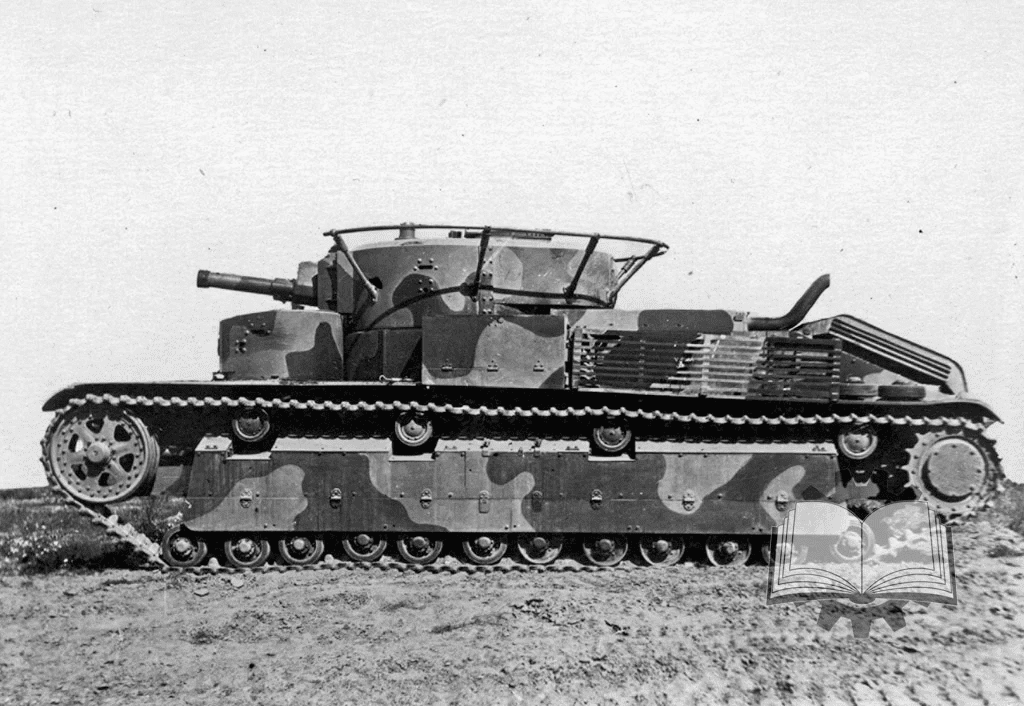
A T-28 tank with three colour camouflage developed for the Middle Asian Military District, summer of 1939.

Friday, 20 August 2021

Winter Camo


 "GABTU Scientific Research Proving Grounds

Approved:
Proving Grounds Chief Colonel Romanov, December 15th, 1941

Approved
Proving Grounds Commissar, Regimental Commissar Dolgov, December 16th, 1941

Conclusions regarding experimental winter camouflage of armoured vehicles

Introduction

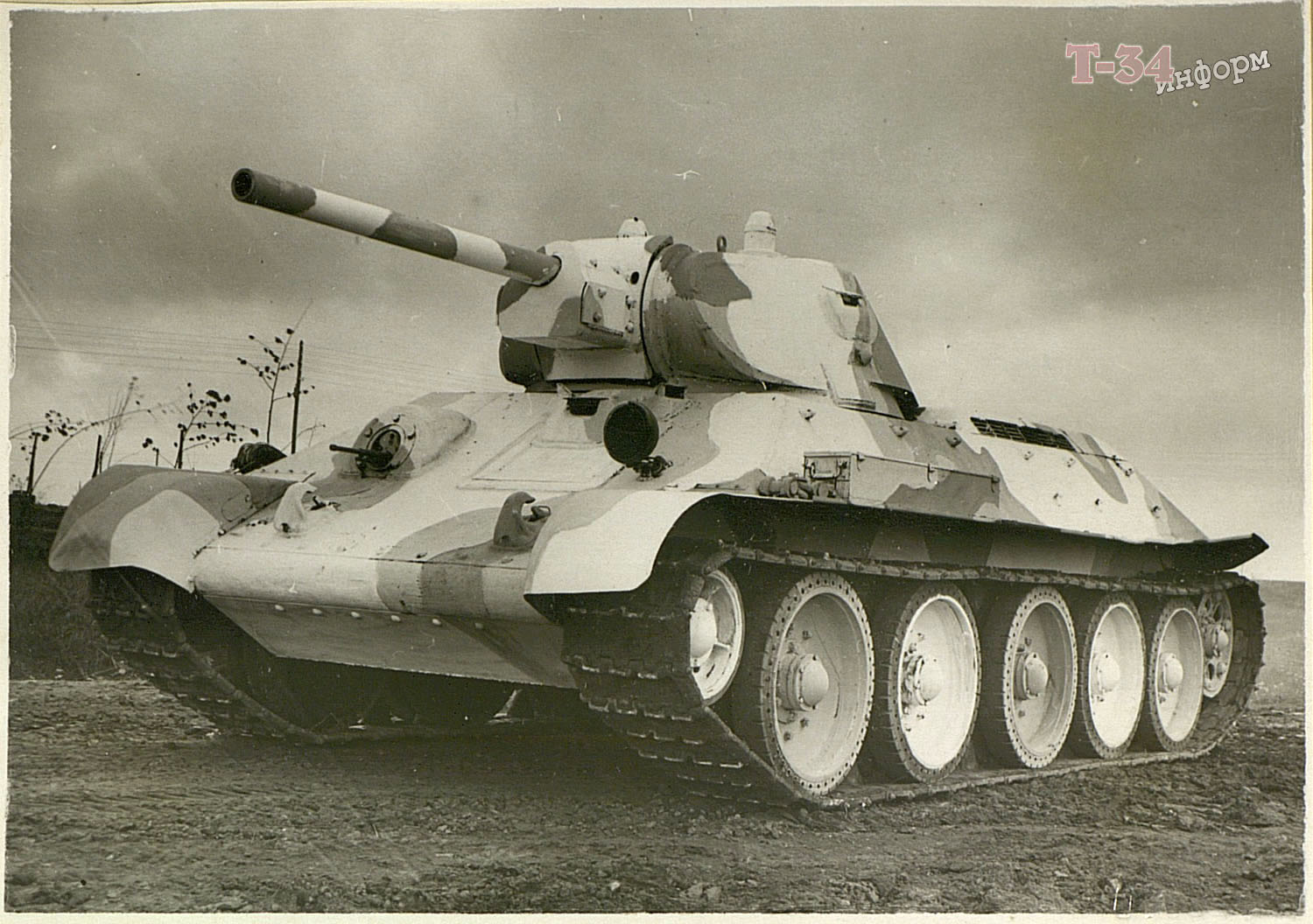
On orders from the GABTU, T-34, T-50, BT, T-26, and T-40 tanks were painted in winter camouflage patterns between September 19th and October 2nd, 1941. The trials were performed at the GABTU proving grounds.

The goal of the trials was to:

  1. Establish the pattern that was the most effective at breaking up the outline and shape of the tanks.
  2. Establish the shade of colours that blend together with the surroundings in winter.
  3. Develop a formula for paint that is sufficiently resilient and easy to produce.
After the pattern, colour, and formula are selected, the proving grounds will apply it to samples of all vehicles used by the Red Army. After experimental camouflage is applied, an instruction manual on winter painting will be composed and requirements will be distributed to factories.

Wednesday, 2 June 2021

War Plans

The Red Army was undergoing a pretty radical reorganization in the summer of 1941. Fans of the theory that the USSR was about to attack Germany and Hitler merely delivered a preemptive strike will be disappointed to find out that not only did the Red Army not consider itself in any situation to fight a war in 1941, 1942 wasn't looking much better either. Compare the number of tanks on hand to the number of tanks required according to authorized strength.


Tank type

Authorized strength

On hand as of Jan 1st, 1941

% Authorized strength as of Jan 1st, 1941

Expected inventory as of Jan 1st, 1942

% Authorized strength as of Jan 1st, 1942

Peacetime

Wartime

Peacetime

Wartime

Peacetime

Wartime

KV

2100

2100

243

11.5

11.5

1093

52

52

T-34

4200

4200

350

8.3

8.3

2850

67.8

67.8

BT

5487

8273

7752

141.5

93.7

7752

141.5

93.7

T-26

13,802

15,872

9987

72.3

62.9

9987

72.3

62.9

T-50


500


T-37/

T-38

2420

3681

3596

152

100

3596

182

116.7

T-40


100


800


Armoured cars

5298

6853

4461

84.2

65

6271

118

91.7

Total as of January 1st, 1941: 22,530 tanks (of those 59 T-35 and 443 T-28), 4461 armoured cars


Via Yuri Pasholok

Friday, 12 March 2021

School of Hard Knocks

 "Order to units of the Leningrad Front #032

Active army
September 16th, 1941

I assigned one tank battalion each (84th and 107th Independent Tank Battalions) to the Slutsk-Kolpino Fortified Region and the 22nd Fortified Region with the special objective of reinforcing the fortified regions' firepower and not for use in counterattacks.

However, on September 5th, 1941, the commander of the 1025th Rifle Regiment of the 291st Rifle Division Major Belousov sent out one KV tank from an ambush to attack Beloostrov, as a result of which the tank was disabled and abandoned on the battlefield. The commander took no action to recover this tank over the course of two days.

Wednesday, 7 August 2019

Fuel Capacity

"Table of one full load of fuel per fighting vehicle."

Vehicle
Capacity in kg
Type of fuel
Notes
T-35
637
BK-70, B-70
Aux. tank 360 L
KV-1 and KV-2
834
RB-70 diesel

T-28
462
BK-70, B-70

BT-7M
619
RB-70 diesel

BT-7
547
BK-70, B-70, RB-70

BT-5
263
ditto

T-34
710/628
BK-70 diesel/B-70

T-26
204
RB-70

T-40
154
RB-70

T-50
255
RB-70

T-60
227
RB-70

T-70
321
RB-70

T-38
90
Automotive gasoline

T-37
90
Automotive gasoline

T-27
35
Automotive gasoline

BA-20 light
75
Automotive gasoline

BA-10 medium
88
Automotive gasoline

BA-11 heavy
115
Automotive gasoline

BA-64
68
Automotive gasoline

MK-3 Valentine
145
Gasoil “3”

MK-2
192
Gasoil “3”

American M3 medium
613
3 cubic cm of RD per 1 kg of B-70

American M3 light
146
2 cubic cm of RD per 1 kg of B-70 or B-74

Universal Carrier
45
B-74 2nd grade

Bren Carrier
68
B-74 2nd grade


Via Valeriy Lisyutin