The Panzerfaust was a very powerful weapon when used correctly. However, there are many misconceptions about the effectiveness of this weapon and the methods devised to protect against it. In this video I talk about how the American, British Commonwealth, and Soviet tank forces protected themselves against the Panzerfaust and similar weapons.

This blog is dedicated to bringing World War II era documents to the general public, with an overall focus on armoured warfare. Questions? Requests? Comments? Email me at tankarchives@gmail.com or find me on Twitter @Tank_Archives.
Showing posts with label penetration. Show all posts
Showing posts with label penetration. Show all posts
Tuesday, 28 October 2025

Monday, 15 September 2025
Video: How to Kill a Ferdinand
With up to 200 mm of armour, the Ferdinand was a formidable opponent. Nevertheless, trials showed that it had its share of weaknesses. Learn how to destroy the infamous tank destroyer in my latest video:
Monday, 14 July 2025
Video: Big HE Shells vs German Tank Armour
The SU-152 made a name for itself as a tank killer thanks to its big 152 mm gun firing a 40 kg high explosive shell, but how good was this weapon at destroying tanks? Was better ammunition not available? In this video, I go over how 122 mm and 152 mm high explosive shells fared against thick armour compared to purpose made ammunition.
Friday, 9 May 2025
Video: KV-1 with Applique Armour
The KV-1 was the heaviest and best protected heavy tank in the world, but the Red Army still wanted even more armour! Find out why and how effective this add-on armour was in my latest video.
Monday, 7 April 2025
Video: 76 mm HE vs German Armour
We know how effective 152 mm high explosive shells were against German tank armour, but what about slightly smaller ones? Check out my latest video to find out.
Monday, 16 December 2024
Armour vs Time
The battle of the sword and shield raged since time immemorial. The sword got an edge once, which led to the end of the era of knights clad in armour. However, history repeats itself, and the idea of armoured cars began to appear even before the First World War. The result of this was the tank, which over time became a fixture of the battlefield. Naturally, anti-tank weapons were created as soon as tanks became known. The battle of the sword and shield continued.
 |
| An example of changing requirements for tank armour. The FCM 2C had the thickest armour of any tank built during the First World War, but penetration trials conducted by the Germans in 1940 showed that this armour was weak by WW2 standards. |
Armour powerful enough to resist cannon shells became a staple of all tanks only during the Second World War. It became clear in the fall of 1939 that bulletproof armour was not enough. At the same time, the idea of armour against shells appeared long before. Protection of tanks against something bigger than a bullet was obvious, but the nature of that something changed over time too, This is what we will talk about today.
Tuesday, 17 September 2024
Pz.Kpfw.I Weak Spots
"Brief characteristics:
- Armour: front, side, and turret armour is 13 mm thick.
- Engine: gasoline.
- Length: 3.7 m, width: 2.1 m, height: 1.8 m
- Armament: 2 machine guns, 2 smoke launchers

Wednesday, 22 May 2024
Quick-Fix Tank Destroyer
British tank building was in crisis in the spring-summer of 1941. The latest Pz.Kpfw.III and Pz.Kpfw.IV tanks encountered in North Africa could only be defeated with the 2-pounder gun at short range. Intelligence reported on heavy and superheavy Pz.Kpfw.V, Pz.Kpfw.VI, and Pz.Kpfw.VII tanks that the 40 mm gun would be completely powerless against. The British were in urgent need of a vehicle with a more powerful gun.
Any color the customer wants
The British needed to find a suitable gun and a suitable chassis. There were promising weapons: the 57 mm 6-pounder and 76 mm 17-pounder. These guns could deal with the even the most modern tanks. There was, however, a small problem. Mass production was not scheduled to start until at least the end of the year. It was also necessary to develop new gun mounts and turrets to fit these guns. The issue of cost was also an important one, as the British had to replenish their tank fleet after abandoning a good part of it in Europe, and a 2-pounder gun was considerably cheaper than a 6-pounder, let alone a 17-pounder.
 |
| Penetration of the 3" gun using a new round with increased muzzle velocity. This gun could theoretically fight any German tank. |
There was a more budget friendly variant. The QF 3-inch 20 cwt AA gun accepted into service back in 1914 was being pushed out of service by a more modern 3.7" gun. Old AA guns could still be found in storage, and they could make a powerful anti-tank weapon.
Trials showed that the HE shell was useless against even light tank armour. However, 12.5 lb (5.67 kg) AP shot with a muzzle velocity of 2600 fps (792 m/s) could penetrate 75 mm of armour at 30 degrees from 400 yards (365 meters), 58 mm from 1000 yards (914 meters) and 37 mm from 2000 yards (1828 meters). An improved AP shot was also developed that was supposed to penetrate 100 mm from 100 yards (91 m) and 80 mm from 750 yards (686 meters). In trials, the shot penetrated 91 mm at 400 yards, 77 mm at 1000 yards, and 55 mm at 2000 yards. This weapon couldn't defeat phantoms like the Pz.Kpfw.VII, but it was good enough to fight any real German tank. There was also some discussion of developing an AP-HE shell that would be more effective than simple shot.
 |
| Carrier, Churchill, 3-inch Gun, Mk.I with a 3" 20 cwt gun. The WD number is still in a tank format. |
Tuesday, 2 January 2024
Video: Comparing the D-25T and 8.8 cm KwK 43 L/71
The IS-2 and King Tiger were equipped with some of the most powerful tank guns used in the Second World War, but which one of them takes the top prize? I compare the penetration power of these two legendary weapons in my latest video.
Friday, 24 November 2023
African Pz.Kpfw.III
The heavy Panthers and Tigers are the best known of Germany's tanks. The lion's share of discussions of armoured vehicles in the Second World War is dedicated to them, even though lighter tanks carried the Panzerwaffe through the majority of the war. The Pz.Kpfw.III tank proved itself to be a worthy opponent in the first half of the war. At the same time, it remained a mystery for the British for a number of years until the first trophies began arriving from North Africa in 1941-42. This is what the British learned from these studies.
Third time's the charm
The Pz.Kpfw.III medium tank was posed as Germany's main tank from the early days of the Nazis' reign, but development was slow. Only 120 tanks were in the field by the start of the Second World War and 381 by the beginning of the Battle of France. Serious losses among them prove that they were actively used and the British Expeditionary Force couldn't have avoided meeting them on the battlefield. However, even if a tank of this type was captured there was no opportunity to study it or send it back to Britain. The speed of the German offensive forced the British to abandon even their own tanks on the continent.
 |
| A column of Pz.Kpfw.III tanks in France prepares to move out. The British did not gather any detailed information on these vehicles in 1940. |
Monday, 8 May 2023
Sherman's African Debut
The Medium Tank M4A1 that arrived in the UK in the summer of 1942 was much more promising than the Medium Tank M3 that had arrived shortly prior. The layout of the armament was much more conventional, the armour was tougher, and the crew's workspaces were more comfortable. Before too long, these tanks were on their way to North Africa, where they would have to fight against the harsh environment in addition to an experienced enemy. The Sherman's career was not going to be an easy one.
First blood on the sand
The tanks that arrived in North Africa were not prepared for desert warfare. They were modernized in field workshops, where British technicians added dust shields, brackets for the Sunshield camouflage tarps, racks for canisters with water and fuel, stowage bins, and other equipment necessary for life in the desert. Desert camouflage was applied over top of the olive drab paint. 252 Shermans were ready by the Second Battle of El Alamein: 92 in the 1st Armoured Division, 124 in the 10th Armoured Division, and 36 in the 9th Armoured Brigade.
The situation with the delivery was far from ideal. The tanks arrived only weeks before the planned offensive. The lack of time to train had an impact not only on the skills of the crews, but also on the cohesion with the forces fighting alongside the tanks. Since the Shermans were going to attack at night through minefields, cooperation with infantry and engineers was quite important.
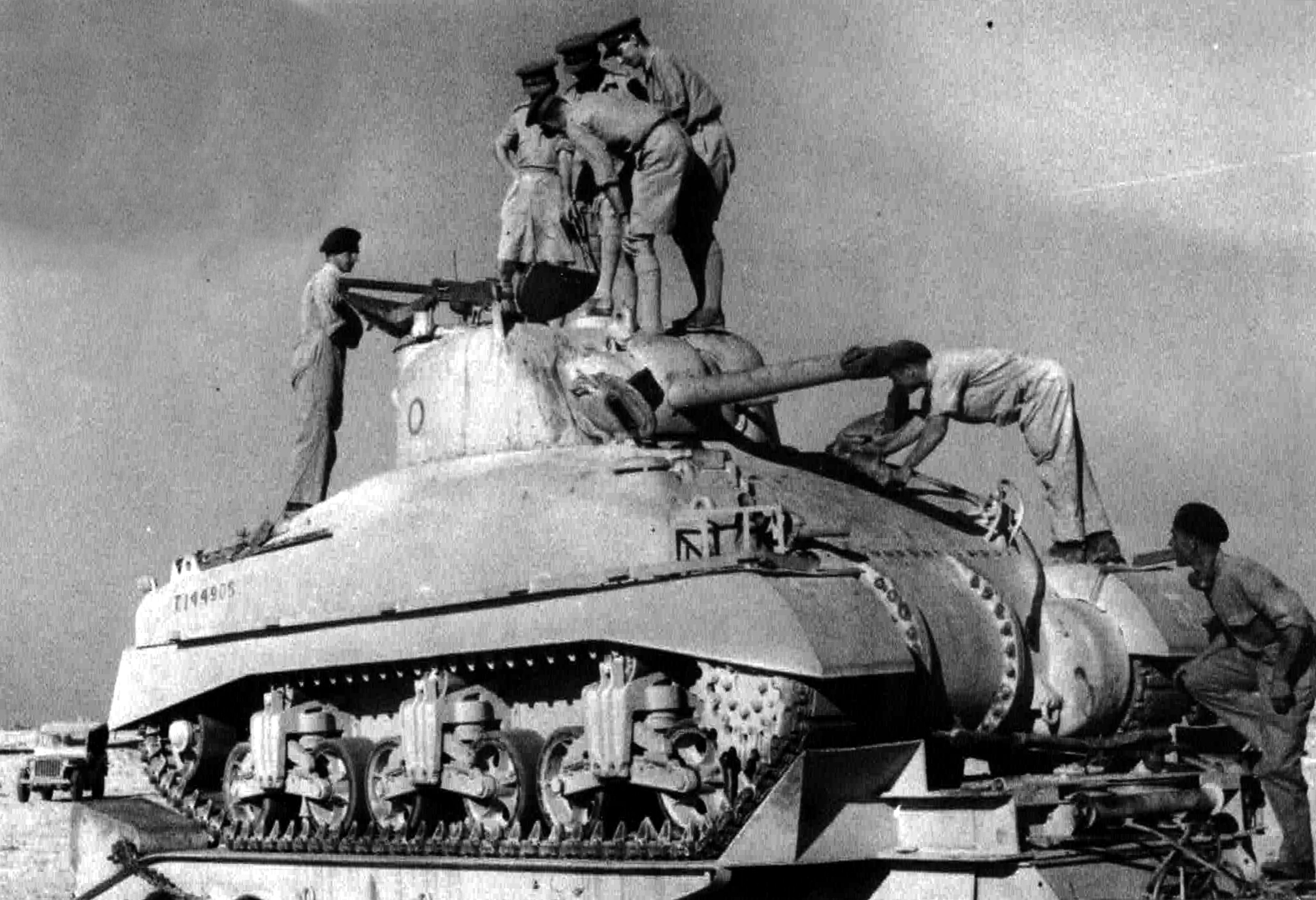 |
| Shermans of the 9th Hussars, 9th Armoured Brigade, September 15th, 1942. The tank is likely already painted in desert yellow, but disruptive camouflage has not yet been applied. |
Wednesday, 19 April 2023
45 mm APCR Penetration
"To the Chair of the State Committee of Defense, comrade I.V. Stalin
We present the main results of proving grounds trials of 45 mm subcaliber armour piercing shot designed by Military Engineer 1st Class comrade Burmistrov.
The shot with heavy and hard tungsten alloy shows the best results. This shot satisfies the requirement of penetrating at least 60 mm of armour with the resistance coefficient of at least 2400 at an angle of 30 degrees at a range of 300-500 meters. They considerably increase the power of the 45 mm model 1932/37 anti-tank gun.
Monday, 10 April 2023
Second Fiddle
Even though the German Pz.Kpfw.IV tank was originally created as a support vehicle (Begleitwagen) and fell short of its counterpart the Pz.Kpfw.III in many ways, it was still the heaviest tank in the German arsenal and mounted the largest caliber gun. Issues with Pz.Kpfw.III production also made it the most numerous German medium tank at the start of WWII. Despite its “secondary” designation, the Pz.Kpfw.IV did not evade the attention of the British. Intelligence agents and tankers alike strived to uncover its secrets.
A meeting in Africa
As with the Pz.Kpfw.III, the British only knew about the Pz.Kpfw.IV from rumours. There was little verified information, but one of the few things known for sure was that the tank was heavier than the Pz.Kpfw.III. Intelligence summaries referred to it as a medium tank, whereas the Pz.Kpfw.III was called a “medium-light tank”. Naturally, the British encountered the Pz.Kpfw.IV in France in 1940, but a sample could not be obtained for study due to the rapid defeat of the British Expeditionary Force. Even though there was no precise data about the armour or armament of the tank, an identification poster was still composed and distributed on December 16th, 1940.
 |
| A drawing of the Pz.Kpfw.IV Ausf.C composed according to intelligence data showing distinguishing features of the vehicle. The antenna deflector, fixed gun mantlet, pistol port in the single piece front plate, and driver’s observation slit were among the features unique to this variant of the tank. |
Friday, 24 March 2023
Panther's Ins and Outs
The Tiger tank no doubt holds the title of the most famous German tank of WW2. The tank is often mentioned as an example of the idea of “quality over quantity”, Tiger aces widely known, and the tanks and battles they fought in are often recreated in movies and video games. However, a more dangerous opponent appeared on the battlefield in July of 1943. The Panther tank had more effective front armour, a more powerful gun, and most importantly the odds of running into a Panther was much higher. The Allies spent a lot of time and effort on finding out its weaknesses. This article will cover the results of British investigations.
A mysterious enemy
Panthers first appeared on the Eastern Front. The Western Allies found out about it pretty quickly from the July 24th 1943 edition of the Red Star newspaper. The information contained in this article was imprecise, but the information exchange continued. More or less accurate information was available by September, and in December of 1943 the British came across a treasure trove. A notebook belonging to a scout from the 26th Reconnaissance Battalion that contained notes on the tank’s characteristics fell into the hands of the 8th Army in Italy. The British discovered that the tank fired three kinds of rounds: armour piercing, subcaliber, and high explosive. The armour piercing rounds were effective at a range of up to 2000 metres, but in some cases it was permitted to fire at a range of 2500 metres. The armour piercing shell penetrated up to 138 mm of armour at an angle (the angle was not noted). Subcaliber shot could be used to engage heavily armoured targets at a range of under 2000 metres. It penetrated up to 194 mm of armour. The high explosive round had a range of up to 4000 metres. The scout noted that the HE shell could not deal significant damage to an enemy tank but could still jam the turret of a Matilda or T-34 tank with a good hit.
 |
| Panther Ausf.D tank #443. The British received a tank from the USSR for testing long before they found one on their own. |
Monday, 20 March 2023
Prime Minister on the Front Lines
In 1941 it became clear to British tankers that the Churchill I armed with a 40 mm 2-pounder and 3” howitzer won’t remain competitive for long. Due to difficulties with developing a new weapon, the Churchill III armed with the more powerful 57 mm 6-pounder only entered production in March of 1942. These tanks gradually forced out the Churchill II, but some units kept the Churchill I as close support tanks. The low reliability of these tanks did not allow the British to test them in the desert, but an opportunity for a trial by fire soon arose.
If at first you don’t succeed…
The Churchill tanks first went into battle on August 19th, 1942, during the infamous Dieppe raid. A raid against German coastal defenses was risky, but after a series of raids including the famous raid on Saint-Nazaire, Lord Mountbatten’s Combined Operations Headquarters had all but carte blanche when it came to planning.
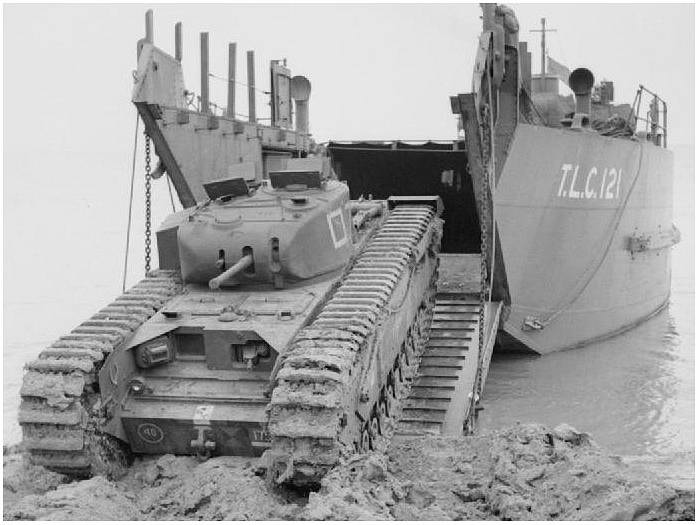 |
| A Churchill II tank used in a practice amphibious landing. |
Friday, 10 March 2023
How to Kill a T-34
Tank design is an endless battle not just against existing enemy tanks, but also prospective ones. No tank can stay at the top of the food chain forever. Even a vehicle with the most powerful gun and thickest armour will sooner or later face a weapon capable of penetrating this armour or an adversary that proves too tough for its gun to crack. Barring that, the enemy will come up with some clever tactics to overcome the tank’s technical advantages. This is what happened with the legendary T-34 tank that the Germans ran into in the summer of 1941.
Tough nut to crack
The Germans already had experience successfully fighting “invincible” tanks by the summer of 1941. The outcome of their first encounter with Matilda tanks in France was not what one would predict from looking at the order of battle on paper. Failure of communications resulted in British tanks going into battle without proper organization or infantry support. The German 3.7 cm Pak was of little use against these new tanks, but there were other weapons available. Some tanks ran into 8.8 cm Flak batteries that had no issue with the Matilda’s thick armour, others were immobilized by field artillery and had to be abandoned. British infantry arrived too late and could not hold ground without support from their tanks. As a result, no evacuation could be organized and the tanks were lost.
The first encounters of the German army with the T-34 tank were not too different in outcome, but left a different impression. German tank ace Otto Carius met these tanks in July of 1941 and remembered them like this:
“Another event hit us like a ton of bricks. The Russians showed up for the first time with their T-34s! The surprise was complete. How was it possible that those at the top hadn’t known about the existence of this superior tank?The T-34 with its good armour, ideal shape, and magnificent 76.2 mm long-barreled cannon was universally feared and a threat to every German tank up until the end of the war. What were we supposed to do to these monstrosities that were being committed in quantity against us? We could only knock at the door with our cannons, inside the Russians were able to play an undisturbed hand of cards. At that time, the 37 mm Pak was still our strongest armour defeating weapon. If lucky, we could hit the T-34 on the turret ring and jam it. With a whole lot more luck, it became combat ineffective. Certainly not a very positive situation!Our only salvation was the 88 mm Flak. Even this new Russian tank could be effectively engaged with it. We thus started paying the utmost respect to the Flak troops who previously had sometimes received a condescending smile from us.”
88 mm AA guns were indeed an effective weapon against the T-34. German instructions suggested firing the AP shell (Pzgr.Patr.) at the T-34’s turret from 1000 meters and at the hull from an even closer range: 100-800 meters. Other instructions suggested firing at 500-600 meters to be sure. 105 mm Flak 38 and Flak 39 guns could fire at the turret from 1200 m and at the hull from 800 m. The 105 mm leFH 18 howitzer and Kanone 18 gun could fire HE shells from any range. Smaller caliber guns had only a small chance to penetrate the turret armour and were only useful for suppressing inexperienced crews. 75 mm HE or larger had a chance of disabling the running gear.
 |
| Guide on dealing with a T-34 tank. Guns smaller than 88 mm in caliber could do little against its armour. |
Monday, 6 March 2023
Video: IS-2 vs Panther, Math and Reality
I've frequently seen the claim that the front of the Panther tank was nearly invulnerable to the IS-2's 122 mm D-25T gun if correctly angled. Indeed, penetration equations suggest that would be the case, but reality is a lot more complicated than that. In this video I go into detail about how line-of-sight armour thickness doesn't tell the whole story.
Monday, 27 February 2023
Modernization in the British Style
Great Britain, the nation that was first to invent the tank, lost its first place in tank building by the end of WWII. Nevertheless, the British designed the 17-pounder, a first class tank gun, and put it to good use on a number of vehicles, both domestic and imported ones. The most famous such vehicle was the Sherman Firefly.
Chassis for a big gun
The main British tank gun at the start of WWII was the 40 mm 2-pounder. This gun was enough against German light and medium tanks at first, but enemy tanks encountered in North Africa already had thicker armour. At first, extra protection came from applique armour that would fall off after 1-2 hits, but soon tanks with 50 mm of monolithic armour appeared that could only be penetrated at point-blank range.
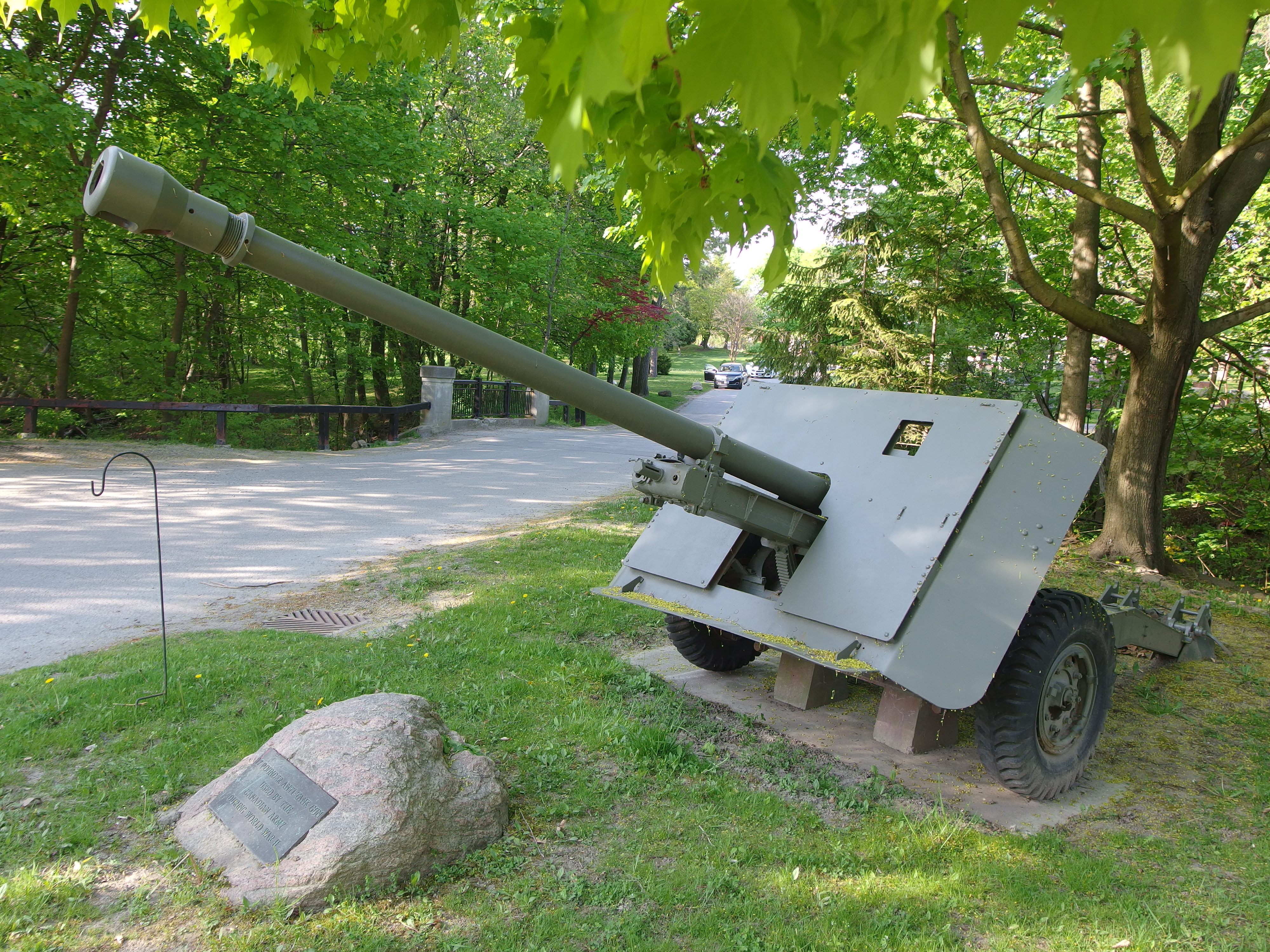 |
| 17-pounder gun, The 17-pounder anti-tank gun was a powerful weapon, but vulnerable on the battlefield due to its size and weight. The muzzle brake on this gun is not original. |
The need for more powerful tank guns was discussed as early as the summer of 1941. Arrivals of Lee and Grant tanks with the 75 mm M2 gun helped, but not for long. The American gun was deemed to be an acceptable interim measure until the arrival of sufficient quantities of towed 57 mm 6-pounder and 76 mm 17-pounder guns. The 6-pounder was small enough to fit into a tank turret, but the 17-pounder was far too large.
Monday, 13 February 2023
A German Cat in King George's Court
Study of the enemy’s new weapons or vehicles is always one of the army’s highest priority objectives. The appearance of the Panther tank on the battlefields of WWII could not have gone unnoticed without the Allies’ knowledge, and the British were no exception. Information on this new tank was gathered in several stages.
Foreign sources
Rumours about a new German tank began to arrive in the UK in the summer of 1943. The British military attache in the USSR sent a translation of an article published in the Red Star newspaper on July 24th, 1943, describing the use of a new German tank called “Panterra”. There was little information on this tank, plus the author continuously mixed up the Panther and Ferdinand. More accurate information only arrived on September 7th. With hindsight, we can see that the 45 ton “German Heavy Tank, Mark V” armed with a 75 mm gun and equipped with eight interleaved road wheels per side is indeed the Panther.
These same characteristics were later published in the American Tactical & Technical Trends magazine, with one important distinction: the tank was now called a medium tank, a halfway point between the 22 ton Panzer IV and 57 ton Tiger. Despite the weight difference, the Americans considered this 45 ton tank to be an analogue of their own Sherman, which according to American sources was highly regarded by the Germans.
 |
| One of the first images of the Panther tank widely distributed among the Allies |
Thursday, 26 January 2023
King Tiger Penetration
"Approved by the Commander of Artillery of the 5th Guards Army
Guards Major General of Artillery Polyektov
September 11th, 1944
Results of penetration tests of the German Tiger B heavy tank (composed from data gathered by the 5th Guards Army, 13th Army, 3rd Guards Tank Army, 31st Tank Corps, 10th Independent Tank Destroyer Artillery Brigade

Notes:
- When firing at the turret with subcaliber shot and AP shells of all the aforementioned calibers, the turret is not torn off.
- The aforementioned calibers do not penetrate the front armour of the hull or turret due to the sharp angle of impact (no more than 46-48 degrees). The 152 mm shell penetrated the tank's front armour at 250 meters at an angle of impact of 86 degrees near the machine gun ball. The diameter of the breach was 350 mm.
- The running gear (tracks, wheels) is vulnerable to all the calibers shown in the table."
Subscribe to:
Posts (Atom)