Showing posts with label 1942. Show all posts

Monday, 17 February 2025

Buggy Americans

"To Deputy Chief of the Engineering Department of the People's Commissariat of Foreign Trade, comrade Ryavchenko

I report preliminary data regarding defects of American tanks based on use in training.

  1. Both types of tanks have no range markings on their sights. It is necessary to order new ones urgently.

Friday, 16 June 2023

Light Tank Destroyer

 "Approved by Deputy People's Commissar of Defense, Colonel General of Artillery, Voronov
October 17th, 1942

Tactical-technical requirements for a 45 mm anti-tank SPG

1. Purpose of the SPG

The 45 mm anti-tank SPG is designed as a weapon for tank destroyer artillery regiments and anti-tank batteries in moto-mechanized units to combat enemy tanks and infantry.

2. Requirements for the SPG

The SPG uses the traversing part of the 45 mm model 1942 "M-42" anti-tank gun. The SPG must satisfy the following requirements:

  1. Muzzle velocity of 870 m/s when firing the 1.4 kg armour piercing shell.
  2. Ability to use armour piercing, high explosive, and subcaliber ammunition.
  3. The practical rate of fire in direct fire mode is no less than 15 RPM.
  4. The elevation angle is no less than +15 degrees.
  5. The depression angle is no less than -5 degrees.
  6. The traverse is at least 30 degrees(15 degrees per side).
  7. The rate of elevation and traverse is at least 1.5 degrees per turn of the flywheel.
  8. The bore axis height is no more than 1600 mm.
  9. The gun uses the AZP sight.
  10. The SPG is serviced by three crewmen (including the driver). The fighting compartment contains folding chairs for two men.
  11. During travel, the gun can be rigidly fixed in the horizontal and vertical plane.
  12. The gun mount must allow for comfortable loading at all elevation and traverse angles.
  13. The SPG can carry two PPSh SMGs.
  14. The ammunition capacity is 90 rounds for the 45 mm gun and 1000 rounds for the submachine guns. The ammunition stowage must be reliable and safeguard the ammunition during travel. It must be easy to extract the ammunition from the racks to load.

Friday, 9 June 2023

SU-76 Requirements

 "Approved by the Deputy People's Commissar of Defense, Colonel General of Artillery Voronov
October 17th, 1942

Tactical-technical requirements for a 76 mm assault SPG

1. Purpose of the SPG

The 76 mm SPG is designed to support moto-mechanized units to combat firing emplacements, tanks, and personnel both with direct and indirect fire.

2. Requirements for the artillery component of the SPG

The SPG uses the stock rotating part of the ZIS-3 76 mm model 1942 gun. The ability to install a 57 mm IS-1 gun must also be retained.

The SPG must meet the following requirements:

  1. Practical rate of fire of no less than 12 RPM in direct fire and at small elevations.
  2. Gun elevation of at least +15 degrees.
  3. Gun depression of at least -5 degrees.
  4. Traverse range of 30 degrees (15 in either direction).
  5. The rate of traverse must be about 1.5 degrees per turn of the flywheel. The effort on the flywheel must not exceed 4 kg.
  6. The rate of elevation must be about 1 degree per turn of the flywheel. The effort on the flywheel must not exceed 4 kg.
  7. The recoil brake must be armoured. The armour must be 8-10 mm thick.
  8. The oscillating part of the gun and the recoil brake armour must be fully balanced.
  9. The bore axis height must be no more than 1650 mm.
  10. The gun position must allow for comfortable loading at all angles of elevation and traverse.
  11. The gun sight must be a mass production type either from the 76 mm regimental gun or the ZIS-3.
  12. Crew of 4 (including the driver).
    During travel, collapsible seats for three men must be installed in the fighting compartment.
  13. The gun must be rigidly fixed in travel and not move vertically or horizontally.
  14. The SPG must carry two PPSh SMGs.
  15. The SPG must carry 60 rounds of ammunition for the gun and 1000 PPSh rounds.
    The ammunition must be stored in places that make it comfortable for the loader to work with, fix securely in its slots, and be easy to unlatch and retrieve.

Wednesday, 10 May 2023

SU-122 Requirements

 "Approved by Deputy People's Commissar of Defense, Colonel General of Artillery, Voronov
October 17th, 1942

Tactical-technical requirements of a 122 mm self propelled howitzer on the chassis of the T-34 tank

1. Purpose of the self propelled howitzer

The self propelled howitzer is designed to accompany infantry and tank units, destroying dugouts and fortified firing positions with direct fire from short range or with indirect fire.

2. Requirements for the artillery component

The artillery component of the SPG is provided by the stock rotating part of the M-30 122 mm model 1938 howitzer. The mounting must meet the following requirements:

  1. Practical rate of fire of no less than 10 RPM in a direct fire role.
  2. Elevation of 25-35 degrees.
  3. Depression of -3 degrees.
  4. Traverse of +/- 10 degrees.
  5. The recoil buffer must be armoured. The armour must be at least 12 mm thick.
  6. The oscillating part of the howitzer with the recoil buffer armour must be completely balanced. Increase in effort required to aim cannot surpass 10%.
  7. The height of the bore axis must be no more than 1500 mm. To achieve this, a cutout in the front of the SPG is permitted.
  8. The gun port must be completely covered at a gun elevation of up to 12 degrees.
  9. The gun mount must allow for comfortable loading at all angles of elevation and traverse.
  10. The sight is the stock sight from the 122 mm M-30 howitzer with a Hertz panoramic sight.
  11. The gunner's seat must rotate with the gun. The seat's rotation in relation to the panoramic sight and aiming flywheels must allow for comfortable operation.
  12. The crew consists of five men, including the driver. All crewmen must have comfortable seats.
  13. The gun must have the ability to be reliably fixed for travel, preventing horizontal and vertical movement.
  14. Two PPSh submachine guns must be carried as auxiliary armament.

Monday, 8 May 2023

Sherman's African Debut

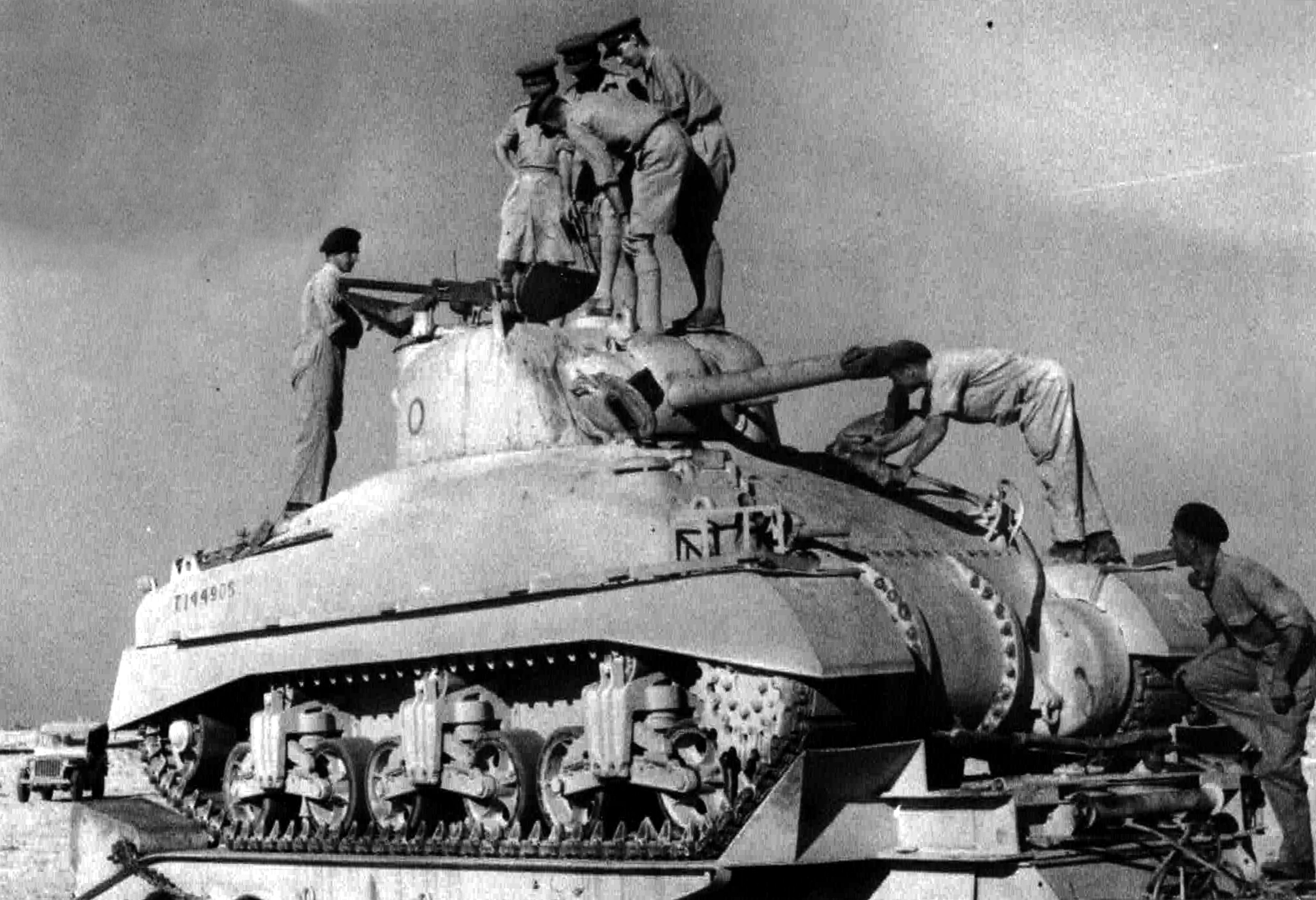
The Medium Tank M4A1 that arrived in the UK in the summer of 1942 was much more promising than the Medium Tank M3 that had arrived shortly prior. The layout of the armament was much more conventional, the armour was tougher, and the crew's workspaces were more comfortable. Before too long, these tanks were on their way to North Africa, where they would have to fight against the harsh environment in addition to an experienced enemy. The Sherman's career was not going to be an easy one.

First blood on the sand

The tanks that arrived in North Africa were not prepared for desert warfare. They were modernized in field workshops, where British technicians added dust shields, brackets for the Sunshield camouflage tarps, racks for canisters with water and fuel, stowage bins, and other equipment necessary for life in the desert. Desert camouflage was applied over top of the olive drab paint. 252 Shermans were ready by the Second Battle of El Alamein: 92 in the 1st Armoured Division, 124 in the 10th Armoured Division, and 36 in the 9th Armoured Brigade.

The situation with the delivery was far from ideal. The tanks arrived only weeks before the planned offensive. The lack of time to train had an impact not only on the skills of the crews, but also on the cohesion with the forces fighting alongside the tanks. Since the Shermans were going to attack at night through minefields, cooperation with infantry and engineers was quite important.

Shermans of the 9th Hussars, 9th Armoured Brigade, September 15th, 1942. The tank is likely already painted in desert yellow, but disruptive camouflage has not yet been applied.

Wednesday, 15 February 2023

Anti-Tank Dogs at Stalingrad

 "10th NKVD Internal Troops Rifle Division
October 1st, 1942
#1/81

To the commander of the 62nd Army, Lieutenant General comrade Chuikov

The 28th Independent Dog Tank Destroyer Group was composed of 202 men and 202 dogs. It was operationally subordinate to the 10th Rifle Division as of August 24th, 1942 and took a direct part in combat actions in defenses of Stalingrad alongside the division's forces.

Friday, 16 December 2022

Tougher Armour

 "Order of the People's Commissar of Tank Production #562s
Moscow

July 31st, 1942

The meeting called by the People's Commissariat of Tank Production in Moscow on the topic of improving quality of hulls produced from high hardness armour reviewed and approved the draft technological process guidelines for all stages of armoured component production and hull welding presented by the 3rd Main Directorate of the NKTP. In order to rapidly bring these processes to production and improve the quality of armour and armoured hulls, I order that:

  1. Directors of the following factories: UZTM (comrade Muzrukov), #200 (comrade Sochivko), #264 (comrade Suvorov), #112 (comrade Rubinchik), #183 (comrade Maksarev), #174 (comrade Katsnelson), #176 (comrade Fedotov), #177 (comrade Volkov), #178 (comrade Skiba), #180 (comrade Orlov), #37 (comrade Frezerov), and #38 (comrade Yakovlev) must develop production instructions based on the approved technological process guidelines and send them to the 3rd Main Directorate of the NKTP after approval by the factory chief engineers. Develop all instructions within ten days of receiving this order or no later than August 15th of this year.
  2. Factory directors must provide the 3rd Main Directorate of the NKTP with reports on the quality of armour plate and armoured hulls with reports of rejected components by reason of rejection.
  3. Factory directors must keep in mind the necessity of highlighting the importance of quality assurance at every stage of production as well as the strengthening of laboratories and metallurgical departments.
  4. Director of TsNII-48 A.S. Zavyalov must:
    1. Compose and publish a list of minimal technical qualifications for workers of all specialties that are connected to production and finishing of armour within one month.
    2. Compose and publish directions for engineering-technical workers connected to production, finishing, and welding of armour within two months.
  5. Directors of all factories must compose a list of minimal technical qualifications for all technical processes among foremen, foremasters, and technologists. Put all welders and cutters through exams. Only permit welders and cutters with appropriate diplomas to work on armour.
  6. Director of factory #183 comrade Maksarev must order his design bureau to work on the T-34 hull with the aim of reducing the amount of welding, components welded onto armour, change in dovetails, reduction of the welding seam length within possible limits. Check these developments with NII-48.
Deputy People's Commissar of Tank Production, Zernov"


Friday, 2 December 2022

Americans at the Right Place, at the Right Time

The first foreign tanks sent to the USSR as military aid arrived in the fall of 1941. These were British Matilda III and Valentine II tanks. They arrived in time to briefly take part in the defensive fighting of late November-early December of 1941. It's hard to say that they played a key part, but it would be incorrect to dismiss their contribution. The situation with American tanks was similar. They first convoy arrived at the end of December of 1941, but shortages of ammunition and other problems delayed their debut to May of 1942. It is often said that the 114th Tank Brigade achieved almost nothing at Kharkov, but that is not correct. The American tanks took part in the offensive on Chepil, which temporarily penetrated the encirclement. An evacuation was organized thanks in part to Soviet tankers fighting in American tanks.

Tanks of the 258th Independent Tank Battalion before battle, early September 1942.

Sunday, 27 November 2022

Anti-Tank Dog Instructions

Check the equipment of both the soldiers and the dogs.

 "Instructions on using anti-tank dogs in various types of combat 
1942

A. Main points

  1. Anti-tank dogs are an auxiliary weapon for infantry in anti-tank defenses, but they can be used in all types of combat.
  2. Anti-tank dog units are subordinate to the Army command. Individual companies or platoons are subordinated to infantry divisions as reinforcements of anti-tank defenses.
  3. The reserve and rear line elements of the anti-tank dog unit are located in the rear of the Army. There the personnel and the dogs systematically train and prepare themselves for service.
  4. An anti-tank dog company has 81 anti-tank dogs. The company is split into three platoons of 27 dogs. The platoon is split into three squads of 9 dogs each.
  5. The main method of destroying tanks is by releasing the dog from cover at a range of up to 200 meters from the enemy tank.
  6. If correctly used at a close range of 100-150 meters, the anti-tank dog is an effective weapon for the destruction of enemy tanks.
  7. A dog will dive under the front part of the enemy tank. The lever touches the floor of the tank and the tank is destroyed by an explosion.
  8. Anti-tank dogs work precisely and flawlessly only if the dogs are systematically trained and correctly fed. To achieve this, anti-tank dog platoons and companies must be removed from forward positions every ten days and recalled to the rear for training.
  9. The infantry division commander allocates one functional tank, preferably a captured one, for training the anti-tank dog company.
  10. For additional maneuverability, the anti-tank dog company commander must be allocated two GAZ-AA (1.5 ton) trucks to move one anti-tank dog platoon rapidly.
  11. Soldiers of anti-tank dog platoons chiefly fight individually, and thus must display initiative, courage, discipline, decisiveness, and calmness.
  12. The anti-tank dog soldier is armed with an anti-tank dog, an automatic rifle, an anti-tank grenade, and two bottles of incendiary fluid. 
  13. Having released his dog, the anti-tank dog soldier continues to fight with his rifle, anti-tank grenade, and bottles with incendiary fluid as a part of his squad.
  14. Anti-tank dog soldiers that released their dogs return to the rear after the completion of the battle to continue service according to their speciality.

Friday, 7 October 2022

Deliveries

 "Table of arrivals of tanks at the front lines in 1941, by type

Type

Domestic

British

American

Total

Month

KV

T-34

T-60

T-70

Mk.II

Mk.III

Mk.IV

M3 S

M3 L

Total 1941


20,740

Jan

126

206

348

-

-

16

-

-

-

696

Feb

165

420

260

-

-

-

-

-

-

845

Mar

105

338

84

-

-

-

-

-

-

527

Apr

320

702

576

-

134

144

-

14

32

1922

May

350

1003

898

-

255

171

-

30

16

2723

Jun

199

698

657

103

-

74

-

144

222

2091

Jul

299

1177

746

371

86

44

-

66

91

2880

Aug

178

1378

250

583

10

63

-

35

98

2595

Sep

45

598

-

439

-

72

-

54

43

1251

Oct

160

1100

75

640

-

10

-

24

5

2024

Nov

215

1312

-

838

85

163

-

187

61

2861

Dec

239

1678

48

1026

-

-

42

23

16

3072

Total 1942

Total domestic:  20,957

Total foreign: 2530

23,487

"

Via Alexey Isayev

This data is interesting on its own, but it's also interesting to compare to deliveries of foreign tanks. The first Matilda and Valentine tanks began arriving during the Battle for Moscow and were thrown into battle with little preparation. As you can see in the above table, once the situation stabilized a little bit it took some time before new units with British tanks could be properly outfitted. Large deployments of Matildas and Valentines only take place in April, four months after deliveries began.

A similar picture can be seen with American tanks. The first shipments arrived in January of 1942 and we start seeing a small number of these tanks on the battlefield in April-May, 4-5 months later. Once the pipeline was set up, it was not as hard to deploy new tanks. A bump shipments that came in May hits the front lines in June. A lot of tanks were tied up in delivery by the end of the year: 3875 foreign tanks were delivered to the USSR in 1941-1942, but only 2530 were actually fielded before the end of 1942.

You can see the same pattern with Soviet tanks. Evacuation of factory #183, the USSR's largest producer of the T-34 tank, began in September of 1941. The factory began to set up in the Urals in December-January, and by May of 1941 you see a spike in deliveries of T-34 tanks. Similarly, production of the T-70 was authorized in March of 1942 and we see these tanks begin to arrive on the front lines in July.