Both the Soviets and the British tested the Medium Tank M4A4 (Sherman V). One of them rejected the tank, the other became a prolific user despite initial hesitation. See what experiences they had in common in my latest video.

This blog is dedicated to bringing World War II era documents to the general public, with an overall focus on armoured warfare. Questions? Requests? Comments? Email me at tankarchives@gmail.com or find me on Twitter @Tank_Archives.
Showing posts with label Foreign Exchange. Show all posts
Showing posts with label Foreign Exchange. Show all posts
Monday, 17 August 2026

Monday, 6 April 2026
Video: Lend Lease Complaints - M4A2 Sherman
The Sherman was a great tank, but it was far from perfect. In my latest video, I discuss the complaints that the British and Soviets had about the M4A2, where they agreed, and where their assessments of the tank's features differed.
Friday, 12 December 2025
Video: Churchill Infantry Tank: Outlier on the Eastern Front
The Churchill tank was the heaviest and most thickly armoured foreign tank to see combat with the Red Army. Why were so few ordered and why do we seldom hear about its accomplishments? I dive into this question in my latest video.
Monday, 17 November 2025
Russo-American Tank Destroyer
One of the key problems with using foreign tanks is keeping a steady supply of spare parts and ammunition. This problem is not exclusive to captured tanks. A similar situation often took place with vehicles that were sent willingly. For example, a lack of ammunition delayed the arrival of American tanks on the battlefields of the Eastern Front by several months. These shortages happened more than once. It is not surprising that arming foreign tanks with domestic guns was a frequently suggested solution.
 |
| S-1 (SU-76I), the first design of the TsAKB. The bureau had some experience in re-arming foreign chassis. |
It just so happened that the best results in rearming foreign tanks were achieved by the design bureaus of factory #92 and factory #592. The first only offered experimental solutions, but the latter built a small batch of SG-122 SPGs. Specialists from both bureaus were later united in one organization: the Central Artillery Design Bureau (TsAKB). Their first project, the S-1, was a part of rearming a foreign tank (SU-76I). It’s not surprising that new rearmament projects followed, including grassroots proposals.
Monday, 17 February 2025
Buggy Americans
"To Deputy Chief of the Engineering Department of the People's Commissariat of Foreign Trade, comrade Ryavchenko
I report preliminary data regarding defects of American tanks based on use in training.
- Both types of tanks have no range markings on their sights. It is necessary to order new ones urgently.
Tuesday, 4 February 2025
Video: Lend Lease Tier List Part 1
Lend Lease reviews can be a thorny topic. Did the Red Army like any foreign tanks at all? Watch my latest video and find out.
Thursday, 21 December 2023
British Tanks in 1943
"Report on use of foreign MK-2 [Matilda] and MK-3 [Valentine] tanks in combat
1. General characteristics
Since the brigade was created on March 25th, 1942, it was armed with MK-2 and MK-3 tanks. The latter showed themselves well in battle as infantry support tanks in all sorts of battles. There were also cases of using them to combat enemy tanks (Pz.Kpfw.III, Pz.Kpfw.IV) at close ranges (200-600 meters), especially from ambush in defensive fighting.
The off-road mobility and maneuverability of the MK-2 and MK-3 tanks is insufficient compared to the T-34 in all types and periods of battle. The MK-2 tank in particular is not very mobile even on even terrain. In cases where it needs to turn 360 degrees, its turning radius is 15 meters. The tracks often fall off on sharp turns. The limit of the slopes it can climb or descend in winter, rainy, or damp weather is 15-18 degrees.
The dimensions of the MK-3 tank allow it to get up close to the enemy using terrain features as cover and take them by surprise. In winter, the depth of the snow conceals it from enemy fire. MK-2 and MK-3 tanks have a clearance of 420 mm with a ground pressure of 0.60 [kg/cm²] when the tracks are submerged by 100 mm. In the winter, they can drive through 50-60 cm deep snow, which allows them to drive on country roads and off-road. If anti-tank obstacles need to be crossed, they can cross a 0.75 m tall wall, ford a one meter deep stream, cross an anti-tank trench [figure missing] wide. In the winter they can handle 18 degree slopes, in the summer and in dry weather they can handle 30 degree slopes.
Friday, 1 December 2023
Video: Did Lend Lease Tanks Save Moscow?
Foreign tanks began arriving in the USSR in October of 1941 and reached the front lines a few weeks after. Were these tanks pivotal to saving Moscow from the Germans? Find out in my latest video.
Friday, 24 November 2023
African Pz.Kpfw.III
The heavy Panthers and Tigers are the best known of Germany's tanks. The lion's share of discussions of armoured vehicles in the Second World War is dedicated to them, even though lighter tanks carried the Panzerwaffe through the majority of the war. The Pz.Kpfw.III tank proved itself to be a worthy opponent in the first half of the war. At the same time, it remained a mystery for the British for a number of years until the first trophies began arriving from North Africa in 1941-42. This is what the British learned from these studies.
Third time's the charm
The Pz.Kpfw.III medium tank was posed as Germany's main tank from the early days of the Nazis' reign, but development was slow. Only 120 tanks were in the field by the start of the Second World War and 381 by the beginning of the Battle of France. Serious losses among them prove that they were actively used and the British Expeditionary Force couldn't have avoided meeting them on the battlefield. However, even if a tank of this type was captured there was no opportunity to study it or send it back to Britain. The speed of the German offensive forced the British to abandon even their own tanks on the continent.
 |
| A column of Pz.Kpfw.III tanks in France prepares to move out. The British did not gather any detailed information on these vehicles in 1940. |
Friday, 6 October 2023
Americans in Africa
The trials of the American Medium Tank M3 in Great Britain gave mixed results. On one hand, the tank had no shortage of design defects. On the other hand, there was nothing else to choose from. The Americans refused to build British tanks under license and Britain's own factories could not meet its army's needs. However, British tanks were far from perfect themselves, and the American tank still had tough armour and a powerful 75 mm gun that outperformed both the British 2-pounder and 3" howitzer. As a result, the American tanks were sent to Africa to prove themselves in battle.
Eye of the hurricane
The North African front stood still after the British retreated to Gazala in February of 1942. This pause allowed to train crews for the new tanks. Small number of Grant tanks began arriving in North Africa back in late 1941, but now shipments really picked up. 666 vehicles of this type were in theater by the end of March.
 |
| An American instructor demonstrates the new tanks to British tankers. |
Monday, 7 August 2023
Shermans in "August Storm"
In Soviet historiography, the Soviet-Japanese War of 1945 is overshadowed by grandiose operations against Berlin and Vienna earlier that year. However, Western historians pay close attention to this campaign and debates on whether it was the A-bombs or the Soviet invasion that forced the Japanese to surrender rage on to this day. Famous historian David Glantz even invented a grandiose name for this operation: August Storm. The Red Army's advance was indeed lightning fast, in part thanks to foreign vehicles. This included the M4A2(76)W HVSS, the most advanced Sherman variant sent to the USSR.
Clouds gather
Stalin promised to enter the war against Japan within three months of Germany's defeat at the Yalta conference in February of 1945. Colonel-General Alfred Yodl signed an order for unconditional capitulation of all German forces on May 7th, 1945, coming into effect at 23:01 on May 8th. This kicked off the countdown for a Soviet offensive against Japan. The Red Army had three months to move an enormous force to the other side of an equally enormous country.
 |
Concentration of the 6th Guards Tank Army in the vicinity of Tamsagbulag. The army included the 9th Guards Mechanized Corps that used Sherman tanks. |
The 6th Guards Tank Army was one of the units that was destined to transfer to the far east. On June 26th, 1945, the unit was reallocated to the Transbaikal Front. It would have to cover a distance of 9000 km to cross from Czechoslovakia to Choibalsan. 88 trains of 60 cars each were allocated for this journey. The full transfer took 30 days, but the first elements began to form up by July 17th. New tanks awaited them there: 100 M4A2(76)W including the latest tanks with HVSS suspensions. These tanks were described in documents as "M4A2 with wide tracks". The 46th Guards Tank Brigade was fully equipped with these vehicles. One company from each of the tank regiments of the 18th, 30th, and 31st Guards Mechanized Brigades that made up the 9th Guards Mechanized Corps also received new tanks.
From Choibalsan, the tanks would make a 300 km march to Tamsagbulag, where the army would prepare for the upcoming offensive. This march took place in extreme conditions. The temperature reached 45 C during the day, as a result of which marches took place only at night to avoid overheating the engines and running gear. This also helped hide the tanks from air reconnaissance, as there was nowhere to conceal them in the desert. The army's documents describe the M4A2 as less sensitive to hot weather than the T-34-85. The American tanks could cover more ground every day, but at the cost of increased fuel consumption. The Shermans normally burned 40 kg of fuel per hour, but this went up to 60 kg in Mongolia. Each tank could only run 90-100 km before refuelling instead of 150 km. The T-34-85 burned only 26 kg of fuel per hour.
 |
| M4A2(76)W HVSS, the newest tanks of the 9th Guards Mechanized Corps. |
Monday, 31 July 2023
Soviet Armour for the British Valentine
History knows many tanks that were created from a grassroots initiative and treated with scepticism by the army, but evolved to become some of the most popular tanks. There are at least two such tanks that made their mark in the Second World War. The first was the Pz.Kpfw.IV. Krupp was originally only entrusted with the turret, but the conglomerate successfully pushed for permission to build two prototypes. As a result, the B.W. (Kp) easily demolished the B.W. (Rh) and survived several attempts to take it out of production. The first battles showed that the Pz.Kpfw.IV was the best tank Germany. had. In 1942 it also turned out that the Pz.Kpfw.IV could take on a long 75 mm gun, but the Pz.Kpfw.III could not. As a result, the Pz.Kpfw.IV became Germany's most numerous tank.
The second example is the Infantry Tank Mk.III or Valentine. Its creation was entirely opposed by the British army but in the end were forced to order it anyway. It turned out that Leslie Little, Vickers' main tank designer, made the right decisions. He successfully fought off the War Ministry's attempts to "improve" his creation and avoided overloading the chassis. The result was the most numerous British tank of the war. Formally, the British withdrew it from the front lines in the spring of 1943, but in reality it kept fighting until May of 1945, again against the army's best attempts.
 |
| A Soviet Valentine lost to a hit from a 75 mm Pak 40. The appearance of this gun was a big contribution to work on improving the tank. |
Monday, 12 June 2023
Firefighters of the Fiery Salient
Supplies of M4A2 tanks to the USSR began in late 1942. Unfortunately due to technical defects (chiefly to do with injectors) they did not see service right away. Only a few units received these tanks in the spring of 1943, but one of them ended up fighting in the most famous tank battle of the Great Patriotic War.
Firefighters of the fiery salient
The 229th Independent Tank Regiment was one of the first Soviet tank units to receive the new American medium tanks. 31 tanks of this type were issued to the unit on April 10th, 1943, and by the start of July the regiment had 38 functional Medium Tanks M4A2. The regiment was assigned to the 48th Army at the time. As of July 1st it was located in reserve in the village of Perehozheye. The regiment was commanded by Lieutenant Colonel Merkulov with Major Bogatyrev serving as the Chief of Staff.
 |
| A very early M4A2 tank in Soviet service. This vehicle still has the return roller in the middle of the bogey, M34 gun mount with a narrow external mantlet, and direct vision ports |
The regiment was moved to the vicinity of Kazakovka by July 5th, 1943. At the start of the Battle of Kursk the regiment had 1.2 loads of fuel per tank, three refills of ammunition, and 4 days worth of rations on hand. The Shermans got lucky, as the German spearhead struck west of them.
Monday, 8 May 2023
Sherman's African Debut
The Medium Tank M4A1 that arrived in the UK in the summer of 1942 was much more promising than the Medium Tank M3 that had arrived shortly prior. The layout of the armament was much more conventional, the armour was tougher, and the crew's workspaces were more comfortable. Before too long, these tanks were on their way to North Africa, where they would have to fight against the harsh environment in addition to an experienced enemy. The Sherman's career was not going to be an easy one.
First blood on the sand
The tanks that arrived in North Africa were not prepared for desert warfare. They were modernized in field workshops, where British technicians added dust shields, brackets for the Sunshield camouflage tarps, racks for canisters with water and fuel, stowage bins, and other equipment necessary for life in the desert. Desert camouflage was applied over top of the olive drab paint. 252 Shermans were ready by the Second Battle of El Alamein: 92 in the 1st Armoured Division, 124 in the 10th Armoured Division, and 36 in the 9th Armoured Brigade.
The situation with the delivery was far from ideal. The tanks arrived only weeks before the planned offensive. The lack of time to train had an impact not only on the skills of the crews, but also on the cohesion with the forces fighting alongside the tanks. Since the Shermans were going to attack at night through minefields, cooperation with infantry and engineers was quite important.
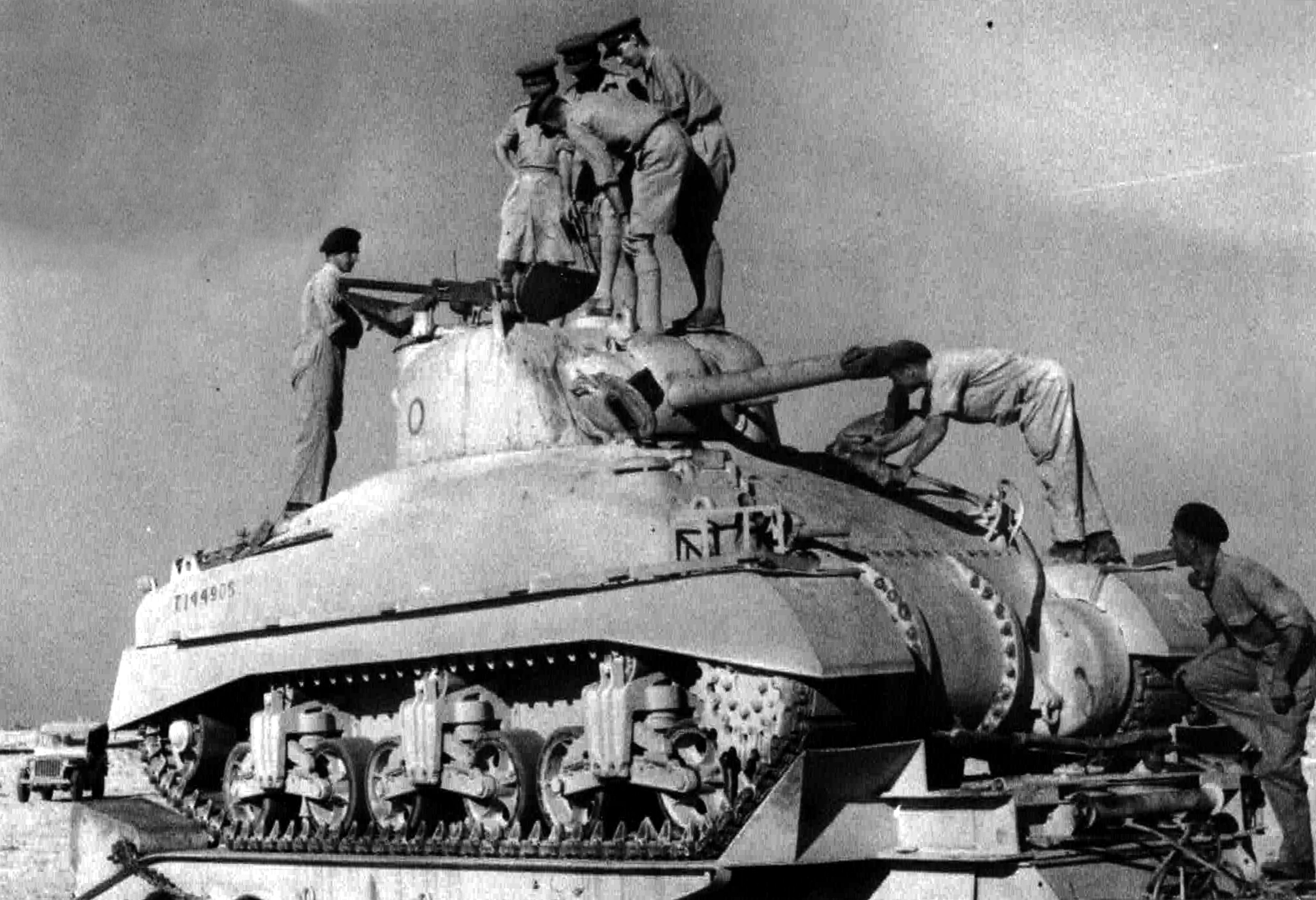 |
| Shermans of the 9th Hussars, 9th Armoured Brigade, September 15th, 1942. The tank is likely already painted in desert yellow, but disruptive camouflage has not yet been applied. |
Wednesday, 26 April 2023
Canada's Valentines
The British War Ministry had no illusions about how the situation in Europe would develop, even in 1938. The policy of appeasement was adopted to postpone the inevitable large conflict, which the kingdom’s military was not prepared for. The situation continued to escalate in the summer of 1939, but the British were still not ready for a full blown war. Cruiser tanks only entered service in 1939, and infantry tanks, with the exception of the Infantry Tank Mk.I, were not even in production. Meanwhile, observers from across the Atlantic Ocean monitored the situation in Europe carefully. The United States began production of the Medium Tank M2 and trials of the Light Tank M2A4. They knew that if a war broke in Europe, they would be drawn into it sooner or later.
Similar sentiments were not uncommon in Canada, but hardly any preparations were being made for war. Unlike the United States or Great Britain, Canada had no tank building tradition. The Canadian armoured battalions that were established during the First World War came too late to take part in the fighting. The Canadian army was not mechanized during the interbellum, and had almost no tanks of its own at the start of the Second World War. Nevertheless, a proposal was made to create a Canadian tank force once more after the fall of Poland in 1939. Mechanization of cavalry units, both of the Permanent and the Non-Permanent Active Militia, was on the table. It quickly became clear that it would be impossible to arm a tank force without setting up domestic tank production. 219 obsolete M1917 light tanks that were purchased from the United States at scrap value, but they were useful for training and not much else.
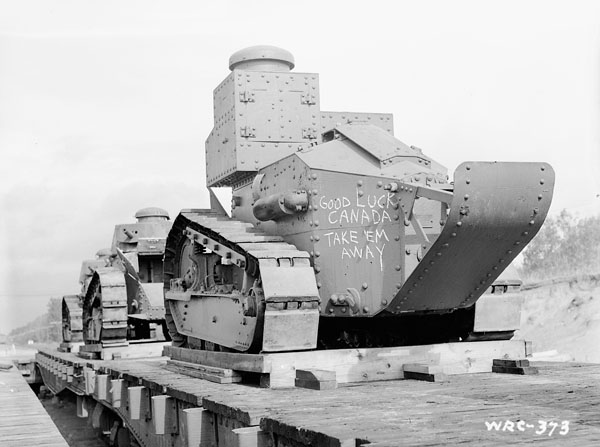 |
| Facing a shortage of armoured vehicles of every kind, Canada purchased worn out and obsolete M1917 Light Tanks from the US at scrap value. These tanks were worth little more than scrap. |
Monday, 10 April 2023
Second Fiddle
Even though the German Pz.Kpfw.IV tank was originally created as a support vehicle (Begleitwagen) and fell short of its counterpart the Pz.Kpfw.III in many ways, it was still the heaviest tank in the German arsenal and mounted the largest caliber gun. Issues with Pz.Kpfw.III production also made it the most numerous German medium tank at the start of WWII. Despite its “secondary” designation, the Pz.Kpfw.IV did not evade the attention of the British. Intelligence agents and tankers alike strived to uncover its secrets.
A meeting in Africa
As with the Pz.Kpfw.III, the British only knew about the Pz.Kpfw.IV from rumours. There was little verified information, but one of the few things known for sure was that the tank was heavier than the Pz.Kpfw.III. Intelligence summaries referred to it as a medium tank, whereas the Pz.Kpfw.III was called a “medium-light tank”. Naturally, the British encountered the Pz.Kpfw.IV in France in 1940, but a sample could not be obtained for study due to the rapid defeat of the British Expeditionary Force. Even though there was no precise data about the armour or armament of the tank, an identification poster was still composed and distributed on December 16th, 1940.
 |
| A drawing of the Pz.Kpfw.IV Ausf.C composed according to intelligence data showing distinguishing features of the vehicle. The antenna deflector, fixed gun mantlet, pistol port in the single piece front plate, and driver’s observation slit were among the features unique to this variant of the tank. |
Friday, 7 April 2023
Heavy Trophies from Leningrad
There are plenty of armoured vehicles that had an impact on tank building worldwide. This list includes German vehicles, especially the Tiger tank. At the moment of its appearance, it was the best protected and most heavily armed tank in its weight class. Even though the effectiveness of Tiger crews is often exaggerated, this was indeed a very dangerous enemy, especially from 1943 to the spring of 1944. Tanks all over the world evolved to deal with Tigers.
 |
| Tiger 121 before winter camouflage was applied. |
At about 9:30 am on January 18th, 1943, the Volkhov and Leningrad Fronts met at the eastern outskirts of Worker's Village #1. This was the first penetration of the Leningrad blockade. Another important event took place on the same day: Tiger tanks were captured in the vicinity of Worker's Village #5. Two samples were delivered to the NIBT Proving Grounds in Kubinka. Their study showed that the Soviet tank program requires some urgent changes. Today, we will discuss how the German tanks were captured and what were the first impressions regarding these tanks.
Friday, 31 March 2023
American Generals in King George's Court
The British found themselves in an undesirable situation in North Africa by 1941. Matilda and Valentine infantry tanks were quite modern and often vulnerable only to 88 mm AA guns, but cruiser tanks did not measure up to their opponents. Even the Crusader, the most modern vehicle of its class, was armed with the same 2-pounder gun as its predecessors. The armour was a little bit thicker than the last generation, but still only resisted the 3.7 cm Pak from long ranges. These tanks were outmatched when German Pz.Kpfw.III and Pz.Kpfw.IV tanks hit the battlefield in 1941. With the British “heavy cruisers” still in early stages of development, salvation came from the Americans with their Medium Tank M3.
Picky guests
The British first asked the Americans for tanks in the summer of 1940, after a large percentage of the British tank force was lost in France. The initial proposal was to build British tanks under license at American factories. This offer was rejected. The British would receive the same tanks as the American army used. However, the USA still had no modern medium tanks, and the British still had some influence on their creation. One of the aspects was the volume of production.
 |
| Assembly of the Medium Tank M3. |
Friday, 24 March 2023
Panther's Ins and Outs
The Tiger tank no doubt holds the title of the most famous German tank of WW2. The tank is often mentioned as an example of the idea of “quality over quantity”, Tiger aces widely known, and the tanks and battles they fought in are often recreated in movies and video games. However, a more dangerous opponent appeared on the battlefield in July of 1943. The Panther tank had more effective front armour, a more powerful gun, and most importantly the odds of running into a Panther was much higher. The Allies spent a lot of time and effort on finding out its weaknesses. This article will cover the results of British investigations.
A mysterious enemy
Panthers first appeared on the Eastern Front. The Western Allies found out about it pretty quickly from the July 24th 1943 edition of the Red Star newspaper. The information contained in this article was imprecise, but the information exchange continued. More or less accurate information was available by September, and in December of 1943 the British came across a treasure trove. A notebook belonging to a scout from the 26th Reconnaissance Battalion that contained notes on the tank’s characteristics fell into the hands of the 8th Army in Italy. The British discovered that the tank fired three kinds of rounds: armour piercing, subcaliber, and high explosive. The armour piercing rounds were effective at a range of up to 2000 metres, but in some cases it was permitted to fire at a range of 2500 metres. The armour piercing shell penetrated up to 138 mm of armour at an angle (the angle was not noted). Subcaliber shot could be used to engage heavily armoured targets at a range of under 2000 metres. It penetrated up to 194 mm of armour. The high explosive round had a range of up to 4000 metres. The scout noted that the HE shell could not deal significant damage to an enemy tank but could still jam the turret of a Matilda or T-34 tank with a good hit.
 |
| Panther Ausf.D tank #443. The British received a tank from the USSR for testing long before they found one on their own. |
Wednesday, 15 March 2023
Tanks Worth Their Weight in Gold
Ways in which Germany could have been victorious in WW2 are still a popular topic of discussion in some circles. One can often hear the claim that the war on the Eastern Front would have ended in 1941 with the fall of Moscow if not for the timely appearance of Lend Lease tanks, issued to the USSR free of charge. As common as this argument is, it has little basis in the truth. Let us see what Western tanks appeared in the USSR and when, and what effect these vehicles had on the course of the war.
Before Lend Lease
For starters, let us clarify what Lend Lease actually was and what it had to do with military assistance to the USSR. The Act to Promote the Defense of the United States was signed into law by the 77th Congress of the United States on March 11th, 1941. It gave the president of the still neutral country the ability to supply weapons, transport, tools, raw materials, agricultural or industrial machinery to any nation whose protection was considered vital to the defense of the United States. The term “lend lease” was derived from the ability to “sell, transfer title to, exchange, lease, lend, or otherwise dispose of” any of the aforementioned items to these nations granted by this act. While the president of the United States had the power to give them away for free, that was far from his only option.
 |
| Matilda tanks earmarked for the USSR. |
Subscribe to:
Posts (Atom)