Monday, 17 June 2013

Ramming Speed!

Tank ramming is occasionally mentioned in discussions of tank combat. Several times, I have seen the claim that tanks, due to the inability to penetrate the armour of the enemy, resorted to ramming them en masse. That assertion is, of course, laughable.

Tank rams, despite the beliefs of some, were not a very common occurrence. They happened in exceptional cases, where the gun was damaged or out of ammunition, or the two tanks found themselves unexpectedly close. Various sources count 52-160 tank-on-tank ram maneuvers being performed during all of WWII, in total. Let's take a look at some recorded ramming maneuvers, in roughly chronological order.

The first recorded tank ram happened before WWII, during the Spanish Civil War. As is well known, the USSR was supplying T-26 tanks and volunteers to the Republican army. One of these volunteers, Lieutenant Osadchiy, used his T-26 tank to shove an Ansaldo tankette into a valley. 

The first tank ram of WWII happened on the day of the attack on the Soviet Union. Lieutenant Gudzya's KV-1 tank rammed several German PzIIIs and an APC. 

Another KV-1 ram is described by Lieutenant-General Popel in his memoirs. "In the heat of battle, the KV commanded by deputy political chief Zhegan went for a ram. The fascist tank was destroyed. From the impact, the engine of the KV stalled, and Zhegan and his driver, Ustinov, lost consciousness. Only the gunner, Mihailov, continued fire while he had shells. The Germans spotted a Russian tank, alone on their flank. Infantry crawled up, climbed up on the tank, started kicking the turret. Zhegan was awakened by this noise. Ustinov was already fiddling with the engine, but could not get it started. The Germans decided to tow the KV with the crew still in it. A PzIV pulled up, and the crew hooked tow cables on the KV. The tank did not move. Another try. The KV started moving. This movement allowed the engine to restart. Ustinov grabbed his levers. Who would win? Our engine was stronger, our tank was heavier. The fascists jumped out of their tank as it moved. The KV is here, right in front of us."

Interestingly enough, another similar incident occurred. Boris Polevoy, a field reporter, wrote: "The KV stalled. The fascists were interested in the new vehicle. They decided to tow the tank away. Two tanks were attached to it with steel cables. The driver, Grigoryev, was ready. He turned on the spare gas tanks and reversed. The powerful vehicle dragged the two enemy tanks. Grigoryev delivered the two tanks to his unit. For his courage, he was made a Hero of the Soviet Union."

While Zhegan's KV took quite a bit of damage from that ram, it did not always happen that way. The KV and T-34 were very heavy, well armoured, sturdy tanks, with powerful engines, making them very good at ramming. The crew commanded by Hero of the Soviet Union Bosov performed 4 tank rams during the Battle of Moscow. KV driver Tomashevich performed 3 rams in one battle on July 12th, 1941. I. Rogozin performed 3 rams at Krivoy Rog, and Lieutenant I. Butenko and Senior Lieutenant P. Zaharchenko performed two rams. 

On June 26th, 1941, Captain Arhipov rammed PzII and PzIII tanks that stopped to refuel. His tanks and crews were in good enough condition to take prisoners. Ramming was chosen in this case due to the operation being carried out at nightfall, and well-aimed gunfire being impossible.

A unique ram was performed on July 7th, 1941. The situation is described by three different sources. From the German side: "7th company of the 1st tank regiment and 2nd company of the 1st motorized regiment stopped and formed a defensive perimeter at an intersection north of Letovo. A fierce tank battle broke out. Around 17:00, the 1st platoon of the 7th company (Lieutenant Fromme) that was guarding the north side received a message about enemy tanks moving in to the crossroads. The company commander, Hauptmann von Falkenberg, saw that a Christie tank that Fromme destroyed rammed his tank (#711) at full speed. The next tank did the same. The enemy crews attempted to escape. Lieutenant Fromme climbed out of his tank and took them prisoner. However, due to reloading his pistol slowly, he had to defend himself with an ax against enemy infantry. He was forced back into his tank with light wounds. After that, more enemy tanks arrived, which tried to pass through the intersection at high speeds."

From the Soviet side: "A curious situation arose in the vicinity of village S. German tanks attacked our infantry. A platoon commanded by Junior Lieutenant Kozulenko received a mission to counterattack and break up the offensive. The only possible route to counterattack was through a bottleneck, where only one tank could pass, and it was currently occupied by a fascist tank. Kozulenko rammed it, knocked it off, and guided his platoon through the bottleneck. The fascists, stunned by this courageous push, turned around and retreated."

From Kozulenko's award order: "Comrade Kozulenko, while fighting German fascists on July 7th, 1941, in defense of the city of Pskov, in the region of Solovyi-Lopatino, where it was necessary to hold against an enemy attack. Comrade Kozulenko, with disregard for his well-being, rammed a German heavy tank with his light tank. As a result, both tanks caught fire, and the path for German tanks was blocked. Comrade Kozulenko left his tank, destroyed the enemy tank crew, and returned to his unit. - Commander of the 3rd Tank Division, Colonel Andreev."

Photograph of the aftermath at the crossroads north of Letovo.

At first, the image seems perfectly normal. However, look at the turret number of the tank seen through the bridge handrail. It is #712. Fromme's tank was #711. Looks like the German report was inaccurate. Instead of both BT tanks ramming #711, one rammed #711, and the other rammed #712. Another award order confirms this: "Comrade Saprykin, during battle in the region of Lopatino-Solovyi, fearlessly destroyed fascists and their tanks. With ramming, he destroyed several enemy tanks. After his tank was immobilized and caught fire, Saprykin, with a machine gun in hand, continued to deflect enemy assaults, killing numerous fascists."

Here is another ramming photo.


I don't have any details on this one, but you can see how devastating a charging T-34 is. The StuG's drive wheel was knocked clean off. 


KV-1 after ramming an 88 mm AA gun. Destroying guns with a tank's tracks was a fairly common occurrence. 

Most of the tank rams happened during the Battle of Kursk. 50 rams were performed by Soviet tankers, 20 at Prohorovka. Mostly, smaller and lighter tanks like PzIIIs and PzIVs were victims of rams, but even heavier German tanks were immobilized when rams destroyed their tracks or wheels. Ivan Feofanovich Kamenetskiy tells the story of one of them: "...I didn't see so many tanks in the whole war, there were less of them in Berlin, I think. Our tanks went into an attack, and we rode on them, 4-5 per tank. I held my submachinegun at the ready. German tanks came up in front of us and opened fire. We dismounted. One of our tanks rammed a German steel monster. I saw how the enemy crew bailed out, and tried to run back to their side. We shot them. It was truly scary, a real slaughter. But we managed to stop the enemy and continue our advance."

Ramming, of course, is more effective against lighter targets, and also those that cannot avoid being rammed. A grounded airplane is a perfect match. Drivers of the 24th Tank Corps rammed 300 airplanes on the ground and 50 loaded on trains right before an offensive during the Battle of Stalingrad, on December 24th, 1942, at the Tanitskaya railroad station. 

Airplanes were also rammed at the airport next to the Polish city of Lubek on January 11th, 1944, where 17 planed were destroyed, and on January 17th, 1945, when 20 planes were destroyed by ramming and cannon fire. 

Soft vehicles are also perfect as targets. Viktor Mihailovich Kryat describes how two KV tanks rammed a German convoy. "At Rzhev, I saw how well our KVs fought. Two KVs against 30 German tanks. The Germans shoot, and the KVs shrug it off. The KVs got up on the highway and started ramming and crushing cars. When we got close, they had so many dents on them. No AT guns could handle us at that time, the Germans had no such shells."

A curious incident occurred on June 24th, 1944, when the crew of Lieutenant Komarov rammed an armoured train with his T-34. A shot from a German armoured train lit his tank on fire and injured him. Komarov's driver, Buhtuyev, rammed the burning tank into the German train, and overturned two train cars. Buhtuyev died, but Komarov escaped into the nearby forests, and was rescued by partisans several days later. Komarov recovered and returned to the front. For his maneuver, he was also made a Hero of the Soviet Union. Another armoured train was rammed by Captain Leonid Maleev. He received his Hero of the Soviet Union posthumously.

Svirin, in his book "Assault Gun Sturmgeshuetz III" describes an instance of a tank ram that was closer to a car accident than an intentional combat action. Three StuH 42 vehicles ran into the advance guard of the 3rd Guards Tank army, quite literally. In the fog, both sides confused the enemy for their own, and climbed out of their tanks to resolve the issue, without bringing as much as a pistol. A StuH gunner that realized that was happening fired, but with an HE shell, killing both Soviet and German tankers. Two of the StuHs managed to escape, dealing minor damage to one of the Soviet tanks. 

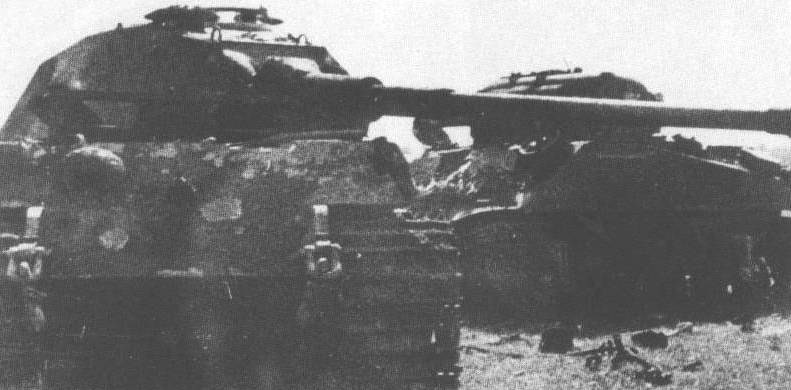
Of course, not only Soviet tanks performed rams during WWII. A famous photograph shows a Sherman tank and a Tiger II together. The Sherman rammed the Tiger II, knocking out both tanks.

Sunday, 16 June 2013

World of Tanks History Section: BT

The Collegiate of the Chief Directorate of Military Manufacturing met at the end of 1929. The main conclusion of these meetings was that the Soviet tank manufacturing industry is incapable of equipping the RKKA with armoured vehicles. Domestic tanks were inferior to foreign ones, newly planned tanks kept getting delayed, engineers lacked appropriate experience. Factories did not have enough materials, equipment, tools, skilled workers.

Based on these conclusions, the commission decided: if we can't do it ourselves, let's use foreign expertise, Invite engineers, buy tanks and documentation. On December 30th, a delegation was sent to America, headed by Innokentiy Halepskiy, the head of the Directorate of Mechanization and Motorization of the RKKA. The delegation's task was to familiarize themselves with samples of latest tanks and purchase them. At first, the work of the Cunningham company seemed the most interesting, but it turned out that the tanks did not match the advertised performance parameters, and are far behind the Vickers tank the USSR already purchased. Further negotiations with Cunningham ceased, and the delegation switched to convertible drive vehicles developed by Christie.

Despite the fact that Christie's tanks reached record speeds, the US army showed no interest in them, as the navy was considered the main weapon of the US. The army was in a secondary role, and had few tanks (why have tanks when the odds of an invasion is negligible?). When Halepskiy familiarized himself with Christie's tanks, he hesitated. On one hand, the tank had no place in the USSR's tank doctrine. On the other hand, the engineer, although with no love for the Communists, was willing to cooperate. He was prepared to not only share all documentation on the tank, but to accompany them to the USSR. The reason for this was simple: the commission was willing to pay a significant amount of money.

The last doubts about the purchase disappeared when the commission discovered that Poland was willing to buy the tanks. If someone were to make a list of the most dangerous enemies of the USSR at the time, Poland would have made top 3. It had a powerful army for the time, with a rapidly developing tank force.

On April 28th, 1930, a contract for two Christie tanks was signed, with accompanying documentation. These were new models were named M1940. The USSR was ready to pay 60 thousand dollars. When the tanks made it to the USSR, it turned out that they were lacking turrets and armament, and the documentation was incomplete. Christie was penalized 25 thousand dollars, and was not invited to the USSR.

The vehicles were sent to trials. In order to objectively evaluate the performance of the tanks, the turret weight had to be accounted for. As the replacement turret was still in development, it was replaced with an 800 kg weight.

Trials showed that Christie's child was poorly behaved, and prone to tantrums. An attempt to turn at high speed on grassy terrain resulted in a wheel carrier falling off. Two days were spent repairing it, but it broke off again after 500 meters. It was repaired again, and failed again. Deadlines were approaching, so it was decided to keep testing in wheel mode. Even here, the tank was not performing well. The tank had great difficulty moving on harsh terrain, and was completely helpless in sand. The driver was rapidly worn out by the inconsistent behaviour of the vehicle and the fact that the steering wheel was literally jumping out of his hands. The engine was in need of constant tuning. The battery could not always start the engine, and entirely incapable of it in cold weather. The gearbox heated up after 2-3 hours, and often broke. The front hatch was too small to fit a person, and the entire crew had to climb in through the turret ring.

Despite the vehicle's questionable qualities, the army decided to adopt it. According to existing classification, it would have been named T-28 or T-29. However, since it did not match doctrine, it was given a new index: BT (fast tank).

Mass production of the BT tank was planned on the Yaroslav automotive factory. However, it was obvious that the factory would be incapable of supporting this load. The Bolshevik factory was considered an alternative, but was also overloaded. Suddenly, the Kharkov Komintern factory was freed up when an order for 200 T-24s was cancelled. The BT order was moved there.

The poor performance of Christie's tank showed that copying it would be fruitless. The turret also had to be developed anew. The task of finishing the tank was given to N. Toskin.

In 1931, 6 BT tanks were scheduled to be produced for the November 7th parade. The factory, however, was not particularly eager to produce a new, untested tank. The pressure came from the very top, and three prototypes managed to be produced, two of which made it to the parade. The third tank suffered an engine fire. This incident cast doubt on the necessity of developing the BT tank, but production continued.

Mass production of the BT started slowly. There was a deficit in everything: raw materials, tools, skilled workers. Parts shipments were constantly late. 50 sets of ball bearings were due for January 1st, 1932. 7 sets were actually produced. 8 "Liberty" engines, 3 hulls, and 4 gearboxes were produced. There was a problem with engines, overall. The "Liberty" engine was produced in the USSR under the brand "M-5", but was already removed from production at that point. It was necessary to buy all the "Liberty" engines available in the US, even broken and used ones. These engines were hard to start, constantly overheated, and sometimes self-ignited.

At this stage, the BT achieved the fame of unprecedented breakdowns. The engines broke, the tracks, made from poorly conditioned steel at the Kramator factory broke, the gearboxes worked poorly.

Most BT tanks made it to army units with no armament, as the PS-2 gun that was intended for the tank was not accepted into service. The B-3 gun was accepted instead, a mix of the PS-2 and German 1K Rheinmetall gun. However, these guns were produced in limited numbers, and it was impossible to outfit a tank with them. As a temporary measure, the gun was replaced with dual machine guns. There was a plan to replace them with a 45 mm gun, but most BT tanks stayed with machine guns. The mass produced BT had four main armament types:

-Two machine guns in one mount.
-Two machine guns in one mount and a third one separately.
-One 37 mm cannon, no machine gun.
-One 37 mm cannon and one machine gun.

396 BT tanks were produced in 1932. In 1933, the BT was renamed BT-2, and 224 more were produced.

The army was not too happy with the new tank. It was too unreliable. The only way it could make the command staff happy was by setting records when jumping from ramps. The BT-2 was seen as a training vehicle, until superior tanks were built. BT-2 tanks were almost entirely used for educational and secondary tasks.

The tank was produced from 1932 to 1933. In 1933, the tank was replaced by its modernization, indexed BT-5.

Regardless, the tank became a new step in Soviet tank-building. It was the first to use a powerful engine, convertible drive, a candle suspension, and a powerful gun for its time. If you compare the BT-2 to foreign tanks of the era, it was one of the best, and remained competitive until the end of the 1930s.

The BT-2 first fought at Khalkin-Gol in 1939, and then during the campaign in West Belarus and Ukraine. A large amount of these tanks took part in the Winter War. In the latter conflict, the largest cause of losses was not combat. The BTs broke down, and had to be sent to the factory for repairs.

By 1941, the tank was totally obsolete. Its armour protected only from bullets, and did not pose a problem for AT rifles at close ranges. Any German tank, aside from the PzKpfw I, could penetrate the BT-2 at any distance. The BT-2 was suitable for scouting, patrols, and other support tasks, as a part of a larger tank force. However, the first years of the war offered no choice.

About 390 BT tanks fought in WWII. They were included in mechanized corps, and fought through the entire front. Most tanks were destroyed in the summer and fall of 1941. However, the tanks continued to fight on the Leningrad front until 1943. A photo exists of a machine gun BT, taken in 1942. According to some sources, BTs were still used in 1944.

No BT-2s survive to this day.

Original article available here.

Friday, 14 June 2013

Soviet Very High Power Guns: BL-9

I have previously written about the BL-8 152 mm Very High Power gun, and briefly mentioned the BL-9 Very High Power gun. Here is how both of these projects started. Surprisingly enough, they were originally meant not for the ISU-152, but for the SU-152. CAMD RF 81-12063-1 tells the interesting story.

"The special NKV telegram #5014 sent on September 24th, 1943, tasked OKB-172 and the #172 Molotov factory to develop a 122 mm self propelled gun, capable of reaching 1000 m/s muzzle velocity with a 25 kg shell.
Giving the highest priority to this project, OKB-172 completed the draft ahead of schedule, and presents it for your approval. As a result of performing the draft work, we have discovered the following:
  1. The task of creating an SPG with the muzzle velocity of 1000 m/s can be accomplished by installing a new barrel on the KV-14 SPG, to replace the model 1937 howitzer, and a new single-sided hydro-pneumatic balancing mechanism. 
  2. As the power of cannons constantly grows, you may be interested in our installation of an OBM-43 barrel, with the muzzle velocity of 880 m/s and a 43.5 kg shell, on the KV-14 SPG, instead of the 122 mm barrel with the 1000 m/s muzzle velocity. Such a solution raises the power of the SPG by 33.5% and increases its armour piercing and concrete piercing capability.
With this solution, not only does the SPG receive a more powerful gun, but the gun is already in use, and will ease production and use of the guns."

KV-14 is, of course, the pre-production index of the SU-152. 

The document then provides comparisons between the different gun options: the ML-20S, 122 mm OBM-50 (BL-9) and the yet unnamed 152 mm gun. The ranges at 22 degree elevation (max elevation for all guns) are: 12 km for the ML-20S, 21 km for the BL-9, and 18 km for the new 152 mm gun. The penetration for both experimental guns at 1500 meters is 195 mm against flat armour, and 160 mm against armour angled at 30 degrees. This is pretty close to the figures given in that other penetration table (197 mm against flat and 160 mm against angled armour). All three guns have the same horizonal traverse: +/-7 degrees. They can carry 16 shells (38 for the new guns with a redesigned fighting compartment). The projected rate of fire is 1.5 RPM for the ML-20S, 2 RPM for the BL-9, and 1.33 RPM for the 152 mm gun. The mass of the SPG is 47 tons with the ML-20S, and 48 tons with either of the new guns.

However, the OBM series wasn't only destined for tank destroyers. A 122 mm OBM-51 gun, almost equivalent to the OBM-50 (BL-9), was planned for a heavy tank. The project requirements were:
  • 1000 m/s muzzle velocity
  • 200 mm of penetration at 1000 meters
  • Use of existing A-19 shells
  • Maximum compatibility with ML-20S components
CAMD RF 38-11369-286: BL-9 against a 203 mm plate at 1000 meters. One shell penetrated completely, 4 shells are stuck in the armour, 3 shells left dents.

You may be thinking of the IS, but no, the tank that was first meant to carry this powerful gun was the KV. On October 26th, 1943, the Technical Department of the NKV held a meeting on the 122 mm OBM-51 tank gun proposed by OKB-172. The details are contained within CAMD RF 38-11355-1403.

"As ordered by the Tech-department of the NKV, OKB-172 developed a project for a modernization of the KV tank by installing a 122 mm gun. The modernization removes the current KV turret and all its armament, and replaces it with a new turret that holds a 122 mm high power gun, two machine guns, and the ammunition rack. The rest of the tank, all of its mechanisms, components, and armoured hull, including the turret ring, remain the same.

The 122 mm gun designed by OKB-172 has the following characteristics:
  1. Caliber: 122 mm
  2. Muzzle velocity: 950 m/s
  3. Shell mass: 25 kg
  4. Maximum gas pressure: 2660 kg/cm^2
  5. Barrel length with muzzle brake: 58.5 calibers
  6. Recoil resistance: 16 tons
The tank's turret consists of homogeneous rolled armour plates. Front: 75 mm, side: 60 mm, roof: 30 mm. In order to balance out the gun, the rear of the turret has 150 mm of armour. 

The gun is installed in the front of the turret on a welded mount. The mount and vertical aiming mechanism are borrowed from the SU-152 SPG with no changes. In order to balance the oscillating part of the gun, a hydromechanical balancing mechanism is planned. The turning mechanism is the same as in the KV turret. The tank carries 45 rounds of ammunition in the turret and on the bottom of the fighting compartment.

After discussion, we have come to the following conclusions:
  1. The modernization of the KV tank to equip it with a powerful 122 mm gun is a modern and reasonable course of action.
  2. The project is approved to continue to the prototype stage.
  3. It is reasonable to also adapt the modernization project, including the turret, to the IS tank.
  4. During development, it is suggested to:
    1. Use the D-5 mount, as it is the most compact.
    2. Use a horizontal sliding breech. 
    3. Increase the muzzle velocity to 1000 m/s on the IS chassis.
    4. Develop a cast turret variant, and make it as short as possible.
    5. Reduce the ammunition capacity to 30 shells to reduce turret height and mass.
    6. Allow for shooting on the move, move the fire button to the elevation mechanism. Implement a secondary electric fire mechanism.
    7. Reduce the tank mass to 45 tons.
  5. Give OKB-172 the highest priority, given the importance of this project.
  6. Suggest that OKB-172 work with naval armament factories."
As we already know, the lower velocity D-25T was chosen as the gun for the IS. Its penetration was entirely adequate for the German tanks that ended up being produced, and the high power 122 and 152 mm guns were ultimately not needed. 

Wednesday, 12 June 2013

KV-1 and T-34 in England

A while ago, I wrote only on the impressions that the British had of the T-34 and KV-1 tanks they tested. Here is the full report, from the shipment to the trials.

CAMD RF 38-11355-1744

"In addition to the previously sent information, I report that tanks "T-34" and "KV" were loaded on June 13th, 1943, in the Bakaritsa port, on the steam transport "Empire Portia". At the same time, I report that there are differences in equipment, as follows:
  • The KV tank is lacking one magazine for the DT machine gun
  • The T-34 tank is lacking 18 magazines for the DT machine gun
  • The T-34 has the following extra components, not recorded in the proving ground documents:
    • crate of parts (no number)
    • konstalin (1 jar)
    • grease (2 jars)
    • tracks (140 links)
On both vehicles, the canvas sheets are very old, the one on the KV is torn in several places.
The discrepancies in equipment are noted in the attachment."

The several pages of attachment are, thankfully, also translated to English. How thoughtful!


The KV-1 sent to England is currently in the Bovington museum, with turret number 716 (belonging to another KV, serial number S-055). 

KV-1 tank on trials in England

The T-34 that underwent trials is not in the museum, but the preliminary study of the tank is available for purchase here. 


Curiously enough, they call it a cruiser tank. While it could conceivably be used in a cruiser role (that the British invented, and then gave up on), it was built for an entirely different purpose. 

Monday, 10 June 2013

Spherical Tanks

A while ago, I translated an article about Soviet spherical tanks. Obviously (or not that obviously, considering how many hit from Google I got), the ShT-1A and ShT-2T were fakes. However, enterprising readers have actually clicked through the links and found that the article had blueprints of a spherical tank in it. That's because, while the history of spherical tanks in the article is a fabrication, actual spherical tanks are not.

At the beginning of the 20th century, futurists and engineers were hard at work thinking about the shape a fighting machine ought to take. Even the engineers settled on a shape we can all recognize as a "tank" in the 1940s (if you think it all ended at the FT-17, recall the unconventional shapes of the M3 Lee and T-35). People somewhat distanced from organized tank building still came up with exceptionally unconventional solutions.


The nature of CAMD RF is that every single document, no matter how insignificant, finds its way into the appropriate section of the archives once it has ran out of usefulness. For design proposals of "limited implementation potential", this was almost instant. CAMD RF contains a great many proposals for tanks that crawl, tanks that drill, tanks that fly (by catapult!), tanks that float, and tanks that roll. While I might eventually do an article on all sorts of crazy proposed designs, let's focus on some rolling ones for now.


The first actual spherical tank design, from 1917. It had no weapons, and could only combat the enemy by rolling at them, or having the crew shoot through an open hatch after stopping.


A German somewhat spherical tank project, surprisingly actually built and considered. It is also from an era when no one was quite sure how tanks are supposed to look like.


An American spherical tank project. These are the blueprints for the tank pictured on the Popular Science cover above.


Here is a colourful sketch of what one of the Soviet projects was supposed to look like. This is a pretty decent looking vehicle. It is very small for a tank, and has considerable firepower. Sadly, it is obvious that a tank of this configuration would easily tip over, and roll away. 

CAMD RF 38-11350-396

Yet another proposal, with only a machine gun. This one seems to be a lot more thought out. 

CAMD RF 38-11350-208

This design gives up any kind of tracks for a spiked, rotating hull. Not only would this be completely unsuitable for any kind of paved roads (or stopping), the size of the door and turret makes it apparent that this tank would be a giant and convenient target for aircraft and artillery.

This project, seemed more promising than all of the above ones:


"From Ashhabad, to the People's Commissar of Internal Affairs Comrade Beria,

A group of four scientists from the Turkmen Academy of Sciences approached us with a request to inform Comrade Stalin of a spherical tank they invented. Today, the first secretary of the Central Committee Fomin and I saw a model of this tank, shaped like a perfect sphere. The model easily traverses slopes, ditches, and has a high speed. The crew compartment remains stationary. The authors' ideas, in our opinion, deserve evaluation. Please advise. 

People's Commissar of the Turkmen SSR, Davydovskiy."


Looks like Davydovskiy had a higher opinion of the project than any real engineer. Judging by the handwritten notes, the project bounced around a little before getting shelved. According to Yuri Pasholok, the vehicle was built anyway, but later scrapped.

CAMD RF 38-11350-634

Another rolling tank, not really spherical. Yevgeniy Petrovich Zamoiskiy, a wine factory accountant, the mastermind behind this project, wrote: 
"I give you a sketch, with an explanatory note, of a round tank. The Red Army might use a few of these tanks. Advantages over a regular tank include:
  1. Good traction in deserts and sand (sand is its best road).
  2. Can easily traverse swamps, bogs, and can swim a significant distance.
  3. Spins in place (like a spinning top).
  4. It is a relatively light and voluminous simple object, and can be constructed from railroad fluid tanks.
  5. The tank can be made any size, with any armament. 

I am a simple accountant, and ignorant of blueprints, drawing, etc, so I could not, of course, illustrate everything in the sketch. If you need me to clarify anything, I can, given notice, ride to Moscow or anywhere else. 
Please instruct whichever Directorate is given this sketch to inform me of its work, as the Department of Inventions of the ArtKom GAU and NKO Invention Bureau, which I have given sketches of a "flying shell" and "flying car", have not graced me with an answer."
The note in the corner of the blueprint says "Note: not to scale. All I had for sketching were a glass, a jam jar, and a plank". 

This next project really cranks it up a notch. Instead of just a tank, it's more of a mobile fortress delivering tanks, men, planes, trains, just by rolling across enemy lines unimpeded. 

CAMD RF 38-11350-307

Spherical tanks aren't limited to Europe. This is an American spherical tank project from 1942.


The German "Kugelpanzer" (round tank) is stored in the Kubinka Tank Museum in Russia under the name "Item 37". It weighs 1.8 tons, has 5 mm of armour all around, and no armament. It achieves motion by two circular track mechanisms, with a single stabilizing wheel behind it. 

Sunday, 9 June 2013

World of Tanks History Section: T28/T95

The Germans are credited with an unhealthy obsession with wonder-weapons. The Maus, Ratte, flying saucers, and many other interesting things come to mind. However, when you look at what was happening in the heads of engineers on the other side of the ocean, you can confidently place them in the same category.

Let us look at a curious example from the Americans.

In September of 1943, the United States begins their heavy tank program. US High Command thinks that these tanks will be necessary in order to penetrate fortified lines in Europe. This was correct, as the standard 75mm gun was insufficient for anti-fortification work. Existing medium tanks also lacked armour. At this point, the US only had one heavy tank, the M6, which was deemed ineffective as an assault platform.

Competing with the desire to create something large and fearsome, in the heads of many-starred generals was also a desire to complete the war with nothing newer than a Jumbo Sherman, which had better front armour than the Tiger. This competition led to no particular commitment to the heavy tank program. The Department of Artillery, under their own initiative, began working on a heavy tank in March of 1944.

The requirements for a new heavy tank came from the discussions of whether or not there should be a heavy tank at all. The front armour must be at least 200mm, the transmission must be electric, the gun must be the 105mm T5E1. This gun had a very high muzzle velocity, and could be used to destroy concrete fortifications.

The head of the artillery department insisted that before the second front opens (so in almost a year), he can not only develop a prototype, but provide 25 new tanks. This claim was very optimistic, this time would have barely been enough to make a prototype. High Command managed to make him see reason and ordered five prototypes, with the additional removal of the unreliable electric transmission, and its replacement with a mechanical one. In the end, the military downsized the order to two prototypes, because the war ended.

The new tank was named "T28". The front armour grew to 305mm, increasing the mass of the tank to 95 tons. Let's examine this American wonder closer.

The layout was, let's just say, non-standard. The tank was short, with no turret, resembling an ugly turtle. The T5E1 gun was placed in the front glacis plate. The horizontal traverse of the gun was 10 degrees, with 20 degrees of elevation and 5 degrees of depression. The crew consisted of four: a driver, a gunner, a loader, and a commander. The driver and the commander got cupolas on their hatches. The commander's cupola was also equipped with an AA mount for a .50 caliber machine gun. In order to reduce the ground pressure, the tank was equipped with a second set of tracks.

Upon viewing this design, the head of the department decided that this was not a tank, and suggested that it be renamed to "tank destroyer T95". This was explained by a lack of turret and weak secondary armament. This decision was accepted on March 8, 1945.

The T95 was a colossal vehicle, whose mass could not be carried by most bridges. The second pair of tracks allowed the tank to traverse cross country terrain, albeit poorly, while increasing the width of the tank. Movement was not easy for this beast due to the 500 hp Ford GAF engine, which was also used in the Pershing tank. A half the weight of a T95, 500 hp wasn't enough for a Pershing. The maximum speed this vehicle could reach was 12 kph, but it was decided that going past 10 kph is not recommended, as it was very hard on the engine.

The T95 couldn't go anywhere on its own. In Aberdeen, it underwent a total of 800 km of trials, in order to determine how long parts could last. Travelling that distance took a very long time.

In order to use this tank anywhere, it would have to be transported by railroad. In order to do that, the outside tracks had to be removed. This took anywhere between 2.5 to 4 hours, and as much to put them on afterwards.

It was unclear what should be done with this vehicle. Tanks were supposed to have turrets, and tank destroyers were supposed to be lightly armoured and fast. The T95 had a tank's armour, but no turret. After deliberations, the T95 was renamed to Super Heavy Tank, with its previous index T28. In 1947, work on the T28 stopped. This was tied to the fact that heavy tanks projects with turrets started springing up, and a mass of 95 tons was considered very high.

Only two T28s were built. In 1947, one was heavily damaged due to an engine fire, and was written off. The other broke down, and was scrapped. For 27 years, the only indication that this wondrous tank ever existed was in blueprints, until the first prototype was found on the territory of Fort Belvoir in Virginia. Currently, it is on display in the Patton Museum, in Fort Knox, Kentucky.

Original article available here.

Friday, 7 June 2013

World of Tanks History Section: Conflict on the Khalkin-Gol River

1. Preamble

In July of 1927, Japan published a “Political program on relations with China”. This document declared that Manchuria and Mongolia are of special interest to the land of the rising sun. Literally days later, General Tanaka handed the Japanese Emperor a memorandum, which announced, without any diplomatic ambiguity: “In order to conquer China, we need to conquer Mongolia and Manchuria. In order to conquer the world, we need to conquer China.”

A necessary and important step of these militaristic aspirations was the military defeat of the USSR. However, during the late 20s, the small country was not ready for such a conflict. Japan decided to limit itself to occupation of Manchuria.

At this time, a young officer class was formed from former rural and urban minor bourgeoisie. These men were militaristically minded, and considered the government's foreign policy insufficiently decisive. They themselves had decisiveness to spare, and a number of coups and political assassinations were attempted by these young officers since 1930. Terror and propaganda grew the military mood in Japan. In September 1931, the invasion of Manchuria began.

By March 1st, 1932, the occupation of Manchuria was complete. It was replaced with the state of Manchukuo, formally led by the Emperor Puyi. Realistically, the Emperor had no power. The country entirely followed the political directions of the Land of the Rising Sun. An ambassador had the power to veto any decision of the marionette Emperor.

Soon after the occupation of Manchuria, Japan presented a claim to the USSR on territories next to lake Hasan and river Tumannaya. From 1934 to 1938, the border was violated 231 times by the Japanese, where 35 of these incursions led to serious battles. The Japanese government demanded twice, on July 9th and 20th, that the USSR leave disputed territories. The demands were rejected, and, on July 29th, Japan attacked Soviet forces. Despite committing a series of regrettable mistakes, the Red Army achieved a decisive victory.

The defeat at lake Hasan damaged the reputation of the Japanese army. The military controlling the country could not allow this to happen. Before the echoes of the last shot fell silent, Tokyo was already preparing a new offensive, even greater in scale.

A victorious campaign was necessary for Japan, and not only to heal its bruised ego. In 1936, the Soviet Union signed a pact of mutual aid with the People's Republic of Mongolia. In accordance with this pact, Mongolia provided a base for the 57th special corps of the RKKA, a large group of Soviet forces, consisting of more than 30 000 soldiers, 265 tanks, 280 armoured cars, 107 airplanes, and a large amount of auxiliary vehicles and artillery. The Japanese were building a railroad close to the border with Mongolia, and this neighbour made them very unhappy. Additionally, the USSR provided military aid to China, which Japan also wanted to conquer.

2. The Conflict Begins

Japan had time to develop two plans of attack, but did not have time to execute either. The war started in May of 1939, and not in the early 1940s as the Japanese commanders had hoped.

In its infancy, the conflict at Halkin-Gol was identical to the conflict at Lake Hasan, but this time Japan's demands were made to Mongolia, and not the USSR. Technically, the demands were made by the government of Manchukuo, but, as stated above, Manchukuo did not have the ability to make their own political decisions. Effectively, Tokyo demanded that the border between Manchukuo and Mongolia be moved to the river of Khalkin-Gol, even though all documents listed the border 20-25 kilometers east of there. Mongolia's objections, and documents placing the border correctly were ignored. Military incursions began, like on Hasan, but on a much larger scale. In 1938, Japanese soldiers crossed the border in small groups, but Mongolia saw crossings of up to a battalion at a time. The conflict practically already started, but war was not declared.

May 11th, 1939, is considered the start of the resistance at Khalkin-Gol. On that day, 300 Japanese soldiers, supported by 7 armoured cars, attacked a Mongolian border patrol near Nomon-Han-Burd-Obo. After killing about 20 patrolling soldiers, the attackers crossed to the eastern bank of Khalkin-Gol.

The Japanese air force began combat operations on May 14th, commanded by the ace Marimoto . Border observation points and airports were attacked from the air. Under the cover of the air force, the Kwantung army swiftly reinforced the attacking forces. Everything was planned perfectly. Barracks and warehouses on Manchuria's territory were built far in advance.

3. The Situation Develops

Upon receiving the news of the location of the enemy forces, the command of the 57th Corps ordered to strengthen the border of the People's Republic of Mongolia. By May 29th, the forward detachments of the 9th motorized brigade reached the region. The tanks traveled 700 km by themselves, which, at the time, was a very impressive feat. The border was also reinforced by the 149th infantry regiment. Despite all this, the Japanese forces had an advantage over the Mongolian and Soviet forces combined: 2.5 times as many soldiers, and 6 times as many armoured cars. The Soviet Union had a tank advantage: 186 tanks versus Japan's 130.

Early morning on May 28th, Japan began a massive offensive. Their goal was the encirclement and destruction of Soviet and Mongolian forces east of the Khalkin-Gol river. The attack was supported by 40 bombers, attacking river crossings and the Soviet-Mongolian troops. Fierce battle raged all day. The Japanese managed to push back a Mongolian cavalry detachment and Senior Lieutenant Bykov's squad, aiding them in the defense. Soviet forces retreated to the delta of Khailastyn-Gol. The Japanese could not complete the encirclement. While trying to cross the river, the Japanese took heavy losses from Lieutenant Bakhtin's artillery battery. The attack stalled. A map was captured, showing the locations of Japanese forces. Additionally, the map marked the disputed territory as Manchurian.

By May 29th, the battle has not calmed. RKKA and Mongolian forces began a counterattack, with the support of two artillery divisions. By the evening, the Japanese were thrown back two kilometers from the river. Japan lost 400 soldiers and officers, and numerous trophies were taken.

The first battles showed that there were not enough forces at Halkin-Gol to push back the attack. Reinforcements were sent: a Soviet tank brigade, 3 motorized brigades, a motorized infantry division, a heavy artillery division, a Mongolian cavalry division and over 100 fighter planes.

June did not see many land battles, but a major air battle broke out. While the Soviets and Japanese fought for the skies, the commander of the 57th Special Corps was replaced. Instead of N. F. Feklenko, whose actions were deemed insufficiently decisive, a future legend, G. K. Zhukov, took command.

4. Final Round

By July, Japanese command developed a plan for further action, titled “Second stage of the nomonhan incident”. This plan consisted of a strong push by the right flank of the Japanese forces to encircle and destroy Soviet-Mongolian forces. Lieutenant-General Kamatsubara, the commander of the Japanese forces, wrote that the morale of the enemy is low, and the time for the crushing blow has come.

The Japanese advance began on July 2nd. After an artillery barrage, infantry and tanks under the command of General Yasuoki went into battle first. The Japanese sent 80 tanks into battle, forcing back Soviet forces on the south-west.

On the night between July 2nd and 3rd, General Kobayasi's second group forded Halkin-Gol and took the Bain-Tsagan mountain. This location allowed the Japanese to deliver a strike to the rear of the Soviet-Mongolian defensive line. Seeing the hazardous situation, Zhukov sent in his mobile reserves. Without scouts or infantry escort, the 11th tank brigade went into battle straight from the march. They were supported by Mongolian armoured cars and aircraft.

The Soviet tanks, accompanies by all available artillery and aircraft, shook the Japanese lines. They did not have enough time to entrench, but defended with all their strength. With their artillery, 15 Soviet tanks were knocked out. Without infantry support, it was very difficult for the tanks to fight. Only towards the middle of the day did the 24th Infantry Regiment join them in battle. Tanks and infantry, despite fierce resistance, moved up. The Japanese were partially encircled and were forced up to the top of the mountain. All Japanese forces that managed to cross the river were trapped. 400 tanks, 800 artillery pieces, and several hundred aircraft were in battle from both sides.

At 1500 hours on July 5th, the Japanese broke their lines and fled across the river. Due to the premature demolition of the bridge by Japanese sappers, many soldiers and officers drowned trying to cross. Only the two meter depth of Halkin-Gol prevented tank forces from pursuing the enemy.

Zhukov's decision to attack was initially met with many complaints and protests, but was later accepted as the only reasonable action in that situation. After their defeat at Bain-Tsagan, the Japanese never attempted to cross Halkin-Gol again.

Zhukov started preparing for an attack. The 57th Corps was expanded into the 1st Army Group under the command of G. M. Shtern. New tank brigades and infantry divisions joined in. At the beginning of the attack, the RKKA possessed 57 000 troops, over 500 artillery guns and mortars, 498 tanks, and 516 airplanes.

The Japanese also gathered forces, planning to attack on August 24th. Simultaneously with collecting forces for an attack, they started construction of defensive emplacements.

On August 20th, Soviet forces started their attack, beating the Japanese by 4 days. The strike was so sudden, that it took an hour for Japanese artillery to open fire. Japanese command could not establish where the Soviets were attacking from. It was considered that the attack was evenly spaced out along the front, where in reality, the southern forces were responsible for the main push. This mistake by Japanese commanders led to a well defended center, but weak flanks. As a result, on August 26th, 1939, Soviet forces entirely encircled the Japanese 6th Army. Attempts to break the encirclement failed.

On August 28th, the assault of the last line of defense at Remizov's Height began. At that time, the Japanese had no artillery left, only machineguns and mortars. Approximately 400 Japanese soldiers were killed trying to break out at night.

By the morning of August 31st, Mongolia had no Japanese forces remaining on its territory. After that, the battle on the land ended, and the battle in the air began. But even here, Japan was not successful, taking out 14 Soviet planes at the cost of 70 of their own. Accepting their defeat, Japan requested a ceasefire, which was signed on September 15th, 1939.

The most important consequence of the victory at Khalkin-Gol was that Japan never attacked the USSR during WWII. Even Hitler's demands did not sway them. This defeat also led to a government crisis in Japan.

It is worth mentioning that the victory of Soviet forces left an optimistic impression of the preparedness of the Red Army for war, for which a great price was paid in 1941. Regardless, the triumph of Soviet forces at Khalkin-Gol deserved the respect and pride of their descendants.

Original article available here.

Wednesday, 5 June 2013

Tank Reliability

As almost everyone knows, the Panther had a lot of mechanical problems when it debuted at Kursk. However, a report from Guderian to Hitler proudly proclaims that these problems have been resolved by 1944.

"The latest messages from the Panther battalions say that the Panther is currently capable of withstanding all combat conditions, and does not even have minor drawbacks. For example, the 1st tank regiment writes on February 22nd, 1944: "The Panther in its current shape is perfect for battle. It greatly surpasses the T-34. Almost all minor drawbacks are gone. It is greatly superior to the PzIV in armament, armour, off-road maneuverability, and speed. The lifetime of the engine is 700-1000 km.
  • Less damage to the engines.
  • There are no more breaches in side reduction gears.
  • The controls and suspension demonstrate their qualities.""
CAMD RF 500-12462-93

700-1000 sounds like a very large number of kilometers. I guess we could take the 1st regiment's word for it that the T-34 isn't the shining star of the Eastern Front anymore, ignoring the fact that Guderian's "all drawbacks are gone" assertion seems to be contradicted by them.

However, just to be thorough, let's look at some numbers from the other side. The 6th Guards Tank Army discovered the following lifespans of their tanks:


"T-34: 2000-2500 km, 250-300 hours
IS/ISU-122: 1200-1800 km, 230-280 hours
M4A2: 2000-2500 km, 250-300 hours
SU-76: 1200-1800 km, 180-200 hours

Individual tanks made it as far as 3000 km, and their motors functioned for 300-350 hours."

These are the figures for all components. Even the weakest link of the Soviet and American tanks served twice as long as the Panther's engine. This is, of course, forgetting its final drive, the average lifespan of which was 150 kilometers. 

Edit: this post at the Tank and AFV Blog contains more information on the Panther's technical woes throughout its service life.

Monday, 3 June 2013

Weak Spots and Hit Zones

All of you have already read the great deal of penetration tests I have posted. However, what practical use do they have? Getting a copy of those tests to every soldier is just not possible (especially since all of those were classified), and it's not like they will remember them anyway. The solution is in the form of easily printable and distributable diagrams. These often also include characteristics of the tank itself.

This diagram is from the Partisan's Companion. Since the PzI was hopelessly obsolete, the only thing it could fight were partisans without anti-tank weapons. The diagram instructs the reader to throw grenades at the roof and tracks, throw incendiary bottles on the engine deck and shoot at the gun and observation ports.


The PzII gets similar treatment. The reader is instructed to damage the gun, tracks, and gas tanks. 


The PzIII is next. The crosshair with 3 circles indicates where to throw incendiary bottles (at the engine deck and observation ports). The crosshair with one circle and a shell indicates where to hit with guns, AT rifles, grenades (side, turret, gas tank, gun, machine gun port, tracks). It also lists how far you can shoot from.
  1. 45 mm gun: 200 meters.
  2. 57 mm and 76 mm guns: all effective combat distances.
  3. AT rifle: 150-200 meters.
  4. Large caliber machine gun: all effective combat distances when aiming at the sides and rear.
  5. Incendiary bottles at 15-20 meters.
  6. AT grenades from 15-20 meters.


PzIV. Gun, engine deck, and gas tanks are indicated. This time, there are no penetration ranges given. 


"Weak points of a German tank with a 75 mm gun". The picture clearly shows a StuG. The format of the diagram and all of the data is the same as the PzIII. The only difference is "destroy the enemy crew with a large caliber machine gun" pointed at the rear of the crew compartment. 


Now we get to the more detailed series. The small bullets represent AT rifles. The large pipe-like shell represents AP and HE from all guns. Red shells with white insides represent AP-HE shells, while completely red shells represent AP. The number on the shell indicates the caliber. The APCR shaped shell indicates APCR from the 45 mm gun.

The image tells you to fire at the front with the 85 mm gun from 1000 meters. The 57 mm gun can take the Panther from 500 meters frontally, 1000 meters from the side, or 1500 meters at the side of the turret. APCR from the 45 mm gun can be fired at the side from 500 meters. The rear of the turret can be shot with the 76 mm gun from 1000 meters. Any shells should be fired at the cupola, the gun, the tracks, the wheels, and the front of the turret. Additionally, grenades should be thrown at any flat surface and hatches. 


Sadly, I don't have a very detailed diagram for a Tiger. This one is very basic. The straight arrow represents all weapons. The curved arrow represents incendiary bottles. The grenade icon represents AT grenades. The  shell icon represents guns of all calibers. The diagram is pretty straight forward. Shoot the gun, machine gun port, tracks, commander's cupola, gas tanks (indicated by the dotted line). 


This image basically says the same thing as above. Throw grenades at the side of the tank, throw incendiary bottles at the back. The title bravely states "If your aim is precise, the enemy tank will not remain intact!" (this rhymes in Russian).  


It's the Ferdinand's turn. The red APCR shell is 45 mm, the black APCR shell is 76 mm. A large AP shell has its caliber written on it. A large tube-like shell is AP and HE of any caliber. A red tube-like shell is HE from any caliber.

The diagram instructs you to shoot 85 mm shells from the side and rear at 1000 meters. Shoot the undertrack hull with 45 mm APCR at 500 meters. Shoot the gun with 45 mm AP or APCR. Shoot the sides with 76 mm APCR and AP at 300 meters. Shoot the sides with 57 mm shells at 500 meters, or the rear at 1000 meters. Shoot any caliber AP or HE at the tracks, or HE from any caliber at the front. Throw grenades and incendiary bottles at the engine grille and hatches. Looks like nobody the creators of this chart about 152 or 122 mm guns.


Another Ferdinand guide shows the location of the crew, engine, ammo rack, and electric motor. 


Last but not least, if you run into a Rheinmetall Neubaufahrzeug, here's how to take it out! From 0-10 meters, the tank crew cannot see you. From 10-35 meters, throw various kinds of grenades. From 35-40 meters, use portable flamethrowers. At 40-60 meters, use rifle grenades. Use armour piercing bullets from 60-80 meters (rifle) or 80-100 meters (machine gun). From 100-150 meters, use an AT rifle. From 150-200 meters, use a large caliber machine gun. 

Sunday, 2 June 2013

Cheating at Statistics

Some individuals that played too many video games like to use kill to death ratios in order to calculate how good a particular tank or unit was in battle. Despite the fact that tanks don't exist in a bubble, and are assisted by aircraft, artillery, and infantry, the very idea of a kill differs between sides. You would think that unlike penetration, the idea of a kill is much more universal, but you would be wrong. For example, the Germans counted losses, at least for aircraft, this way:


So we total those up, and get 85% damage, less than one plane lost. I'm no airplane expert, and maybe the missing propeller, bent engine, fallen off bits, and generally being on fire are all reparable by German technicians. However, even if you don't know the source of the photographs (Russian archives), the Red Army uniforms should give it away. Two of these airplanes are in Soviet territory, and thus 100% lost, and yet, out of the three lost planes, barely one is recorded. In a similar fashion, there are instances of shot up/ burnt out tanks that were beyond repair, or worse, left on Soviet territory, that are listed as "in long term repair".